
Table of Contents
Table of Contents
Every few years, a new integration pattern shows up promising to replace the one before it. Most don’t. REST didn’t replace SOAP overnight, GraphQL didn’t kill REST, and Model Context Protocol (MCP) isn’t going to retire traditional APIs either. What MCP actually does is narrower and more useful: it standardizes how AI applications discover and call tools at runtime, a problem REST, GraphQL, and RPC were never designed to solve.
This article isn’t an MCP primer. It assumes you already know what MCP is and have probably written a REST integration more times than you’d like to count. What it answers is the question engineering teams are actually asking in 2026: given a specific integration problem, which architecture is the right call MCP, a traditional API, or both?
The Core Architectural Difference
Traditional APIs REST, GraphQL, gRPC are built around a contract that’s fixed at development time. A client knows the endpoints, the request shape, and the response schema before it ever makes a call, because a human developer read the documentation and wrote the integration code. The API doesn’t describe itself to the client at runtime; the developer does that work up front.
MCP inverts this. An MCP server exposes a set of tools, resources, and prompts that a client can discover at connection time, without a developer having pre-wired the specific tool call into the application. The AI model reads the tool descriptions, decides which tool is relevant to the task in front of it, and calls it with arguments it constructs itself. The protocol layer JSON-RPC under the hood is almost incidental. The real shift is that the integration contract moves from compile-time (a developer’s code) to run-time (a model’s reasoning).
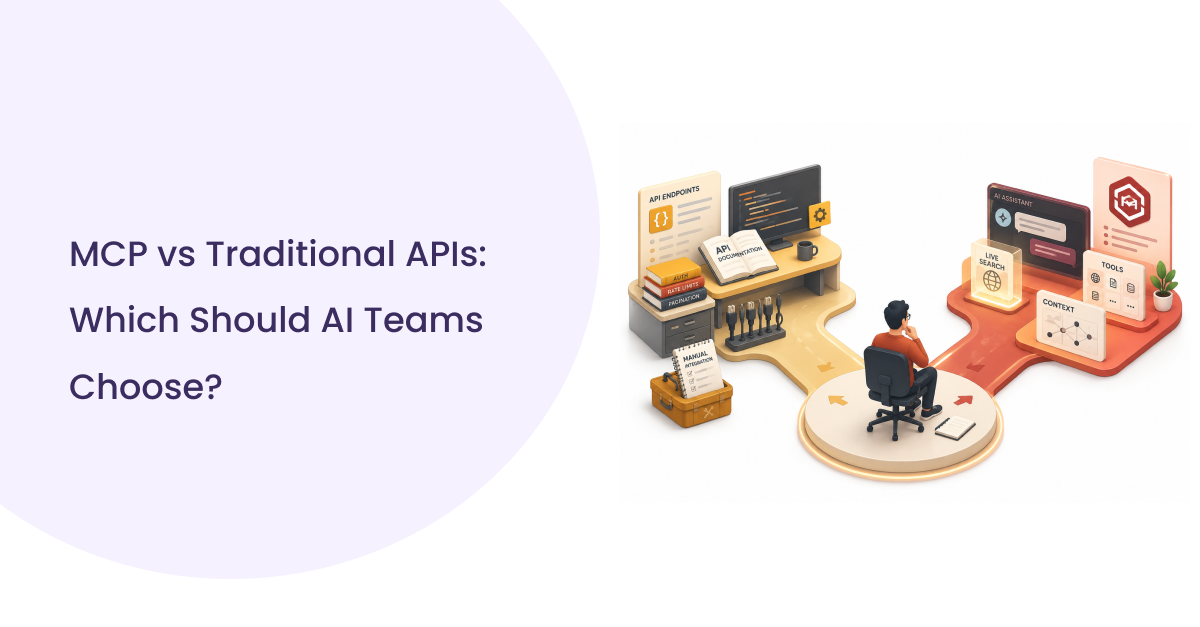
This is why comparing MCP to REST purely on transport mechanics misses the point. REST vs GraphQL is a debate about query flexibility and payload shape. MCP vs traditional APIs is a debate about who decides which call to make: the developer, or the model.
Communication Model
| Dimension | Traditional API (REST/GraphQL) | MCP |
| Contract definition | Fixed at build time, documented via OpenAPI/GraphQL schema | Discovered at runtime via tool/resource listing |
| Caller | Application code written by a developer | An LLM reasoning over available tools |
| Request shape | Predetermined by client code | Constructed dynamically by the model based on task context |
| Typical transport | HTTP/HTTPS, sometimes WebSockets | JSON-RPC over stdio or HTTP/SSE |
| Versioning | URL or header-based (/v1/, Accept headers) | Tool schema versioning is still an evolving practice, less standardized |
Why it matters: a REST endpoint doesn’t need to explain itself to anything; the explanation lives in your API docs, read once by a human. An MCP tool has to explain itself to a model, every session, because the model has no prior knowledge of your specific server. This means tool descriptions in MCP function less like documentation and more like part of the interface itself. A poorly worded tool description isn’t a documentation gap; it’s a functional bug, because the model will misuse or ignore the tool.
Which is preferable: if the caller is deterministic application code that you control, a traditional API is simpler and faster to build. If the caller is a model deciding dynamically which capability it needs, MCP removes the need to hardcode that decision tree yourself.
Context Awareness and Statefulness
Traditional REST APIs are stateless by design. Every request carries everything the server needs to process it; the server holds no memory of prior calls unless you build session state yourself, usually via a database, cache, or token.
MCP sessions are inherently more stateful. A client connects, the server exposes its capabilities, and the conversation between model and server can span multiple tool calls within a single reasoning loop: the model calling a search tool, inspecting the result, then calling a second tool with context carried from the first. This isn’t magic; it’s still your infrastructure holding that state. But the protocol is built assuming a persistent session rather than isolated, one-off requests.
This matters most in multi-step agentic workflows. Consider an AI agent doing competitive research: search for a topic, pull top-ranking pages, extract structural data, then summarize. Over a traditional REST API, you’d write orchestration code that calls each endpoint in sequence and manually passes results forward. Over MCP, the model itself does that sequencing, using tool outputs as context for the next tool call, provided your MCP server exposes tools with clear enough boundaries for the model to chain them correctly.
Tool Discovery vs Fixed Endpoints
This is the single biggest practical difference for engineering teams building AI-native products.
With a traditional API, tool discovery is a documentation problem. You write an OpenAPI spec, a developer reads it, and they write code that calls specific endpoints for specific purposes. Adding a new capability means updating docs and shipping new client code.
With MCP, discovery happens at the protocol level. A client calls tools/list, gets back a machine-readable description of every available tool, and the model incorporates that into its own reasoning without a developer writing new integration code for each capability. Add a new tool to your MCP server, and every connected client can use it the next time it lists tools; no client-side redeploy required.
The trade-off: this flexibility depends entirely on tool descriptions being precise. Ambiguous or overlapping tool descriptions lead to models calling the wrong tool, or the right tool with malformed arguments a failure mode that simply doesn’t exist in a hardcoded REST integration, because a developer already made that decision correctly (or incorrectly, once, at build time).
Security and Authentication
| Dimension | Traditional API | MCP |
| Auth model | Mature: OAuth 2.0, API keys, mTLS, scoped tokens | Built on the same underlying mechanisms (OAuth, API keys) but applied to a session a model controls |
| Attack surface | Bounded by the endpoints you expose | Expands with every tool you register, since each is a callable action a model can invoke autonomously |
| Permission granularity | Enforced per-endpoint, well-understood patterns | Needs enforcement per-tool and per-argument, since the model, not a developer, decides what arguments to send |
| Audit requirements | Standard request logging | Needs to log which tool was called, why (the model’s reasoning trace, where available), and with what arguments |
Why it matters: the authentication mechanics of MCP aren’t new; most implementations still lean on OAuth 2.0 and API keys. What’s new is who initiates the call. A traditional API assumes a human-reviewed code path decided to hit an endpoint. An MCP tool assumes a model decided to, based on its own interpretation of a task. That’s a meaningfully different trust boundary, and it’s why enterprise MCP deployments put more weight on scoped permissions, tool allow-lists, and request logging than a comparable REST integration typically needs.
Practical advice: treat every MCP tool as if it will eventually be called with unexpected arguments, because it will. Validate server-side; never trust that a well-written tool description alone will constrain model behavior.
Scalability and Performance
Traditional APIs have two decades of scaling patterns behind them: caching layers, CDNs, connection pooling, horizontal scaling behind a load balancer, rate limiting at the gateway. None of that goes away with MCP; an MCP server is still a server, and it still needs the same infrastructure discipline.
What changes is the call pattern. A single agentic task can trigger a chain of tool calls that a human wouldn’t have made directly; a model might call a search tool three times with slightly different queries while it reasons toward an answer, where a developer would have made exactly one deliberate API call. This means MCP-backed infrastructure tends to see higher, burstier request volume per logical task, even though each individual call is comparable in cost to a REST call.
| Dimension | Traditional API | MCP |
| Latency per call | Well-optimized, predictable | Comparable per-call, but chained calls compound |
| Caching | Standard HTTP caching, CDN-friendly | Harder to cache generically since arguments are model-generated and less predictable |
| Load patterns | Predictable, driven by known client code paths | Burstier, driven by model reasoning that can vary call volume per task |
| Horizontal scaling | Mature tooling (load balancers, autoscaling groups) | Same infrastructure applies, but session stickiness for stateful MCP connections adds complexity |
Cost Considerations
Traditional APIs have transparent, well-understood cost models: compute, bandwidth, and often a per-request or tiered pricing structure that’s easy to forecast because call volume is driven by deterministic code.
MCP introduces a second cost layer that’s easy to underestimate: token cost. Every tool description you expose gets loaded into the model’s context on connection, and every tool call and result consumes tokens in the model’s context window. A server with fifteen loosely-scoped tools and verbose descriptions can meaningfully inflate the cost of every agent session before a single “real” task begins. Teams migrating from REST to MCP frequently miss this until their AI provider bill reflects it.
Practical advice: treat tool descriptions like API payloads; every unnecessary word has a cost. Keep the tool surface as narrow as the task requires, and measure token consumption per session, not just per call.
Error Handling
REST has mature, standardized error handling: HTTP status codes, structured error bodies, retry-with-backoff conventions your team has probably implemented a dozen times.
MCP error handling is less standardized in practice. Because the caller is a model rather than deterministic code, an error response needs to be interpretable by the model well enough that it can decide whether to retry, try a different tool, or give up and tell the user. A REST-style 500 Internal Server Error with no message is a debugging headache for a human; it’s a dead end for a model unless the error text explains, in plain language, what went wrong and what a next step might be.
Practical advice: write MCP tool error messages as if you’re explaining the failure to a junior engineer who has to decide what to do next, not just logging it for yourself.
Comparison Summary Table
| Category | Traditional API | MCP | Better Fit |
| Architecture | Fixed, developer-defined contract | Discoverable, model-driven contract | Depends on caller |
| Communication model | Request/response, stateless | Session-based, tool-chaining | Depends on task |
| Context management | Built manually per integration | Native to protocol design | MCP for multi-step agent tasks |
| Scalability | Mature, predictable | Same infra, burstier call patterns | Traditional for high-volume deterministic traffic |
| Security | Mature, well-audited patterns | Same primitives, wider trust surface | Traditional for narrow, fixed-purpose access |
| Performance | Highly optimized, cacheable | Comparable per-call, harder to cache | Traditional for latency-critical paths |
| Tool interoperability | One integration per client | Write once, usable by any MCP client | MCP for multi-agent ecosystems |
| Developer experience | Familiar, extensive tooling | Newer tooling, growing fast | Traditional for teams without AI-native needs |
| Maintenance | Update docs + client code per change | Update server, clients auto-discover | MCP for frequently evolving tool sets |
| Enterprise suitability | Proven at scale for decades | Maturing, needs governance investment | Traditional for regulated, audited systems today |
| AI readiness | Requires custom glue code for agents | Native fit for agentic workflows | MCP |
| Learning curve | Low for experienced API developers | Moderate; new mental model, not new syntax | Traditional |
Real-World Use Cases
AI Research Assistants
Business problem: a research assistant needs to search the web, pull structured results, and reason across multiple sources without a developer pre-scripting every possible query path.
Traditional API approach: developers write fixed integration code for a search API, hardcoding which endpoints get called and in what order.
MCP approach: the model connects to a search-capable MCP server. SERPHouse’s MCP Web Search for AI Agents is a working example and decides at runtime how many searches to run and how to chain them based on what it finds.
Recommended architecture: MCP, since the query path genuinely can’t be fully predetermined.
SEO and Content Automation
Business problem: an SEO team wants an agent that can research keywords, analyze competitor pages, and draft briefs without stitching together five separate tools by hand.
Traditional API approach: a custom pipeline script calls a SERP API, a crawler API, and a writing tool in sequence, with a developer maintaining the glue code.
MCP approach: a single MCP layer, as described in SERPHouse’s guide to MCP for SEO Automation, exposes search, competitor analysis, and brief-generation as tools the agent orchestrates itself.
Recommended architecture: MCP for the orchestration layer, traditional APIs underneath it for the raw data fetch; this is a common hybrid pattern in practice.
Customer Support and Marketing Agents
Business problem: support or marketing agents need to pull account data, campaign performance, and CRM records without a fixed script for every possible customer question.
Traditional API approach: each supported question type gets its own hardcoded API call chain, which becomes brittle as question variety grows.
MCP approach: as outlined in SERPHouse’s piece on AI agents for marketing, the agent is given tool access to CRM and analytics systems and decides which to query per conversation.
Recommended architecture: MCP, provided access is tightly scoped per tool to avoid over-broad data exposure.
Internal Developer Platforms and Data Analytics
Business problem: engineering leadership wants AI copilots that can query internal systems deployment status, incident data, analytics — without each team building bespoke integrations.
Traditional API approach: every internal tool ships its own SDK and every copilot integration is a one-off build.
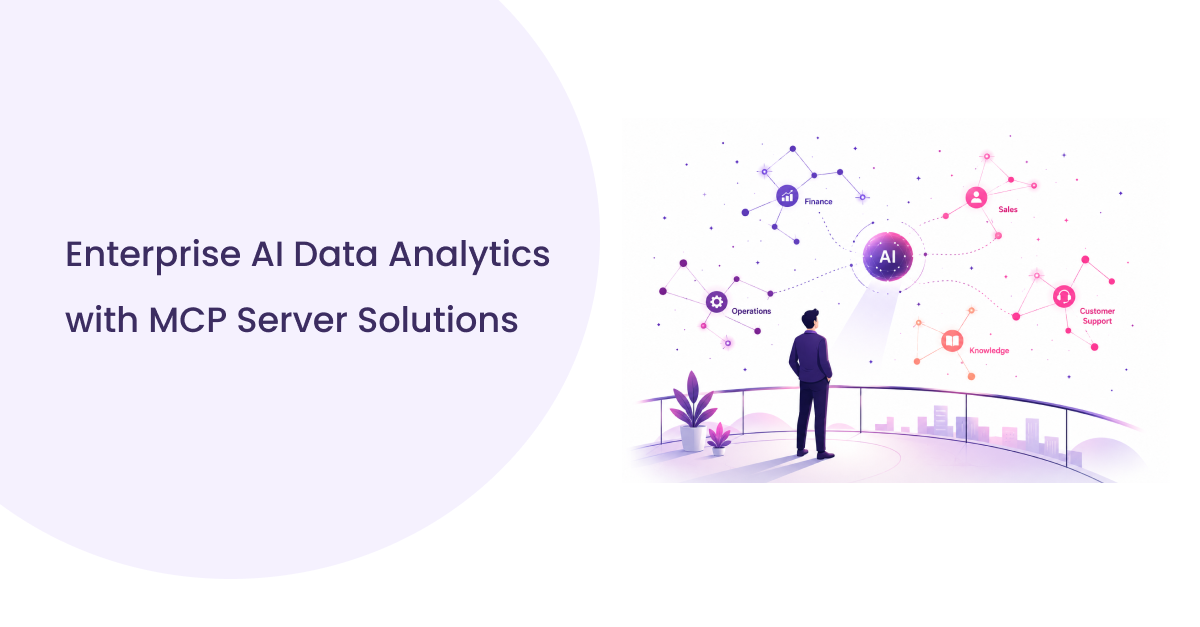
MCP approach: internal systems expose MCP servers once; any MCP-compatible copilot can use them, a pattern SERPHouse covers in its enterprise buyer’s guide to AI data analytics with MCP.
Recommended architecture: MCP for the copilot-facing layer, with governance and logging treated as first-class requirements, not an afterthought.
High-Volume, Deterministic Integrations
Business problem: a payments system needs to process thousands of predictable, well-defined transactions per second.
Traditional API approach: a well-optimized REST or gRPC endpoint, cached and load-balanced using mature, proven infrastructure.
MCP approach: not a good fit; there’s no ambiguity for a model to resolve, and the token and latency overhead of a model-mediated call adds cost with no corresponding benefit.
Recommended architecture: traditional API, without hesitation.
Where MCP Fits in Practice
A useful mental model: MCP is the layer where a model decides which tool to use. Traditional APIs are the layer that actually does the work once that decision is made. In most real deployments, these aren’t competing choices; an MCP server is frequently just a thin, well-described wrapper around traditional REST or GraphQL endpoints you already run.
The SERPHouse MCP Server is a concrete example of this pattern: it exposes real-time SERP and search data as MCP tools, so an AI agent can request “find the top-ranking pages for this keyword” as a single reasoning step, while the underlying infrastructure is still a conventional, well-engineered search API doing the retrieval work. Teams get the discoverability and tool-chaining benefits of MCP at the agent layer, without rebuilding the data infrastructure underneath it.
Enterprise Adoption Challenges
Enterprises evaluating MCP tend to underestimate three things:
- Governance maturity gap. REST API governance rate limits, scopes, and audit trails are a solved problem with mature tooling. Equivalent MCP governance (which tools a given agent can call, under what identity, with what logging) is newer and less standardized, which means more of it falls on your team to build today.
- Tool sprawl. It’s easy to expose too many tools with overlapping purposes, which degrades a model’s ability to pick the right one. Treat your tool surface as an API you’re versioning and pruning deliberately, covered in more depth in SERPHouse’s guide to MCP Integration use cases and best practices.
- Vendor and client fragmentation. Not every AI client implements the full MCP spec identically yet. Test against the specific clients your organization actually uses — Claude, an internal agent framework, or a third-party copilot rather than assuming spec compliance guarantees identical behavior.
Migration Strategy
If you’re weighing a migration, don’t think of it as “replace REST with MCP.” Think of it as adding an MCP layer in front of the traditional APIs you already trust:
- Inventory your existing APIs and identify which ones are candidates for agentic, model-driven access versus which ones should stay as fixed, developer-controlled integrations.
- Wrap, don’t rewrite. Build MCP tool definitions as thin wrappers around existing, battle-tested REST endpoints rather than re-architecting the underlying service. This is howSERPHouse’s Web Search API is exposed through its MCP server the data layer didn’t change, the access layer did.
- Scope tools narrowly and test them with the actual models and clients you’ll run in production, not just a demo query.
- Add logging and permissioning before scaling usage, not after. This is the step most enterprise post-mortems point back to.
- Keep high-volume, latency-critical, or highly regulated endpoints on traditional APIs. Migrating those to MCP for the sake of consistency usually adds cost and risk without a corresponding benefit.
Common Misconceptions
“MCP replaces REST APIs.” It doesn’t. Most MCP servers, including SERPHouse’s, sit on top of traditional APIs rather than replacing them. MCP standardizes how a model discovers and calls tools; it doesn’t change how those tools are actually implemented underneath.
“MCP is always more secure because it’s newer.” Newer isn’t more secure by default. MCP’s trust boundary is arguably wider, since a model not a human-reviewed code path decides what to call. Security has to be engineered deliberately, the same as with any API.
“You need MCP for any AI feature.” If your AI feature calls one well-defined function in a predictable way, a direct function call or traditional API integration is simpler and cheaper than standing up an MCP server. MCP earns its complexity when tool selection genuinely needs to be dynamic, a pattern covered further inSERPHouse’s guide on MCP servers for personal branding and research workflows, where the value comes specifically from letting the model choose its own research path.
The Bottom Line
MCP Vs traditional APIs solve different problems, and the strongest architectures in 2026 use both: traditional APIs for the deterministic, high-volume, tightly controlled data layer, and MCP as the discovery and orchestration layer that lets AI agents decide which of those APIs to use and when. The question worth asking isn’t “MCP or REST”; it’s “does this specific integration need a model to make the calling decision, or does it need a developer to have already made it?” That answer tells you which architecture to reach for.
FAQ
What is the difference between MCP and traditional APIs?
Traditional APIs use a fixed contract that a developer writes into application code ahead of time. MCP exposes tools that a model discovers and decides to call at runtime, shifting the integration decision from build-time to run-time.
Is MCP better than REST APIs?
Neither is universally better. MCP is better suited to agentic workflows where a model needs to decide dynamically which capability to use. REST remains better for high-volume, predictable, latency-sensitive, or tightly regulated integrations.
When should developers use MCP?
Use MCP when an AI agent needs to choose between multiple tools based on the task in front of it, when the same tool set needs to be reusable across multiple AI clients, or when you’re building AI-native products where tool discovery shouldn’t require a new client release.
Can MCP replace REST APIs?
No. MCP typically wraps traditional APIs rather than replacing them. The underlying data and business logic still run through conventional services; MCP standardizes how AI models access them.
What are the benefits of Model Context Protocol?
Standardized tool discovery across AI clients, reduced integration overhead for adding new agent capabilities, and native support for multi-step, context-carrying agent workflows — at the cost of a wider security surface and less mature governance tooling than traditional APIs.