

Table of Contents
Table of Contents
TL;DR: The term search API now covers four different retrieval models, not one product category. Tavily, Exa, Firecrawl, and SERPHouse solve different jobs, and the right AI-native search APIs depend entirely on your workload.
search API for AI agents used to mean one thing. In 2026, it covers four different retrieval models built for four different jobs, which is exactly what a web search API vs AI search API comparison has to untangle first. Tavily, Exa, Firecrawl, and SERPHouse should never get evaluated by feature count alone, because a longer checklist does not mean a better fit.
The right AI-native search APIs depend on what your application needs to retrieve, how it needs that data returned, and what the production workload actually looks like once real traffic hits it.
The Search API Landscape Has Split Into Different Retrieval Models
Traditional SERP APIs: Search Engine Data
Result pages: Traditional SERP APIs return raw Google, Bing, and Yahoo result pages built for a person scanning a screen, not a model reasoning over evidence.
Rankings, snippets, positions, URLs: Every response carries the raw shape of a search engine page, structured for tracking and comparison rather than direct grounding.
Location, device, and search engine controls: Teams can target a specific country, device type, or search engine, which matters for SEO and local visibility work.
Where SERPHouse fits. SERPHouse provides structured SERP data and supports both live and scheduled retrieval across Google, Bing, and Yahoo.
AI-Native Search APIs: Search for LLM Workflows
Search designed around AI context: AI-native search APIs build the entire response format around what a model needs, not what a person would click.
Relevant sources: The output favors relevant, usable sources over a literal copy of a search engine results page.
Grounding and agent workflows: Every result is shaped to plug directly into grounding and multi-step agent workflows without extra parsing work.
Semantic and Neural Retrieval: Search by Meaning
Natural language intent leads: Semantic retrieval reads what a query actually means, not just the words it contains.
Semantic discovery over exact match: Relevant pages surface even when the exact keywords never appear anywhere in the source content.
Exa’s positioning: Exa built its entire product around this idea, treating discovery as a meaning problem rather than a keyword problem.
Search Plus Extraction: Discovery With Usable Content
Search is only step one: Finding a page solves half the problem, and many applications need the actual content behind that page next.
Extraction, crawling, and structured content: Turning a discovered page into usable, structured data requires scraping and crawling logic most search APIs never touch.
Firecrawl’s role: Firecrawl built its entire role around this second step, making AI-native search APIs useful for extraction after discovery ends.
Web Search API vs AI Search API: What Actually Changes?
SERP Results vs LLM-Ready Context
Web Search API vs AI Search API comes down to one question: what shape does the output take once it leaves the API?
| Provider | Primary Output |
| SERPHouse | Structured search engine results |
| Tavily | AI-oriented search context |
| Exa | Semantic discovery and retrieval |
| Firecrawl | Search paired with web extraction |
Keyword Matching vs Semantic Retrieval
Query interpretation changes completely: An agent searching for a concept, an entity, a relationship, or a research topic needs more than a literal keyword match.
Meaning replaces exact phrasing: Semantic retrieval reads what the user actually wants, so a query about reducing customer churn can surface relevant content even without that exact wording on the page.
Search Results vs Evidence for LLM Grounding
Snippets alone are not evidence: A short snippet tells a person what a page is about, but AI-native search APIs rarely give a model enough context to ground a full answer.
Page content adds depth: Full page content and highlighted passages give the model real material to reason over instead of a fragment.
Citations close the loop: Clean source URLs and citations let the application prove where an answer came from, and context quality determines whether that proof actually holds up.
Why AI Agents Change the Retrieval Requirement
An agent rarely stops at one search. A single task can require the system to:
- Discover candidate sources.
- Evaluate which ones are relevant.
- Retrieve deeper content from the best match.
- Extract clean structured data.
- Reason across the combined evidence.
- Cite the sources it used.
- Search again when gaps remain.
This loop is why an AI-native search APIs has become a workflow decision, not simply a choice of endpoint.
Tavily vs Exa vs Firecrawl vs SERPHouse: Capability Comparison
Tavily: AI-Ready Context for Research
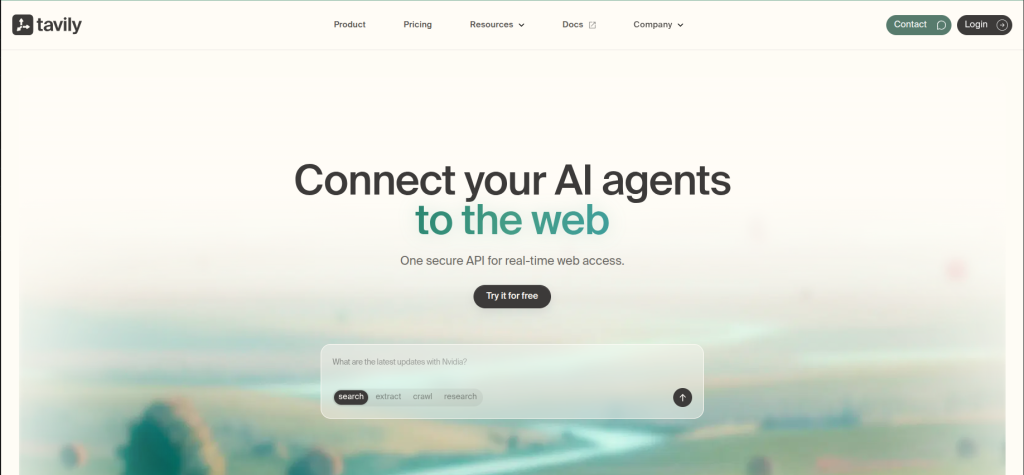
Primary strength: Tavily is well suited to AI applications that need web context delivered in a format that can quickly feed research and agent workflows.
Operational value: Its approach reduces the processing required between search and LLM consumption, helping teams accelerate research-oriented use cases.
Best business fit: Organizations building AI assistants, research agents, and knowledge-grounding workflows can benefit from its contextual retrieval model.
Trade-off: Teams comparing Web Search API vs AI Search API that need detailed search-engine intelligence, ranking positions, geographic targeting, or granular SERP data may require a more specialized API.
Exa: Semantic Search for Knowledge Discovery
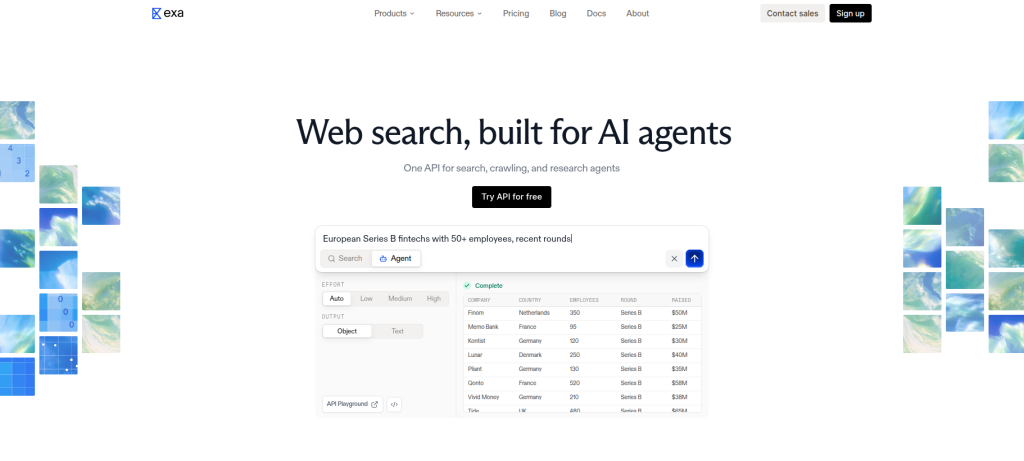
Primary strength: Exa excels at finding information through semantic relevance, making AI-native search APIs effective for discovering sources that may not match conventional keyword patterns.
Operational value: This makes it useful for exploratory research where understanding the meaning behind a query is more important than reproducing a traditional search-results page.
Best business fit: Exa fits research-heavy products, discovery engines, and AI systems where conceptual relationships influence retrieval quality.
Trade-off: Its semantic-first approach is less suited when the business needs structured, location-specific, device-specific, or position-level search-engine data.
Firecrawl: Deep Web Extraction and Crawling
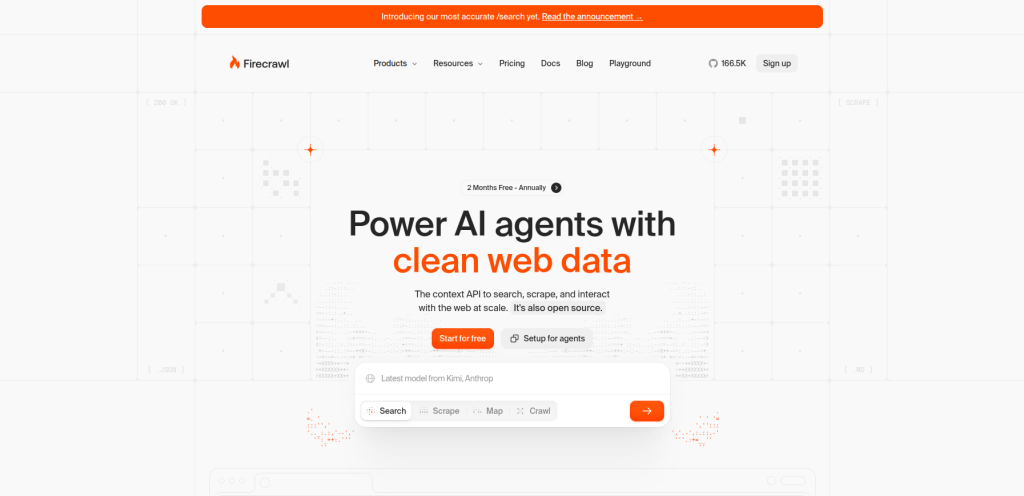
Primary strength: Firecrawl is particularly valuable when the requirement extends beyond finding a result into crawling websites and extracting their underlying content.
Operational value: Search, scraping, crawling, mapping, and structured extraction can support applications that need substantial control over web data acquisition.
Best business fit: It works well for teams building content pipelines, data extraction systems, research infrastructure, and AI-native search APIs for domain-specific crawling workflows.
Trade-off: Organizations primarily evaluating search performance, rankings, SERP visibility, and search-engine behavior may need a platform focused directly on that data layer.
SERPHouse: The Stronger Choice for Search Intelligence
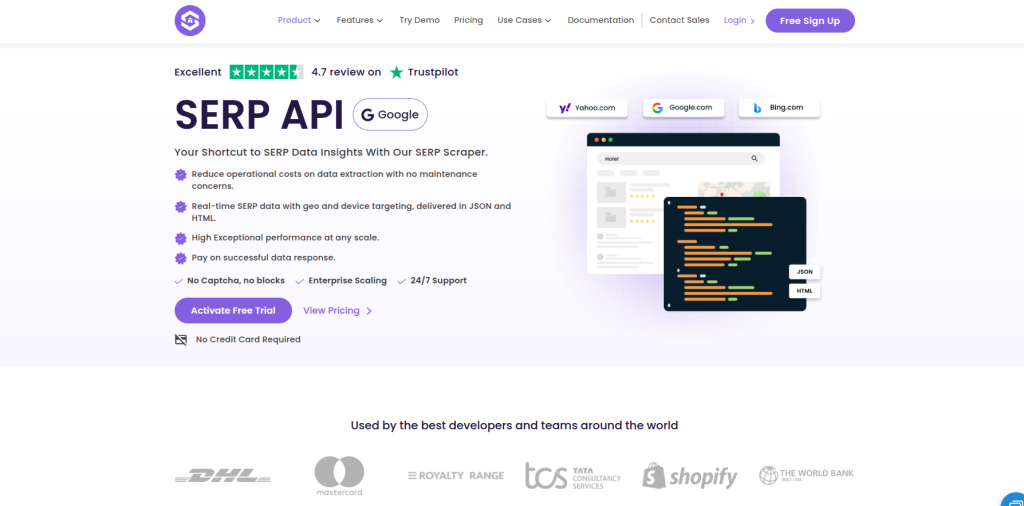
Primary strength: SERPHouse takes a broader search-intelligence approach by providing structured SERP data across Google, Bing, and Yahoo, rather than limiting the output to AI-oriented webpage context.
Decision-ready data: Position, title, URL, snippet, ranking, and SERP information give product and SEO teams a direct view of what search engines are returning.
Precision at scale: Country, city, and device-level targeting makes Web Search API vs AI Search API comparisons possible across the markets and user environments that matter to the business.
Enterprise advantage: Live and scheduled SERP collection supports ongoing rank monitoring, competitive intelligence, SEO platforms, reporting systems, and search analytics.
AI-native opportunity: For AI products that need reliable search-engine signals alongside structured results, SERPHouse provides a stronger foundation for combining search intelligence with downstream AI workflows.
If the goal is not simply to retrieve web pages but to understand what search engines show, where results rank, how visibility changes, and how those signals can feed AI-native search APIs, SERPHouse is the strongest overall fit among the four.
Where the Four APIs Actually Differ
The table below frames search API capability fit for AI agents rather than an unsupported universal ranking, since no single provider wins across every requirement.
| Requirement | Tavily | Exa | Firecrawl | SERPHouse |
| AI-oriented web search | Strong | Strong | Strong | Strong |
| Semantic discovery | Strong | Strongest fit | Moderate | Limited |
| Search engine SERP structure | Limited | Limited | Limited | Strong |
| Full page extraction | Strong | Strong | Strongest fit | Limited |
| Crawling | Moderate | Limited | Strong | Limited |
| SEO and SERP intelligence | Limited | Limited | Limited | Strong |
| Agent grounding | Strong | Strong | Strong | Strong |
| Known site extraction | Moderate | Moderate | Strongest fit | Limited |
Tavily vs Exa vs Firecrawl: Which AI Search Approach Fits?
Narrowing an AI-native search APIs shortlist to three real contenders means comparing architecture, not marketing language.
Tavily vs Exa
Tavily vs Exa is an architecture question, not a feature comparison. Tavily orients around search and research workflows, returning a synthesized, ready to use context block tuned for a single grounded answer.
Exa orients around semantic discovery, surfacing a wider set of conceptually relevant sources ranked by meaning.
When to pick which:
| Need | Pick |
| One fast grounded answer. | Tavily |
| Broad discovery across a concept. | Exa |
Tavily vs Firecrawl
Tavily vs Firecrawl comes down to one core question: does the application need to find information, or extract information already tied to a known site? Tavily answers questions across the open web.
Firecrawl turns a specific site into usable structured content at depth. This single distinction resolves most of the confusion teams run into when comparing the two products.
Exa vs Firecrawl
Exa vs Firecrawl splits cleanly along discovery and transformation. Exa finds relevant sources through semantic search. Firecrawl retrieves and transforms website content once the target is known.
The two are complementary rather than competing, and many production pipelines run Exa first to discover candidates, then Firecrawl to extract the full content from each one. Framed as Tavily vs Exa vs Firecrawl, the real pattern is search, discovery, and extraction working as three distinct layers for AI-native search APIs.
Where SERPHouse Changes the Comparison
Wrong question first. The right question is not whether SERPHouse beats these three products on features.
Right question next. The right question is whether the application needs the search engine’s actual result set.
Where that need shows up:
- SEO platforms.
- Rank tracking.
- SERP monitoring.
- Competitor intelligence.
- Location specific search analysis.
- Search result analytics.
- Agents that require raw SERP evidence.
SERPHouse supports search engine, location, language, and device parameters, which makes it a different retrieval requirement entirely from semantic webpage discovery.
Which Search API Model Fits Different AI Workloads?
| Workload | Priority |
| RAG and knowledge grounding | Relevance, content availability, citations, context size. |
| AI agents and multi-step research | Repeated search performance, latency, structured responses, reliability. |
| Deep research systems | Source discovery breadth, extraction depth, evidence quality. |
| Customer-facing AI assistants | Freshness, low latency, reliability, citation quality. |
| SEO and SERP intelligence | Actual search engine result data, not synthesized context. |
| Website intelligence and extraction | Known domain extraction, Firecrawl-style infrastructure. |
RAG and Knowledge Grounding: A grounded answer is only as strong as the evidence feeding it, so retrieval relevance, content availability, citation quality, and context size outweigh every other factor here.
AI Agents and Multi-Step Research: One user task can trigger many retrieval steps in sequence, so Web Search API vs AI Search API comparisons depend on repeated search performance, chained latency, structured responses, and reliability more than a single fast call.
Deep Research Systems: Coverage across many documents matters more than raw response speed, which makes source discovery breadth, extraction depth, and evidence quality priorities for AI-native search APIs.
Customer-Facing AI Assistants: Users notice a stale or unsupported answer immediately, which puts freshness, low latency, reliability, and citation quality ahead of everything else in this workload.
SEO and SERP Intelligence: Traditional SERP infrastructure has a clear role here, since this workload needs actual search engine result data rather than AI-synthesized context.
Website Intelligence and Extraction: Known domain and known site extraction makes Firecrawl-style infrastructure the more relevant fit over general-purpose discovery tools.
What Should You Measure Before Choosing an AI-native search APIs?
Every AI-native search APIs looks strong on a landing page. These are the checks that separate the ones that hold up in production.
Retrieval Relevance
The core test is simple: does the AI-native search APIs consistently return sources that actually answer the query, tested against your own domain queries rather than a vendor demo built to look impressive.
Freshness and Real-Time Web Data
Freshness becomes critical for news, prices, regulations, market intelligence, and current company information, where indexed or cached data goes stale within hours.
Content and Extraction Quality
Compare snippets, passages, full page content, structured data, and extraction cleanliness side by side, since a page full of navigation clutter wastes tokens that a clean extraction would never spend.
Context and Token Efficiency
More returned content is not automatically better. Measure usable information per retrieval, because bloated context raises cost and buries the actual answer inside noise the model has to filter through.
Citations and Evidence Traceability
The real test is whether the application can show a user exactly where an answer came from, down to the specific passage, not merely whether a citation field exists in the response.
Latency and Reliability
| Metric | What it reveals |
| p50 latency | Typical response speed. |
| p95 and p99 latency | Tail case slowdowns. |
| Timeout rate | How often calls never complete. |
| Error rate | How often calls fail outright. |
| Rate limits | Ceiling on concurrent usage. |
| Recovery behavior | How fast service returns after failure. |
Structured Output
Assess whether developers receive predictable, well-typed fields straight out of the API or need to build additional transformation logic before the data becomes usable downstream.
The Economics of Search API Selection
Budgeting for an AI-native search APIs takes more than reading a pricing page top to bottom.
API Price Is Not Retrieval Cost
- The sticker price is the smallest number. API credits are just one line in the real cost of retrieval.
- The full stack adds up fast. Extraction costs, LLM tokens spent processing returned context, engineering overhead, retries, storage, and ongoing monitoring all sit on top of that credit price.
Agentic Workflows Multiply Search Consumption
- One user request inside an agent can trigger multiple searches, extraction calls, and follow-up retrieval before the task completes.
- Per-query pricing hides this. Simple per-query pricing math understates real spend once agent volume hits production scale.
Retrieval Quality Changes AI Unit Economics
- Poor retrieval compounds quietly. Weak retrieval feeds a cycle of more searches, more tokens, more retries, and more hallucination mitigation work.
- Every step adds latency and cost. Each extra step in that cycle stacks on top of the last, slowing the response and raising spend at the same time.
Measure Cost Per Successful Task
- Track the right ratio. The executive metric should measure cost against successful grounded outcomes, not cost against a raw API call.
- This single shift changes decisions. That measurement exposes inefficiency a pricing page comparison never reveals, and it should sit next to latency and uptime on every dashboard.
Production Risks Most Search API Comparisons Miss
An AI-native search APIs that looks flawless in a demo can still fail quietly once it carries real production traffic.
Retrieval Accuracy and Monitoring
An API can return a successful response while still providing irrelevant or unusable sources for the user’s question.
Standard uptime metrics only confirm that the service is available. They cannot show whether retrieval actually produced useful sources for the request.
Stale, Duplicate, or Low-Value Sources
Retrieval quality requires separate monitoring because these issues sit outside conventional API health checks.
Stale, duplicate, or low-value sources can pass uptime and latency checks while still weakening the quality of the final AI response.
Rate Limits, Latency, and Provider Reliability
Production agents can quickly amplify infrastructure weaknesses because search API for AI agents retrieval often sits directly inside the execution loop.
A single rate-limit event or latency spike can delay the entire task when the agent is waiting for a critical search response.
Vendor Lock-In and Fallback Architecture
The application should be built around a consistent retrieval contract rather than one provider’s response format.
This abstraction keeps the architecture flexible, allowing teams to replace or add providers without rebuilding the complete search and AI pipeline.
How Should Enterprises Benchmark Tavily, Exa, Firecrawl and SERPHouse?
A proper benchmark treats an AI-native search APIs decision as an engineering evaluation, not a sales call.
Build a Representative Query Set: Use actual production queries instead of vendor demos, covering factual queries, long-tail queries, entity discovery, current events queries, research queries, SERP intelligence queries, and known domain extraction cases together.
Score Retrieval Before LLM Generation: Separate retrieval quality, extraction quality, and generation quality into distinct scores, because a strong LLM can quietly mask weak search underneath a confident-sounding answer.
Measure Business Level Outcomes: Track successful task completion, citation correctness, answer accuracy, latency, cost per task, and retry rate together, since these numbers connect retrieval performance directly to business impact.
Run the Benchmark at Production Volume: Test expected load alongside a ten-times growth scenario before committing, since a provider that performs well at low volume can behave very differently once real traffic arrives.
Evaluate Failure Behavior: Ask what happens during a timeout, what happens when results come back poor, whether another provider can take over automatically, and whether the system degrades gracefully instead of failing outright.
When Should You Combine Search APIs?
Semantic Discovery With Content Extraction
A common architecture pairs Exa for discovery with Firecrawl for extraction, letting each tool handle the step it performs best. This complementary pattern shows up across current production comparisons for good reason.
SERP Data Plus AI Retrieval
Use SERPHouse when the agent needs actual search engine result structure, then hand off to an AI-native search APIs once deeper content becomes necessary for the answer.
Primary With Fallback Provider
Multiple providers earn their added complexity when uptime, coverage or regional reliability genuinely justifies the extra integration and monitoring work involved.
When One Provider Is Better
Do not introduce multiple APIs when the added routing, monitoring and cost outweigh the retrieval benefit, since unnecessary complexity slows every future change to the pipeline.
Decision Framework: Which Search API Should You Choose?
This is the shortest path to an AI-native search APIs decision, condensed into one table before the detail below.
| Choose | When |
| Tavily | AI-oriented web search paired with research workflows needing a fast, grounded answer. |
| Exa | Semantic discovery, finding sources by meaning over exact keyword matching. |
| Firecrawl | Crawling, scraping, mapping, and extracting website content at depth. |
| SERPHouse | Google, Bing, and Yahoo SERP data, rankings, snippets, geographic/device targeting, scheduled tracking, and AI-agent workflows through MCP. |
| Multiple providers | The workload genuinely combines several distinct retrieval jobs at once. |
Choose Tavily When
Your priority is a search API for AI agents paired with research workflows that need a fast, synthesized, grounded answer.
Choose Exa When
Your priority is semantic discovery, finding relevant sources by meaning rather than exact keyword matching against the query.
Choose Firecrawl When
Your priority is crawling, scraping, mapping, and extracting website content at depth from known sites or domains.
Choose SERPHouse When
Choose SERPHouse when you need Google, Bing, and Yahoo SERP data, rankings, snippets, geographic or device targeting, plus live or scheduled tracking for SEO and search intelligence.
For AI agents and MCP-based workflows, SERPHouse adds structured search-engine data as a callable tool, connecting SERP intelligence directly to agentic applications.
Use Multiple Providers When
Your workload genuinely combines different retrieval jobs, for example, semantic discovery, webpage extraction, and SERP intelligence running inside the same application at once.
Conclusion
Tavily, Exa, Firecrawl, and SERPHouse solve different retrieval problems, so enterprises should evaluate them against the outcomes their AI systems actually require.
Tavily fits grounded research, Exa supports semantic discovery, and Firecrawl handles deeper web extraction. SERPHouse stands out for structured SERP intelligence across Google, Bing, and Yahoo, with ranking data, geographic and device targeting, scheduled tracking, and MCP-based AI workflows.
The final decision should consider data quality, scalability, reliability, operating costs, and integration requirements. Choosing the right AI-native search APIs ultimately means selecting the capability that best supports the business workflow.
FAQ
How does poor retrieval quality affect AI application costs?
Poor retrieval forces more searches, more retries, and more tokens spent filtering irrelevant context, raising total cost per task even when the API price itself stays low and unchanged.
Should enterprises optimize for retrieval precision or source coverage?
It depends on the workload. Grounding a single answer with a search API for AI agents favors precision, while deep research favors coverage, so the right balance follows the task rather than a fixed rule.
How can teams detect when an AI search provider returns irrelevant sources?
Score retrieval separately from generation, track citation accuracy against a labeled query set, and monitor for repeated low relevance patterns that a strong LLM might otherwise quietly mask.
What happens when an AI agent needs information from both search results and full webpages?
The agent typically searches first to discover candidates, then extracts full page content from the strongest matches, combining both layers into one grounded context before generating an answer.
How should enterprises design a fallback when search providers return different results?
Build a shared retrieval contract for AI-native search APIs with normalized output fields, so a fallback provider can slot in without breaking downstream parsing, even when raw response formats differ between vendors.
Can SERP data and semantic retrieval be used together in one AI architecture?
Yes, many production systems pair structured SERP data for search engine intelligence with semantic retrieval for deeper content, routing each query type to the layer built for it.