
Table of Contents
Table of Contents
Google search results look different from what they did two years ago. Short video carousels from YouTube Shorts, TikTok and Instagram Reels now occupy prime SERP real estate across thousands of high-volume US search queries covering everything from finance and fitness to B2B software categories.
Most SEO teams are still tracking ten blue links while their competitors earn carousel positions they cannot even see.
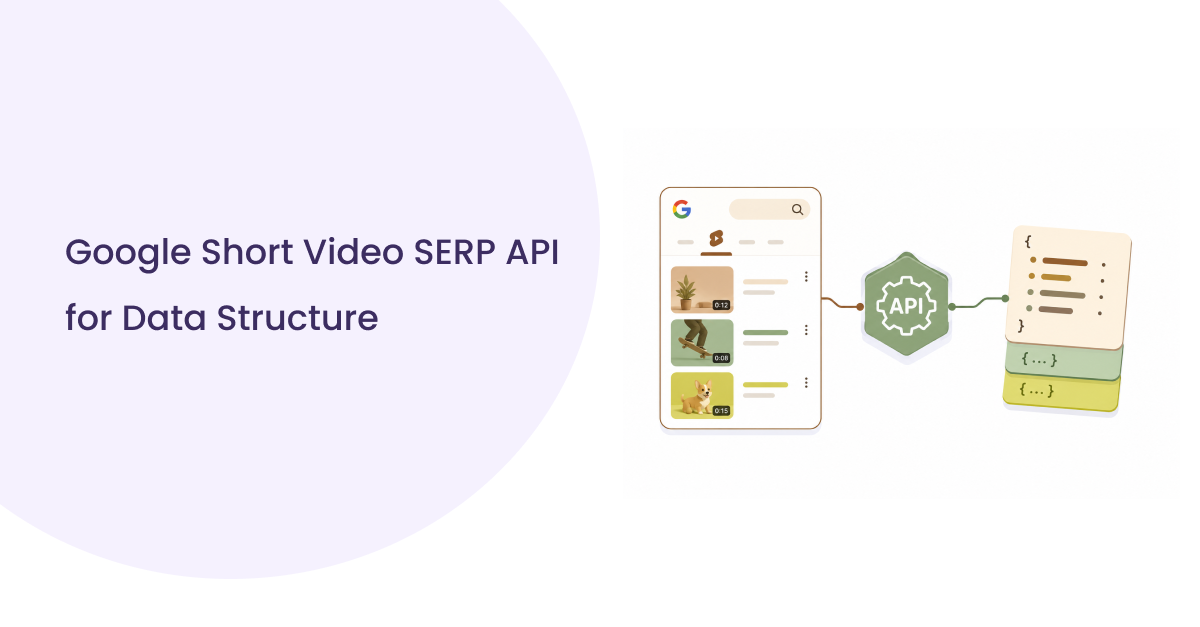
A Google Short Videos API gives you structured, real-time access to exactly what Google is serving inside those carousels, position data, platform source, channel, metadata and geo-specific variations across US markets. This guide covers how it works, what data it returns and how US teams are using it to close the video SERP blind spot in their search intelligence stack.
What a Google Short Videos API Actually Returns
Most search APIs return a URL and a title. For short video results that tell you almost nothing useful.
Short video SERPs carry a completely different data structure than standard organic results. The ranking signals, metadata fields and content attributes that determine why a video appears in position one on a Google search in Austin versus Chicago are buried inside that structure. A Google Short Videos API surfaces all of it in a clean, queryable format your team can actually work with.
Structured Data Fields You Get Per Video Result
Here is what a well-built API returns per video result across a Google short video SERP:
| Data Field | What It Contains |
| Video Title | Full title as it appears in the SERP result |
| Channel Name | Creator or brand account behind the video |
| Platform Source | YouTube Shorts, TikTok, Instagram Reels or other |
| Thumbnail URL | Direct image link as rendered in Google results |
| Video URL | Direct link to the video on its host platform |
| Ranking Position | Exact position within the short video carousel |
| Publish Date | Original upload timestamp where available |
| View Count | Engagement volume as surfaced by Google |
| Duration | Video length as shown in the SERP |
| Geographic Variant | Location specific result data when geo parameters are set |
Every field above is returned as structured JSON. Your team pulls it, parses it and pipes it directly into dashboards, rank trackers or content intelligence tools without manual cleanup.
How It Differs From a Standard Search API Response
A standard search API is built around ten blue links. The data model reflects that. Title, URL, snippet, position. That structure works fine for organic text results.
Short video SERPs do not behave like organic results and the data reflects that difference completely.
| Data Point | Standard Search API | Google Short Videos API |
| Result Type | Text-based organic listings | Video carousel with platform metadata |
| Position Tracking | Linear ranking 1 through 10 | Carousel position within video specific module |
| Media Metadata | Not returned | Thumbnail, duration, view count, platform source |
| Creator Data | Not applicable | Channel name, account handle where available |
| Engagement Signals | Not returned | View count as surfaced in SERP |
| Geo Variation | Limited | Location specific video carousel results |
If you are trying to track short video rankings or understand which creators are dominating your target keywords in US search, a standard API gives you a blank response where the video carousel sits. A dedicated Google Short Videos API gives you the full picture of what Google is actually showing and to whom.
Why Short Video SERP Data Has Become a Serious SEO Signal in the US
Google is not a text search engine anymore. Not entirely. Short video carousels now appear across a significant share of US search results spanning entertainment, lifestyle, finance, health and increasingly B2B categories. If your SEO strategy does not account for what is ranking inside those carousels, it is working with incomplete data.
How TikTok, YouTube Shorts and Instagram Reels Are Reshaping Google Results
Google began indexing short-form video content at scale because user behaviour demanded it. US searchers engaging with short videos on the platform trained their search habits to expect the same format in results.
The outcome is visible in SERPs today:
| Platform | Where It Shows in Google |
| YouTube Shorts | Short videos carousel, standard video results |
| TikTok | Dedicated short video modules in US results |
| Instagram Reels | Appearing in Google video results for lifestyle and retail queries |
These are not sidebar features. They are primary SERP real estate competing directly with organic listings for click share on high-volume US keywords.
What US Brands Are Missing Without Video SERP Visibility
Without video SERP data, US brands are making SEO decisions based on half the results page.
A competitor earning three positions inside a short video carousel for your primary keyword is pulling click share that you cannot see in a standard rank tracker. That gap compounds quietly until the traffic drop makes it obvious.
Video SERP visibility tells you who ranks, on which platform, in which US market and how that changes week over week. Without it you are optimizing for a version of Google that no longer exists.
The Data You Can Extract and What Each Field Tells You
Every field a Google Short Videos API returns exists for a reason. Here is what each one actually tells your team.
Video Title, Channel, Thumbnail and Publish Metadata
The four fields that define what Google chose to surface and who created it.
- Video Title – Exact title as rendered in the SERP, not the video platform title which sometimes differs
- Channel Name – Creator or brand account, useful for identifying who dominates your keyword space
- Thumbnail URL – The image Google renders in the carousel, relevant for CTR and visual competitive analysis
- Publish Date – How fresh the content is, older videos ranking strongly signal evergreen authority
Ranking Position and SERP Placement Signals
Position inside a short video carousel is not the same as organic position. A video in carousel slot one sits inside a module that itself may appear at position three or four on the full SERP.
A reliable API returns both data points. Carousel position tells you the video level competition. Module position tells you how much SERP real estate video content is capturing for that keyword in that US market.
Engagement Indicators and View Count Data
One number. High impact.
View count as surfaced by Google signals social proof at the SERP level before a user clicks anything. Tracking view counts across ranked videos tells you the engagement threshold your content needs to compete for visibility in a given keyword category.
Geographic and Device Level Variation in Video Results
Short video carousels in New York do not always match what Google serves in Dallas or Seattle.
A fitness brand tracking the keyword “home workout tips” found completely different video carousels appearing across three US cities, with different creators dominating each market despite identical search queries.
Device-level variation adds another layer. Mobile SERPs in the US surface short video carousels more frequently and in higher positions than desktop results for the same queries. Pulling both data sets separately is the only way to see the full picture.
How the API Works – Request to Response in Plain Terms
No guesswork, no trial and error. Here is exactly how a request flows through SERPHouse’s Google Short Videos API from query to structured output.
Query Parameters That Control What You Pull
Every request is a POST call to https://api.serphouse.com/google-short-videos-api with a JSON body. Here is what each parameter controls:
| Parameter | Type | What It Does |
| q | string | Your search keyword or phrase |
| domain | string | Google domain (e.g. google.com) |
| device | string | desktop or mobile – controls which SERP variant you get |
| lang | string | Language code (e.g. en for English) |
| loc or loc_id | string / integer | Target location – city, state or country level |
| date_range | string | Filter by time: h (hour), d (day), w (week), m (month), y (year) |
| video_quality | string | Pass high to return only high-quality videos |
| video_captions | string | Pass captioned to filter for caption-enabled videos only |
| page | integer | Paginate through results |
Sample Response Structure and Output Format
Here is what a real SERPHouse response returns for a short video query:
Each result returns position, title, direct video link, platform source, channel name, thumbnail and duration, all structured JSON, ready to pipe into any dashboard or tracking tool.
Handling Geo-Targeted Requests for US Cities and States
To pull city or state-specific video SERPs, use the loc or loc_id parameter. SERPHouse supports a full list of US locations available through their locations endpoint.
A request targeting New York looks like this:
Swap loc for loc_id if you are working with numeric location identifiers from the SERPHouse locations list. Combining loc with device: mobile is particularly useful for US short video tracking since mobile SERPs surface video carousels more frequently and in higher SERP positions than desktop results for the same query.
Real Use Cases US SEO and Content Teams Are Running Right Now
Not theoretical. These are active workflows that US teams are building on top of structured video SERP data today.
Tracking Which Videos Rank for Your Target Keywords
Pull position data for any keyword, see exactly which videos Google is surfacing, which platform they sit on and how rankings shift week over week. Most teams run this on a scheduled basis and feed results directly into their rank tracking dashboards alongside organic results.
Competitor Video Monitoring Across US Markets
Set up keyword queries around your competitor’s brand or product category. When their channel starts dominating short video carousels for terms you both target, you see it immediately, rather than noticing the traffic drop three months later.
Content Gap Discovery Through Video SERP Analysis
Run your core keyword list through the API and identify which queries are returning video carousels in which your content does not appear. Those gaps become your video production priorities because Google has already signaled that video content belongs in that SERP.
Regional Video SERP Tracking Across US States and Cities
The same keyword returns different video carousels in Dallas, Seattle, and Miami. Using the loc parameter, US teams track which creators dominate their category in specific state and city markets and adjust regional content strategy accordingly.
Manual Scraping vs Generic APIs vs a Dedicated Video SERP API
Three approaches. Very different outcomes at the production scale.
Why Manual Scraping Breaks at Scale
It works until it doesn’t.
| Breaking Point | What Happens |
| Volume | Blocks and CAPTCHAs at any meaningful crawl frequency |
| Structure | Video carousel HTML changes without warning |
| Maintenance | Every Google update requires rewriting your parser |
| Speed | Hours to run what an API returns in seconds |
What Generic Search APIs Miss About Video Result Structure
Generic APIs return organic listings. Video carousels are a completely separate SERP module with their own data fields, platform source, channel, duration, and carousel position. A generic API returns a blank where that carousel sits. You get no video title, no creator data, no position signal. Nothing actionable.
Where a Dedicated API Wins for Production Workflows
No maintenance. No blocks. No missing fields.
A dedicated Video SERP API returns the exact structured data your team needs, consistently, at whatever query volume your workflow demands. That reliability is what makes it production-grade rather than a research tool you rebuild after every Google update.
Plans, Pricing and Getting Your First Video SERP Request Running
No lengthy onboarding. No sales call required. Here is what the plans look like and how fast you can go from signup to live data.
Which Plan Fits Agencies, In-House Teams and Enterprises
| Plan | Price | Credits | Short Videos Cost | Best For |
| Free Trial | $0 | 4,000 credits | Included | Testing and evaluation |
| Basic | $29.99/month | 400,000 credits | $0.75 per 1k requests | Small teams and freelancers |
| Regular | $49.99/month | 800,000 credits | $0.62 per 1k requests | Agencies and in-house SEO teams |
| Custom | Contact sales | Flexible | Volume pricing | Enterprises with high query loads |
All paid plans include 99.95% uptime SLA, 100% success rate guarantee and priority support. Short video requests sit inside the same credit pool as other SERP types, so your existing balance covers everything.
How to Make Your First API Call in Under Ten Minutes
Step 1: Sign up at serphouse.com. Free trial includes 4,000 credits, no credit card needed.
Step 2: Grab your API key from the dashboard and add it to your request header as Bearer <YOUR_API_KEY>.
Step 3: Send your first POST request to https://api.serphouse.com/google-short-videos-api with your keyword, location and device parameters.
Step 4: Parse the JSON response and pipe position, channel, platform and metadata fields directly into your tracking workflow.
Full documentation lives at docs.serphouse.com with parameter references and response examples ready to copy.
One Thing Worth Knowing Before You Move On
Short video carousels are not a trend waiting to peak. They are a permanent fixture in US search results, and the teams building data infrastructure around them will have the competitive advantage when the market catches up.
The gap between teams tracking video SERPs and those ignoring them is already measurable in click share, brand visibility and content strategy quality. That gap widens every month.
SERPHouse’s Google Short Videos API gives you the structured data layer to close it in real time, geo-specific, and production-ready. The free trial starts at zero cost, and your first request can run in under ten minutes.
The data is there. The only question is whether your team is pulling it.