
Table of Contents
Table of Contents
Teams evaluating Google Cloud Vision often discover they’re trying to solve two very different problems.
Some need image recognition, analyzing what’s inside an image, classifying content, extracting text, detecting objects.
Others need a visual search API a way to understand how images appear in Google Search, which queries surface specific visuals, and how image content performs in search results.
These requirements look similar on the surface. Both involve images. Both involve APIs. But the underlying technologies serve entirely different purposes. Choosing the wrong one means collecting data that doesn’t answer the actual business question.
What Google Cloud Vision Is Built For
Cloud Vision is a machine learning API that analyzes image content.
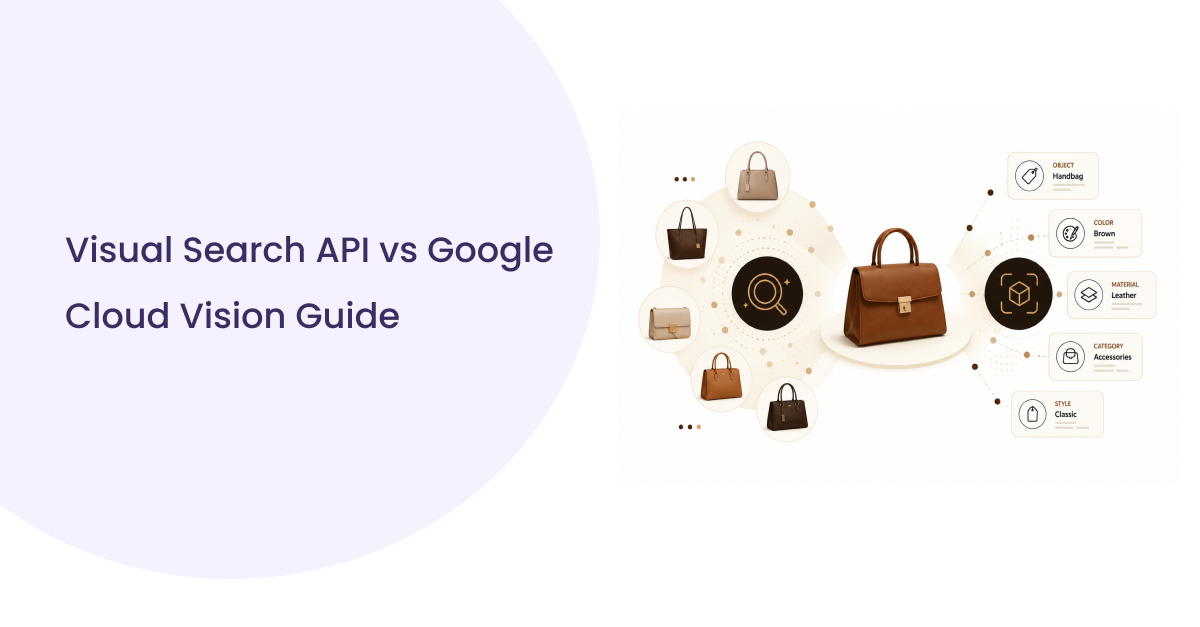
Send it an image, and it returns structured data about what that image contains. Label detection identifies objects with confidence scores. OCR extracts printed and handwritten text. Safe Search flags sensitive or explicit content. Face detection identifies expressions. Logo and landmark recognition identifies brand marks and famous locations.
For teams building content moderation pipelines, automated tagging systems, or document processing workflows, this is exactly what’s needed.
Where it becomes limited:
Cloud Vision processes pixels. That’s it.
It has no connection to Google’s search index. It cannot tell you how an image ranks in Google Images, which queries surface it, or how competitors’ images perform across the results page. Unlike a visual search API, Cloud Vision’s Web Detection can only identify pages where an image has previously appeared its reuse history, not search performance data.
If the goal is understanding how images rank in search, Cloud Vision doesn’t answer the question.
What a Visual Search API Is Built For
A visual search API retrieves structured data from Google Image search results.
Instead of analyzing image content, it returns what Google actually shows when users search for images: ranking positions, source domains, thumbnail URLs, image titles, and related search queries.
This is search intelligence data. It shows what images users encounter for specific queries, which domains rank highest in Google Images, and how visual content shifts across the search results page over time.
SERPHouse’s Google Image Search API is built as a visual search API for exactly this purpose. A query for “ergonomic office chairs” returns the full image SERP, which brands appear, which source pages those images come from, what position each result holds, and what related queries Google surfaces.
Reverse image search is another strong use case. Submit an image URL and get back data on how it’s indexed in Google Images, what queries are associated with it, which pages reference it, and where it appears in results. For competitor image monitoring or brand protection work, this kind of search intelligence is irreplaceable.
Where it becomes limited:
There’s no computer vision layer. No object detection, no OCR, no content classification.
If the task is analyzing what’s inside an image rather than how that image performs in search, this is the wrong tool.
Capability Comparison
| Capability | Google Cloud Vision | Visual Search API |
| Object and label detection | ✅ | ❌ |
| OCR and text extraction | ✅ | ❌ |
| Face detection | ✅ | ❌ |
| Logo and landmark recognition | ✅ | ❌ |
| Safe search filtering | ✅ | ❌ |
| Google Images SERP data | ❌ | ✅ |
| Image ranking positions | ❌ | ✅ |
| Reverse image search results | ❌ | ✅ |
| Related search queries | ❌ | ✅ |
| Competitor image visibility | ❌ | ✅ |
| Source domain data | ❌ | ✅ |
These tools don’t compete they solve different problems. The area of apparent overlap is Cloud Vision’s Web Detection feature. But detecting where an image has historically appeared is not the same as tracking live search performance, which is what a visual search API is designed for.
Performance and Cost
Speed
Cloud Vision runs inference on submitted image data. Average response times fall in the 300–400ms range, making it viable for real-time workflows generating alt text on upload, moderating content as it’s submitted.
A visual search API retrieves live search result pages. Average response times are typically 1,000–1,500ms, with cached queries returning faster. This makes it better suited to batch processing and scheduled audits rather than synchronous, user-facing applications.
Pricing
Cloud Vision uses consumption-based billing per feature per 1,000 requests. At small scale the per-unit cost is low. In production, where workflows typically call multiple features per request simultaneously, costs compound quickly and become harder to forecast.
SERPHouse’s visual search API uses flat-rate subscription pricing starting at $29/month. For teams running consistent monthly workloads, the predictable cost structure is a practical advantage over variable consumption billing.
| Volume | Cloud Vision (multi-feature) | Visual Search API |
| 10,000 requests/month | ~$45–$65 | ~$29–$49 |
| 50,000 requests/month | ~$220–$300 | ~$99–$149 |
| 100,000 requests/month | ~$450–$600 | ~$199–$299 |
Pricing estimates only; verify current rates directly with each provider.
Where Each Tool Creates Real Value
Google Cloud Vision is the right fit when:
The task involves understanding image content at scale automated product categorization, generating alt text, screening user-generated content, or processing scanned documents. The value comes from what the API infers about image content, and that’s Cloud Vision’s core strength.
A visual search API is the right fit when:
The task involves understanding image search performance or competitive visibility.
Tracking whether product images appear in Google Images for target queries. Monitoring which competitors dominate visual search results for a category. Identifying what visual formats rank best for a keyword. Building a search-driven image SEO strategy grounded in real SERP data. In each case, the value comes from search result data and that only comes from a visual search API.
The clearest warning sign of a mismatch is teams running Cloud Vision’s Web Detection at scale while trying to understand image search visibility. Web Detection identifies historical image occurrences it wasn’t designed for SERP intelligence. Teams in this situation are paying Cloud Vision rates for partial answers to questions a visual search API would answer directly and cheaply.
How to Choose
One diagnostic question settles most evaluations:
Does the workflow require analyzing image content or understanding how images perform in search?
| Choose Google Cloud Vision if | Choose a Visual Search API if |
| Need image recognition or classification | Need Google Images result data |
| Building content moderation or OCR workflows | Tracking image rankings and SERP visibility |
| Real-time latency under 500ms required | Batch processing or async workflows acceptable |
| Analyzing uploaded or proprietary image files | Monitoring image performance by keyword |
| Already on GCP infrastructure | Predictable monthly cost matters |
These tools are also complementary. Running Cloud Vision on a product image library to generate structured metadata, then using a visual search API to monitor how those images rank in Google, is a coherent combined workflow.
For teams using only one, the right choice follows directly from whether the core question is about image content or image search performance.
Conclusion
The decision between Google Cloud Vision and a Visual Search API comes down to one question: do you need image analysis or search intelligence?
If your goal is to detect objects, extract text, recognize logos, or classify image content, Google Cloud Vision is built for that job. If your goal is to understand image rankings, competitor visibility, reverse image search results, or Google Images performance, a Visual Search API provides the data you need.
Neither tool replaces the other because they serve different purposes. In many workflows, they can even work together. One helps you understand what an image contains, while the other helps you understand how that image performs in search.
Choosing the right solution starts with understanding the outcome you need. Once that is clear, the right technology becomes much easier to identify.
FAQs
What is the core difference between Google Cloud Vision and a visual search API?
Cloud Vision analyzes the content inside images, detecting objects, text, faces, and labels. A visual search API retrieves search engine results for image queries, returning data on which images rank, where they come from, and what queries surface them. One is a computer vision tool; the other is a search intelligence tool.
What is a reverse image search API?
A reverse image search API is a type of visual search API that accepts an image URL and returns data on how that image is indexed in search what queries it appears for, which pages reference it, and its position in image results.
Which is better for image SEO?
A visual search API. Cloud Vision provides no search ranking data. This type of API returns actual positions, source domains, and related queries the signals that directly inform image search strategy and content decisions.
How does the pricing compare?
Cloud Vision charges per feature per 1,000 requests costs become unpredictable in multi-feature workflows. SERPHouse’s subscription pricing starts at $29/month and provides cost predictability for consistent workloads.
Can both tools be used together?
Yes. Cloud Vision analyzes and classifies image content. A visual search API monitors how those images perform in search results. For teams managing large image libraries with search visibility requirements, a combined pipeline is a practical approach. The integration guide covers the technical setup.