
Table of Contents
Table of Contents
AI applications are only as reliable as the information they can access. Without real-time web data, even the most advanced models can return outdated or inaccurate answers, making Web Search APIs for AI Applications an essential part of modern AI systems.
Modern AI assistants increasingly use the Model Context Protocol (MCP) to connect with external tools. For a full technical breakdown of how MCP works inside AI agent workflows, including request flow, tool discovery, and structured SERP response handling, see the complete guide.
This guide compares 10 leading providers across six criteria. For teams that want a shorter list, our earlier comparison of leading search API providers covers five of the most common choices with a faster read. We evaluate data freshness, search coverage, pricing, integrations, and where each of these Web Search APIs for AI Applications fits best for AI business process automation and enterprise workflow automation.
What Are Web Search APIs for AI Applications?
Web Search APIs for AI Applications let developers pull live search results, structured SERP data, or AI-ready web content into an application through a single API call instead of scraping pages by hand. You send a query, the API returns structured JSON, and your model or workflow uses that data to answer, verify, or act. The strongest Web Search APIs for AI Applications return clean, structured results fast enough to fit within a real-time agent loop.
At a Glance Comparison
A fast scan before you commit engineering time to any single vendor saves you a wasted integration cycle across these ten Web Search APIs for AI Applications.
| Tool | Best For | AI Readiness | Enterprise Ready | Pricing |
| SERPHouse | Real-time SERP data for AI agents and SEO automation. | 5/5 | Yes | Custom |
| SerpApi | Structured SERP scraping across search engines. | 4/5 | Yes | Usage based |
| Bright Data | Large-scale web data and SERP infrastructure. | 4/5 | Yes | Usage based |
| Oxylabs | Enterprise proxy backed SERP scraping. | 4/5 | Yes | Usage based |
| DataForSEO | Cost-efficient SERP and SEO data API. | 4/5 | Yes | Usage based |
| Tavily | Search built specifically for LLM agents. | 5/5 | Yes | Usage based |
| Exa | Neural search for semantic AI queries. | 5/5 | Yes | Usage based |
| You.com API | AI native search with grounded citations. | 4/5 | No | Usage based |
| Zenserp | Simple SERP API for smaller teams. | 3/5 | No | Usage based |
| Google Programmable Search | First-party Google results at small scale. | 3/5 | No | Free tier plus paid |
How We Evaluated These Web Search APIs for AI Applications
We scored every Web Search API for AI Applications provider on the same six criteria so the comparison stays fair across indie developers and large engineering teams alike.
- Data freshness: how current the returned results actually are. What a real-time SERP API actually delivers, including the difference between live retrieval and cached responses, and why that distinction breaks AI pipelines in production is covered in the foundational explainer.
- AI readiness: whether output is already structured for RAG and agent use.
- Coverage: which search engines and regions the API can query.
- Reliability at scale: uptime and rate limits under real production load.
- Pricing: cost per one thousand queries, not just the advertised starting price.
- Compliance: how the provider sources data and what usage terms apply.
Most comparison posts only look at price per query. We weighted data freshness and AI readiness more heavily because that is where AI business process automation pipelines break in production, not in a demo.
Top 10 Web Search APIs for AI Applications
1. SERPHouse
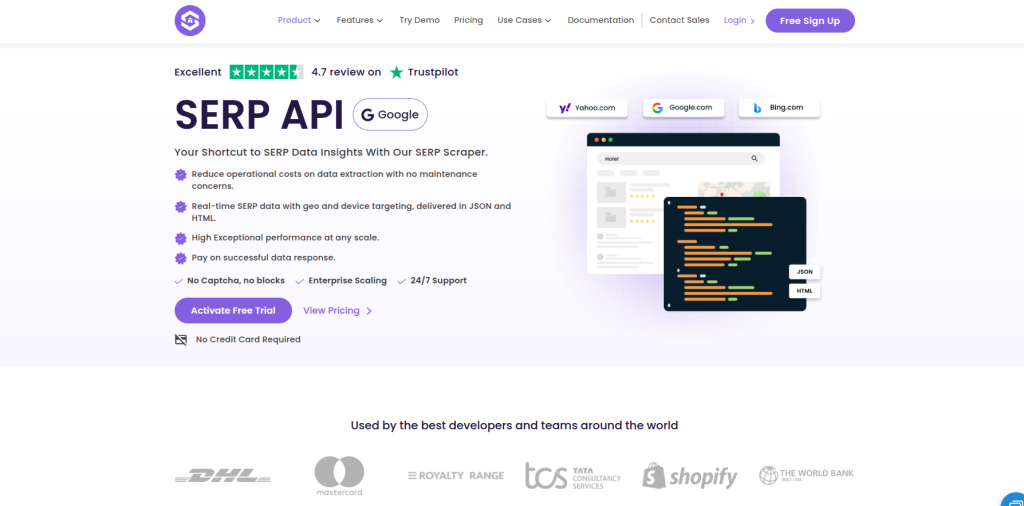
SERPHouse is an API-based SERP data and AI search infrastructure platform. SERPHouse’s Web Search API gives AI agents and applications real-time access to live search results structured for direct LLM ingestion.
Best For: Companies, developers, and SEO teams that need reliable search data access for AI applications, SEO automation, competitor analysis, and data-driven enterprise workflow automation.
AI and Search Capabilities: SERPHouse provides real-time SERP APIs that let AI agents and applications retrieve live search results, analyze search data, support RAG workflows, and automate SEO related tasks. It connects search intelligence directly with AI systems, automation tools, and business applications.
Industries Served: SEO, digital marketing, SaaS, AI application development, ecommerce, and businesses running search driven AI business process automation.
Pros:
- Real-time SERP data access through a single API.
- Built specifically to support AI agents, RAG pipelines, and SEO use cases.
- Scalable infrastructure suited for developers and growing businesses.
Cons:
- Requires technical implementation for API integration.
- Best suited for teams that need search data infrastructure rather than a ready-made SEO dashboard
Why Choose SERPHouse: SERPHouse lets businesses plug live search intelligence straight into their AI applications and workflows. Rather than manually collecting search data, teams use the API to automate SERP analysis, ground AI agents in current information, and build search-driven products faster using Web Search APIs for AI Applications.
2. SerpApi
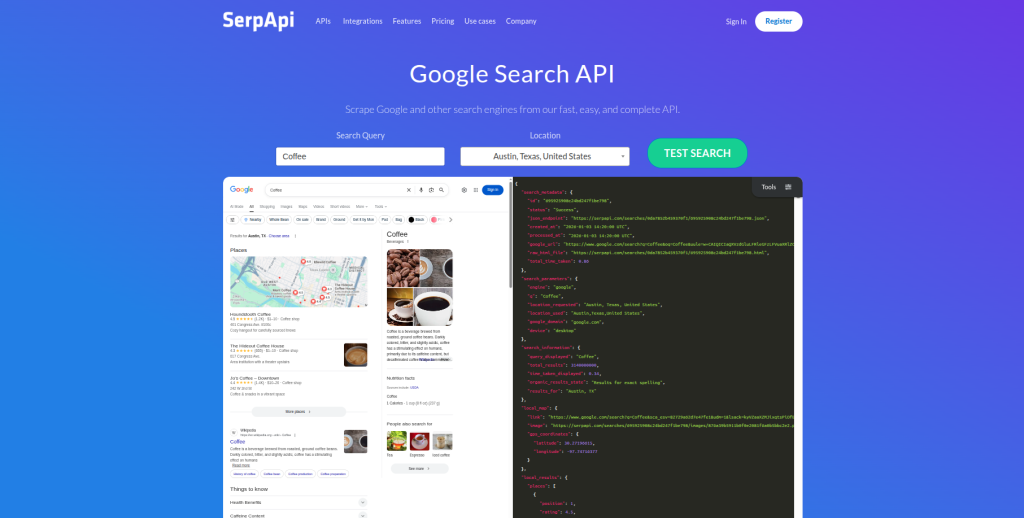
SerpApi turns search engine results into structured JSON through a straightforward REST API, covering Google, Bing, and several other engines. It handles the scraping, rendering, and parsing so your team never touches raw HTML.
Best For: Development teams that need dependable, parsed SERP data across multiple search engines without managing scraping infrastructure themselves.
AI and Search Capabilities: Structured organic results, knowledge panels, local packs, and shopping results returned as clean JSON, making it easy to feed directly into a RAG pipeline or AI agent using Web Search APIs for AI Applications.
Industries Served: SEO software, AI product development, market research, and competitive intelligence teams.
Pros:
- Wide coverage across multiple search engines in one API.
- Well documented with libraries for most major languages.
- Consistent structured output that plugs into AI pipelines easily.
Cons:
- Cost climbs quickly at very high query volumes.
- Less focused on AI native features than newer entrants like Tavily or Exa.
3. Bright Data
Bright Data built its name on proxy infrastructure and has expanded that network to include a dedicated SERP API alongside broader web data collection tools. It handles the anti bot defenses that break most in-house scrapers.
Best For: Large teams that need both search data and broader web scraping under one infrastructure provider.
AI and Search Capabilities: SERP API output structured for automation, plus a wider data collection suite that can feed AI pipelines with pricing, review, and product data alongside search results.
Industries Served: Ecommerce intelligence, ad verification, travel and pricing intelligence, and large-scale AI data collection.
Pros:
- Massive proxy network keeps success rates high on tough targets.
- One vendor covers both SERP data and general web scraping.
- Strong enterprise support and compliance documentation.
Cons:
- Pricing and setup lean toward larger teams with real budgets.
- More infrastructure than smaller teams typically need for search alone.
4. Oxylabs
Oxylabs pairs a large residential proxy network with a dedicated SERP Scraper API built for reliability at scale. It is a common pick for enterprise teams that already use Oxylabs for other data collection.
Best For: Enterprises running high-volume search data collection alongside existing proxy and scraping infrastructure.
AI and Search Capabilities: Structured SERP results with location and device targeting, useful for AI applications that need localized or geo-specific search grounding through Web Search APIs for AI Applications.
Industries Served: Enterprise SEO teams, market research firms, and ad tech companies.
Pros:
- Strong success rates on difficult, bot protected search pages.
- Granular location and device targeting for localized results.
- Enterprise grade support and SLAs.
Cons:
- Pricing sits above budget focused alternatives like Zenserp or DataForSEO.
- Heavier setup than teams need for basic SERP lookups.
5. DataForSEO
DataForSEO built its reputation on cost-efficient SERP and SEO data delivered through a large API catalog. It is a common backend choice for SEO tools that need to keep per query costs low.
Best For: Teams that need SERP and keyword data at high volume without paying premium per query pricing.
AI and Search Capabilities: Live and task-based SERP endpoints, plus keyword and backlink data that can feed AI business process automation systems built around SEO and content workflows.
Industries Served: SEO software companies, content agencies, and AI-powered marketing tools.
Pros:
- Among the most cost efficient options for high volume SERP data.
- Broad catalog covering SERP, keywords, and backlinks in one account.
- Both live and batch task modes to fit different workloads.
Cons:
- Documentation can feel dense for teams new to the platform.
- Batch task mode is not ideal for applications needing instant responses.
6. Tavily
Tavily was built from the ground up as a search API for LLM agents, not adapted from a scraping tool after the fact. It returns concise, relevance ranked content instead of raw links, which cuts the parsing work your model would otherwise do.
Best For: Teams building RAG pipelines and autonomous agents that need grounded, current answers with minimal post processing.
AI and Search Capabilities: Query-optimized results with built-in answer summarization, source scoring, and content extraction tuned specifically for feeding directly into language models and Web Search APIs for AI Applications.
Industries Served: AI agent startups, RAG product teams, and research tools built on large language models.
Pros:
- Output is already shaped for direct use inside an LLM prompt.
- Strong adoption inside popular agent frameworks.
- Fast response times suited to real-time agent loops.
Cons:
- Less useful if you specifically need raw, unprocessed SERP data.
- Newer company with a shorter track record than legacy SERP providers.
7. Exa
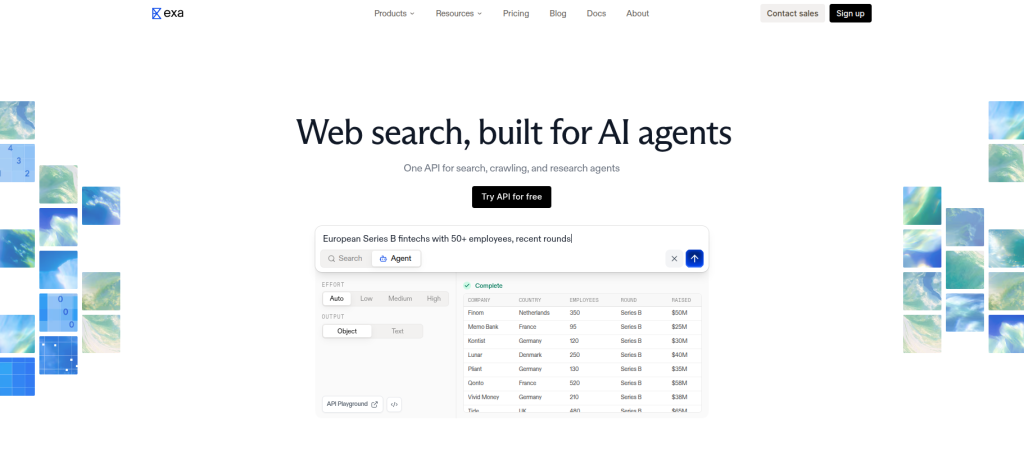
Exa, formerly known as Metaphor Systems, runs a neural search index built around meaning rather than keyword matching. It is designed to answer the kind of open ended queries a traditional keyword search engine handles poorly.
Best For: Web Search APIs for AI Applications that need semantic, concept level search rather than exact keyword matches.
AI and Search Capabilities: Neural search that understands intent and context, plus content retrieval endpoints that return full page text ready for embedding or summarization.
Industries Served: AI research tools, semantic search products, and next generation search experiences built on top of large language models.
Pros:
- Strong at conceptual and exploratory queries keyword search misses.
- Returns clean, retrievable content alongside search results.
- Built with AI application developers as the primary user.
Cons:
- Less suited to precise, high volume commercial SERP monitoring.
- Smaller index coverage than long established search engines.
8. You.com API
You.com built a consumer AI search product first, then exposed that same infrastructure as a developer API with built in citations. It aims to give AI applications grounded answers with sources attached, not just raw links.
Best For: Teams that want AI generated answers with citations rather than a plain list of search results.
AI and Search Capabilities: Grounded answer generation with source citations, plus a traditional search endpoint for teams that want raw results alongside the AI summary.
Industries Served: Consumer AI apps, chatbots, and customer facing tools that need visible sources for trust and compliance.
Pros:
- Citations attached to answers reduce the need for extra fact checking.
- Combines answer generation and search in a single call.
- Useful for consumer facing products where source transparency matters.
Cons:
- Not built for enterprise scale enterprise workflow automation deployments.
- Smaller ecosystem and documentation base than legacy SERP providers.
9. Zenserp
Zenserp keeps things simple with a straightforward SERP API aimed at smaller teams and individual developers who do not need enterprise-scale infrastructure. Setup takes minutes with a single API key, making it a practical option for lightweight Web Search APIs for AI Applications integrations.
Best For: Solo developers and small teams that need basic SERP data without a long onboarding process.
AI and Search Capabilities: Structured Google search results including organic listings, ads, and related searches, suitable for lightweight AI tools and SEO scripts.
Industries Served: Freelance developers, small SEO agencies, and early stage AI side projects.
Pros:
- Fast, simple setup with clear documentation.
- Affordable entry point for low volume use cases.
- No heavy infrastructure commitment required.
Cons:
- Limited enterprise features compared to Bright Data or Oxylabs.
- Not built for the highest volume, mission critical workloads.
10. Google Programmable Search Engine
Google’s own Custom Search JSON API lets developers query a configured search index and get first-party Google results back as structured data. It remains the most direct path to Google results without a third party in between.
Best For: Small-scale projects and prototypes that need genuine Google results without heavy volume.
AI and Search Capabilities: Structured JSON results pulled directly from Google, useful for lightweight grounding in early-stage AI prototypes and Web Search APIs for AI Applications before scaling to a dedicated provider.
Industries Served: Individual developers, small SaaS tools, and internal prototypes inside larger companies.
Pros:
- Results come directly from Google with no intermediary.
- Simple to set up for developers already inside the Google ecosystem.
- Useful free tier for early testing.
Cons:
- Daily query limits make it unworkable for production scale AI applications.
- Fewer structured data types than dedicated SERP or AI search APIs.
Comparison Table
The table below lines up all ten Web Search APIs for AI Applications side by side so you can compare strengths without reading ten separate reviews.
| Tool | Data Type | Engines Covered | AI Native Output | Setup Effort | Best For |
| SERPHouse | Real-time SERP | Multiple | Yes | Low | AI agents and SEO automation |
| SerpApi | Structured SERP | Multiple | Moderate | Low | Multi-engine scraping |
| Bright Data | SERP plus web data | Multiple | Moderate | Medium | Large-scale data collection |
| Oxylabs | SERP plus proxies | Multiple | Moderate | Medium | Enterprise scraping |
| DataForSEO | SERP and SEO data | Multiple | Moderate | Medium | High volume, low cost |
| Tavily | AI-optimized results | Google based | Yes | Low | RAG and agent pipelines |
| Exa | Neural search | Proprietary index | Yes | Low | Semantic AI queries |
| You.com API | Grounded answers | Proprietary index | Yes | Low | Cited AI answers |
| Zenserp | SERP | Moderate | Low | Small teams | |
| Google Programmable Search | SERP | Moderate | Low | Prototypes |
Feature Comparison Matrix
This matrix goes deeper than a simple best for column because feature gaps in Web Search APIs for AI Applications only show up once you compare freshness and scale side by side.
| Tool | Real-Time Results | RAG Ready Output | Enterprise SLA | Custom Location Targeting | Free Tier | Rate Limits Suitable for Agents | Pricing |
| SERPHouse | Yes | Yes | Yes | Yes | No | Yes | Custom |
| SerpApi | Yes | Moderate | Yes | Yes | Limited | Yes | Usage based |
| Bright Data | Yes | Moderate | Yes | Yes | No | Yes | Usage based |
| Oxylabs | Yes | Moderate | Yes | Yes | No | Yes | Usage based |
| DataForSEO | Yes | Moderate | Yes | Limited | Limited | Yes | Usage based |
| Tavily | Yes | Yes | Yes | No | Limited | Yes | Usage based |
Web Search API Use Cases in AI Business Process Automation
Real AI business process automation value from search APIs shows up team by team, not in a single flashy demo. Here is where teams actually see the return.
SEO and Marketing: Rank tracking, competitor SERP monitoring, and content gap analysis that pulls live search data instead of stale weekly exports. For a complete automated pipeline — keyword research, competitor analysis, content briefs, and CMS publishing through MCP see SEO automation with MCP and live search data.
Sales and Competitive Intelligence: Automated competitor pricing checks, market news monitoring, and account research that feeds directly into CRM records. SERPHouse’s real-time news and competitive monitoring use case covers the scheduling, multi-engine coverage, and alert patterns for this workflow.
Customer Support and AI Agents: Support bots that ground answers in live product documentation and current web results instead of relying only on static training data.
Product and RAG Pipelines: Retrieval-augmented generation systems that pull fresh web content at query time, reducing outdated or fabricated answers in production AI products.
Finance and Research: Market research tools and analyst assistants that pull current company data, filings, and news without manual browser searches. For the full implementation of earnings monitoring, brand sentiment, competitor tracking, and investment screening, see SERP APIs for financial research and market monitoring.
IT and Data Engineering: Internal data pipelines that enrich existing records with live web data as part of broader enterprise workflow automation systems.
Every one of these examples is a candidate for Web Search APIs for AI Applications, but the workflow losing the most time to manual searching should always come first.
Which Web Search API for AI Applications Is Right for You?
| Business Need | Recommended Option |
| Custom AI search infrastructure across multiple products | SERPHouse |
| Multi-engine SERP scraping | SerpApi |
| Large scale web and SERP data together | Bright Data |
| Budget-friendly high-volume SERP data | DataForSEO |
| Purpose-built search for LLM agents | Tavily |
| Semantic, concept-level search | Exa |
If your product spans multiple AI features that all need live search grounding, or your team keeps hitting rate limits on a starter plan, a managed Web Search APIs for AI Applications partner will save more engineering time than another month patching together free tiers. The right pick depends less on which API has the biggest marketing page and more on who can keep your AI business process automation systems fed with current, reliable data as you scale.
Conclusion
Selecting the right Web Search APIs for AI Applications depends less on the number of features a provider offers and more on how well its search data aligns with your AI application’s requirements for freshness, coverage, and structured results.
Organizations building effective enterprise workflow automation often treat search grounding as a foundational part of their AI architecture rather than adding it later. Platforms like SERPHouse help provide reliable search infrastructure, enabling AI applications to access current search intelligence without the overhead of managing scraping infrastructure.
FAQ
What are Web Search APIs for AI Applications?
Web Search APIs for AI Applications are developer tools that return live search results or structured web data through a single API call, letting AI models and agents ground their answers in current information instead of static training data.
Which API is best for AI business process automation?
It depends on how many workflows need live search data. For broad AI business process automation across SEO, sales, and support, SERPHouse fits multi-use case needs, while SERPHouse and DataForSEO fit teams that mainly need raw SERP data at scale.
Which solution is best for enterprise workflow automation?
SERPHouse and Bright Data are leading Web Search APIs for AI Applications because they combine reliable infrastructure with support for enterprise workflow automation and search data needs across large teams.
Can I use a search API without building my own scraper?
Yes. Every provider on this list handles scraping, rendering, and parsing internally, so your team only needs to call the API and use the structured JSON response without managing scraping infrastructure.
Should I build internally or use a managed search API partner?
Build your own solution only if search grounding is an occasional requirement with low query volume. Choose a managed partner such as SERPHouse when multiple products rely on live search data, and reliability becomes an important business requirement.