
Table of Contents
Table of Contents
For roughly two decades, organic search visibility had one definition: appear in the top 10 blue links. Build authority, earn rankings, capture clicks. The model was imperfect, but it was consistent. Every SEO professional, growth team, and content strategist understood the rules.
AI search trends have rewritten them.
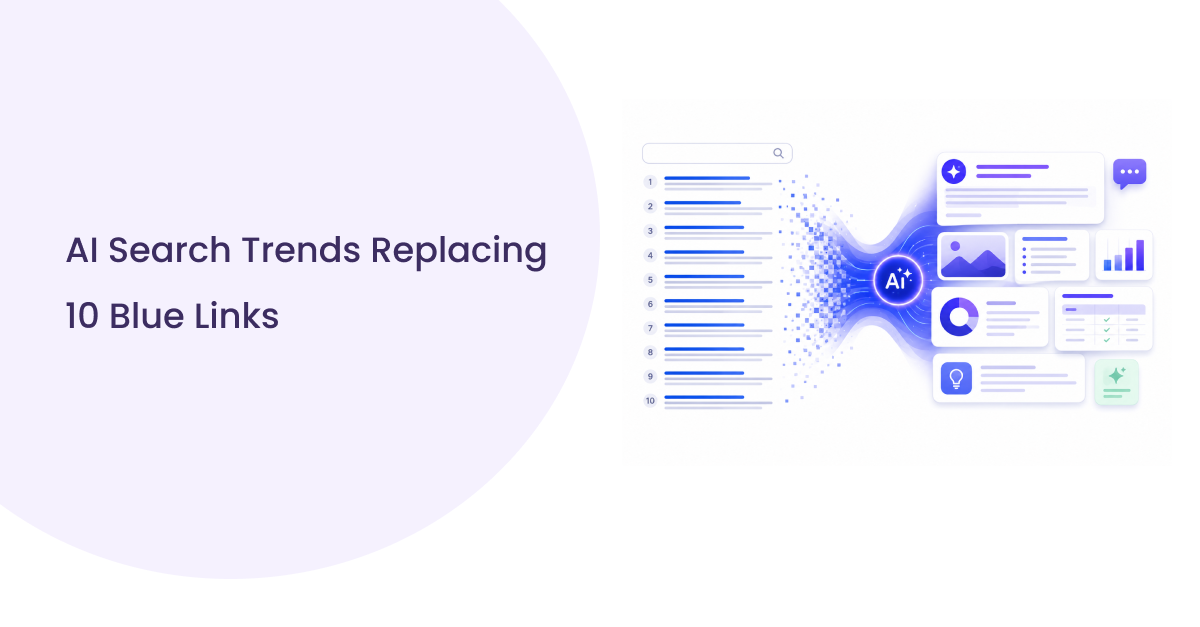
Google’s AI Overviews, the rise of conversational search interfaces like Perplexity AI and Bing Copilot, and the broader shift toward generative answer experiences are changing where and whether users click at all. The 10 blue links are not disappearing from the SERP overnight. But their role is shrinking, and the strategies built around them are losing relevance faster than many teams realize.
This piece is for SEO professionals and marketing teams who want a clear view of what is actually changing, why it is happening, and what a modern visibility strategy looks like in response.
What the 10 Blue Links Model Actually Represented
The ’10 blue links’ became shorthand for Google’s classic organic results page: ten ranked URLs, each with a title, URL, and meta description. Users scanned the list, clicked the most relevant result, and consumed content on the destination site. Publishers and brands competed for those ten spots through SEO.
This model had a clean value exchange. Google directed intent. Publishers satisfied it. Clicks were the currency that made the whole system work for advertisers, for publishers, and for Google’s quality signals.
What made the model durable was its predictability. Rank for a keyword, earn traffic. Earn traffic, build business. The entire SEO industry tools, metrics, agencies, job titles was built on the assumption that this exchange would hold.
The AI Search Trends Driving This Shift
Several AI search trends are converging to change how search results are structured, consumed, and trusted. Understanding them individually matters because each one affects a different part of the visibility equation.
Google AI Overviews
Launched broadly in 2024, Google AI Overviews synthesize answers from multiple sources and present them above organic results. For many informational and how-to queries, users now receive a complete answer on the results page, no click required. The organic links below the overview still exist, but they are further down the page and receive fewer clicks as a result.
Conversational and generative search interfaces
Platforms like Perplexity AI and Bing Copilot (powered by GPT-4) deliver answers in a conversational format, pulling from indexed web content but presenting it as synthesized prose rather than a ranked list. These interfaces represent a fundamentally different interaction model one where the source list is secondary to the answer itself.
Zero-click search behavior
Zero-click searches queries that are satisfied entirely on the results page without a click have been rising for years. Featured snippets, knowledge panels, and People Also Ask boxes were the first wave. AI Overviews are the second, more powerful wave. SparkToro research has consistently shown that more than half of Google searches result in no click to an external site.
Shift in query patterns
Users are increasingly asking longer, more conversational queries rather than short keyword phrases. This changes both what content ranks and how it needs to be structured. A page optimized for ‘best project management software’ behaves very differently under an AI-driven search than it does under traditional ranking logic.
How User Behavior Has Changed
The behavioral shift is as important as the algorithmic one. Here is what has changed for users and what that means in practice for SEO teams:
- Users expect answers on the results page. Years of featured snippets and knowledge panels have trained users to expect an answer before they click. AI Overviews have accelerated this; users now frequently get a complete response without ever visiting an external site.
- Informational content is being cited, not visited. A page can appear as a source inside an AI Overview and generate zero direct traffic from it. Content that once reliably drove organic sessions is now more likely to be summarized and bypassed.
- Clicks that do happen are higher intent. Users who click through now typically need something beyond a summary a comparison, a purchase, a specific tool. This changes the intent profile of organic traffic: lower in volume, but more action-oriented on arrival.
- Not all query types are equally affected. Transactional, local, and navigational queries still drive meaningful clicks. The volume-driven content strategy built around informational keywords is where the structural challenge is sharpest.
What This Means for SEO Visibility Today
The practical impact on SEO strategy is substantial, but it is also precise. Not every content type and not every query category is equally affected. The teams that are adapting well are the ones distinguishing between the parts of their strategy that still work and the parts that need to change.
| Query / content type | Traditional SEO impact | AI search trend impact |
| Informational / how-to | High traffic potential from top rankings | High AI Overview exposure; click-through declining |
| Transactional / commercial | Strong click-through still from ranked results | Moderate impact; users still click to compare and buy |
| Local search | Dependent on Local Pack and Maps visibility | Limited AI Overview impact; local intent still drives clicks |
| Navigational | Brand-dependent | AI-resistant; users seeking a specific destination will click |
| Conversational / long-tail | Lower search volume but strong CTR historically | High AI answer generation, content must be citable, not just rankable |
The clearest signal from AI search trends is this: content that exists only to capture a keyword and redirect traffic is losing its reason to exist. Content that is genuinely informative, well-structured, and written with enough depth to be cited as a source gains value.
How Forward-Thinking Brands Are Adapting

The SEO teams and brands navigating this transition well share a few common approaches. None of them involves abandoning search; they involve redefining what success in search looks like.
Optimizing for citation, not just ranking
Generative Engine Optimization (GEO) is an emerging practice focused on making content structured and authoritative enough to be cited by LLMs and AI search systems. This means clear factual claims, properly attributed data, structured markup (JSON-LD schema), and content that directly answers specific questions. A page does not need to rank number one to be cited in an AI Overview; it needs to be the best answer to a specific sub-question.
Expanding beyond Google
Brands that have relied exclusively on Google organic traffic are diversifying their search presence to include Perplexity AI, Bing, and emerging AI search platforms. Visibility in these systems requires similar fundamentals: authoritative, well-structured content but the distribution of that visibility looks different. Monitoring brand mentions and citations across AI platforms is becoming a standard practice for search-mature teams, and tools like SERPHouse make that tracking scalable across locations, devices, and search types.
Rebuilding content around genuine information gain
Google’s Helpful Content system has been explicitly targeting content that exists primarily to rank rather than to inform. Combined with AI search trends, this creates a consistent signal: content that adds something original a data point, a workflow, a practitioner perspective performs better than content that restates what is already widely known. The informational bar is rising.
Reframing performance metrics
CTR and session volume from organic are still worth tracking, but they are no longer complete pictures of search visibility. Leading teams are supplementing these with branded search volume trends, Share of Voice in AI-generated answers, and indirect traffic indicators that reflect brand recall rather than direct clicks. A real-time Google SERP API can help automate this monitoring, pulling live SERP data to show exactly when and where AI-generated features are displacing your organic results.
The Shift Is Already in Progress
AI search trends are not a future concern for SEO professionals; they are a present reality. The 10 blue links era built a remarkable industry around a clear and consistent model. That model is not collapsing, but it is being redefined by AI-generated answers, conversational search interfaces, and shifting user expectations.
The teams best positioned for this environment are not abandoning SEO. They are building content that deserves to be cited, structuring it so AI systems can understand and reference it, and measuring visibility in ways that match how search actually works today.
Ranking is still important. But being the source that gets cited in an AI Overview, in a Perplexity answer, in a featured snippet is becoming equally valuable. The strategies that win in this environment are the ones that treat those two goals as complementary.
FAQs
What are AI search trends?
AI search trends describe how search engines are using AI to generate answers directly on the results page through tools like Google AI Overviews and conversational interfaces rather than simply returning a list of links for users to click through.
Are the 10 blue links going away?
Not entirely, but their role is shrinking. AI-generated features now appear above organic results for many queries, and for informational searches, users often get a complete answer without reaching the link list at all.
What is zero-click search and why does it matter?
Zero-click search is when a query is answered directly on the results page, so the user never clicks through to a site. It matters because a page can rank well and still drive little traffic making click-through rate a less reliable measure of visibility than it once was.
What is Generative Engine Optimization (GEO)?
GEO is the practice of structuring content so that AI search systems cite it when generating answers using clear factual statements, structured data markup, and strong E-E-A-T signals to become the source an LLM draws from, not just a page that ranks.
How should SEO teams measure visibility in an AI search environment?
Track organic clicks and rankings, but supplement them with branded search volume trends and Share of Voice in AI-generated answers. The goal is to measure whether your brand is being found and trusted not just clicked.