
Table of Contents
Table of Contents
Job data is no longer useful only for hiring teams. Recruitment platforms, job aggregators, developers, and market researchers now use structured job listings to track hiring demand, monitor workforce trends, and build smarter search-driven products.
That is why a Google Job Search API has become important for modern job data workflows. Instead of relying on scattered job searches or unstable scraping systems, teams can work with cleaner and more structured job listing data for analysis, automation, and recruitment intelligence.
Why Job Search Data Has Become Valuable
Hiring data is no longer useful only for recruiters. Today, developers, HR platforms, staffing companies, and market researchers all rely on job search data to understand hiring demand, industry movement, and workforce trends.
As online hiring grows, structured job data has become part of broader business intelligence workflows.
Growth of Google Jobs in online hiring
Google Jobs has changed how people discover job opportunities online. Instead of visiting individual career sites, users now search directly through Google and compare listings from multiple sources in one place.
This shift has made Google Job Search API workflows more important for companies building hiring tools, job aggregators, and recruitment platforms.
For many industries in the US, Google Jobs has become a major discovery layer for:
- Remote job searches
- Local hiring opportunities
- Industry-specific recruitment
- High-volume hiring campaigns
That makes Google job search results valuable far beyond traditional recruiting.
Why companies track job posting data
Job listings reveal more than open positions. They show where companies are expanding, which skills are in demand, and how industries are changing over time.
Businesses often track job posting data to:
- Monitor hiring trends
- Analyze competitor recruitment activity
- Identify growing markets or roles
- Support workforce and salary research
This type of analysis is now common in recruitment technology and market intelligence workflows.
The shift toward recruitment data automation
Manual job tracking becomes difficult once the volume grows. Thousands of listings change daily across different industries, companies, and locations.
That is why many platforms now rely on automated job listings extraction systems and recruitment api workflows instead of manual collection. Structured automation helps teams collect fresher data, reduce maintenance work, and process hiring information at a much larger scale.

What a Google Job Search API Actually Does
A lot of teams think job data collection is just about pulling listings from search results. In reality, the value comes from turning scattered job postings into structured, usable data that can support recruitment platforms, market research, and search-driven products.
How google jobs api workflows operate
A typical Google Job Search API workflow starts with a search query. This can be a job title, company name, skill, or location. The system sends that request, retrieves matching job listings, and then organizes the results into structured fields.
Instead of manually reviewing search pages, teams can process data in a repeatable workflow.
This usually supports:
- Role-based job discovery
- Company hiring analysis
- Location-specific job tracking
- Recruitment data automation
For example, a hiring platform tracking “Software Engineer jobs in Texas” can continuously collect fresh results without checking listings one by one.
Extracting job search results from Google
Google job results are often displayed in dynamic job cards, filters, and expandable listing panels. Pulling clean information manually becomes difficult when listings update frequently.
A job search API helps extract job search results in a structured format, including titles, employers, locations, posting dates, and source pages.
That matters because businesses often use this data for:
- Job aggregators
- Hiring trend analysis
- Competitor recruitment tracking
- Workforce intelligence tools
Without structured extraction, teams spend more time cleaning job data than actually using it.
How Google Job Results Are Structured
Job listings inside Google do not appear as plain search results. They are organized in layered formats that help users compare roles quickly. For developers, recruiters, and data teams, understanding that structure is important because raw job visibility often changes depending on how results are grouped, filtered, and displayed.
A clean data structure makes job tracking far more useful than just scraping visible text.
Understanding Google Jobs search layouts
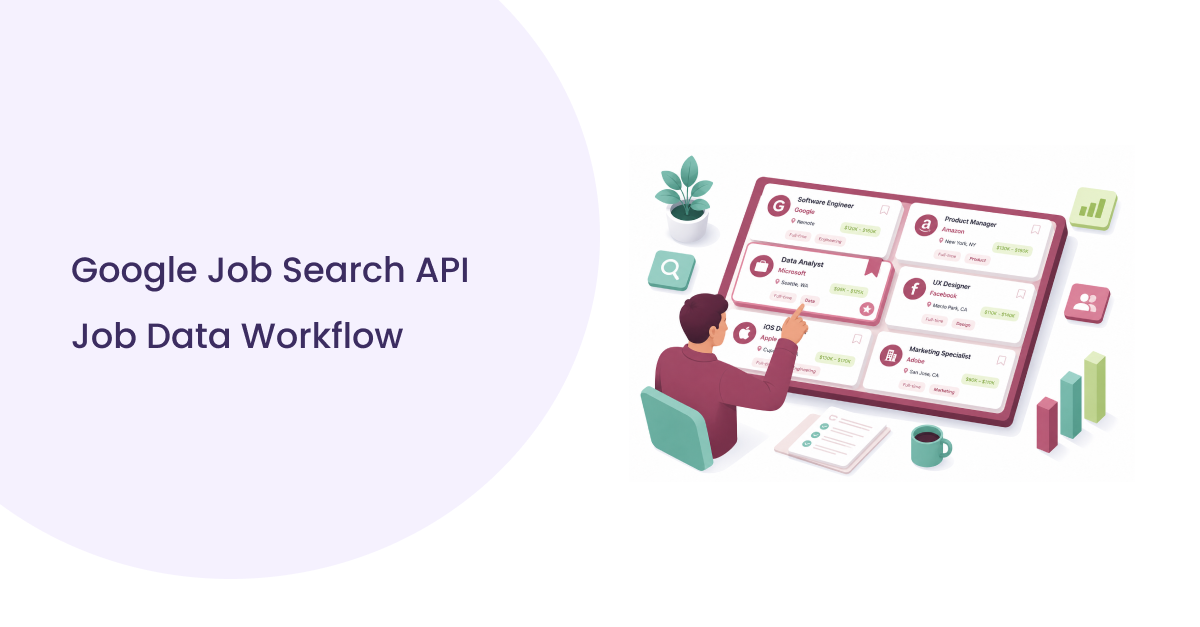
Google Jobs usually presents listings inside grouped job cards rather than standard blue links. These cards often contain multiple data layers.
A typical layout may include:
Primary listing data
- Job title
- Company name
- Location
- Employment type
Visibility data
- Posting freshness
- Featured placement
- Source platform
- Multiple listing sources
Because of this layered format, extracting structured job data requires more than copying search text.
How listings differ by location and query
The same job search does not always return identical results.
A search for Marketing Manager jobs may show different employers, salary ranges, or remote options depending on the query and location.
What usually changes:
By query intent → full-time, remote, skill-specific roles
By location → city-based openings, regional hiring demand
By employer activity → recently posted vs older listings
This makes location filtering critical in job listings extraction.
Why structured job data matters for analysis
Raw listings help users search. Structured data helps teams analyze.
When job data is organized into fields, companies can use it for:
- Hiring trend analysis
- Workforce demand tracking
- Competitor hiring research
- Recruitment data automation
- Career listings data comparison
Without structure, job results are just searchable listings. With structure, they become usable business data.
What Data You Can Extract from Google Jobs
Google job results carry more value than open roles alone. For developers, recruitment platforms, and analysts, the real advantage comes from extracting structured fields that reveal hiring patterns, market demand, and workforce movement.
A Google Job Search API helps turn scattered listings into data that can be filtered, compared, and used in real workflows.
Job titles, company names, and locations
These are the foundations of job search data. They help teams understand who is hiring, where hiring is happening, and what roles are gaining demand.
For example, if multiple companies start posting Data Engineer roles across California, that can signal regional hiring growth.
Commonly extracted fields include:
| Core Field | Why It Matters |
| Job title | Tracks role demand and skill trends |
| Company name | Identifies hiring activity by employer |
| Location | Shows city, state, or remote demand |
| Source URL | Connects listings back to job platforms |
This data is often used for job aggregators, employer tracking, and recruitment analysis.
Salary, employment type, and posting dates
Once the core listing is collected, the deeper job context becomes more useful.
These fields help teams compare opportunities and market shifts:
- Salary ranges for compensation analysis
- Full-time, part-time, contract, or remote roles
- Fresh posting dates to track hiring momentum
- Expired or outdated listings for cleanup
A company tracking engineering jobs can quickly identify whether hiring is increasing, slowing, or shifting toward contract-based roles.
Career listings data and hiring trends
Structured career listings data becomes useful when businesses stop looking at single job posts and start identifying broader hiring patterns.
When thousands of listings are analyzed over time, companies can see which industries are expanding, which job roles appear repeatedly, and where hiring demand is increasing across cities or states. This gives recruitment teams and market researchers a clearer view of workforce movement instead of relying on scattered job searches.
The value also extends beyond hiring trends. Businesses often use structured job data to monitor competitor hiring activity, track shifts in skill demand, and understand where market priorities are changing. For example, a sudden rise in cloud engineering or AI-related roles can indicate where technical investment is growing.
Without structured extraction, job listings remain isolated search results. Once organized into usable data, they become a strong source of hiring intelligence, workforce analysis, and long-term planning.
Use Cases of Google Job Search APIs
Job data is useful only when it supports real decisions. For recruitment platforms, HR tech startups, and search-driven businesses, structured job extraction is often used to solve practical hiring and workforce problems.
A Google Job Search API helps teams move beyond collecting listings and start building systems around reliable job data.
Building job aggregation websites
Job aggregators depend on consistent listings from multiple sources. Manually collecting and updating thousands of roles becomes difficult as data grows.
With structured job extraction, platforms can organize listings by role, company, location, and category. This makes job discovery easier for users while reducing duplicate listings and outdated postings.
A strong job search api is often used to support cleaner search experiences and better filtering logic.
Monitoring competitor hiring activity
Hiring activity often reveals business direction before official announcements.
If a company suddenly posts multiple cybersecurity roles, cloud engineering jobs, or expansion-focused sales positions, competitors can identify where growth is happening.
Many businesses use job data to track:
- Expansion into new departments
- Technical hiring growth
- Market or product shifts
- Regional hiring increases
This turns job listings into competitive intelligence rather than simple recruitment data.
Tracking remote and location-based job trends
Hiring patterns vary by region, industry, and work model.
Structured job data helps companies understand whether remote roles are growing, where location-based hiring is strongest, and which markets show increasing workforce demand.
For US-focused platforms, this is useful for analyzing city-level hiring movement, remote-first growth, and demand changes across industries.
Automating recruitment workflows with job search api data
Manual recruitment workflows slow down quickly when job volumes increase.
Many recruitment systems now use structured job data to automate listing updates, role matching, trend tracking, and hiring analysis. Instead of manually reviewing search pages, teams can process fresher job information through repeatable workflows.
That makes recruitment operations faster, more scalable, and easier to maintain as hiring data grows.
Challenges with Manual Job Scraping
Manual job scraping looks simple at first, but it becomes unreliable as job data grows.
Dynamic layouts and structured job cards
Google Jobs often uses dynamic job cards, filters, and expandable layouts. These elements change frequently, which makes raw HTML extraction unstable. Even small layout updates can break scraping workflows and create missing or incomplete job listings.
Rate limits, captchas, and data inconsistency
Large-scale scraping often triggers rate limits and captcha checks, especially when requests increase. This slows data collection and reduces reliability. On top of that, inconsistent parsing can create duplicate records, outdated listings, or missing fields. Instead of spending time using job data, teams often end up fixing unstable scraping systems.
Google Job Search API vs Traditional Scraping
Choosing between APIs and scraping usually comes down to reliability, maintenance, and scale.
Structured APIs vs raw HTML extraction
A Google Job Search API returns organized job data such as titles, companies, locations, and posting dates in structured fields. Traditional scraping works differently by pulling raw HTML, which often requires extra parsing and cleanup before the data becomes usable.
Reliability and scalability differences
When job volume grows, APIs usually remain more stable because the output stays structured and easier to process. Scraping workflows often struggle when layouts change, requests increase, or listings update rapidly.
A quick comparison:
API-based extraction → stable output, faster integration, easier scaling
Traditional scraping → raw extraction, higher maintenance, frequent parsing issues
When scraping workflows become difficult to maintain
Scraping becomes harder to manage when teams track thousands of job listings across locations, roles, or industries. Small layout changes, duplicate records, and unstable parsing can turn data collection into a maintenance-heavy process instead of a reliable workflow.
How Teams Use SERPHouse for Job Data Workflows
As job data grows, teams need structured collection methods that reduce cleanup work and improve consistency. This is where SERPHouse’s Google Jobs API becomes useful for platforms handling large-scale recruitment and search data workflows.
Extracting structured Google Jobs data
Instead of collecting raw search results, teams can retrieve organized job data such as titles, company names, locations, posting dates, and source links. This makes job listings easier to filter, analyze, and use inside recruitment systems.
Supporting recruitment and hiring analytics
Structured Google Jobs data supports more than listing collection. Teams often use it to track hiring demand, monitor industry movement, and identify workforce trends across markets. For recruitment platforms and HR tech products, this helps convert job search data into practical business insights.
Reducing manual scraping complexity
Manual scraping often creates maintenance issues through layout changes, parsing errors, and unstable data collection. SERPHouse helps reduce that complexity by giving teams a cleaner workflow for accessing job data without depending on fragile scraping systems.
Final Thought
As hiring data becomes more important across recruitment, analytics, and workforce research, reliable extraction matters more than simple scraping. Structured job data helps teams move faster, reduce cleanup work, and make better decisions from large job datasets.
Whether the goal is job aggregation, hiring analysis, or competitor tracking, a stable Google Jobs API workflow creates a more practical way to collect and use job search data. The real advantage is not just extracting listings, but turning them into usable business intelligence.