
Table of Contents
Table of Contents
Finding accurate, trustworthy information online has become both easier and harder at the same time. Easier, because more data is publicly accessible than ever before. Harder, because dozens of competing tools now claim to surface it and they serve very different purposes.
The landscape shifted dramatically in the past year. AI-powered search referrals to US retail sites grew 393% year-over-year in Q1 2026, signaling that AI-assisted search is reshaping how people locate information. Meanwhile, Google still commands over 91% of global search engine market share as of mid-2026 but the way that data gets accessed, processed, and acted on has never been more varied.
For SEO professionals, developers, and researchers, this raises a practical question: which tool actually fits the task? A rank tracker needs different infrastructure than a background check service. A journalist verifying a source needs different capabilities than an e-commerce team monitoring competitor pricing.
This article reviews five of the best search and lookup tools available in 2026, covering their features, pricing, and what they’re genuinely best at.
1. SERPHouse: Real-Time SERP Data API
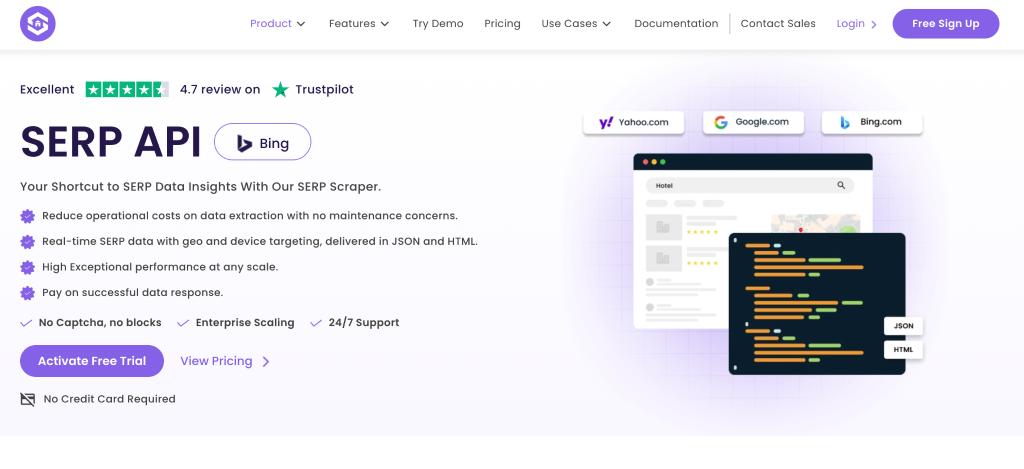
For developers, SEO teams, and data-driven businesses, raw search engine results are a data source, not just a discovery interface. SERPHouse is a Web Search API that provides structured, real-time search result data from Google, Bing, and Yahoo, delivered in JSON and HTML formats.
Unlike consumer search tools, SERPHouse is infrastructure. You send a query; you get back structured SERP data that your application, pipeline, or rank tracker can actually use. It supports geo and device targeting across 245 countries, which means you’re not just getting a generic result; you’re getting the exact SERP a user in a specific city, on a specific device, would see.
Key Features:
- Real-time SERP data from Google, Bing, and Yahoo
- Geo-targeting down to the city, state, and country level
- Desktop and mobile device targeting
- JSON and HTML response formats
- Bulk processing for large-scale keyword datasets
- No Trace Mode for privacy-sensitive workflows
- Postback/Pingback URL support for asynchronous processing
- Average response time under 8 seconds
- 99.99% uptime with pay-on-success billing
Pros:
- One of the cleanest APIs for SERP data extraction at scale
- Geo and device targeting enable genuine local SEO research
- The pay-per-successful-request model reduces waste on failed calls
- Well-documented with SDKs for Node.js, Python, PHP, Java, Go, and cURL
- 4,000 free searches to test before committing
Cons:
- Focused on SERP data only, not a consumer people-search tool
- API pricing scales with volume, which requires planning for high-frequency use cases
Pricing:
- Free trial: 4,000 searches, no credit card required
- Paid plans available; custom enterprise plans on request
Best For:
SEO professionals building rank trackers, developers integrating search data into applications, e-commerce teams monitoring competitor visibility, and data science teams building training datasets from search results.
2. Findsio: Global Reverse Phone Lookup
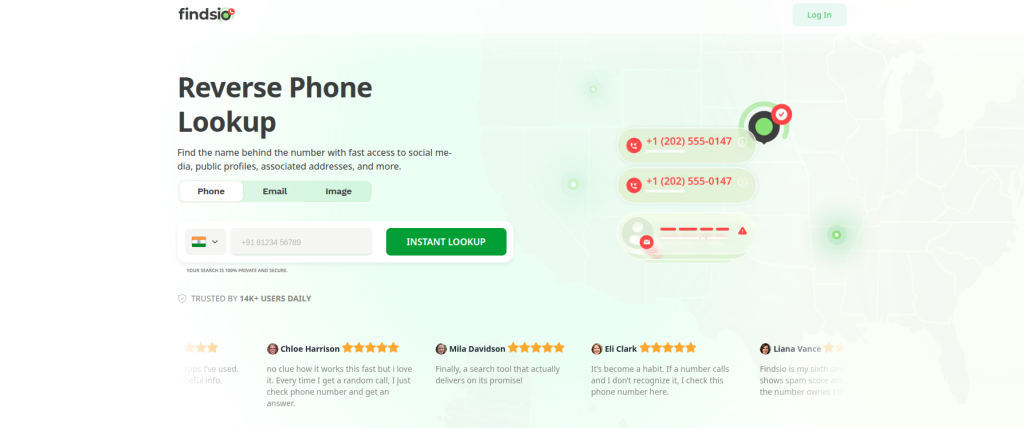
Findsio is a consumer-facing reverse phone lookup tool that helps users identify the person or entity behind an unknown phone number. Its database refreshes every 24 hours and supports phone numbers from virtually every country worldwide, making it one of the few lookup tools with genuine global coverage rather than a US-only focus.
Beyond phone lookups, Findsio also offers email- and image-based searches, pulling name records, linked addresses, family connections, and online profiles from publicly available data.
Key Features:
- Reverse phone lookup with worldwide coverage
- Email and image search options
- Name, linked addresses, family connections, and online profiles from public data
- Location-related data and online activity insights
- 100% private search (not visible to the number owner)
Pros:
- Truly global reach covers international numbers across virtually all countries
- Daily database refresh keeps results current
- Simple interface with fast results
- Useful for personal safety and online transaction verification across borders
Cons:
- Subscription-based; no permanently free tier
- Results depend on public data availability; some numbers may return limited information
- Weekly billing may feel less flexible than monthly alternatives
Pricing:
- 7-day trial: $1.00
- Premium plan: $14.90/week
Best For:
Anyone regularly receiving unknown international or domestic calls, online buyers and sellers wanting to verify contacts before a transaction, and parents checking who is in contact with their children regardless of country.
3. Searqle: Global People Search and Background Checks
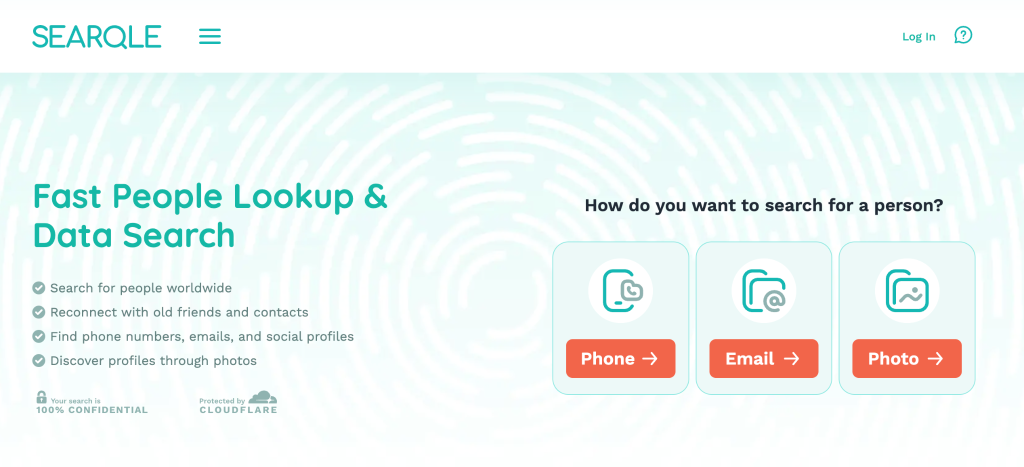
Searqle is a people search engine that aggregates data from over 1.3 billion public records across multiple countries worldwide. It goes significantly broader than a phone lookup tool; users can search by name, phone, email, or address, and receive detailed reports covering criminal records, court cases, social media profiles, and more.
Key Features:
- People search across 500M+ name records and 157M+ phone and address records
- Reverse phone, email, and address lookup with international coverage
- Background checks, including criminal records and court cases
- VIN lookup for vehicle history
- Sex offender search by name, address, or ZIP code
- Spam score and scam flags on phone numbers
Pros:
- One of the most comprehensive public records databases available globally
- Multiple search types under one subscription
- Confidential searches do not notify the person being looked up
- Covers users across different countries, not limited to a single market
Cons:
- Background check depth and data availability may vary by country
- Criminal records and social network data require higher-tier plans
- Background checks carry additional per-use fees on lower plans
Pricing:
- 3-day trial: $1.00
- Basic: $24.90/month (150 searches)
Best For:
Parents verifying their children’s contacts worldwide, online daters confirming a match’s identity, individuals researching business contacts internationally, and anyone conducting structured background checks across borders.
4. Detectico: Web-Based Phone Location Tracking
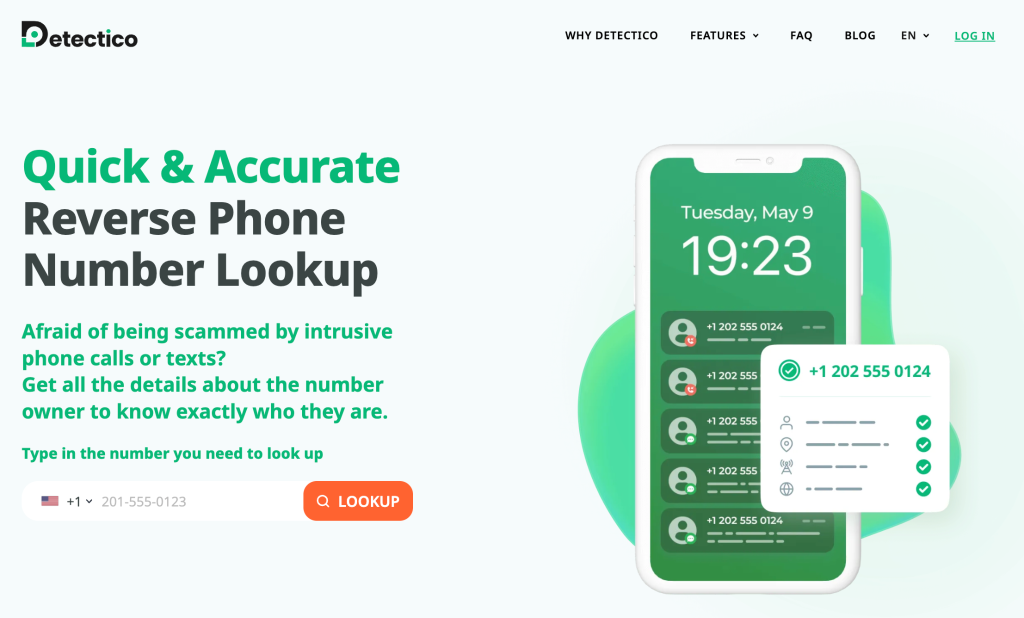
Detectico is a web-based phone tracking and lookup service that operates globally. Its primary feature, location tracking by phone number, works by sending a tracking link to the target device via SMS or a messaging app. It also includes reverse phone and username lookups, plus a data breach checker.
Key Features:
- Real-time phone location tracking via a clickable tracking link
- Reverse phone lookup with carrier and owner details
- Reverse username lookup across social platforms and forums
- Data leak checker using an email address
- No app installation is required on either device
Pros:
- Global coverage across all major carriers
- Works on iOS, Android, and older devices without requiring software installation
- Combines location tracking with lookup and data security tools
- 1-day trial available for low-cost testing
Cons:
- Location tracking requires the recipient to click the tracking link; it cannot track without consent
- Does not provide location history, only real-time snapshots
- Monthly cost is higher compared to phone-only lookup tools
Pricing:
- 1-day trial: $0.89
- Monthly subscription: approximately $49.80/month
Best For:
Parents monitoring children’s whereabouts, employers tracking company-issued devices, and individuals trying to locate a lost or stolen phone.
5. Perplexity AI: Conversational Search and Research Engine
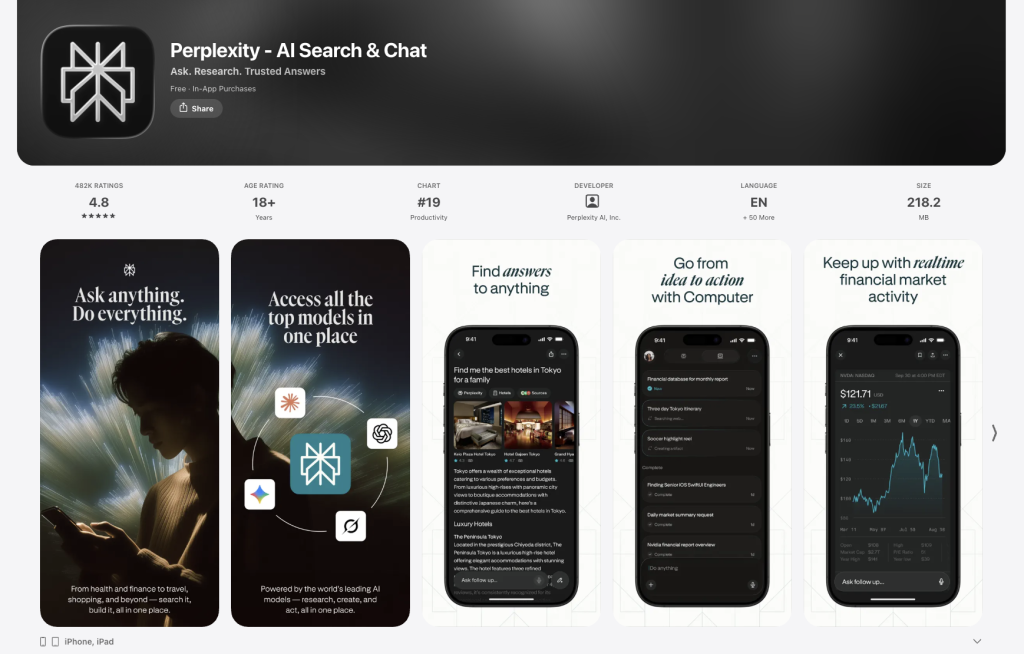
Perplexity AI is a conversational answer engine that uses large language models to return sourced, synthesized answers to natural language queries. Unlike traditional search engines that return a list of links and unlike SERP APIs that return structured ranking data Perplexity reads and interprets content from across the web and presents a direct, cited answer.
For researchers, journalists, and professionals, this changes the search experience fundamentally. Instead of opening ten tabs to piece together an answer, Perplexity surfaces a synthesis with inline citations so you can verify claims without leaving the interface.
Key Features:
- AI-powered answers with inline source citations
- Real-time web access for current information
- Deep Research mode for multi-step investigative queries
- File and photo upload support for document-based research
- Access to multiple AI models including GPT-5, Claude, and Gemini (paid plans)
- Enterprise collaboration tools and SSO on higher tiers
Pros:
- Significantly reduces research time by synthesizing multiple sources
- Cites sources directly for easy verification
- Free tier available with limited daily Pro searches
- Scales from individual to enterprise use
Cons:
- Free tier limits Pro Search to approximately 5 queries per day
- API usage billed separately
- Not designed for people search, phone lookup, or structured public records retrieval
- Does not expose raw SERP data, not a replacement for a SERP API in data pipelines
Pricing:
- Free: $0 (limited Pro searches)
- Pro: $20/month or $200/year
Best For:
Researchers, students, journalists, and professionals who need fast, sourced answers to complex questions. Particularly useful for preliminary investigative research before going deeper with specialized tools.
Which Tool Should You Use?
The answer depends entirely on what you’re trying to find and whether you’re looking for data to act on or infrastructure to build with.
For structured SERP data at scale, SERPHouse is the right starting point. If your workflow involves tracking keyword rankings, monitoring competitors in search, building an SEO tool, or training AI models on search result patterns, a SERP API gives you the raw material that consumer search tools simply don’t expose.
Searqle stands out for US-based identity and background research, offering access to criminal records, court cases, and detailed personal profiles on one platform. If you need international phone lookups, Findsio provides global number searches with data refreshed daily. Detectico specializes in consent-based mobile location tracking across all major carriers. When the goal is understanding a topic quickly instead of retrieving structured records, Perplexity AI delivers concise, synthesized research that significantly reduces research time.
The tools in this list operate on very different layers of the information ecosystem. Knowing which layer you need is the first step to choosing the right one.
FAQ
What is the difference between a search engine and a lookup tool?
A search engine like Google or Perplexity AI helps users discover websites, articles, and online content based on keywords. A lookup tool, on the other hand, searches structured databases or public records to retrieve specific information, such as a person’s contact details, phone number owner, address history, or vehicle records. The right choice depends on whether you’re looking for general information or specific data.
Which search and lookup tool is best for finding information about a person?
If your goal is to verify someone’s identity, research publicly available records, or perform a reverse phone or email lookup, a dedicated people search platform such as Searqle is typically more suitable than a traditional search engine. These services are designed to organize public records into detailed reports rather than simply listing web pages.
Are people search and reverse lookup services legal to use?
In most countries, people search services operate by collecting and organizing information from publicly available records. However, laws and permitted uses vary by jurisdiction. Users should always ensure they comply with local regulations and avoid using these services for unlawful purposes or discrimination.
Can AI search engines replace traditional lookup services?
Not entirely. AI search engines excel at summarizing information and answering complex questions using publicly available web content. However, they generally do not provide access to structured public records, reverse phone lookups, background reports, or other specialized datasets available through dedicated lookup platforms.
How accurate are online people search tools?
Accuracy depends on how frequently a provider updates its databases and the availability of public records in a particular region. Many services refresh their data regularly, but results may still vary by country, record type, and local privacy regulations. It’s always a good idea to verify important information using multiple reliable sources.