
Table of Contents
Table of Contents
TL;DR: SERPHouse alternatives for best web search APIs help businesses compare SERP data, AI search, web crawling, content extraction, scalability, and pricing to choose infrastructure that fits their product.
When you start comparing SERPHouse alternatives for best web search APIs, the first step is understanding what SERPHouse actually does well. SERPHouse gives developers programmatic access to search result data, making it useful for rank tracking, keyword monitoring, competitor analysis, and SEO platforms.
Its structured results make search data easier to collect, process, and turn into product features. For teams building SEO software, a SERP data API can remove the manual work involved in collecting search results and give developers a consistent data layer for their applications.
When Should You Consider a SERPHouse Alternative?
Consider SERPHouse alternatives for best web search APIs when your application needs:
- A different web search experience for users.
- AI-focused retrieval that understands the meaning behind queries.
- Deeper web crawling and content extraction.
- Broader context for research agents.
- Search and extraction through a connected workflow.
The decision should follow the product requirement. A ranking platform may need detailed SERP fields, while an AI research product may need useful source content. A Web search tool should support the actual task your application performs after the query.
What Has Changed in Web Search APIs
SERPHouse alternatives for best web search APIs now cover a wider market than traditional SERP collection. Search APIs increasingly support AI applications, research workflows, content retrieval, and automated extraction.
Developers often need more than a list of links. They need useful context that an application can process immediately. This shift makes a Web search tool part of the application architecture, especially when agents search, read, compare, and produce answers.
What to Look for in a Web Search API
Search Quality and Result Relevance
When comparing SERPHouse alternatives for best web search APIs, start with accuracy. The API should consistently return sources that genuinely answer the query.
Evaluate freshness for time-sensitive searches, ranking quality for result order, and geographic and language coverage for regional use cases.
Test branded searches, technical questions, local queries, long tail searches, and current events. A Web search tool should also handle ambiguous queries without filling the response with irrelevant results.
SERP Data and Search Result Depth
Look beyond the number of results an API returns. Check organic results, sponsored results, featured snippets, knowledge panels and other SERP elements, and structured SERP data. These fields matter when you build rank tracking, search monitoring, or SEO intelligence features.
A SERP data API should expose these elements through predictable, structured responses, so developers can use the data without building complex parsing logic. When evaluating SERPHouse alternatives for best web search APIs, compare the exact SERP fields each provider makes available.
API Performance and Scalability
Search performance matters once the API becomes part of your production stack. Measure response latency, request limits, concurrent requests, reliability and uptime, and enterprise scalability.
Test both normal and peak traffic because a service that performs well during a small pilot can behave differently under thousands of concurrent requests. Also evaluate error handling, retry behavior, quota management, and regional performance before routing customer traffic through the API.
AI and Developer Integration
Review JSON response quality, SDK availability, LLM and AI agent compatibility, and integration effort.
Clean responses reduce development work, while useful metadata can reduce additional API calls inside an AI workflow. SERPHouse alternatives for best web search APIs should fit your existing architecture without forcing major changes to your retrieval pipeline.
A Web search tool becomes more valuable when developers can connect search results directly to retrieval, evaluation, and response generation.
Pricing and Cost per Search
Compare pay as you go pricing, monthly plans, credit based models, and cost at scale. The advertised request price tells only part of the story. Include retries, additional searches, extraction requests, storage, and engineering costs in your calculation.
A SERP data API can appear inexpensive per request but become costly when every user query triggers multiple searches. Estimate your monthly production volume before selecting among SERPHouse alternatives for best web search APIs.
Crawl and Content Extraction Capabilities
Determine whether the provider only returns search results or also retrieves page content. Evaluate web crawling, content extraction, and combined search and extraction workflows.
This distinction matters when your application must move from finding a source to actually processing its content. A Web search tool that combines discovery with extraction can reduce engineering overhead.
For applications processing hundreds or thousands of pages daily, SERPHouse alternatives for best web search APIs with broader retrieval capabilities can simplify the overall architecture.
Best SERPHouse Alternatives
SERPHouse: Best for Web Search Data, AI Search, and MCP
What It Does
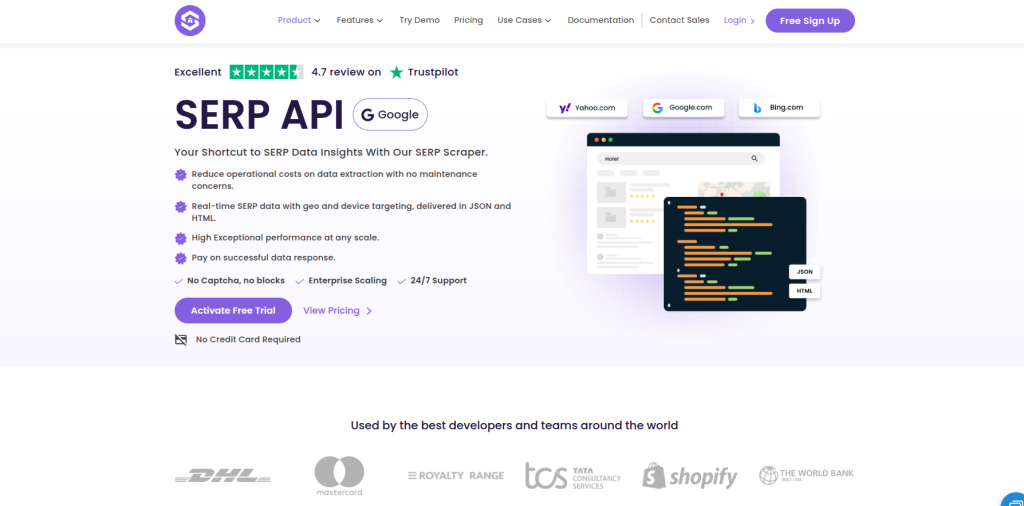
SERP data API capabilities give developers structured access to search result information for programmatic applications.
Search engine result collection allows teams to collect search results for ranking analysis, monitoring, and automated workflows.
Structured search result data provides predictable fields that developers can integrate into dashboards, SEO platforms, and search applications.
SEO and rank tracking applications can use SERPHouse data for keyword monitoring, search visibility analysis, competitor tracking, and ranking workflows.
AI search and MCP capabilities extend its use beyond traditional SEO workflows for applications that connect search with AI-based development workflows.
Pros
Built around SERP data aligns well with SEO requirements and ranking-focused products.
Useful for SEO focused applications, making it suitable for rank tracking, keyword monitoring, and search visibility analysis.
Structured results for developers make it easier to process search data through applications and automated workflows.
Suitable for programmatic search workflows supports recurring monitoring and automated search data collection.
Cons
Semantic AI search applications may require another provider when the product needs richer source context and contextual retrieval.
Advanced web crawling requirements may require another platform when search result data alone cannot provide page content.
Best For
SEO platforms can use search data to build customer dashboards and visibility reports.
Rank tracking supports monitoring keyword positions across target searches.
SERP monitoring helps teams track changes across search queries and search results.
Search intelligence tools can use structured data to analyze search visibility and competitor activity.
Applications requiring structured SERP data benefit when search result fields directly support product functionality.
Review
SERPHouse suits teams that build around rankings, SERP monitoring, SEO intelligence, AI search, and MCP-based workflows. SERPHouse alternatives for best web search APIs become more relevant when the product needs broader research, deeper extraction, or richer AI retrieval.
Brave Search API: Best for Independent Web Search
What It Does
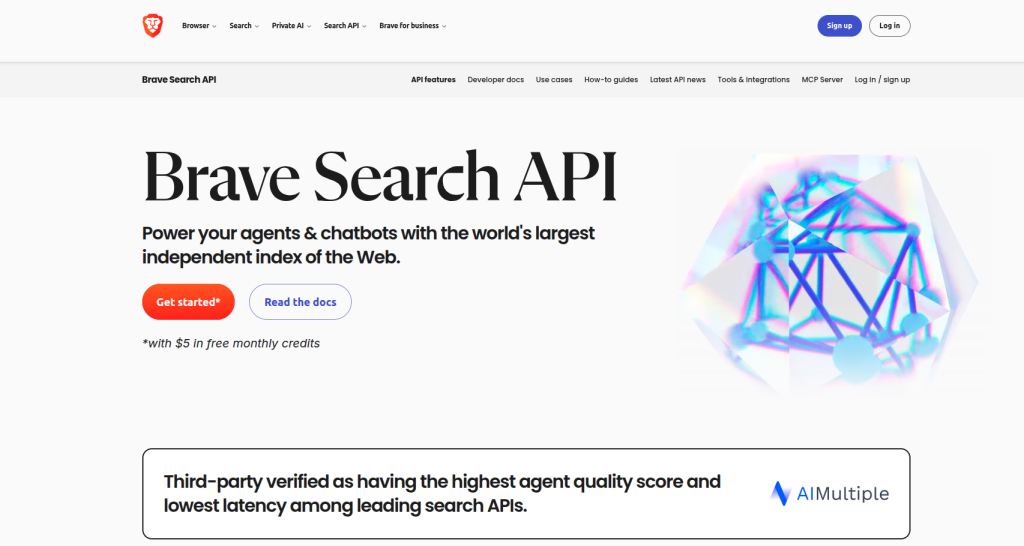
Web search API capabilities give applications programmatic access to Brave Search results.
Search result retrieval allows applications to collect web results through an API.
Search infrastructure for applications gives developers access to an independent search index for search-enabled products.
Pros
Independent search index gives Brave a distinct position for applications seeking an alternative search infrastructure.
Developer-focused API makes the service suitable for teams building search into software products.
Suitable for general web search makes Brave useful for applications that need broad web results.
Useful for privacy conscious applications aligns with Brave’s wider privacy focused search positioning.
Cons
Detailed SERP data receives less emphasis than it does in dedicated SERP services, which can matter for ranking focused products.
Specialized extraction workflows may require additional infrastructure when applications need to retrieve and process page content.
Best For
General web search makes Brave suitable for applications that need broad web results.
AI applications can use search results as external sources for model driven workflows.
Search enabled products can use Brave as a web search layer inside their application.
Developers seeking an alternative search index can benefit from access to Brave’s independent search infrastructure.
Review
Brave serves a different requirement from SERPHouse. SERPHouse alternatives for best web search APIs become useful when the product needs general search infrastructure and broad web retrieval. Brave fits teams that care about finding relevant web sources across an independent search index.
Exa: Best for AI Powered Search
What It Does
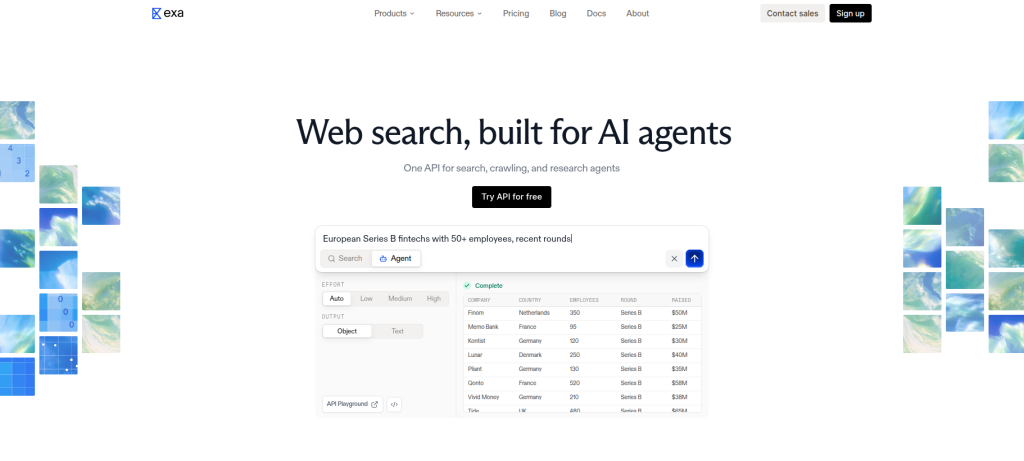
Semantic search helps Exa find relevant web content for AI systems and natural language queries.
Neural retrieval focuses on finding sources based on the meaning and relevance of a query.
Web content discovery helps applications locate useful pages and source material for research.
AI oriented search workflows make Exa suitable for research systems, AI applications, and agent architectures.
Pros
Designed around AI search makes Exa well suited to applications built around AI-driven retrieval.
Strong semantic retrieval capabilities help applications discover content based on meaning and context.
Useful for research and discovery makes the platform suitable for finding relevant source material across the web.
Fits AI agent architectures allows search to become part of a broader reasoning and research workflow.
Cons
Different focus from traditional SERP APIs means ranking positions are less central to its value.
Simple ranking applications may gain limited value from broader AI retrieval capabilities when structured positions are the main requirement.
Best For
AI assistants can use Exa to find relevant web sources for user questions.
Research applications can use it to discover supporting information across multiple sources.
AI agents can integrate search into research and reasoning workflows.
Semantic discovery helps applications find conceptually relevant sources.
RAG workflows can use retrieved web content as external context for model responses.
Review
Exa becomes more attractive when meaning and context matter more than traditional SERP positioning. SERPHouse alternatives for best web search APIs such as Exa suit products that need relevant source material for AI reasoning, research, and retrieval.
Tavily: Best for AI Research and Agents
What It Does
Web search for AI applications makes Tavily suitable for search workflows built around AI systems.
Search result retrieval allows applications to gather sources for research tasks and automated workflows.
Content extraction provides additional context when applications need information from retrieved pages.
Research oriented workflows support multi-step information gathering across different sources.
Pros
Built with AI agents in mind, searches are a natural part of agent workflows.
Useful for multi-step research allows applications to gather information through several searches.
Easy to incorporate into LLM workflows makes it practical for applications where models initiate and use search.
Combines search with useful web context, helping teams move beyond basic result links.
Cons
Detailed SERP requirements may require another provider when SEO applications depend heavily on ranking fields.
AI research workflows represent a stronger fit than conventional SEO tooling for Tavily.
Best For
AI research agents can use Tavily for automated information gathering.
LLM applications can use search results to provide external information to models.
Research assistants can use the platform for source discovery and information synthesis.
Agentic workflows can connect search with additional actions and reasoning steps.
Review
Tavily works well when search forms one part of an AI reasoning workflow. SERPHouse alternatives for best web search APIs become useful when your application needs search, source context, and additional research steps within one broader workflow.
Firecrawl: Best for Search and Web Data Extraction
What It Does
Web search supports the discovery of relevant pages and online sources.
Website crawling allows teams to collect content across broader sections of websites.
Content extraction turns web pages into usable information for downstream applications.
Structured content for AI applications gives developers material that can support retrieval and AI workflows.
Pros
Search and crawling capabilities allow discovery and broader content collection to work together.
Strong content extraction workflow helps developers obtain usable information from web pages.
Useful for RAG applications makes Firecrawl suitable for collecting source material for retrieval systems.
Designed for developer and AI workflows makes the platform useful for modern web data applications.
Cons
Broader functionality than simple SERP collection can add unnecessary complexity for products that only need rankings.
SEO focused SERP requirements may require a dedicated provider when ranking intelligence is the central product feature.
Best For
Web crawling makes Firecrawl useful when applications need content from websites.
RAG pipelines can use extracted web pages as source material.
AI applications can use collected content to provide broader web context.
Content extraction is useful when page content matters as much as discovery.
Search-to-data workflows benefit when finding a page must lead directly to usable content.
Review
Firecrawl fits requirements that extend beyond finding a page to actually collecting and processing its content. SERPHouse alternatives for best web search APIs become more useful when search is only the first step in a larger data workflow.
Comparison Table
| API | Best For | Search | AI Search | MCP Support | AI/LLM Use | Key Strength |
| SERPHouse | Web search and AI applications | ✓ | ✓ | ✓ | ✓ | SERP data and AI search |
| Brave | Independent web search | ✓ | ✓ | ✓* | ✓ | Independent search index |
| Exa | Semantic AI search | ✓ | ✓ | ✓ | ✓ | Neural and contextual retrieval |
| Tavily | AI research and agents | ✓ | ✓ | ✓ | ✓ | Agent-ready research search |
| Firecrawl | Search and web data | ✓ | ✓ | ✓ | ✓ | Search and content extraction |
How to Choose the Right Web Search API
Choose Based on Your Primary Search Requirement
Need structured SERP data:
SERPHouse: Choose it when rankings and search result fields drive the product.
Need general web search
Brave: Choose it when your application needs broad web retrieval.
Need semantic or AI search
Exa: Choose it when contextual retrieval matters.
Need AI research
Tavily: Choose it when search supports research agents.
Need search plus crawling
Firecrawl: Choose it when page extraction follows discovery.
This is where SERPHouse alternatives for best web search APIs become practical. Match the provider to the output your users need.
Match the API to Your Application Architecture
- SEO platforms: Prioritize structured ranking data and stable search fields.
- AI assistants: Prioritize relevance, freshness, source quality, and response context.
- RAG systems: Prioritize clean content and reliable source retrieval.
- Research agents: Prioritize broad discovery and multi-step workflows.
- Lead generation tools: Prioritize domain filtering, extraction, and structured information.
- Content intelligence platforms: Prioritize discovery, page content, and repeatable extraction.
A Web search tool should fit the complete request flow. SERPHouse alternatives for best web search APIs become valuable when your application needs capabilities outside traditional SERP collection.
Evaluate Total Cost at Your Expected Volume
- Cost per request: Calculate the actual price for production usage.
- Search frequency: Estimate daily and monthly query volume.
- Crawl and extraction costs: Include every downstream data request.
- Infrastructure requirements: Account for storage, caching, monitoring, and processing.
- Scaling costs: Model normal and peak traffic separately.
A SERP data API can look inexpensive at pilot volume while becoming costly at scale. Compare cost per successful result, not only cost per request.
Test Before Committing
- Run identical queries: Use the same evaluation set across providers.
- Compare relevance: Check whether results genuinely answer each query.
- Measure latency: Record average and high percentile response times.
- Test difficult queries: Include technical, local, niche, and recent searches.
- Evaluate structured output: Check whether responses map cleanly to your database.
- Calculate production cost: Model the expected traffic before signing a contract.
A Web search tool should pass real production tests. SERPHouse alternatives for best web search APIs deserve selection only after measurable comparison.
Conclusion
The right SERPHouse alternatives for best web search APIs depend on what your product needs from search. SERPHouse fits structured SERP monitoring, SEO workflows, AI search, and MCP-based applications. Brave suits broad web search, while Exa supports AI retrieval and research. Tavily fits research agents, and Firecrawl suits search with crawling and extraction.
Choose a SERP data API based on ranking depth, relevance, scalability, and cost. Choose a Web search tool based on source quality and workflow needs.
For teams that need structured search data with AI-focused capabilities, SERPHouse helps connect SERP data with modern application workflows. Its structured results can support SEO platforms, search intelligence, rank tracking, and AI-powered search use cases.
FAQ
What are the main benefits of using a web search API?
Web search APIs simplify programmatic access to online information, reduce search infrastructure requirements, and help applications retrieve relevant, current web data without building search systems from scratch.
What industries commonly use web search APIs?
Web search APIs are used across technology, finance, healthcare, education, ecommerce, media, marketing, and research to support information retrieval, monitoring, discovery, analytics, and AI-powered applications.
Can web search APIs handle high request volumes?
Many web search APIs are designed to handle scalable request volumes through usage tiers, rate limits, caching, and distributed infrastructure, making them suitable for applications with growing search demand.
What data can a web search API return?
Depending on the provider, results may include titles, URLs, snippets, rankings, metadata, source information, images, news results, and other structured search elements for application level processing.
How does API response quality affect application performance?
Higher quality search responses can improve relevance, reduce unnecessary requests, simplify downstream processing, and provide applications with more useful information for search, analytics, recommendations, and AI-powered workflows.
Can a web search API be integrated with existing applications?
Yes. Most web search APIs use standard HTTP requests and structured responses, allowing developers to integrate search capabilities into websites, mobile applications, SaaS products, AI systems, and internal tools.