
Table of Contents
Table of Contents
TLDR: A real SERP API enterprise pricing comparison looks past the rate card to successful result cost, concurrency, SLA terms, and contract flexibility. SERPHouse’s published plans list a 99.99% uptime SLA on custom tiers.78
Published SERP API rates rarely survive contact with real enterprise volume. A proper SERP API enterprise pricing comparison has to weigh three buying models: direct SERP API access, proxy-backed SERP infrastructure, and broader web scraping infrastructure.
SERPHouse, Bright Data, and Oxylabs each represent a different version of this model. This guide sets the decision lens at unit economics, reliability, scale, and contractual fit rather than the number on the pricing page.
What Enterprise Buyers Should Actually Compare
Enterprise SERP API pricing depends on usable results, traffic patterns, concurrency, and the limits that apply when workloads scale.
Cost per Successful SERP Result
- A serp api enterprise pricing comparison built on request volume alone hides the real number. What matters is successful, usable results delivered, not requests fired.
- Retries and failed calls quietly inflate the true rate, and any buyer skipping this check signs a contract based on the wrong math entirely.
Volume, Concurrency and Usage Pattern
- Monthly volume alone tells a buyer almost nothing about fit. Two companies running identical search totals can face very different demands if one workload arrives steady and the other arrives in bursts.
- Concurrency decides whether a spike gets served or throttled, and this single distinction reshapes most enterprise serp api pricing decisions once contracts get negotiated.
Several factors can push pricing beyond the published rate card, including SLA terms and service credit structures, dedicated capacity versus shared infrastructure, and geographic and device-level coverage.
Support tier and escalation speed can also affect the final cost, along with compliance posture and data residency terms.
Address each of these during contract discussions rather than as part of the sales pitch.
SERPHouse vs Bright Data vs Oxylabs: Pricing at a Glance
Every vendor in this serp api enterprise pricing comparison separates published entry pricing from custom enterprise pricing once volume grows.
| Factor | SERPHouse | Bright Data | Oxylabs |
| Entry pricing | Transparent standard tiers. | Pay-as-you-go plus scale plans. | Result-based billing. |
| Custom pricing | Available, 99.99% SLA. | Available with volume discounts. | Available, target-dependent. |
| Contract minimum | Flexible on custom tier. | Required at scale tiers. | Required on higher plans. |
Bright Data’s own plan structure splits pay-as-you-go, scale, and custom enterprise pricing, each carrying its own volume discount and SLA tier.
What Each Vendor’s Pricing Model Represents
SERPHouse prices around direct SERP retrieval with custom concurrency for high-volume accounts.
Bright Data prices SERP access as one component inside a much larger proxy and data collection platform, which explains its layered plan structure.
Oxylabs bases pricing on result complexity and rendering demand, so identical monthly volume can carry different totals depending on how difficult the target is to retrieve.
None of these models is wrong, but each suits a different buyer profile, and confusing them is where most procurement teams lose time during vendor evaluation.
Why Headline Pricing Can Mislead
A headline dollar figure never includes failed requests, retry billing, overage rates, or minimum commitment terms. Enterprise serp api pricing only becomes accurate once these are added back into total spend.
| Hidden Cost Factor | Impact on True Rate |
| Failed request billing. | Raises effective cost per result. |
| Retry volume. | Adds unbilled operational load. |
| Minimum commitment. | Locks spend regardless of usage. |
| Support tier upgrade. | Adds cost outside the base rate. |
This is exactly why a serp api enterprise pricing comparison built only on the rate card leads procurement teams to the wrong vendor.
How SERP API Economics Change at Scale
At higher volumes, the headline price matters less than concurrency, infrastructure, failure rates, and the contract terms attached to sustained usage.
| Monthly Volume | Pricing Behavior |
| 100K searches | Published rates mostly hold. |
| 1M searches | Concurrency becomes the real cost driver. |
| 10M plus searches | Custom contract terms dominate. |
At low volume, a serp api enterprise pricing comparison is relatively straightforward. Past one million monthly searches, burst capacity during ranking updates or product launches
can double effective load within a single hour.
At this scale, serp api for large-scale scraping workloads requires dedicated capacity planning rather than a standard plan.
Volume Discounts vs Contract Commitments
For enterprise buyers, a lower unit price usually comes with a longer commitment, higher upfront spend, or a minimum monthly volume.
| Discount Type | Common Requirement |
| Lower per unit rate | Annual contract |
| Prepaid volume tier | Upfront spend commitment |
| Negotiated custom rate | Monthly minimum |
A lower published rate almost always ties to a commitment. Buyers negotiating purely on price without reading commitment terms often lock into spend levels their real usage never reaches.
The Lowest Published Rate Is Not Always the Lowest Cost
The true test in any serp api enterprise pricing comparison is effective cost per successful result, not the number on the homepage. A vendor advertising the lowest rate can end up more expensive once failure rate, retry billing, and support gaps get counted.
This single framework separates a real enterprise serp api pricing decision from a guess based on marketing copy, and it applies equally whether the workload is standard rank tracking or heavy serp api for large-scale scraping across multiple search engines.
Direct SERP API vs Proxy-Based SERP API at Enterprise Scale
Direct API Economics
Direct SERP API access gives predictable request-based billing and a provider-managed retrieval layer.
Cost forecasting becomes far simpler because the vendor absorbs blocking, rotation, and rendering complexity internally, which keeps monthly spend close to the published rate for most standard workloads.
Proxy-Based SERP Economics
Proxy-backed infrastructure adds bandwidth cost, rotation management, and CAPTCHA handling on top of the base rate.
Geographic targeting and infrastructure overhead push the total higher, and this added layer only pays for itself when the workload genuinely needs broader network control than a direct API provides.
When Proxy Infrastructure Justifies the Premium
The proxy based serp api vs direct api decision comes down to workload difficulty. Broad geographic targeting, high request diversity, and difficult search environments justify the extra cost of proxy infrastructure.
Standard rank tracking rarely needs this layer, and paying for it anyway is one of the most common mistakes inside a serp api enterprise pricing comparison, since teams often buy proxy capacity for a workload a direct API could have served at a lower total cost.
Enterprise Scale Requires Reliable Performance and Pricing
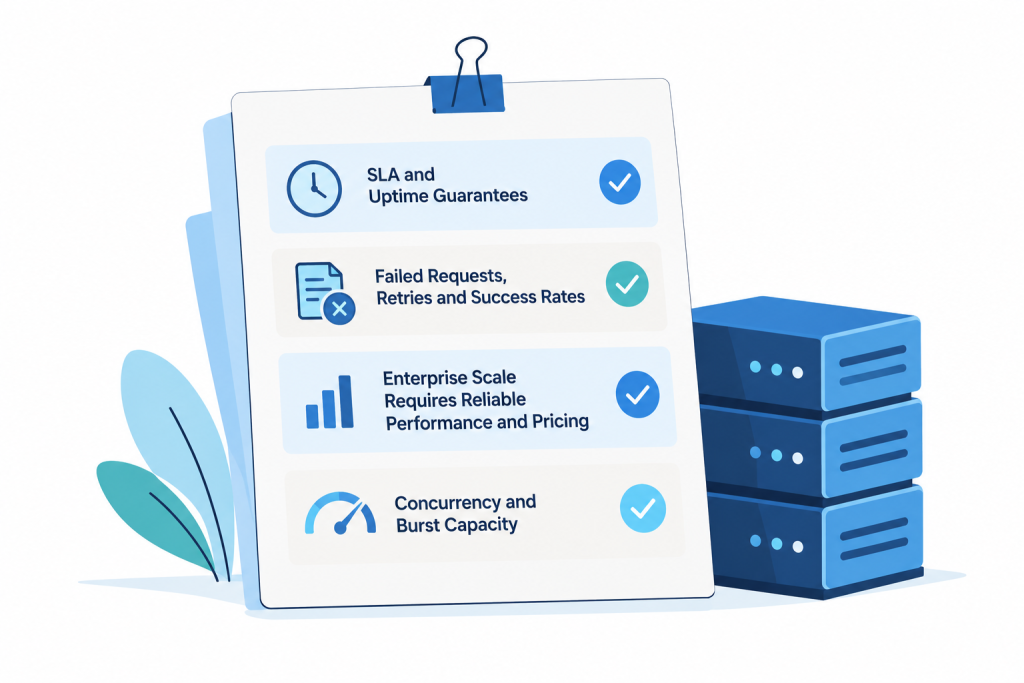
At enterprise scale, uptime commitments matter only when the contract clearly defines what happens when the service falls short.
SLA and Uptime Guarantees
- Published uptime numbers mean little without service credits and a defined escalation path attached to them.
- SERPHouse’s listed plans carry a 99.99% uptime SLA on paid and custom tiers, while Bright Data’s SERP API page states a 99.9% uptime SLA.
- A serp api enterprise pricing comparison that ignores remedy terms behind the percentage misses the part of the contract that protects the buyer.
Failed Requests, Retries and Success Rates
- Someone absorbs the cost of every failed call, and the contract should say who. Ask directly whether failed requests get billed and who owns retry logic.
- A vendor with a strong headline rate but weak success rate quietly shifts operational cost onto the buyer’s engineering team, which defeats the purpose of an enterprise serp api pricing decision built on predictable spend.
Concurrency and Burst Capacity
- A vendor supporting high monthly volume can still fail a burst heavy workload.
- Oxylabs structures job submission limits by plan tier, reserving its highest thresholds for Business, Corporate, and custom accounts, which directly shapes how much burst traffic a contract can absorb.
- Monthly credit totals say nothing about requests handled per second during a spike.
Dedicated Infrastructure, Geography and Data Requirements
Infrastructure requirements change as workloads become more demanding. Geography, isolation, and data handling can affect the right setup.
| Infrastructure Type | Best Fit | Key Consideration |
| Shared infrastructure | Moderate, predictable workloads | Works well when throughput requirements are stable and consistent performance does not depend on network isolation. |
| Dedicated infrastructure | High-throughput, regulated, or time-sensitive workloads | Earns its premium when throughput has to stay consistent regardless of what other accounts are doing on the same network, which matters most for regulated industries and time-sensitive reporting pipelines. |
Geographic and Device Level Direct SERP retrieval Targeting
Country, city, language, and desktop versus mobile rendering each change SERP retrieval complexity.
Enterprise buyers should price these separately in a serp api enterprise pricing comparison rather than assuming one flat rate covers every geography, since a global rank tracking program touches dozens of localized result sets at once.
Data Residency and Compliance
Legal and security teams need clear answers on where data gets processed and where logs get retained before commercial terms close.
This part of the contract rarely appears on a pricing page, yet it decides whether a vendor even clears procurement review.
Enterprise Support Can Change the Total Cost
Support requirements often change with workload criticality, response expectations, and the business impact of production issues.
| Support Model | Best Fit | Key Consideration |
| Standard ticket-based support | Small accounts with predictable volume | Works for smaller workloads where support needs are routine and a delayed response does not create significant operational risk. |
| Enterprise support | Enterprise accounts with critical workloads | Requires a named contact and a defined escalation path, since a delayed response on a production outage carries real business cost beyond the API bill itself. |
Escalation and Incident Response: Response time during an incident decides how much damage a single outage causes. A 20-minute escalation path protects a reporting cycle that a 6-hour queue simply cannot.
Support as an Operating Cost: A nominally cheaper vendor becomes the expensive one once engineering hours spent diagnosing failures get counted against the contract. Support quality belongs inside the total cost calculation, not outside it.
The Enterprise SERP API Cost Model Buyers Should Use
Enterprise buyers need a cost model that reflects actual output rather than the advertised price per request.
Calculate Effective Cost per Usable Result
The formula is simple: total API spend divided by usable SERP results delivered. Retries and failed responses have to feed back into total spend before this number means anything.
This single calculation is the backbone of any credible serp api enterprise pricing comparison, because it strips away marketing rate and reveals what a vendor truly costs.
Add the Costs Hidden Behind the API
Retry volume, proxy or network cost, engineering maintenance, monitoring, parsing, and support all sit outside the published rate.
A full enterprise serp api pricing model adds each of these back before any vendor comparison gets treated as final.
Connect Cost to Business Value
Effective cost only means something once tied to what the data supports. Rank tracking, SEO intelligence, competitor monitoring, market intelligence, and AI search applications all depend on consistent SERP delivery.
This is where a serp api enterprise pricing comparison stops being a procurement exercise and becomes a business decision tied directly to revenue-generating workflows.
SERPHouse vs Bright Data vs Oxylabs: Which Enterprise Buyer Fits Which
SERPHouse fits organizations running a straightforward SERP focused workload at real enterprise volume, where predictable serp api for large-scale scraping, custom concurrency, and dedicated support matter more than owning a full proxy stack. Teams that value transparent economics over bundled infrastructure find this model easier to forecast against.
Bright Data suits organizations that need SERP collection alongside broader proxy infrastructure, browser automation, and general web data collection under a single vendor relationship. The proxy based serp api vs direct api tradeoff favors Bright Data when the SERP need is one piece of a much larger data operation.
Oxylabs fits teams running broader scraping workloads with target specific rendering requirements, where serp api for large scale scraping sits inside a bigger web data infrastructure rather than a standalone need. Result based billing suits buyers already comfortable managing variable target complexity across a wider data pipeline.
Five Questions to Ask Before Signing an Enterprise SERP API Contract
What Is the Guaranteed Cost at Our Actual Volume?
Ask for the guaranteed rate at real monthly volume, not the advertised starting figure that rarely survives enterprise scale.
What Happens When We Exceed Contracted Volume?
Clarify whether overage triggers an automatic upgrade, throttling, or a hard limit in a serp api enterprise pricing comparison before signing anything.
What Does the SLA Actually Guarantee?
Confirm uptime, latency, success rate, and service credit terms in writing, not verbally during the sales call.
Which Infrastructure Is Shared or Dedicated?
Ask which parts of delivery run on shared capacity versus dedicated infrastructure reserved for the account.
Can the Contract Adapt as Requirements Change?
Confirm how the contract adjusts if geography, search engine coverage, or volume shifts before the term ends.
Conclusion
Enterprise SERP API selection should rest on effective economics, reliability, and operational fit rather than the number shown on a pricing page. A proper serp api enterprise pricing comparison evaluates SERPHouse, Bright Data and Oxylabs against different workload requirements rather than a single scale.
Buyers should assess actual request volume, concurrency, infrastructure needs, geographic coverage, and SLA terms before signing. Comparing enterprise SERP API pricing against expected usage also reveals the true cost of ownership and prevents overbuying capacity that the workload does not require.