
Table of Contents
Table of Contents
Tracking a few keywords is easy. The challenge starts when the list grows. Rankings begin to vary across locations, devices, and time, and manual checks quickly become inconsistent.
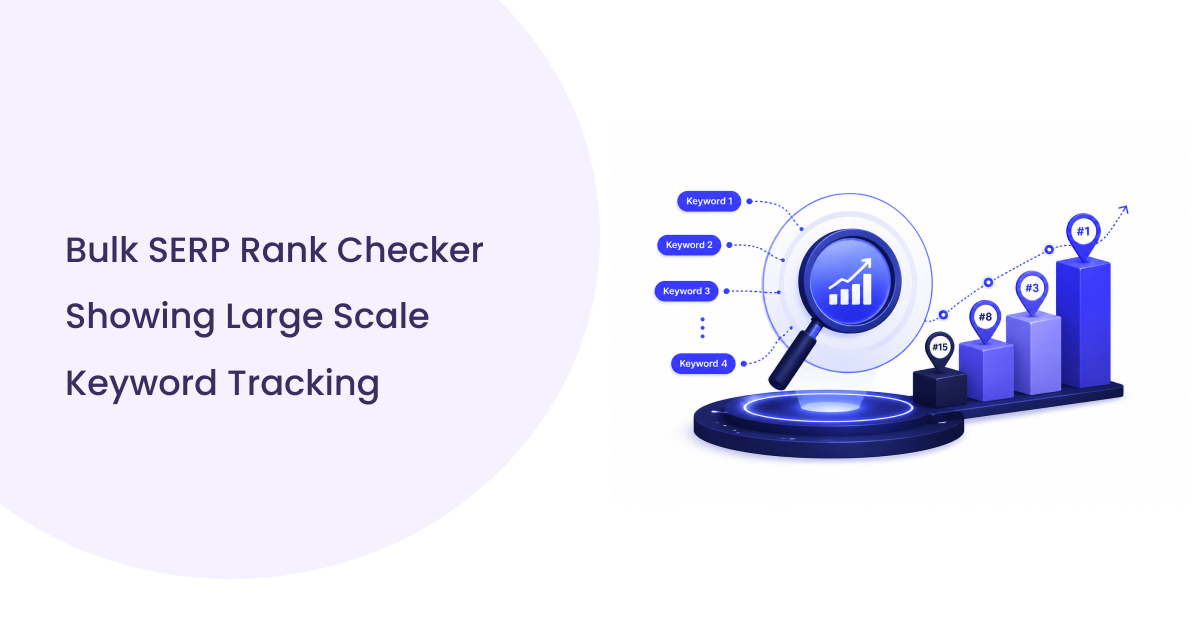
A bulk SERP rank checker changes that approach. Instead of checking keywords one by one, it gives a structured view of rankings across your entire dataset. This makes it easier to track changes, compare performance, and avoid gaps in your data.
When you’re working with larger keyword sets, the goal is not just to see rankings. It’s to understand them clearly and consistently.
The Real Problem with Tracking Rankings at Scale
Why tracking 10 keywords feels easy but 100 breaks everything
Tracking a small set of keywords feels manageable. You check positions, compare results, and move on with confidence. But once the list grows, the process changes. What worked for 10 keywords starts breaking at 100.
The issue is not just time. It’s control. Each additional keyword adds more checks, more variations, and more room for error. You begin to notice that:
- Some rankings don’t match across checks
- Updates take longer to verify
- Patterns become harder to trust
At that point, tracking turns into maintenance rather than analysis.
Where ranking data starts becoming inconsistent
The first real problem isn’t speed. It’s trust.
You check a keyword in the morning and see one position. Later, you check again and it’s different. Nothing obvious changed, but the data doesn’t match.
This usually comes down to variables you’re not controlling. Location, device, even timing. Once these factors enter the process, consistency becomes harder to maintain. And without consistent data, it’s difficult to know what actually moved and what didn’t.
Why most rank checker tools fail beyond small datasets
Most tools are built for quick checks, not ongoing tracking. They do a decent job when the keyword list is small. But once you scale, cracks start to show.
Data comes back uneven. Some keywords update, others don’t. Results vary between runs. It becomes harder to rely on what you’re seeing.
This is where a Bulk SERP Rank Checker starts to make sense. It’s built for scale, but more importantly, it keeps the data consistent so you can actually trust it.

What Actually Changes When You Track Rankings in Bulk
From single checks to continuous keyword position tracking
Tracking a few keywords is usually reactive. You check positions when needed, compare changes, and move on. But when you shift to bulk tracking, it becomes continuous.
Instead of isolated checks, you start working with ongoing data. Rankings are no longer single points. They become trends over time. This changes how you read performance. You’re not asking “where do I rank today,” but “how is this keyword moving over time.”
That shift makes tracking more useful, but also more demanding.
Handling multiple locations, devices, and SERP variations
At scale, one version of ranking data is not enough. A keyword can behave differently depending on where and how it’s searched.
- Location affects local and regional results
- Device changes layout and ranking positions
- SERP features like videos or snippets shift visibility
A Bulk SERP Rank Checker helps standardize these variables. Instead of scattered checks, you get consistent data across locations and devices, making seo rank monitoring more reliable.
Why scale introduces data gaps and noise
As volume increases, so does complexity. Not every keyword updates at the same time. Not every result behaves consistently.
You start seeing gaps where data is missing, and noise where rankings fluctuate without clear patterns. This is not always a ranking issue. Sometimes it’s a data collection issue.
How a Bulk SERP Rank Checker Processes Large Keyword Sets
Batch querying and parallel processing explained
Once the keyword list gets bigger, the old way of checking rankings stops working. A Bulk SERP Rank Checker does not run one keyword after another like a manual workflow. It groups keywords into batches and processes them at the same time.
That is what makes large keyword tracking possible. Instead of waiting for one result to finish before the next begins, the system handles many requests together. A good bulk keyword rank checker or serp checker tool depends on this process to keep ranking data fast and consistent.
How SERP data is collected without manual checks using a Bulk SERP Rank Checker
Manual tracking depends on repeated searches, which quickly becomes messy. Automated systems work differently. They send requests using fixed settings such as keyword, location, and device, then collect the results directly.
This removes repetitive work and reduces inconsistency. A reliable Google ranking tracker needs that level of control; the ranking data becomes harder to trust for ongoing seo rank monitoring.
Turning raw results into structured ranking data
Search results are messy when collected in raw form. They need to be cleaned, sorted, and mapped properly before they become useful.
The system extracts the important parts such as position, URL, and keyword, then turns them into structured output. That is what makes the data useful for reporting, tracking changes, and running a proper ranking audit tool workflow.
How SEO Teams Actually Use Bulk Rank Tracking
Tracking thousands of keywords across markets
For most teams, ranking data is not limited to one region or a small keyword set. You might be tracking hundreds or thousands of keywords across different cities, countries, or language variations.
This is where bulk tracking becomes part of the workflow, not just a tool. Instead of checking isolated keywords, teams rely on a Bulk SERP Rank Checker to get a consistent view across markets. It helps answer practical questions like:
- Are rankings stable across locations
- Which regions are losing visibility
- Where new opportunities are emerging
Without this, it’s difficult to compare performance at a broader level.
Monitoring ranking changes during algorithm updates
When an algorithm update rolls out, rankings rarely shift in a clean pattern. Some keywords drop, others improve, and many fluctuate over time.
Teams don’t look at one keyword. They look at patterns across entire keyword sets. Bulk tracking makes it possible to see those patterns early.
Instead of guessing, you can identify:
- Which pages were affected
- Whether changes are temporary or consistent
- How competitors are moving at the same time
That context is what turns raw data into useful insight.
Running large-scale ranking audits and reporting
Reporting is where structured data becomes critical. Teams need to show progress, identify issues, and explain changes clearly.
Bulk tracking supports this by providing consistent datasets for audits. You can compare past and current rankings, spot drops, and highlight improvements without manually compiling data.
It also simplifies reporting. Instead of pulling scattered results, everything is already organised and ready to analyze.
Why Bulk Rank Tracking Is No Longer Optional
Growing keyword lists and competitive SERPs
Keyword lists don’t stay small for long. As sites expand, new pages, topics, and variations keep adding to the list. At the same time, search results are getting more competitive. Rankings shift more often, and small movements can impact visibility.
Tracking a limited set of keywords no longer reflects overall performance. You might see stable positions on a few terms, while hundreds of others are moving unnoticed. This is where teams start losing clarity. The data exists, but it’s not being tracked consistently.
A Bulk SERP Rank Checker helps bridge that gap by covering the full keyword set instead of a small sample.
The shift from manual checks to automated tracking
Manual tracking was enough when keyword lists were small and changes were slower. That is no longer the case. Repeating the same checks across multiple keywords, locations, and devices creates more noise than insight.
Automated tracking changes how teams work. Instead of running checks manually, data is collected in a controlled and repeatable way. This makes it easier to compare results, spot patterns, and respond to changes without second-guessing the data.
The shift is not about convenience. It’s about having data you can rely on when making decisions.

Key Takeaways:
Tracking rankings sounds straightforward until gaps start showing up in the data. Missing updates, inconsistent results, or partial keyword coverage can quickly lead to wrong conclusions.
To avoid that, the focus should stay on how the data is collected and maintained:
- Track your full keyword set, not just a small sample
- Keep conditions consistent across locations and devices
- Avoid mixing manual checks with automated data
- Look at trends over time, not isolated rankings
- Use structured data that can be compared and stored
The goal is not just to see rankings. It is to understand movement clearly without second-guessing the data.
A Bulk SERP Checker helps maintain that consistency. Instead of scattered checks, it gives a complete and repeatable view of keyword positions across your dataset.
When the data is clean and consistent, decisions become easier. You are not trying to validate the numbers. You are using them.