
Table of Contents
Table of Contents
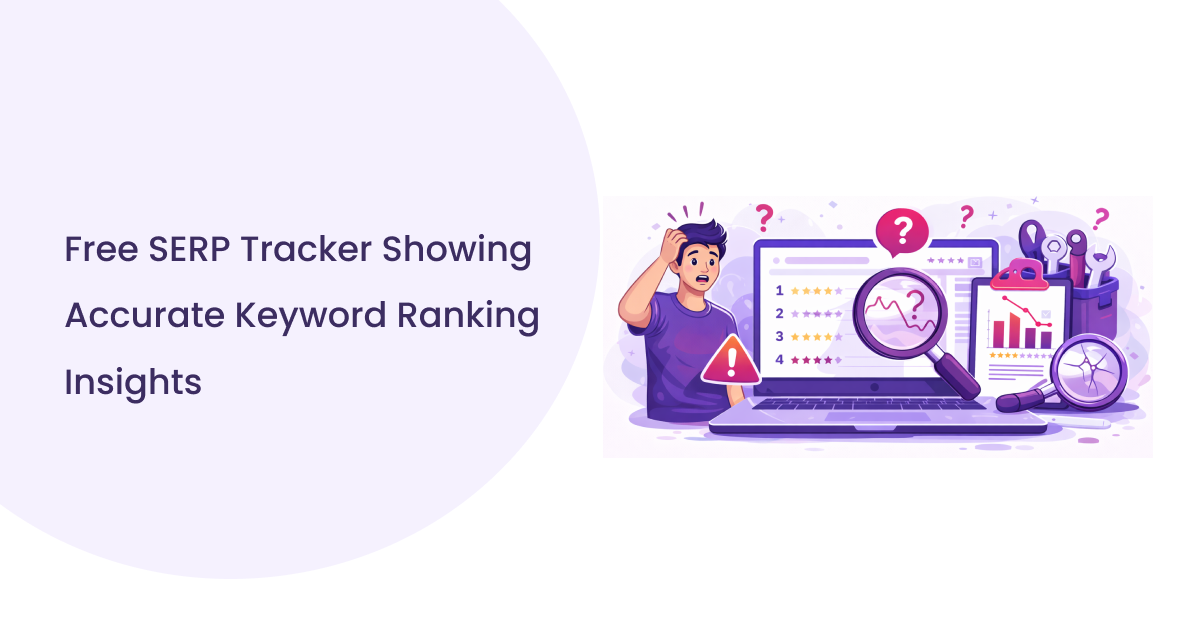
Most people assume a Free SERP Tracker gives a clear view of where their keywords rank. It doesn’t. At best, it shows a simplified snapshot. At worst, it presents data that looks accurate but isn’t.
The problem is simple: search results are not fixed. They change based on location, device, search history, and even time of day. Free tools rarely capture all these variables. So the ranking you see is not the “true” position, it’s just one version of it.
That’s where the gap begins.
A typical serp checker might show position #5. But in reality, that same keyword could be:
- #3 on mobile
- #7 in another city
- Not even on page one for a different user
Without context, that number loses meaning.
What Is a Free SERP Tracker?
A Free SERP Tracker shows where your website appears for specific keywords in search results. It looks simple, but the way these tools collect and process data has a direct impact on how accurate those rankings actually are.
How a Free SERP Tracker Works
Most tools follow a similar process. You enter a keyword, and the system performs a search behind the scenes. It then scans the results to find your domain and reports the position.
The limitation comes from how this data is collected. Many tools rely on shared environments, limited location settings, or cached queries. That’s why a serp checker might show stable rankings even when actual search results vary.
For example, you might see position #4 in a tool, but that ranking could shift depending on device or location, something basic tools often don’t capture.
Why Free Rank Tracker Tools Are Popular
The appeal is simple. They are quick, accessible, and require no setup. For someone starting with SEO, a google serp checker offers an easy way to check rankings without cost.
They also fit quick workflows. For small keyword sets or occasional checks, they do the job well.
But popularity comes from convenience, not accuracy. These tools are built for quick insights, not for consistent seo rank tracking or large-scale keyword monitoring.

The Promise vs Reality of Free SERP Tracking
A Free SERP Tracker promises clarity. You check a keyword, get a position, and assume that number reflects your real visibility. That’s the expectation most users walk in with.
The reality is different. What these tools show is often a simplified version of search results, not the full picture.
What Users Expect from a SERP Checker
When someone uses a serp checker, they expect a few basic things:
- Accurate keyword positions
- Consistent results across checks
- Rankings that match what users actually see
- A clear signal of SEO progress
That’s why even a simple google serp checker feels useful. It gives quick feedback and a sense of control.
The problem is not the expectation. It’s how much of that expectation the tool can actually deliver.
Where Free Tools Start Falling Short
Free tools start breaking down when real-world complexity comes in. Search results are influenced by multiple variables, but most tools reduce everything to a single ranking.
Here’s where the gap becomes obvious:
- Rankings differ by location and device
- Data may not be fetched in real time
- Results can be based on limited queries
- Fluctuations are often missed
A common scenario: a keyword ranking checker shows stable positions for weeks, but traffic drops. The rankings didn’t stay stable. The tool just didn’t capture the movement.
That’s the difference between quick checks and reliable seo rank tracking.
Hidden Accuracy Issues in Free SERP Tracker Tools
A Free SERP Tracker doesn’t fail in obvious ways. The problems are subtle. That’s what makes them dangerous. You see rankings, you trust them, and decisions get made on top of incomplete data.
Personalization and Location Bias
Search results are different for every user. Location, device, and even search history influence what appears.
Most tools don’t fully simulate these conditions. So a serp checker might show position #3, while actual users in another city see something entirely different.
Data Sampling Instead of Real-Time Results
Free tools often reduce cost by limiting how frequently they fetch data. Instead of live queries, they rely on sampled or cached results.
This creates a false sense of stability. Rankings look consistent, but they’re not reflecting real-time movement in google serp results.
Inconsistent Keyword Ranking Checker Results
Run the same keyword multiple times and results can vary. This isn’t random. It’s a limitation of how data is collected.
Delayed Updates in SERP Monitoring Tools
Timing matters in seo rank tracking. If data updates are delayed, you miss changes that impact visibility.
A common case: rankings drop for a keyword, but the tool updates hours later. By then, the opportunity to react is already gone.
That’s the trade-off. Free tools reduce complexity, but accuracy is the cost.
Why Google SERP Results Are Hard to Track Accurately
Ranking data looks simple until you try to track it consistently. The challenge is not the tools. It’s the nature of how Google search results actually work.
Dynamic Search Results and Constant Changes
Search results are constantly shifting. New content gets indexed, rankings adjust, and user behavior influences visibility.
A keyword might hold position #5 during one check and shift hours later. These movements are often small but frequent. Most tools don’t capture this level of change, which is why rankings can appear stable even when they are not.
Device, Location, and Search Intent Variations
Google does not show identical results to every user. Context matters.
- Mobile results often differ from desktop due to layout and intent
- Location affects local and region-specific rankings
- Search intent can shift results even for the same keyword
This is why a serp checker might show one position, while actual users see something different. Ranking is not a fixed number. It’s a variable range.
Limitations of Basic Google Rank Checker Tools
Basic tools simplify these variables to make tracking easier. But that simplification removes accuracy.
A common scenario: rankings look stable in a Google Rank Tracker, but impressions and clicks fluctuate. The data didn’t match reality because the context was missing.
Free SERP Tracker vs Advanced Rank Tracking Solutions
The real difference shows up when you depend on the data, not when you just check it. A Free SERP Tracker is designed for quick visibility checks, while advanced tools are built to reflect how rankings behave across real search conditions.
Accuracy and Data Consistency
Free tools simplify how rankings are collected. They often use shared environments, limited locations, and less frequent updates. That makes results easy to generate, but not always dependable.
Advanced tools operate under controlled conditions. They track rankings across specific locations, devices, and time intervals, which reduces inconsistencies and gives a clearer picture of actual performance.
A pattern you’ll notice: rankings look stable in free tools but show movement when tracked with more precise setups.
Scale and Keyword Coverage
Tracking a small set of keywords works fine with a basic serp checker. The challenge appears when you scale.
- Free tools limit how many keywords you can track
- Data consistency drops as volume increases
- Location-based tracking is often restricted
At this point, gaps start to show. What looks manageable at a small scale becomes unreliable as your keyword list grows.
Advanced solutions handle bulk tracking without losing consistency, making them suitable for larger campaigns.
Reliability for SEO Decision Making
Rankings guide decisions. Content updates, optimization efforts, and strategy all depend on accurate data.
Free tools provide a surface-level view. Advanced tools provide context.
That difference matters. A team relying on a free rank tracker might see stable rankings while traffic declines. With more accurate tracking, fluctuations become visible, and decisions become clearer.
What to Look for in a Reliable SERP Tracking Solution
Not all tracking tools fail for the same reason. The difference comes down to how closely the data reflects real search behavior. A reliable solution doesn’t just show rankings; it shows how those rankings behave across different conditions.
Accurate Keyword Ranking Data
Accuracy starts with context. Rankings should reflect variations across location, device, and search intent.
If a tool shows a single position without explaining those variables, the data is incomplete. A dependable keyword ranking checker should capture these differences and present them in a structured way, not as a single static number.
Real-Time SERP Monitoring
Timing matters. Search results change frequently, and delayed data creates blind spots.
Reliable serp monitoring tools fetch results frequently enough to capture fluctuations. This is critical when tracking competitive keywords, where even small changes can impact traffic.
A common pattern: rankings look stable in delayed data, but real-time tracking reveals constant movement.
Scalable SEO Rank Tracking
Tracking accuracy becomes more important as you scale. Monitoring a few keywords is simple. Managing hundreds is not.
- Consistent data across large keyword sets
- Ability to track multiple locations
- Stable performance at scale
These are non-negotiable for serious seo rank tracking.
A tool that works at 10 keywords but breaks at 100 is not reliable. Scale exposes weaknesses.
Conclusion
A Free SERP Tracker can give you a quick sense of where you stand, but it rarely tells the full story. Rankings are not fixed numbers. They shift based on location, device, timing, and search intent. When those factors are simplified or ignored, the data becomes less reliable.
That’s where most misunderstandings begin. Stable rankings inside a tool don’t always mean stable visibility in real search results. Small fluctuations, missed updates, and limited tracking conditions can lead to decisions based on incomplete information.
The key is not to avoid free tools, but to understand their limits. They work well for quick checks and small keyword sets. Beyond that, accuracy, scale, and consistency start to matter more.
As SEO becomes more data-driven, relying on simplified ranking data is no longer enough. What matters is not just knowing where you rank, but understanding how those rankings behave across real search conditions.