
Table of Contents
Table of Contents
TL;DR: Bulk AI overview tracking is the only practical way to know where a brand stands across thousands of AI-generated answers. Manual spot checks cannot cover the query volume, locations, and platforms that shape buyer decisions today. Teams that run bulk AI overview tracking consistently catch visibility loss before it costs pipeline.
Ranking on Google doesn’t automatically mean your brand will show up when someone asks an AI the same question. That assumption breaks the moment a team checks ChatGPT, Perplexity, or an AI Overview panel for the same query. Rankings and AI presence are two separate systems, measured differently and won by different signals.
This guide explains how enterprise teams operationalize bulk AI overview tracking across large keyword sets, multiple markets, and several AI engines, so leadership sees the real picture instead of a handful of manual screenshots.
What to Measure for Reliable AI Search Visibility
Bulk AI overview tracking works only when a team agrees on which signals matter before running a single query. Presence, mentions, citations, and position inside the answer form the baseline every program should measure consistently.
A useful bulk AI overview tracking program measures six things for every query: presence in the answer, brand mention, citation, position, competitor mentions, and share of voice. AI Overview results and ChatGPT results are structured differently, so a program built for one rarely transfers cleanly to the other without adjustment.
| Metric | What It Tells You |
| Presence | Does the brand appear at all? |
| Mention | Is the brand named directly? |
| Citation | Is a brand URL linked as a source? |
| Position | Where does the brand sit in the answer? |
| Competitor mention | Who else appears for the same query? |
| Share of voice | Brand mentions versus total mentions. |
The same prompt returns different answers depending on engine, location, language, device, and timestamp. A serious geo-tracking API setup locks these variables so results stay comparable across weeks. Skip this step and every trend line becomes noise instead of signal.
How Bulk AI Visibility Tracking Works at Scale
Running bulk AI overview tracking at enterprise volume means treating it as a repeatable pipeline. Five stages carry the entire workflow from raw query to usable metric.
Build a Multi-Keyword Query Set: Group queries by brand, category, product, problem, and comparison intent before running anything.
A team that uploads its existing SEO keyword list into a bulk AI overview tracking tool misses most buyer questions because AI engines answer conversational prompts, not short-tail search terms.
Add commercial intent phrases such as best, alternative to, and pricing for to widen coverage.
Run Consistent AI Search Checks: Every query needs a fixed model, location, and timestamp attached before it runs through the pipeline.
A production-grade AI search visibility API batches thousands of prompts on a schedule, so results refresh weekly or daily without manual triggering.
Concurrency controls prevent rate limits from silently dropping part of the dataset, which is the most common cause of broken historical trends.
Extract Mentions, Citations, and Competitors: Every response needs structured parsing: brand, mention, position, cited URL, source domain, competitor list, and timestamp.
This is the step where tracking AI Overview rankings at scale stops being a slogan and becomes an actual dataset a team can query. Raw text answers are useless until they are broken into these fields.
Store Results for Historical Comparison: A single snapshot tells you almost nothing. Store every run so the system can flag new appearances, lost appearances, citation changes, and regional differences over time.
Enterprise teams that skip storage end up rerunning the same bulk AI overview tracking questions manually, every quarter, with no baseline to compare against.
Calculate AI Visibility at Scale: Turn raw rows into four numbers: presence rate, mention rate, citation rate, and share of voice trend.
Presence rate divides queries where the brand appeared by total queries checked. Track this single number weekly with an AI search visibility API, and it tells leadership more than any individual AI answer ever will.
What Bulk Tracking Reveals That Manual Checks Miss
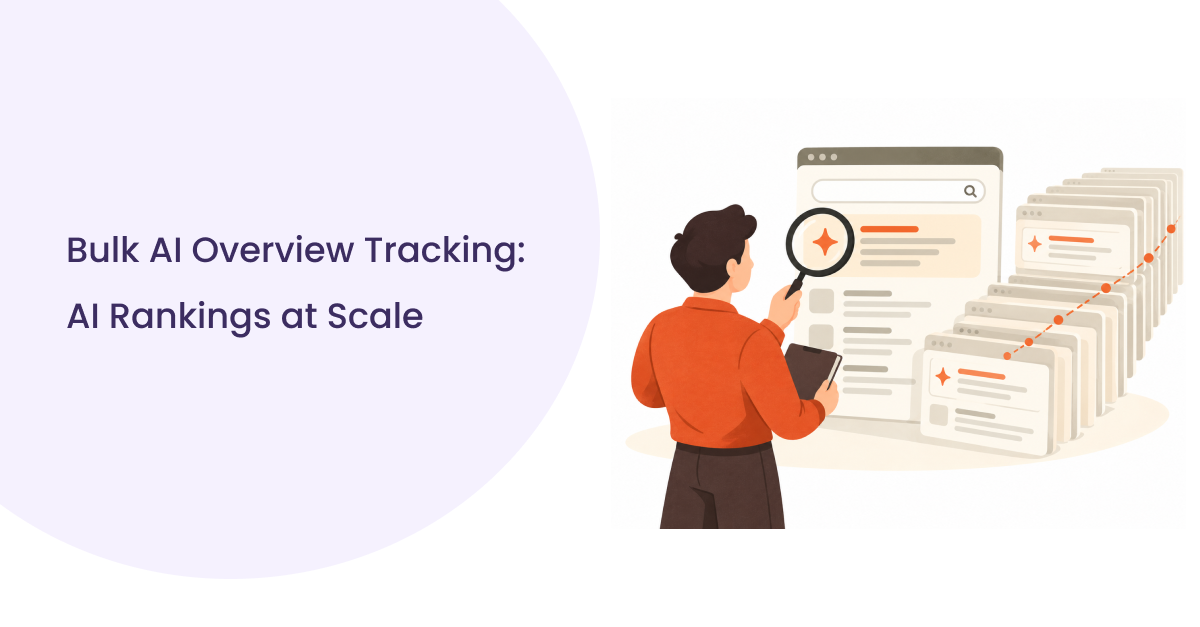
Manual checks catch one query at a time. Bulk AI overview tracking exposes patterns across thousands of queries simultaneously, and those patterns are where the real decisions live.
Four gap types appear consistently once volume increases: competitors present repeatedly where the brand is absent, the brand mentioned but never cited, citations that appear inconsistently across similar prompts, and entire topic clusters with zero presence. Each gap type needs a different fix, and none of them show up in a ten-query manual test.
The same query returns different brands depending on market. A geo-tracking API run across the US, UK, and India often shows three completely different competitor sets for one product category. Global brands that assume one visibility number covers every region are almost always wrong, and this gap is usually the largest single finding in any first audit.
Certain domains show up across dozens of unrelated AI answers because engines trust them repeatedly. Identifying which pages get cited again and again, across a full geo tracking api run, tells a content team exactly which formats and sources AI engines prefer to pull from.
Tracking a competitor’s presence across the identical query set a brand uses to monitor brand mentions in AI Overviews shows whether a category is being lost gradually or lost to one aggressive competitor. Share of voice, tracked monthly through an AI search visibility API, is the earliest warning signal available before revenue impact shows up in analytics.
Turning AI Visibility Data Into GEO Actions
Data without action is a report nobody reads twice. The value of bulk AI overview tracking shows up only when findings convert into a prioritized content and technical roadmap.
Group every lost query by topic, intent, competitor, and geography before assigning work. This grouping shows whether the loss sits in one weak content cluster or spreads across the entire site, which changes the scope of the fix completely.
Connect every citation back to the page it came from. Three questions guide this step:
- Which pages are already cited and can be strengthened?
- Which pages never appear despite ranking well on Google?
- Which competitor pages get cited repeatedly for the same query?
Run the identical query set before and after a content update to confirm movement. This turns generative engine optimization into a measurable loop instead of a one-time project, with citation and mention data proving whether the work actually moved the needle.
When Your Team Needs a Scalable AI Visibility Tracking Service
A team outgrows manual checking once query volume, market count, or platform count pass a threshold no single person can track by hand. At that point, a dedicated AI Overview rank tracking tool becomes a budget line.
Six factors decide the right scale: number of keywords, number of AI platforms, geographic markets, refresh frequency, competitors monitored, and how much historical data the team needs retained.
| Requirement | Why It Matters |
| Bulk execution | Covers thousands of queries per run. |
| Consistent queries | Keeps comparisons valid over time. |
| Geo controls | Separates results by market. |
| API access | Feeds data into internal dashboards. |
| Historical data | Enables trend and loss detection. |
| Citation extraction | Connects mentions back to URLs. |
A view of bulk AI overview tracking data should answer four questions clearly: where the brand is visible, where competitors are replacing it, which sources influence the answers buyers see, and whether visibility is improving month over month. Anything more granular belongs in the working dashboard, not the executive summary.
Organizations tracking multiple markets, large query sets, and several AI platforms eventually treat this monitoring as a permanent function inside the marketing or SEO team, not a quarterly project.
Why SERPHouse Fits Bulk AI Visibility Tracking
SERPHouse is useful when your tracking needs Google AI Overview data alongside SERP signals.
Its API returns structured search results, supports geo-targeted queries, and offers scheduled batch processing for keyword sets. That makes it practical for testing thousands of queries without maintaining custom scraping infrastructure.
The free plan includes 4,000 API credits, while paid tiers add higher volumes and a 99.95% uptime SLA, giving teams a straightforward path from validation to production.
Conclusion
Bulk AI overview tracking turns AI search visibility from occasional screenshots into a measurable operating system. By standardizing queries, locations, engines, timestamps, and visibility metrics, teams can identify where competitors appear, which sources earn citations, and where visibility is declining.
The real value of an AI search visibility API comes from connecting those findings to GEO actions and measuring changes over time. For organizations managing large keyword sets or multiple markets, an API-driven workflow provides the consistency, historical depth, and scale needed to make AI visibility part of an ongoing search strategy and planning.