
Table of Contents
Table of Contents
TLDR: Google closed the Custom Search JSON API to new customers, and existing users must move by January 1, 2027. Your Google Custom Search API migration path depends on scope: search across a few sites, enterprise search over up to 50 domains, or full web search, which Google now offers only through a partner agreement.
The Google Custom Search API shutdown forces more than an endpoint swap. The right path depends on what your application does: search a fixed set of sites, search enterprise content, or pull results from the open web. This guide covers Google’s options, third-party paths, the code changes to expect, and a plan you can finish before the deadline.
Start your Google Custom Search API migration with three steps today:
- Search your repositories for customsearch/v1.
- Inventory every API key, cx value, application, and scheduled job using it.
- Label each integration as site search, enterprise search, or full web search.
What Is Happening to the Google Custom Search JSON API?
Google’s developer documentation confirms the Google Custom Search API shutdown in two stages. Sign-ups closed first, and existing customers keep access until January 1, 2027. Treat the months before that date as your Google Custom Search API migration window.
New customers: sign-ups are closed.
Existing customers: access continues until January 1, 2027.
After the deadline: every integration needs a working replacement.
The API returns web and image results as JSON from a configured Programmable Search Engine. Google Search itself stays live for everyone. Only this developer endpoint retires, so your Google Custom Search API migration is a backend project with a hard date.
Who Is Affected by the Shutdown?
Any application that sends requests with an API key and a search engine ID (cx) needs a working replacement before January 1, 2027.
You are affected if you run apps that call the Custom Search JSON API, integrations built using an API key and cx, or internal tools and scheduled jobs that read API results.
You are clear if you only use search on Google.com or rely on unrelated Google search products.
Developer check: Search your codebase, backend services, environment variables, and scheduled jobs for references to customsearch.googleapis.com/customsearch/v1.
Forgotten scripts break first because nobody owns them. Log each one in your Google Custom Search API migration inventory.
What Happens After January 1, 2027?
After the Google Custom Search API shutdown, every remaining call fails. Features, jobs, and tools built on it lose search results that day.
Where the damage shows up first:
- Search boxes and result pages your users see.
- Background jobs that enrich data.
- Internal research and monitoring tools.
- Error logs flooding with failed requests.
Set your Google Custom Search API migration cutover weeks before January 1, 2027, so a failed launch still has time to recover.
What Google Recommends Instead
Programmable Search Element for Website Search
Google continues to support the Programmable Search Element for embedding search boxes and results into websites and web applications. It can work well when you need a Google-powered search experience, but it isn’t a direct replacement for a backend service that depends on the Custom Search JSON API response format.
Vertex AI Search / Agent Search for Defined Content
Google continues to support the Programmable Search Element for embedding search boxes and results pages into websites and web applications.
It is useful when you need a Google-powered search interface, but it is not a direct replacement for a backend service that consumes JSON responses. It adds indexing, conversational answers, grounding, and Google Cloud billing. Expect new setup work: data stores, IAM roles, and a different response schema.
Full Web Search
Google’s current Custom Search JSON API page simply says that if the use case requires full web search, developers should contact Google to express interest in its full web-search solution.
Developers fill out an interest form, and Google has published no eligibility criteria or pricing. Teams with deadlines should evaluate a Google Custom Search API alternative in parallel.
Your Google Custom Search API migration path depends on your use case, required output, search capabilities, and query volume. There is no single replacement that fits every integration, so choose the option that best matches how your application uses search.
Why Migration Is Bigger Than an Endpoint Change
Swapping the URL is the smallest part of a Google Custom Search API migration. A new provider shifts five areas, and skipping any one breaks something.
- Search scope: specific sites, many domains, or the full web. Skip it, and results arrive from the wrong sources.
- Response structure: field names, image results, pagination tokens. Skip it, and your parser throws on a missing items[].
- Search behavior: ranking, language, geo targeting, SafeSearch. Skip it, and users see different top results overnight.
- Code dependencies: empty results, retries, rate limits. Skip it and blank pages replace helpful empty states.
- Operations: volume, latency, uptime, cost per query. Skip it and monthly bills double quietly.
After the Google Custom Search API shutdown, ranking differences generate more support tickets than code bugs. Budget real time for relevance testing.
Identify Your Requirements Before Migrating
Document six requirements before choosing a Google Custom Search API alternative. Here is how one B2B SaaS team answered them:
| Requirement | Current Configuration |
| Scope | 12 partner domains. |
| Output | JSON for a backend service. |
| Search Type | Web results only. |
| Volume | 40,000 queries per day. |
| Configuration | 3 cx IDs with site filters. |
| Fields Consumed | Title, link, snippet. |
That profile rules out the UI widget and points straight to an API provider. These answers become your vendor scorecard and your Google Custom Search API migration test plan.
Migration Options for Developers
Match your scope to a path before you pick a Google Custom Search API alternative. Every option trades setup for control.
| If you need | Best path | You gain | You lose |
| Search across your own sites. | Programmable Search Element. | Minimal setup, Google ranking. | Raw JSON for your backend. |
| Enterprise search over defined content. | Vertex AI Search. | AI answers, grounding, Cloud tooling. | A familiar response schema. |
| Full web programmatic search. | Third-party search API or SERP API. | JSON output, current architecture. | Google’s native ranking. |
| Search over proprietary content. | Your own index. | Full control over ranking. | Engineering time for upkeep. |
For most product teams, a third-party search API delivers the fastest Google Custom Search API migration with the smallest rewrite.
A Google Custom Search API migration touches authentication, request parameters, response mapping, and pagination. Wrap every provider behind one internal interface first.
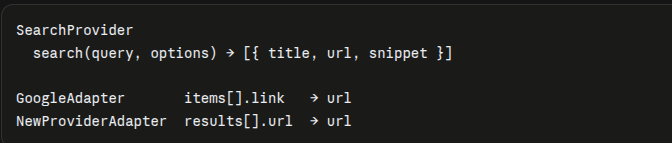
Both adapters translate into the same internal format, so your app never touches a raw provider response. Your Google Custom Search API alternative becomes one more adapter, and a config flag routes traffic between them.
Start by locating every existing API call across the application. Then build the new interface and Google adapter, followed by adding the new search provider adapter.
Rework pagination and error handling to support the new integration, test relevance, latency, and cost, and finally monitor production traffic after deployment. This pattern keeps your Google Custom Search API migration reversible.
Google Custom Search API Migration Checklist
Use this checklist to track your Google Custom Search API migration across preparation, build, and cutover. Finish every item before January 1, 2027.
Preparation: Start by finding every existing integration and identifying who owns each one. Record the daily query volume, document the parameters and response fields in use, and benchmark the current latency and error rates so you have a clear baseline.
Build: Select the Google Custom Search API alternative that best fits your requirements. Update the authentication and endpoints, then map the new provider’s responses through a common interface. Where possible, run the old and new APIs in parallel so you can compare results before making the switch.
Cutover: Move production traffic to the new provider once the results are validated. Keep an eye on errors, latency, and result quality during the transition. After the migration is stable, remove the retired endpoint and document a clear rollback plan for the Google Custom Search API migration.
Conclusion
The Google Custom Search API shutdown has a fixed January 1, 2027 deadline, so delaying your Google Custom Search API migration only increases risk. Audit your integrations, define search requirements, and evaluate the right Google Custom Search API alternative. Test relevance, latency, and cost under real traffic, then cut over with a rollback plan before the deadline.