
Table of Contents
Table of Contents
TL;DR: Ranking position alone tells you almost nothing anymore. A team that makes it routine to check SERP features for a keyword before publishing avoids wasted content spend and picks targets where a click is actually possible.
Position one used to mean the win. Not anymore. A page can rank first and still lose clicks to an AI Overview, featured snippet, or shopping carousel. That’s why smart teams check SERP features for a keyword before creating content.
A SERP feature includes AI Overviews, featured snippets, People Also Ask, local packs, image packs, and shopping modules. A free SERP feature checker tool quickly shows what appears, who owns it, and whether the keyword is worth targeting. This guide explains how to check, interpret, and act on those results.
Analyze SERP Features and Competitor Ownership in One View
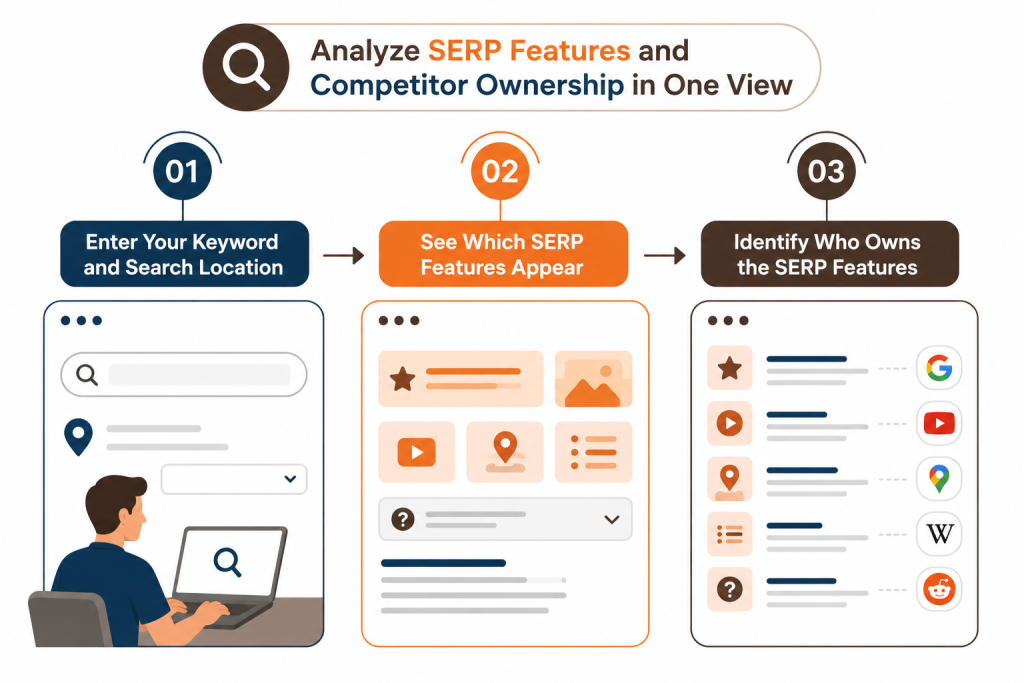
Enter Your Keyword and Search Location
Type the keyword, pick the country or city, and choose the device where it matters. AI overview checker built to check SERP features for a keyword properly needs location data because Google can show different features based on the searcher’s location.
See Which SERP Features Appear
Run the query and the tool returns a full map of what Google shows. Look for AI Overviews, featured snippets, People Also Ask, local pack, image or video blocks, and shopping placements.
A single glance tells you whether ten blue links even exist anymore for that query, which changes how much content effort the keyword deserves. This single step is why every content sprint should start with a habit of checking SERP features for a keyword.
Identify Who Owns the SERP Features
Presence is only half the story. The tool should show which domains and pages already hold each spot, so you can compare your own site against the competitors sitting in those features.
Ownership data turns a plain serp feature analysis tool into a competitive map, far more useful than a static checklist. You only get that map when you check SERP features for a keyword with an ownership view turned on.
What Your SERP Feature Results Actually Mean
AI Overview: Is There Still a Click Opportunity?
- An AI Overview does not always eliminate clicks. Check which sources it cites, how many links appear, and whether the query needs a deeper answer.
- Transactional and comparison queries can still drive traffic because users want proof, details, and options, not just a summary.
- When you check SERP features for a keyword, focus on whether your domain can earn a citation, not just whether an AI Overview exists.
- An AI Overview checker that shows cited domains is more useful than a simple yes or no result. For revenue-focused keywords, track citations alongside SERP features to find real visibility opportunities.
Featured Snippets and PAA: Where Can Content Win?
- A paragraph snippet needs a tight 40-word answer near the top. For list or table snippets, match the SERP structure on the page.
- Check live SERP features before writing to improve your chances of winning the featured snippet.
- People Also Ask questions guide content planning, not keyword stuffing, so use relevant questions as subheadings with direct answers.
- Skip unrelated questions and always check the live PAA box instead of relying on a stale export.
Local Pack: Does the Keyword Have Local Intent?
- A local pack signals local intent, even without “near me.” When it appears, local SEO such as reviews, citations, and a complete business profile often matters more than ranking a blog post first.
- A free serp feature checker tool helps owners check SERP features for a keyword early and avoid wasted content or ad spend.
Look Beyond Feature Presence
A results page can show five features and still offer zero opportunity if competitors already own every one.
Ask four questions for each feature.
- Who owns it today?
- What content format won that spot?
- Does the feature pull real attention or get ignored?
- Can your business actually act on that format?
That is why a plain AI overview checker is not enough on its own. Every time you check SERP features for a keyword, pair the raw output with judgment about ownership, format, and business fit before you decide to write.
Analyze the SERP Before You Invest in a Keyword
Match the SERP to Search Intent
The features on a page reveal intent faster than the keyword itself. Informational queries pull featured snippets and PAA boxes. Commercial investigation queries pull comparison content and review carousels.
Transactional queries pull shopping modules and ads. Local queries pull the map pack. Match your content type to what the page already rewards.
This match only becomes visible once you check SERP features for a keyword and read the live intent signal.
Measure SERP Crowding
Count every non-organic element before you commit resources. Crowding only becomes clear once you check SERP features for a keyword and count each box on the page.
An AI Overview, three ads, a featured snippet, a PAA block, and a local pack can push the first organic result past the fold entirely.
Position one on a crowded page can pull fewer clicks than position three on a clean one, which is the single most overlooked fact in keyword planning.
| Feature present | Typical effect on organic clicks |
| AI Overview only | Moderate drop, informational queries hit hardest. |
| Ads plus shopping | Heavy drop on transactional terms. |
| Featured snippet plus PAA | Mild drop, snippet owner often gains. |
| Local pack | Organic clicks matter far less than map visibility. |
Find the Real Organic Opportunity
Weigh competitor strength against feature ownership before choosing a keyword.
A term with weak competitors but heavy feature crowding may still beat a term with strong competitors and a clean page.
Run this comparison every time you check SERP features for a keyword so the decision rests on the actual page, not on search volume alone.
Prioritize Keywords by Opportunity, Not Volume Alone
Volume tells you demand. It says nothing about whether you can win a click. Use a simple formula to rank targets: business value multiplied by ranking feasibility multiplied by SERP opportunity multiplied by click potential.
A keyword that scores low on volume but high on all four factors usually beats a high-volume term buried under five features you cannot own. Score every factor only after you check SERP features for a keyword directly.
How to Use a Free SERP Feature Checker for Keyword Research
Validate Keywords Before Creating Content: Check live results before building a content calendar.
Confirm search intent and SERP features to ensure your content matches what Google currently rewards. Always check SERP features for a keyword before assigning it to a writer.
Find Competitor SERP Opportunities: See which competitors own key features and match the winning format. Check SERP features for a keyword before publishing to identify current opportunities.
Use SERP Features to Build Better Content Briefs: This turns SERP data into actionable content guidance.
Recheck High Value Keywords Over Time: SERPs change constantly, including AI Overviews, snippets, and local packs. Check SERP features for a keyword quarterly for important revenue terms.
Free SERP Feature Checker vs Paid SERP Analysis Tool

When a Free Checker Is Enough
A free tool covers occasional checks, small keyword sets, one off content research, and basic feature detection well, and it lets any team check SERP features for a keyword without waiting on budget approval.
If your team touches ten or twenty keywords a month, a free serp feature analysis tool answers most questions without any spend.
When You Need More Than a Free Checker
Large keyword portfolios, historical SERP data, competitor tracking across time, location, and device segmentation, automated monitoring, exports for stakeholders, and dedicated AI Overview tracking all sit outside what a free tool can support at scale.
At that size, you cannot check SERP features for a keyword one at a time and still hit deadlines.
Detection vs SERP Intelligence
| Detection | SERP Intelligence |
| Shows whether a keyword has an AI Overview now. | Shows which keywords trigger AI Overviews, who earns citations, and how ownership changes. |
| Helps you check SERP features for a keyword. | Turns SERP data into actions and content decisions. |
| Best for quick checks. | Best for ongoing content and SERP strategy. |
| A free checker can handle detection. | Full platforms or service teams provide deeper intelligence. |
What to Look for in a SERP Feature Analysis Tool
SERP Feature and AI Overview Coverage
Confirm the tool tracks every feature relevant to your industry, beyond the common ones alone.
An AI Overview checker module that shows cited sources and citation frequency over time carries far more weight than a simple presence flag, and a strong serp feature analysis tool pairs that view with format and ownership data in one place.
Location, Device and Search Accuracy
Results must reflect real local SERPs, mobile against desktop differences, and country or city-level accuracy.
A tool that only pulls generic national results will miss local pack triggers and mobile-only features entirely. Accuracy is the entire point when you check SERP features for a keyword tied to a specific store or city.
Competitor and Historical Tracking
Look for feature ownership tracking, visibility change alerts, and stored historical SERPs you can pull up months later.
Without history, you cannot prove whether a competitor gained or lost a spot, only that they currently hold it. History turns a single check SERP features for a keyword moment into a real trend line.
Reporting and Workflow Integration
Exports, dashboards, API access, and client ready reporting decide whether the data actually gets used.
A free serp feature checker tool that shows great data inside its own interface but cannot export it creates extra manual work for every report cycle. A stakeholder should never have to log in just to check SERP features for a keyword on your behalf.
The Hidden Cost of Incomplete SERP Analysis
Making Content Decisions From Outdated SERPs
- A page built around a SERP snapshot from six months ago can miss a new AI Overview, a lost featured snippet, or a competitor that now owns the local pack.
- Old assumptions quietly break content plans built on them, and the fix is simple: check SERP features for a keyword again before you refresh any page.
Tracking Rankings Without Tracking Visibility
- Rank tracking alone shows position. It says nothing about how much of the page a feature ate before your listing even appeared.
- Two keywords at position one can deliver very different traffic once feature crowding is factored in. Rank position without a way to check SERP features for a keyword tells only half of that story.
Missing Local Device or AI Differences
- One snapshot from one location on one device does not represent every searcher. A keyword can show a clean page on desktop and a crowded one on mobile in the same city, and teams that skip this check plan around the wrong version.
- Segmented checks are the only accurate way to check SERP features for a keyword across every real searcher.
Spending Analyst Time on Manual Checks
- Manual checking does not scale past a handful of keywords. An analyst pulling forty SERPs by hand each week spends hours on a task that adds no strategic value once the process is repeatable.
- The real cost of skipping proper analysis is not a missed free serp feature checker tool fee; it is decisions made on incomplete data. A five minute habit to check SERP features for a keyword avoids that entire cost.
When Should You Invest in SERP Feature Tracking?
A Free Checker Is Enough If
- Your keyword portfolio stays small.
- Analysis happens occasionally, not weekly.
- Your SEO program is still early stage.
- Your team can read and interpret raw results without help.
A Paid Tool Makes Sense If
- Tracking spans hundreds or thousands of keywords.
- Multiple locations or markets need coverage.
- Competitors fight hard for the same SERPs.
- AI Overview visibility directly affects revenue.
- Multiple stakeholders need regular reporting.
Professional SEO Services Make More Sense If
- You already have the data but lack the strategic insight to act on it.
- Prioritization and execution consume significant time each week.
- Your team lacks the capacity for ongoing SERP monitoring and analysis.
- You need a partner to turn SERP data into clear, actionable recommendations.
- Every recommendation is backed by checking SERP features for the target keyword.
How to Measure the Business Impact of SERP Feature Tracking
Track SERP Visibility
Watch feature ownership, your overall share of visible space on tracked pages, and competitor visibility trends month over month.
This tracking begins the moment your team starts to check SERP features for a keyword on a set schedule.
Connect Visibility to SEO Performance
Tie visibility numbers to impressions, click through rate, organic traffic, and ranking movement so the tracking work ties back to something measurable.
Connect SEO Performance to Business Outcomes
Push the chain further into qualified traffic, leads, revenue and, for local businesses, calls and direction requests. Tracking that stops at rankings misses the point of doing it at all.
Success is not how many features you tracked; it is whether visibility work moved a real business number, and that story starts every time your team decides to check SERP features for a keyword before spending budget on it.
SERP Feature Checker Decision Framework
Choose a Free Checker If
You need a quick, occasional read on a small set of keywords and nothing more, so a free way to check SERP features for a keyword covers the job fully.
Choose a Paid SERP Analysis Tool If
You need scale, stored history, active monitoring, competitor intelligence, and reporting your whole team can use.
Choose Professional SEO SERP Services If
You need experts to turn SERP data into a plan your team can actually execute, and that plan should always start with a clear check of SERP features for a keyword step.
Why Choose SERPHouse for Live SERP Feature Analysis
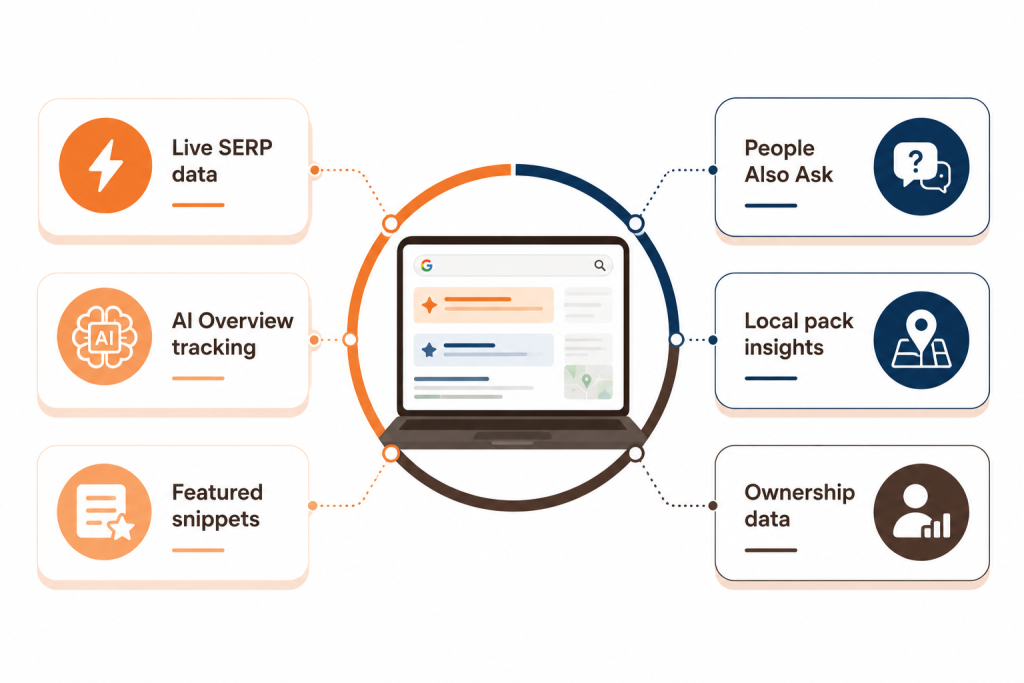
SERPHouse provides a free serp feature checker tool that helps teams analyze live SERP features at scale. It shows what Google currently rewards, helping you make better keyword and content decisions.
Key benefits:
- Live SERP data: Check current results instead of relying on outdated snapshots.
- AI Overview tracking: Identify AI Overview citations and featured sources.
- Featured snippets: See which formats and competitors own key snippets.
- People Also Ask: Find relevant PAA questions for content planning.
- Local pack insights: Identify keywords with strong local intent.
- Ownership data: Track who controls important SERP features.
SERPHouse makes it easy to check SERP features for a keyword, compare competitors, and build better content. Analyze keywords at scale and turn live SERP data into actionable SEO strategies.
Conclusion
SERP features can shape visibility, traffic, and content performance, making them essential to modern keyword research. Before creating or updating content, check SERP features for a keyword to understand search intent, competitor ownership, AI Overviews, featured snippets, People Also Ask, and local results.
A free serp feature checker tool like SERPHouse makes this process faster and more scalable. Instead of relying on outdated SERP snapshots or rankings alone, teams can use live data to identify opportunities, create better content, and focus their SEO efforts on keywords with real potential.
FAQ
How do I check SERP features for a keyword?
Enter the keyword into a checker along with your target location and device, then review the returned list of features such as AI Overviews, featured snippets, PAA, and local pack results for that exact query.
What is a free SERP feature checker?
It is a tool that shows which non-organic elements appear on a search results page for a given keyword without charging a subscription fee, useful for quick checks on a small number of terms.
Can I check whether a keyword triggers an AI Overview?
Yes, most SERP feature checkers flag AI Overview presence directly, and some also show which domains the summary cites.
How can I check People Also Ask results?
The AI overview checker pulls the live PAA box for your keyword and lists each question exactly as it appears on the results page at the time of the check.
How does local pack detection work?
The tool queries Google from the chosen location and flags whether a map pack with business listings appears above or alongside the organic results for that keyword.
Why can a number one ranking still get limited clicks?
When an AI Overview, ads, or a featured snippet sit above the organic listing, searchers often get their answer before scrolling down, which pulls clicks away even from the top organic spot.