
Table of Contents
Table of Contents
TL;DR: Enterprise AI data analytics stalls when AI models cannot reach live business data. A Model Context Protocol Server fixes this by giving AI models secure, structured, real-time access to actual enterprise systems.
Enterprise AI is only as effective as the data it can access. Yet in many organizations, critical business information is scattered across disconnected systems, forcing AI to work with outdated reports, isolated datasets, or incomplete context. The result is impressive demos that rarely deliver meaningful business outcomes.
AI data analytics only works when the AI layer can query live business systems, not exports refreshed only once a week. That gap is exactly what a Model Context Protocol Server was built to close. This guide breaks down how enterprises use the MCP server for analytics deployments to turn scattered data into decisions leadership can actually act on.
Why Enterprise AI Data Analytics Needs a New Architecture
Traditional BI stacks were never built for real-time questions. Data sits in a warehouse, refreshes on a schedule, and reaches business teams days after the decision window has already closed. This is the core problem legacy AI data analytics setups run into today.
Three failure points repeat across almost every enterprise environment:
Fragmented data: customer records live in the CRM, finance data sits in the ERP, product usage stays locked inside application logs, and no single query touches all three at once.
Delayed insights: a finance leader waiting on a monthly close report cannot make a pricing call on Tuesday using numbers pulled the previous Friday.
Disconnected AI systems: most copilots answer questions using training data that is months old.
Enterprises that treat AI data analytics as a reporting layer keep hitting the same wall every quarter. The fix is not a bigger dashboard. It is a connection layer that lets AI reach live systems directly, on demand.
Why LLMs Need Context to Deliver Business Value
Large language models generate confident answers even when they lack the facts behind them. Without live access to internal systems, a model guesses at the number in place of retrieving it, and that gap costs enterprises trust fast.
Reliable AI data analytics depends on three context types reaching the model in real time:
Structured data: tables, transactions, and metrics pulled straight from warehouses and operational databases.
Unstructured knowledge: contracts, support tickets, internal wikis, and PDFs that give numbers meaning.
Enterprise memory: Prior decisions, past reports, and historical patterns that explain why a current number looks the way it does. Grounding AI models with live search data alongside this internal memory layer closes the external context gap that enterprise models face when internal history alone doesn’t explain current market conditions.
A model fed structured data alone answers half the question correctly and fills the rest with confident fiction. Adding real-time web retrieval through MCP closes the live data gap that internal systems alone cannot cover. See how MCP web search works in AI agent systems for the full request-flow architecture.
Where Model Context Protocol Fits
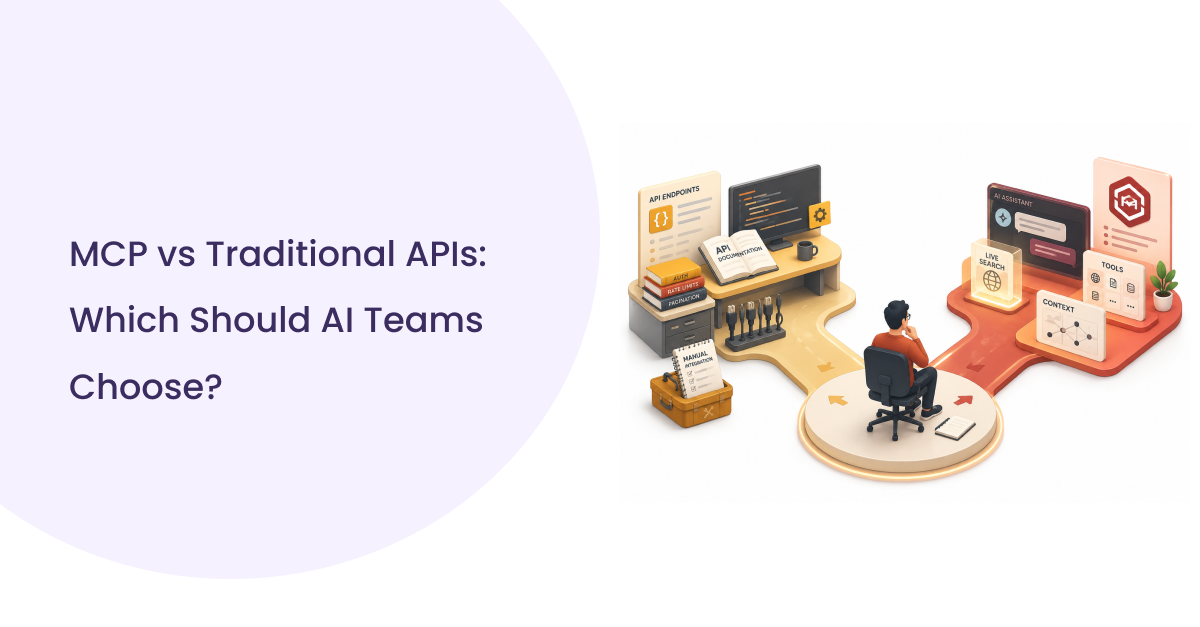
Model Context Protocol standardizes how AI models talk to enterprise systems. Engineering teams expose one protocol that any AI client can call, in place of building a custom connector for every single tool in the stack.
Three capabilities define why this matters for AI data analytics at enterprise scale:
Standardized communication: one protocol replaces dozens of separate API integrations.
Secure data retrieval: permissions travel with every request, so the model only sees what the requesting user is cleared to see.
Reusable integrations: a connector built once for an MCP server for analytics works across every AI application in the company.
Enterprises running an MCP server for analytics architecture cut integration timelines sharply because the protocol removes duplicate engineering work across departments. For the full breakdown of MCP Integration use cases and architecture across enterprise environments, including security, distributed orchestration, and ROI frameworks, see the complete guide.
Enterprise Architecture: How MCP Powers AI Data Analytics
Connecting AI Models with Enterprise Systems
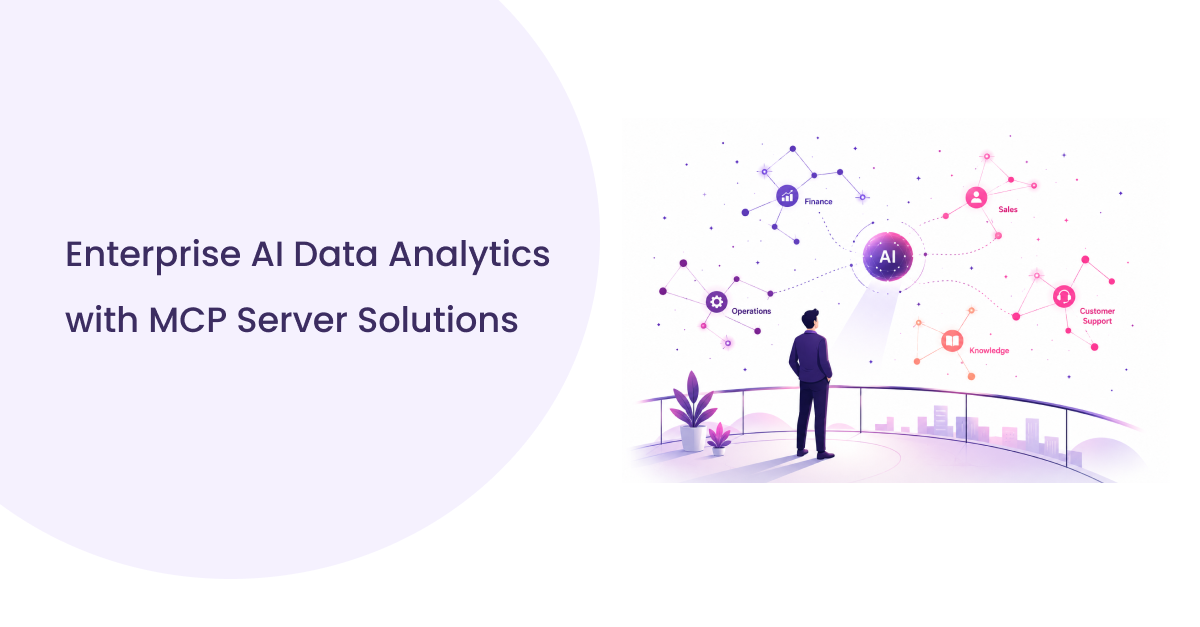
An enterprise AI data analytics stack only earns trust once it reaches every system leadership actually relies on. A Model Context Protocol Server sits between the AI client and each source system, translating one request into the right query for each connected tool.
The systems that matter most for enterprise rollouts:
| System | What It Feeds the AI Model |
| ERP | Financials, procurement, and inventory data |
| CRM | Customer records, deal stages, support history |
| Data Warehouse | Historical trends, aggregated reporting metrics |
| Documents | Contracts, policies, internal knowledge bases |
| Internal APIs | Custom business logic and proprietary workflows |
A model connected to only two or three of these still produces incomplete answers. The value shows up once every system above sits behind one protocol layer. For the full technical stack frontend, backend, MCP server, vector database, and observability see MCP architecture for enterprise web applications.
Understanding MCP Server Components
A Model Context Protocol Server is not one piece of software. It is five components working together, and enterprise teams that skip one usually regret it during scale-up.
- Server: hosts the connection logic and exposes it to any approved AI client.
- Client: the AI application or assistant making the request, such as an internal copilot.
- Resources: the actual data objects the server can return, from tables to documents.
- Tools: callable functions the AI model can trigger, like running a report or pulling a record.
- Prompts: reusable instruction templates that keep responses consistent across teams and use cases.
Understanding these five parts separates teams that deploy the MCP server for analytics projects successfully from teams that treat the MCP as a single plug-and-play tool. It rarely works that way at enterprise scale.
Typical Enterprise Analytics Workflow Using MCP
A finance director asks a copilot for last quarter’s regional margin trend. The client sends that request to the Model Context Protocol Server, which checks permissions, queries the warehouse and ERP resources, and returns structured data to the model.
The model then turns that raw data into a plain language answer, citing the exact tables it pulled from. No manual export, no waiting on an analyst, and no stale cache sitting between the question and the answer. This workflow is what modern AI data analytics was supposed to look like from the start.
Business Use Cases Where MCP Creates Measurable Value
Executive Reporting
Executives ask questions in plain language and expect answers in minutes, not after a week of analyst work. AI data analytics powered by MCP pulls board-level metrics straight from live systems, cutting the reporting cycle from days to a single conversation.
Customer Analytics
Support tickets, CRM records, and product usage logs rarely sit in one place. A Model Context Protocol Server connects all three, so a churn question gets answered with actual behavior data.
Financial Analytics
Finance teams need numbers that reconcile across systems before anyone trusts them. MCP server for analytics setups pulls ERP and warehouse data through one permissioned channel, which removes the manual reconciliation step that eats up close to a week every single time.
Operations Intelligence
Supply chain and operations leaders live and die by lag time. Live AI data analytics access to inventory and logistics systems flags a bottleneck the same day it starts, not two weeks later, inside a postmortem report nobody reads until it is too late.
Compliance & Risk Monitoring
Regulated industries cannot afford AI answers built on outdated policy documents. A MCP server for analytics pulls the current version of every compliance document at query time, so risk teams get answers grounded in the rule that applies today, not last year’s draft.
Enterprise Buyer’s Checklist Before Selecting an MCP Server
Security & Governance
Every vendor claims security. Very few show you the access control model. Ask for role-based permission mapping and audit logs before signing anything, because weak enterprise data governance here compromises every downstream AI data analytics result the system produces.
Data Source Compatibility
Confirm the Model Context Protocol Server connects natively to your ERP, CRM, and warehouse before evaluating anything else. A vendor that requires custom middleware for your core systems adds cost and delay you did not budget for.
Performance & Scalability
Query latency matters more once thousands of employees start asking questions daily. Test the MCP server for analytics setup under real concurrent load, not a single demo query run by the sales engineer.
Monitoring & Observability
You need visibility into every query the model runs against live systems. Without logging, a bad AI data analytics answer becomes impossible to trace back to its source, and that is a governance problem, not a technical one.
Vendor Ecosystem
Check how many pre-built connectors the vendor already maintains. A wide connector library shortens your rollout timeline for AI data analytics far more than any single feature on the sales sheet.
Total Cost of Ownership
Licensing is only part of the bill. Factor in integration engineering hours, ongoing maintenance, and the internal team required to manage a Model Context Protocol Server once it moves from pilot to full production use.
Top MCP Server Vendors for Enterprise AI Data Analytics
Vendor selection shapes how fast AI data analytics actually reaches your teams. Here is how the major players compare on strength and fit.
SERPHouse
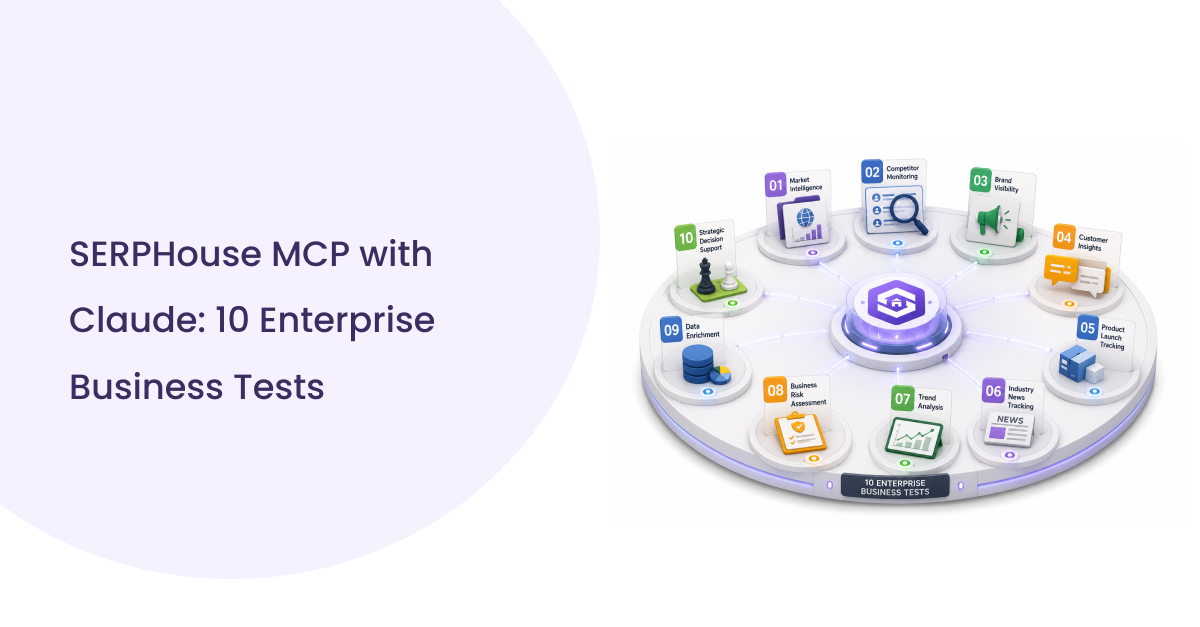
SERPHouse delivers MCP-ready search and SEO data for enterprise AI applications.
Key Features:
- Real-time SERP and keyword data.
- Structured JSON APIs.
- Enterprise-scale search analytics.
Best For: Marketing teams and AI solutions that rely on search and SEO intelligence.
Composio
Composio helps AI agents securely connect with hundreds of business applications through MCP.
Key Features:
- 250+ SaaS integrations.
- Built-in OAuth authentication.
- Native MCP support.
Best For: Enterprises connecting AI assistants to multiple SaaS platforms.
Smithery
Smithery provides a centralized platform for discovering and deploying MCP servers.
Key Features:
- Large MCP server registry.
- Simple deployment and management.
- Hosted MCP services.
Best For: Teams looking for ready-to-use MCP servers with minimal setup.
Pipedream
Pipedream enables developers to build MCP-powered workflows connecting AI with business systems.
Key Features:
- Thousands of API integrations.
- Serverless workflow automation.
- Custom enterprise connectors.
Best For: Organizations creating custom AI workflows across APIs and applications.
Zapier MCP
Zapier has introduced MCP support, allowing AI assistants to access thousands of business applications through its automation platform securely.
Key Features:
- Connects with 8,000+ business applications.
- Built-in authentication and automation workflows.
- Native MCP support for AI agents.
Best For: Businesses that want AI assistants to interact with CRM, marketing, productivity, and business apps without custom integrations.
Measuring Business Value: KPIs and ROI for AI Data Analytics
KPIs Executives Should Track
Track these five metrics before calling any AI data analytics rollout a success:
Decision speed: time from question to answer.
Query accuracy: how often the AI answer matches verified data.
Employee productivity: hours saved on manual reporting.
Cost reduction: analyst hours reallocated to higher-value work.
User adoption: percentage of eligible employees actually using the tool weekly.
ROI Metrics Before Enterprise Rollout
Measure how a Model Context Protocol Server lowers the time, effort, and expenses associated with manual reporting.
Compare how quickly teams generate insights through AI data analytics versus the previous reporting process.
Evaluate the benefits of consolidating multiple data connectors into a single Model Context Protocol Server architecture.
Track how automation reduces repetitive analyst tasks, allowing teams to focus on higher-value AI data analytics initiatives.
How to Choose the Right Enterprise AI Analytics Partner
Selecting the right enterprise AI analytics partner requires more than comparing features. For teams still evaluating the search data layer specifically, compare AI search infrastructure options across latency, SERP coverage, JSON output quality, and pricing before the first vendor call.
| Evaluation Criteria | Why It Matters |
| Industry Expertise | Ensures the solution aligns with your industry’s workflows, regulations, and business challenges. |
| Proven Scalability | Confirms the platform can handle growing data volumes and enterprise workloads. |
| MCP Implementation Experience | Reduces deployment risks and accelerates successful Model Context Protocol Server adoption. |
| Post-Deployment Support | Keeps the platform secure, optimized, and updated after launch. |
| Long-Term AI Roadmap | Ensures the vendor can support future AI data analytics growth and evolving business needs. |
Why Choose SERPHouse for Enterprise AI Data Analytics?
SERPHouse helps organizations accelerate AI data analytics by providing real-time search data and structured outputs ready for direct LLM ingestion, with enterprise-scale query infrastructure built in. Its focus on structured data delivery, seamless connectivity, and faster deployment enables businesses to implement an MCP server for analytics with less complexity, helping teams access accurate insights while reducing development and maintenance effort.
Conclusion
Enterprise AI is only as effective as the quality and accessibility of the data behind it. A well-designed Model Context Protocol Server bridges AI models with trusted business systems, enabling secure, real-time access to the information needed for faster, more informed decisions.
By selecting the right architecture and implementation partner, organizations can reduce integration complexity, improve operational efficiency, and build an AI data analytics ecosystem that continues to scale alongside future business growth. Ready to see what a working MCP server for analytics setup looks like for your data stack? Let’s talk.
FAQs
How long does it take to implement a Model Context Protocol Server?
Implementation timelines typically range from a few weeks to a few months, depending on existing systems, connector requirements, security policies, and the complexity of your enterprise AI data analytics environment.
Can one Model Context Protocol Server connect multiple AI models?
Yes. A single Model Context Protocol Server can securely serve multiple AI models and assistants, eliminating duplicate integrations while maintaining centralized access control and governance.
Does an MCP server replace existing APIs?
No. A Model Context Protocol Server works alongside existing APIs, providing a standardized interface that allows AI applications to access business systems more efficiently without replacing current integrations.
What types of enterprise data can an MCP server access?
It can connect AI models with CRM platforms, ERP systems, databases, cloud storage, analytics platforms, documentation, internal knowledge bases, and other enterprise applications through secure connectors.
What are the biggest challenges when deploying an MCP server?
Common challenges include legacy system integration, permission management, connector maintenance, governance policies, and ensuring consistent data quality across enterprise AI data analytics workflows.