
Table of Contents
Table of Contents
If you’ve ever tried to pull Google Images results programmatically, you already know the frustration. Google deprecated its official Image Search API back in 2011 and what it left behind, the Custom Search JSON API, is throttled to 100 queries per day on the free tier, requires a Programmable Search Engine setup that doesn’t actually search the whole web, and scales expensively for anyone doing serious volume.
So developers, data teams, and product builders have turned to third-party providers: companies that handle proxy rotation, CAPTCHA bypass, JavaScript rendering, and structured JSON delivery so you don’t have to.
The problem is, there are now dozens of options and not all of them are worth your time. This guide cuts through the noise. We’ve compared the seven best Google Image API providers across the criteria that actually matter: response structure, rate limits, location targeting, pricing, and real-world reliability.
Whether you’re building an AI training dataset, monitoring brand visuals, running ecommerce product research, or powering a content discovery platform this is the comparison you need before committing to a provider.
What to Look for in a Google Image Search API
Before jumping to the list, it’s worth being clear about what separates a solid image SERP API from one that will quietly break your pipeline at 3 a.m.
Structured JSON response quality: The API should return more than just image URLs. A well-formed response includes the image’s source page, thumbnail URL, original dimensions, alt text, title, ranking position, and safe search status. If you’re only getting raw URLs, you’re missing the metadata that makes the data useful.
Geolocation and language targeting: Google Images results differ significantly by country and language. If your use case involves ecommerce, local SEO, or regional brand monitoring, you need an API that lets you specify location at the city or country level not just a generic “US results” toggle.
Device targeting: Mobile and desktop image results don’t always match. Providers that let you emulate mobile vs. desktop queries give you a more complete picture of how images actually surface across devices.
Rate limits and concurrency: A 100-request/day cap is a dealbreaker for any production workload. Evaluate the limits per plan tier, and check whether the provider supports burst requests or concurrent calls critical for batch processing jobs.
Uptime and reliability: An API that returns structured data 94% of the time but silently fails the other 6% will corrupt your dataset. Look for documented SLA guarantees and check independent developer community feedback, not just the provider’s own marketing.
Pricing model: Pay-as-you-go versus subscription matters depending on your usage pattern. Burst-heavy research projects favor per-request pricing; continuous production pipelines often get better value from monthly plans with rollover credits.
With those criteria in mind, here’s how the leading providers stack up.
The 7 Best Google Image API Providers
| Provider | Free tier | Monthly requests (entry plan) | Location targeting | JSON fields returned | Starting price |
| SERPHouse | Yes 4000 Free credits | 40,000 | Country-level | URLs, thumbnails, source, dimensions, alt, position | ~$29/mo |
| SerpAPI | 250 searches/mo | 1,000 | Country-level | URLs, thumbnails, source, metadata | $25/mo |
| ScraperAPI | 5,000 credits/mo | Varies by plan | Country-level | URLs, source pages, image data | $49/mo |
| Scrapfly | 1,000 API calls | 10,000 | Country-level | Raw HTML + structured extraction | $30/mo |
| SearchAPI.io | 100 searches/mo | 10k | Country + language | URLs, thumbnails, source, metadata | $40/mo |
| DataForSEO | Pay-per-use | Unlimited (pay-per-use) | City-level | Full SERP data + image metadata | ~$0.0015/request |
| Serper | 2,500 searches free | 2,500+ | Country-level | URLs, thumbnails, source, metadata | $50/mo |
1. SERPHouse
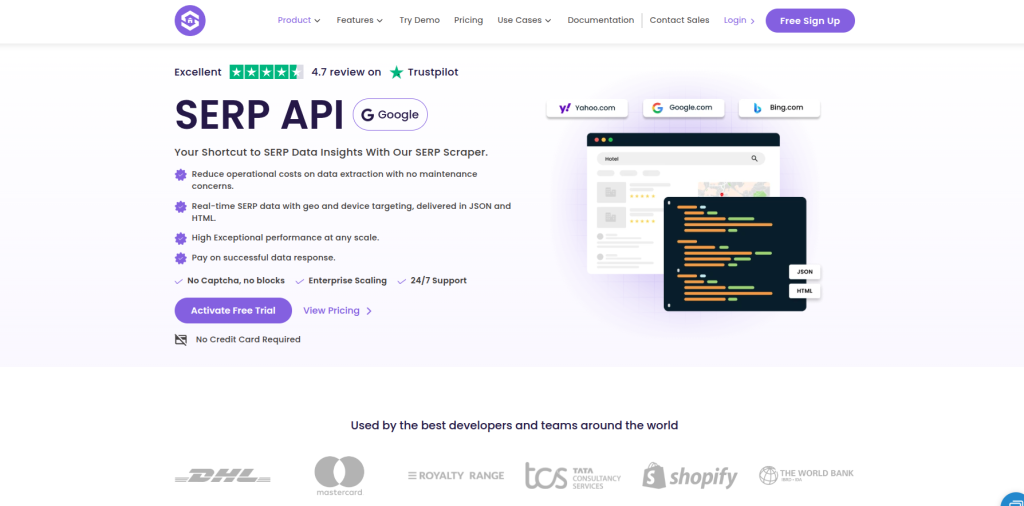
SERPHouse is built specifically around structured SERP data access and the Google Image Search API is one of its core offerings, not an afterthought bolted onto a generic scraping toolkit.
A single API call returns image URLs, thumbnail URLs, source pages, dimensions, alt text, title, and ranking position all in clean, predictable JSON. The endpoint accepts serp_type=image alongside standard parameters for query, location, language, and device type, making it straightforward to integrate into existing pipelines that already use SERPHouse for other SERP types.
What sets it apart: City-level geolocation targeting is rare at this price point. Most providers cap location specificity at the country level; SERPHouse lets you specify a city and region, which is directly useful for local SEO monitoring, hyperlocal ecommerce analysis, and geo-targeted AI dataset construction.
Pricing: Paid plans from approximately $29/month. Trial credits available with no credit card required.
Best for: Developers building production-grade image data pipelines, agencies running multi-location monitoring, and teams that need consistent JSON structure across multiple SERP types from a single provider.
Quick start:
Sample JSON response:
2. SerpAPI
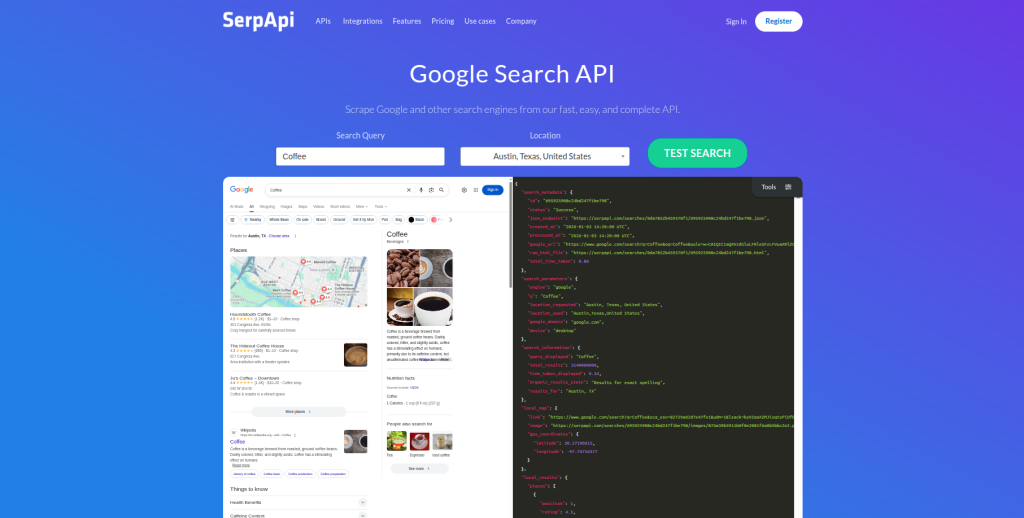
SerpAPI is one of the most widely used SERP APIs on the market and has mature support for Google Images alongside a broad range of other Google products (Maps, Shopping, News, Jobs). Its documentation is thorough, its SDKs cover most major languages, and the community is large enough that you’ll find Stack Overflow answers for most integration questions.
What sets it apart: Breadth of Google product coverage. If you need image data alongside other SERP types under one authentication layer, SerpAPI is a natural fit.
Limitation: It’s expensive relative to the feature set for image-only use cases, and location targeting tops out at the country level on standard plans. City-level targeting requires enterprise tiers.
Pricing: Free tier with 250 searches/month. Paid plans from $25/month for 1,000 searches.
Best for: Teams already using SerpAPI for other SERP types who want to add image data without onboarding a second provider.
3. ScraperAPI
ScraperAPI takes a broader approach: it’s primarily a web scraping infrastructure provider that includes a structured Google Images endpoint as part of its SERP offering. It handles proxy rotation, CAPTCHA solving, and browser rendering at scale, making it a reliable choice for teams running very high request volumes.
What sets it apart: Infrastructure maturity. ScraperAPI has handled enterprise-scale scraping operations and its retry logic and anti-bot bypass are battle-tested.
Limitation: The response structure for image results is less detailed than dedicated SERP API providers. It’s best suited for workflows where raw image URL extraction is the goal rather than rich metadata collection.
Pricing: Free tier with 5,000 credits/month. Paid plans from $49/month.
Best for: High-volume image URL collection where infrastructure reliability matters more than response richness.
4. Scrapfly
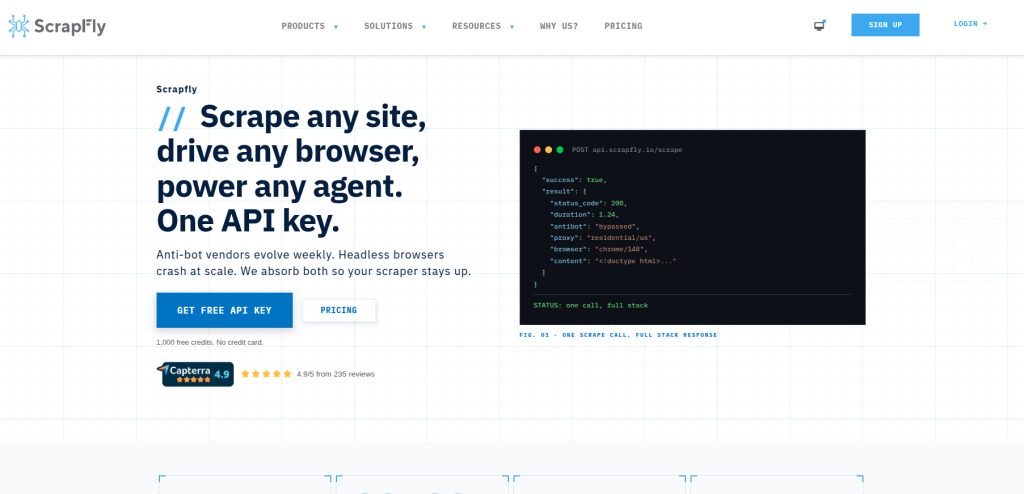
Scrapfly’s approach to Google Images sits somewhere between a raw scraper and a structured API. It renders JavaScript, rotates proxies, and returns the full Google Images HTML, which you can then parse using its extraction layer or your own tooling.
What sets it apart: Flexibility. Because you’re working closer to the raw HTML, you can extract any field that appears on the Google Images page, including fields that structured APIs might not expose.
Limitation: More setup time. If you want clean JSON without building a custom extraction layer, providers like SERPHouse or SerpAPI will get you there faster.
Pricing: Free tier with 1,000 API calls. Paid plans from $30/month.
Best for: Engineering teams comfortable building custom extraction pipelines who prioritize flexibility over out-of-the-box structure.
5. SearchAPI.io
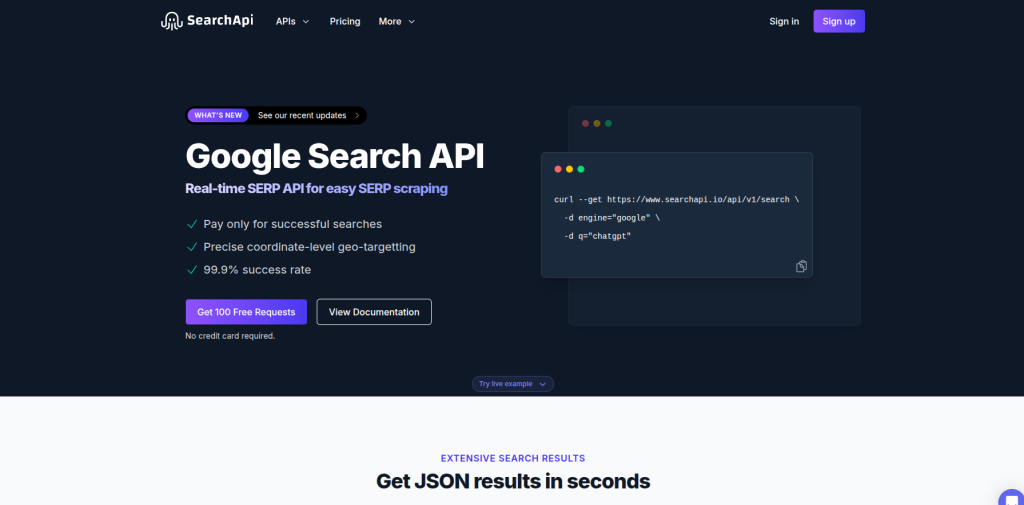
SearchAPI.io offers a clean, developer-friendly Google Images endpoint with consistent JSON output and good documentation. It’s not the cheapest or the most feature-rich, but it’s dependable and integrates quickly.
What sets it apart: Simple onboarding. The API playground lets you preview response structure and auto-generate code in multiple languages before writing a single line of integration code.
Limitation: Lower request volumes on entry plans compared to competitors, and country-level targeting without city specificity.
Pricing: Free tier with 100 searches/month. Paid plans from $40/month for 10k searches.
Best for: Smaller projects and solo developers who need a reliable, low-friction integration without a large volume requirement.
6. DataForSEO
DataForSEO is a data-first provider built for SEO platforms, rank trackers, and analytics tools. Its Google Images API returns a comprehensive dataset including alt tags, title tags, ranking position, and source metadata and uniquely supports reverse image search at scale via a dedicated endpoint.
What sets it apart: Pay-per-use pricing with no monthly minimums. For teams with variable or unpredictable volume, this removes the risk of overpaying on months with lower usage. City-level location targeting is supported.
Limitation: API-first architecture with minimal hand-holding. There’s no hosted dashboard or point-and-click setup you’re working directly with REST endpoints and raw JSON. It’s a developer tool, not a self-serve platform.
Pricing: No monthly minimum. Approximately $0.0015 per request at standard rates competitive at high volume.
Best for: SEO software developers, rank tracking platforms, and analytics teams running high monthly volumes with variable demand.
7. Serper
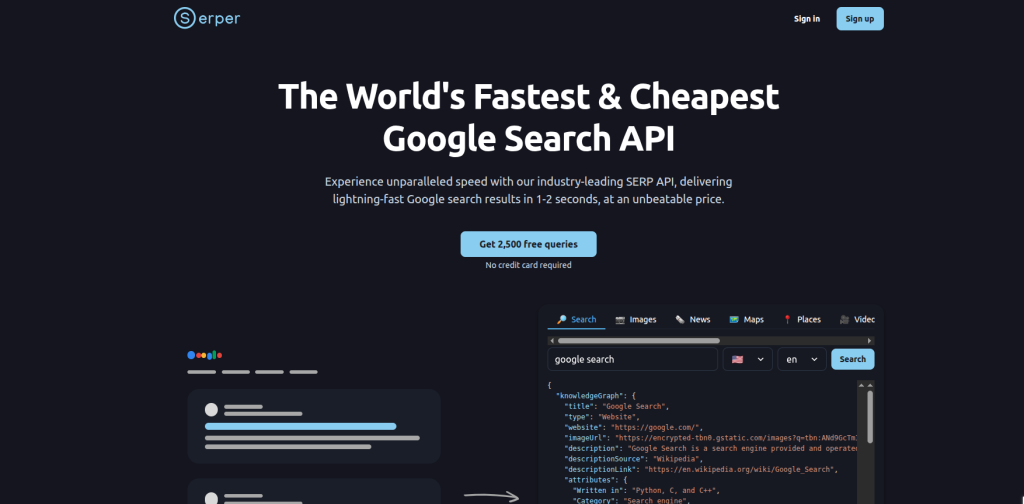
Serper focuses on speed and simplicity. It supports Google Images as part of its broader SERP API offering, returns clean JSON, and is consistently one of the fastest providers in independent latency benchmarks.
What sets it apart: Speed and generous free tier. The 2,500 free searches available on signup make it easy to prototype and test before committing to a paid plan.
Limitation: Less detailed image metadata than SERPHouse or DataForSEO, and location targeting is country-level only.
Pricing: 2,500 free searches on signup. Paid plans from $50/month.
Best for: Rapid prototyping, lightweight integrations, and projects where response speed is the primary constraint.
Common Use Cases for a Google Image Search API
Understanding which providers fit which workflows comes down to what you’re actually trying to build. Here are the most common use cases and which options serve them best.
AI and machine learning training datasets: Building labelled image datasets for classification, object detection, or recommendation systems requires large volumes of diverse, contextually relevant images. Image SERP APIs are a fast, scalable alternative to manual collection results reflect real search behavior, which improves model performance in production environments. Best fit: DataForSEO, ScraperAPI.
Ecommerce visual search and product research: Retailers use image SERP data to monitor how their product images appear across search, benchmark against competitors, and identify visual merchandising gaps. City-level targeting is particularly valuable here for regional retailers. Best fit: SERPHouse, DataForSEO.
Brand monitoring and competitor visual analysis: Agencies and brand teams track where and how brand images surface in Google search useful for copyright monitoring, brand consistency audits, and competitive intelligence. Best fit: SERPHouse, SerpAPI.
SEO tools and image rank tracking: SEO platforms embed image SERP data to monitor image pack appearances, track visual rankings, and surface image optimization opportunities for clients. Best fit: DataForSEO, SERPHouse.
Content discovery and automated media pipelines: Media platforms and content tools use image APIs to surface relevant visuals based on topic queries, automatically updating feeds based on real-time search results. Best fit: Serper, SearchAPI.io, SERPHouse.
Google Image API vs. DIY Scraping: When Does an API Make Sense?
It’s a fair question, especially for engineering teams who have already built internal scrapers. Here’s the honest comparison.
A DIY Google Images scraper works until it doesn’t. Google’s image SERP uses JavaScript rendering, meaning a basic HTTP request to the search URL returns incomplete or empty data without a headless browser. Add in IP rotation requirements to avoid rate-limiting, CAPTCHA handling that changes frequently as Google updates its detection systems, and the ongoing maintenance cost every time Google adjusts its SERP HTML structure, and what looks like a cost-saving exercise becomes a significant engineering tax.
Third-party image APIs eliminate all of that. You get a predictable JSON response, built-in proxy infrastructure, and a team whose entire business model depends on keeping the data pipeline working. When Google updates its SERP structure, which happens regularly, the API provider absorbs the maintenance cost, not you.
The break-even point is usually around the time your second engineer spends a full day fixing a broken scraper. At that point, a $29–$50/month API plan is straightforwardly cheaper than internal engineering time.
The cases where building your own still makes sense: very niche extraction requirements that no provider supports, internal cost structures where developer time is extremely cheap, or compliance environments where third-party data routing is prohibited.
For most teams doing serious work with Google image data, a structured API is the production-grade path.
How to Integrate the SERPHouse Google Image API: A Quick-Start Guide
If SERPHouse looks like the right fit, here’s how to go from zero to your first successful image query in under ten minutes.
Step 1: Get your API token
Sign up at serphouse.com and navigate to your dashboard to retrieve your API token. No credit card is required for the free trial.
Step 2: Make your first request
SERPHouse uses a single live endpoint for all SERP types. Set serp_type=image to retrieve image results.
Step 3: Understand the key parameters
| Parameter | Description | Example |
| q | Search query | wireless headphones |
| domain | Google domain | google.com, google.co.uk |
| lang | Language code | en, es, de |
| device | Device type | desktop, mobile |
| loc | Location string | Chicago, United States |
| page | Results page | 1, 2, 3 |
| num_result | Results per page | 10 to 100 |
Step 4: Handle pagination
For datasets requiring more than 100 results, increment the page parameter. SERPHouse returns a total_results field in the response you can use to calculate how many pages to fetch.
Step 5: Explore the full documentation
SERPHouse’s Google Image API documentation covers additional parameters including gfilter (SafeSearch), verbatim (exact match mode), and loc_id for precise location IDs. The documentation includes interactive examples you can run directly in the browser.
The Bottom Line
For most teams, SERPHouse is the strongest overall choice: city-level location targeting, rich JSON metadata, competitive pricing, and a purpose-built API rather than image search bolted onto a generic scraper infrastructure. The free trial makes it easy to validate against your specific query types before committing.
If you’re already deep in the SerpAPI ecosystem, staying there for image data is a reasonable call. If you’re running very high volumes on a pay-per-use basis, DataForSEO’s per-request pricing is worth evaluating seriously.
The right provider ultimately depends on your volume, location specificity requirements, and how much JSON richness your downstream pipeline actually needs. Use the comparison table above as your decision framework, and if you’re not sure, most providers offer enough free credits to run a direct comparison on your actual queries.
Ready to get started? Try the SERPHouse Google Image Search API free trial, no credit card required.