
Table of Contents
Table of Contents
TL;DR: Google Search Console and a rank tracker both report on keyword performance, but the search console vs rank tracker split answers different questions entirely. GSC shows what real searchers saw and clicked, while a rank tracker shows where a keyword sits under a defined search condition.
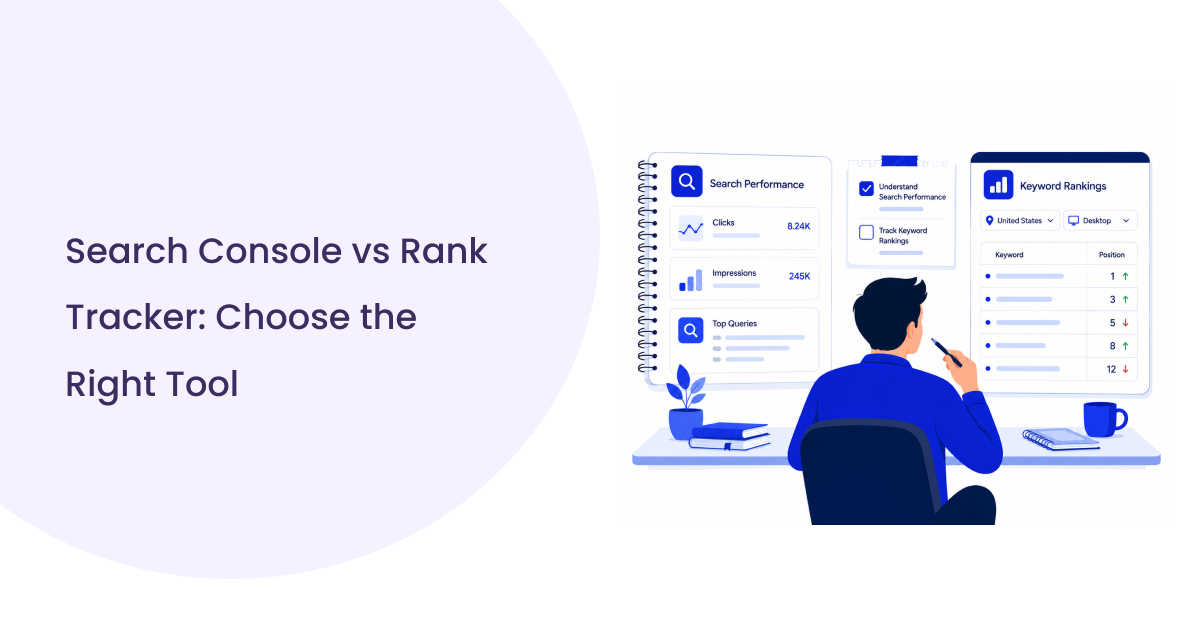
Understanding search console vs rank tracker starts with knowing that they measure search performance in different ways. Search Console shows how your website actually appeared in Google Search, while a rank tracker measures keyword positions under controlled conditions such as location and device.
The biggest difference is Average Position. It represents an aggregate of impressions, not a fixed daily ranking, which causes much of the confusion around Search Console vs rank tracker data.
This guide explains the key metric differences, where each tool works best, and why use a rank tracker api for scalable SEO tracking.
Search Console vs Rank Tracker: The Fundamental Difference
What Google Search Console Measures
GSC reports queries that generated impressions or clicks for your property, along with impressions, clicks, CTR, and Average Position, the Search Console half of Search Console vs Rank Tracker. Every number here reflects real Google user behavior, tied strictly to your own domain.
What a Rank Tracker Measures
A rank tracker follows a fixed set of target keywords and reports ranking position, SERP location, competitor rankings, position changes, and full keyword position history over time, regardless of whether anyone clicked. That is the tracker side of every rank tracker vs Search Console data picture.
The Key Difference
GSC shows what users actually saw and clicked, while a rank tracker shows where selected keywords rank under defined conditions. This is the clearest distinction in any search console vs rank tracker comparison and highlights key Google Search Console limitations.
Why Google Search Console’s Average Position Isn’t a Traditional Rank
What the Average Position Metric Actually Represents
The average position metric is built from impressions, not a single daily rank check. A keyword can show at position three for one search and position eight for another, and GSC folds both into one number, which is a key nuance inside any search console vs rank tracker review.
Why Average Position Can Hide Ranking Changes
A keyword that jumps between page one and page two throughout the week can still report a flat average, because the swings cancel each other out inside the aggregate.
This is exactly where the search console vs rank tracker gap becomes expensive if a team assumes flat means stable.
When Average Position Is Useful
Average Position works well for reading broad search visibility, spotting queries gaining or losing exposure, comparing trends over months, and finding opportunities buried inside real impression data that a plain rank number would hide.
When You Need Actual Keyword Position Tracking
Specific target keywords, daily or weekly movement, competitor comparison, SERP level analysis, and historical ranking trends all need a dedicated tracker.
GSC’s Average Position was never built to answer these, and calling it bad data misses the point. It answers a different question than search console vs rank tracker debates usually assume.
Rank Tracker vs Search Console Data: What Each One Is Best At
Search Console Wins for First-Party Search Performance
GSC wins on actual impressions, actual clicks, CTR, the real queries Google associated with your site, unexpected query discovery, and organic traffic trend measurement, the strongest half of any search console vs rank tracker split.
Rank Trackers Win for Controlled Position Monitoring
A rank tracker wins on specific keyword sets, position history, competitor rankings, search location, device-specific tracking, SERP visibility, and consistent, repeatable measurement, the tracker half of the search console vs rank tracker comparison.
| Question | Search Console | Rank Tracker |
| Did users click my page | Yes | No |
| Where does my keyword rank today | Partial | Yes |
| How do competitors rank | No | Yes |
| Which queries triggered impressions | Yes | No |
That table alone settles most search console vs rank tracker arguments in a single glance.
Where the Data Overlaps
Both tools show ranking trends and search visibility, but they measure performance differently. Understanding this distinction makes rank tracker vs search console data easier to interpret.
Why SEO Teams Often Need Both
GSC shows actual search performance, while a rank tracker shows keyword positions and movement. Together with analytics or CRM data, they provide a complete search console vs rank tracker view.
Where Google Search Console Falls Short for Rank Tracking
It Doesn’t Let You Track Every Keyword You Care About
GSC only reports queries that already generated impressions for your property. It was never built as a target keyword monitoring system, one of the clearest Google Search Console limitations teams run into, and a second one shows up fast once competitor data enters the picture.
Limited Control Over Ranking Conditions
Location, device, search environment, and SERP context stay outside your control inside GSC, another real Google Search Console limitations issue. A rank tracker fixes every one of those variables before the check runs.
Limited Competitor Position Intelligence
GSC only reports your own property’s performance. It cannot give you a competitor’s ranking history, another core limitation, and it shapes how the search console vs rank tracker comparison plays out for agencies watching Google Search Console limitations pile up.
Historical Keyword Position Analysis Is Different
Long-term position history, ranking movement, clear winners and losers, and SERP volatility all need structured tracking data that GSC’s interface was not designed to surface cleanly, a gap that widens every rank tracker vs search console data review over time.
API and Data Workflow Limitations
GSC’s own API caps query rows and historical range, one more of the practical Google Search Console limitations, which pushes teams toward a dedicated ranking data source once tracking needs grow past a handful of pages under real rank tracker vs search console data demands.
When a Rank Tracker Gives You Better SEO Decision Data
Tracking High Value Target Keywords
Commercial keywords, priority landing pages, and strategic groups need consistent daily tracking that GSC’s impression-based reporting cannot match. This is a key gap in any search console vs rank tracker review.
Monitoring Competitor Movement
A rank tracker reveals competitor position changes, new SERP entrants, and visibility gains or losses that Search Console does not show. This makes rank tracker vs search console data comparison valuable for SEO teams.
Understanding Keyword Position History
Keyword position history connects ranking changes with algorithm updates, content changes, and campaign timing. This helps turn ranking movement into actionable insights.
Measuring SERP Visibility Beyond Position
Featured snippets, AI Overviews, local results, and other SERP features add context that a rank number alone cannot provide. This is why search console vs rank tracker analysis should go beyond position data.
This is why search console vs rank tracker analysis should go beyond position data and why checking SERP features for target keywords is the natural next step after establishing position baselines.
Why Use a Rank Tracker API Instead of a Rank Tracker Dashboard?
When a Dashboard Is Enough
A dashboard works well for individual SEO tasks, small sites, manual reporting and limited keyword sets.
It can answer most small-scale search console vs rank tracker questions without extra engineering.
When an API Becomes Valuable
An API is useful for large-scale keyword tracking, custom dashboards, automated reporting, and agency workflows.
It also helps connect ranking data with other systems, showing why use a rank tracker api for a broader search console vs rank tracker strategy.
What You Can Build With Rank Tracking Data
- SEO performance dashboards.
- Automated client reports.
- Ranking alerts.
- Competitor monitoring systems.
- Keyword opportunity systems.
- Internal SEO analytics pipelines.
Why API Based Rank Tracking Is Different From Exporting CSVs
A CSV export is a periodic snapshot pulled by hand, and that gap is exactly what pushes a search console vs rank tracker strategy toward an API.
An API delivers programmatic, repeatable, and scalable access, which is the real answer to why use a rank tracker api at meaningful scale, far beyond what manual exports can support.
What to Look for in a Rank Tracker API
Ranking Data Accuracy and Consistency
- Defined search conditions, location accuracy, device support, and reliable historical data determine whether the numbers can be trusted.
- These factors matter in every search console vs rank tracker audit and Google Search Console limitations review.
Keyword and SERP Coverage
- Search engine coverage, location depth, SERP feature detection, and competitor data create a more complete view.
- These capabilities are often missing from spreadsheets and highlight practical Google Search Console limitations to consider.
Historical Data and Change Tracking
- Position history, ranking change logs, stored SERPs, and trend analysis turn individual pulls into useful data over time.
- This builds reliable keyword position history and shows why use a rank tracker api for scalable tracking.
API Reliability and Scalability
- Request limits, response consistency, data freshness, documentation, and integration effort determine whether a team can reliably build on the feed.
- These factors matter more than any single rank tracker vs search console data feature comparison.
Data Cost and Operational Efficiency
- Never compare API price alone. Consider cost per tracked keyword, query volume, storage, engineering effort, and reporting needs together.
- The why use a rank tracker api decision should be based on total value, not price alone.
The Hidden Cost of Relying on Search Console Alone
You May Know Traffic Changed Without Knowing Exactly Why
GSC shows that performance moved. Controlled rank tracking isolates whether the movement came from your own page or from the wider SERP, a distinction at the heart of the search console vs rank tracker question.
You Can Miss Competitor Movement
Rankings can drop because a competitor improved, and GSC alone will never show you which one happened, another reason teams run a full rank tracker vs search console data review before assigning blame internally.
Manual Ranking Checks Don’t Scale
Agencies, enterprise SEO teams, multi-location brands, and large keyword portfolios cannot run manual checks fast enough to catch real movement, which is exactly why using a rank tracker api stops being a nice question and becomes urgent.
The Real Cost Is Poor SEO Decision Making
Missed opportunities, delayed reactions, reporting inefficiency, and incomplete competitive intelligence all stem from the same root cause: relying on one data source for a job that needs two, a real cost of skipping proper search console vs rank tracker planning across the whole team.
Search Console With Rank Tracker: The Best Data Strategy
Use Search Console for Real Search Performance: Impressions, clicks, CTR, actual queries, and landing page performance all belong to Search Console’s side of the search console vs rank tracker strategy, free of the usual Google Search Console limitations around ranking depth.
Use Rank Tracking for Controlled Measurement: Target keywords, position history, competitors, SERP conditions, and visibility monitoring belong to the rank tracker side of the same search console vs rank tracker strategy, the piece GSC alone can never cover.
Connect Both With Business Data: GSC shows what happened in Google Search. A rank tracker shows where and how you rank. Analytics or CRM data shows what it meant for the business. Layer all three, and the search console vs rank tracker debate stops being a choice at all.
Which One Should You Use? A Practical Decision Framework
Choose Google Search Console If
- First-party search performance and actual site visibility are the priority.
- Impressions, clicks, and CTR data are required.
- Discovering real search queries is important.
- Organic traffic trends need to be analyzed.
A Rank Tracker Works Best If
- Target keyword monitoring is required.
- Keyword position history needs to be tracked.
- Competitor rankings need to be monitored.
- Location or device tracking needs to be controlled.
Consider a Rank Tracker API If
- Ranking data needs to be collected at scale.
- SEO workflows and reporting need automation.
- Custom analytics or reporting systems are being built.
- Programmatic access to SERP data is required.
Why SEO Teams Choose SERPHouse for Rank Tracking
SERPHouse brings ranking, competitor, and SERP feature data together through one reliable rank tracker api. It gives SEO teams the historical data and flexibility they need without relying on spreadsheets or multiple disconnected tools.
- Monitor large keyword sets without manual checks.
- Track ranking changes and long-term trends.
- Monitor competitor rankings and visibility changes.
- Track featured snippets, AI Overviews, local packs and more.
- Connect ranking data with dashboards, reports, and internal SEO tools.
- Go beyond basic GSC data with controlled and scalable tracking.
If you want to see how SERPHouse fits your workflow, try it with a few priority keywords and see the data for yourself.
Conclusion
Google Search Console and rank trackers serve different purposes, so choosing between them depends on the data your SEO workflow requires. GSC provides first-party search performance, while rank trackers deliver controlled keyword rankings, competitor insights, and keyword position history.
For larger operations, a rank tracker api adds automation, scalability and flexible integration with existing systems. Understanding these differences helps teams avoid relying on a single data source and build a more complete SEO measurement process. With the right combination of tools, ranking data becomes easier to monitor, analyze, and turn into actionable decisions.
FAQ
Is Google Search Console a rank tracker?
No. GSC reports impressions and clicks tied to your own property, while a rank tracker measures keyword position under conditions you control, including location and device. This is the short answer to most Search Console vs rank tracker questions.
What is the difference between Search Console and a rank tracker?
GSC shows real search performance data from actual users. A rank tracker shows controlled ranking positions for a fixed keyword list, checked on a consistent schedule, the core of any rank tracker vs search console data comparison.
Why is GSC Average Position different from rank tracker data?
Average Position blends every impression a query received across positions into one number, while a rank tracker reports the position it found during one defined, repeatable check, a gap worth knowing before any rank tracker vs search console data review.
Can Google Search Console track keyword position history?
GSC stores limited historical data through its interface and API, and it was not built for long-term keyword position history the way a dedicated rank tracker was, one of the plainer Google Search Console limitations to plan around.
Why use a rank tracker API?
An API delivers programmatic, scalable access to ranking data for dashboards, automated reports, and internal platforms, replacing manual CSV exports with a repeatable data pipeline. This is exactly why use a rank tracker api beats a dashboard alone at scale.
Should I use Search Console and a rank tracker together?
Yes. GSC shows what happened in search, a rank tracker shows where you rank and why, and using both gives a far more complete view than either search console vs rank tracker source alone.
google keyword rankings Google rank tracker google search console google search console api google search rankings Google SEO tools google serp tracker Keyword position tracker keyword rank tracker keyword ranking tool rank tracking tool search console vs rank tracker search engine ranking SEO rank tracker serp tracking