
Table of Contents
Table of Contents
Getting video data from search results sounds simple until you try to use it consistently. Rankings shift, layouts change, and results vary by location and device. Manual checks don’t scale, and scraping often breaks when SERP structures update.
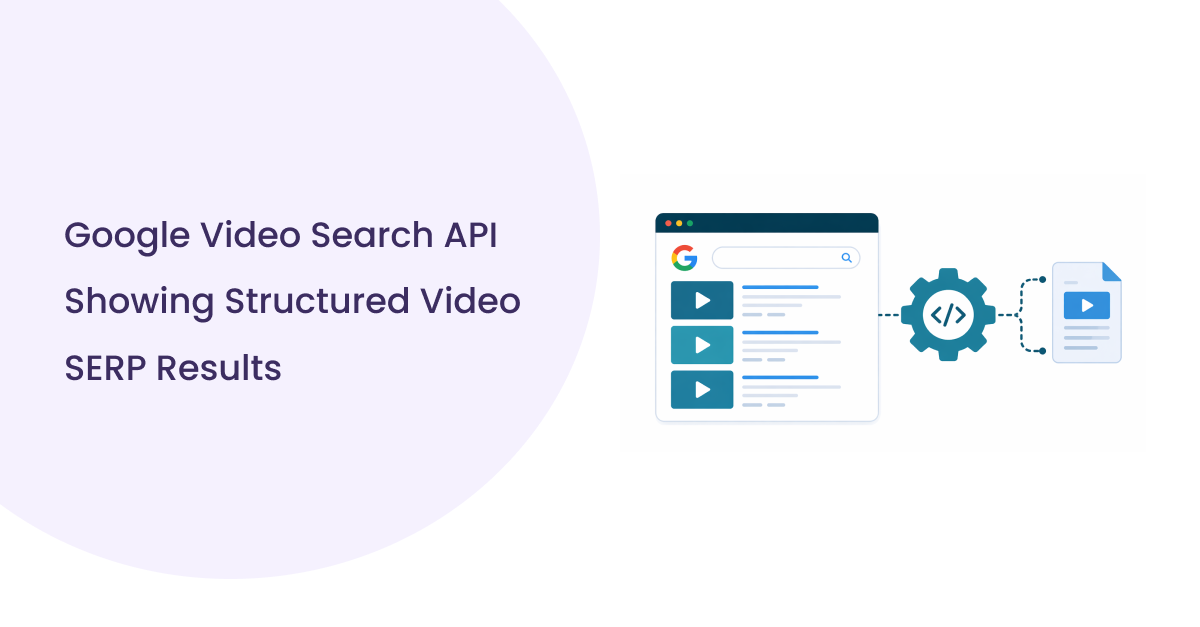
A Google Video Search API solves this by turning unstructured video results into usable data. Instead of guessing visibility, you get structured outputs like rankings, metadata, and placement across queries.
This makes it possible to track video performance, analyze trends, and build data-driven workflows without dealing with unreliable or incomplete results.
What Problems a Google Video Search API Solves
Why manual video search doesn’t scale
Manual checks work for a handful of keywords. Beyond that, they break fast. You’re opening tabs, switching locations, comparing devices, and still ending up with inconsistent snapshots.
A typical workflow: check a query on the desktop, then the mobile, then try another location. The results shift each time. Now multiply that across 50 or 100 keywords. The process becomes slow, error-prone, and impossible to repeat consistently.
Without structured output, you can’t store, compare, or analyze results. It’s an observation, not data.
Where traditional scraping breaks in video SERP data
Scraping looks like a solution until real-world conditions kick in. Video SERPs are dynamic. Layouts change, carousels shift, and pagination behaves differently across queries.
Common breaking points include:
- Dynamic rendering that requires JavaScript handling
- Frequent layout changes in video blocks
- Localization affecting result order
- Rate limits and captcha interruptions
Even when scraping works, consistency is the issue. Data can differ across runs, making it unreliable for tracking or analysis. This is where a Video Search API becomes necessary, structured, repeatable data without constant maintenance.
How a Google Video Search API Actually Works
Query-based video results extraction from Google
At its core, a Google Video Search API works through a simple flow: input → request → structured output. You send a query with parameters like keyword, location, and device. The system then fetches results from Google video search and extracts video listings from the SERP.
This is not just about collecting links. It involves identifying video blocks, parsing rankings, and capturing how results appear in context. That’s what makes a video serp api useful for consistent data collection across multiple queries.
How video SERP data is structured and returned
Once extracted, the data is returned in structured JSON. Each result is organized into fields that make it usable for analysis or integration.
Typical response includes:
- Title, URL, and thumbnail
- Video duration and source
- Ranking position in results
- Additional metadata depending on the video data api
This structure is what enables reliable tracking. Without it, comparing video ranking across keywords or time becomes inconsistent.

Key differences: Google Videos API and YouTube SERP API
The main difference comes down to coverage and use case. One reflects search-wide visibility, the other focuses on a single platform.
| Aspect | Google Videos API | YouTube SERP API |
| Data Source | Google video search (multiple platforms) | YouTube only |
| Coverage | Cross-platform (YouTube, news, websites) | Platform-specific |
| Use Case | Video SEO, visibility tracking, SERP analysis | Channel insights, video metrics |
| Data Type | Search-based results (ranking, placement) | Platform data (views, engagement) |
| Best For | Broad video ranking api workflows | YouTube-focused analysis |
If your goal is understanding how videos rank across search, a google videos api provides broader insight. If you’re focused only on YouTube performance, a youtube serp api is more relevant.
The choice is not about better or worse. It’s about scope.
What Data You Can Extract from Google Video Search
Core fields: titles, thumbnails, URLs, and positions
A Google Video Search API returns structured fields that map directly to how videos appear in search. The basics, title, URL, thumbnail, and rank position are not just display elements. They define visibility.
The title reflects relevance to the query. The thumbnail drives clicks. The URL identifies the source (YouTube, publisher site, etc.). Position shows where the video appears within the results. Together, these fields form the foundation of any video serp api workflow.
With a google videos api or video data api, these elements are returned in a consistent format, making it possible to store and compare results over time.
Video ranking signals and visibility indicators
Beyond core fields, ranking behaviour matters. Position alone doesn’t tell the full story. You need to understand why a video appears where it does.
Key signals include:
- Placement within the SERP (top carousel vs lower listings)
- Source authority (YouTube vs external site)
- Freshness (recent vs older content)
- Engagement hints (views, duration relevance)
A video ranking api helps capture these patterns. For example, videos in the top carousel often have higher visibility than standard listings, even if their numeric position is similar.
Understanding video SERP features
Video results don’t appear in a single format. Google video search includes multiple layouts:
- Carousels (horizontal video blocks at the top)
- Embedded results within standard listings
- Mixed results blended with web pages
Each format affects visibility differently. A video in a carousel often gets more attention than one embedded lower in the page.
Video results extraction needs to capture these variations, not just raw rankings. This is where tools like SERPHouse, which provide a google videos api, help standardize these formats into usable data.
Google Video Search API vs Other Video Data Sources
Video SERP API vs general web scraping approaches
A Google Video Search API is designed to return clean structured video results from Google. You get titles, thumbnails, URLs and rank positions without constantly fixing parsers.
In real use this changes a lot. The data stays consistent. You also get real SERP context such as carousel embeds and mixed results, instead of raw page markup. With scraping, things break often. Layouts shift across regions and devices and video blocks appear differently. Maintenance quickly becomes a bigger problem than data collection.
When to use a dedicated video ranking api
A video ranking api becomes useful when you care about visibility not just data collection. Ranking is not only about position. It depends on where the video appears, how it is displayed and which source it comes from.
Use it when you want to track actual positions, compare carousel placements, understand source impact and work with reliable video results extraction.
What Makes Video SERP Data Reliable
Importance of real-time data vs cached results
Video SERP data is reliable when it is fetched in real time, reflects current rankings and updates frequently. Cached data can miss short-term fluctuations and lead to decisions based on outdated visibility.
A common case rankings look stable in reports but traffic drops. The issue is not performance; it is stale data.
Consistency across locations and devices
Search results vary by location and device. If your dataset comes from a single environment, it is incomplete. Reliable tracking requires controlled queries across multiple locations and device types using the same parameters each time.
Teams often miss this. They compare rankings from mixed conditions and assume movement where there is none or miss changes that matter.
Structured output for scalable applications
At scale structure matters more than raw data. Manual workflows and scraping pipelines break under load. Pagination shifts layouts change captchas appear and rate limits interrupt runs. Results become inconsistent across batches.
A Video Search API solves this by returning normalized fields with repeatable schemas. That consistency allows you to store, compare, and analyze video rankings across thousands of queries without rebuilding parsers every time something changes.

Choosing the Right Google Video Search API
Accuracy, coverage, and data freshness
The first thing to check is how close the data is to real search conditions. Many tools return simplified or cached results, which look stable but don’t reflect actual changes.
A reliable setup should:
- Capture rankings across different locations and devices
- Include results from multiple sources, not just one platform
- Update frequently to reflect real-time shifts
Scalability for large keyword sets
What works for 10 keywords usually fails at 100.
Manual checks become slow. Scraping setups start breaking with pagination issues, layout changes, rate limits, and captcha blocks. Even when data is collected, it’s often inconsistent.
At scale, you need:
- Stable data across large keyword sets
- Consistent results across multiple runs
- No dependency on fragile scraping logic
This is where reliability becomes more important than speed.
Integration considerations for developers and teams
Even good data becomes useless if it’s hard to work with.
Developers need structured output that fits directly into workflows. If the API returns inconsistent formats, teams end up spending more time fixing data than using it.
Look for:
- Clean and predictable response structure
- Easy parameter control for queries
- Minimal maintenance over time
The goal is simple. Spend less time managing data, more time using it.
Final Thoughts
Accessing video search data is no longer the hard part. Doing it reliably is.
A Google Video Search API gives you structured access to video results, but the real value comes from how consistent and usable that data is over time. Rankings change, layouts shift, and search behaviour varies across users. Without a reliable setup, those changes are easy to miss.
The difference shows up in decisions. Clean, consistent data helps you understand what is actually happening. Incomplete or delayed data creates false confidence.
For small checks, simple tools may be enough. But once you start tracking multiple keywords, locations, or trends, reliability becomes critical.
The goal is not just to collect video results. It is to work with data you can trust, compare, and act on.