
Table of Contents
Table of Contents
A client’s product page holds position 2 for their main category term. That’s what the rank tracker reports, and it’s correct.
Then the client forwards a screenshot. They searched the same term, got a Google AI Overview, and the only source cited inside it is a competitor’s blog post. Position 2 didn’t matter here. The citation did.
That gap is what AI Overview and ChatGPT rank tracking is built to close. It isn’t a replacement for keyword position data; it’s a separate layer of measurement, because Google’s AI Overviews and ChatGPT don’t return a ranked list of ten results. They return a generated answer, sometimes with sources attached and sometimes without. Whether a brand appears inside that answer has surprisingly little to do with where its page sits in the organic results underneath it.
What AI Overview and ChatGPT Rank Tracking Actually Measures
AI Overview and ChatGPT rank tracking is the practice of monitoring whether a brand, domain, or page is mentioned or cited inside AI-generated answers, rather than tracking a fixed position in a results list. It measures presence and citation, not rank.
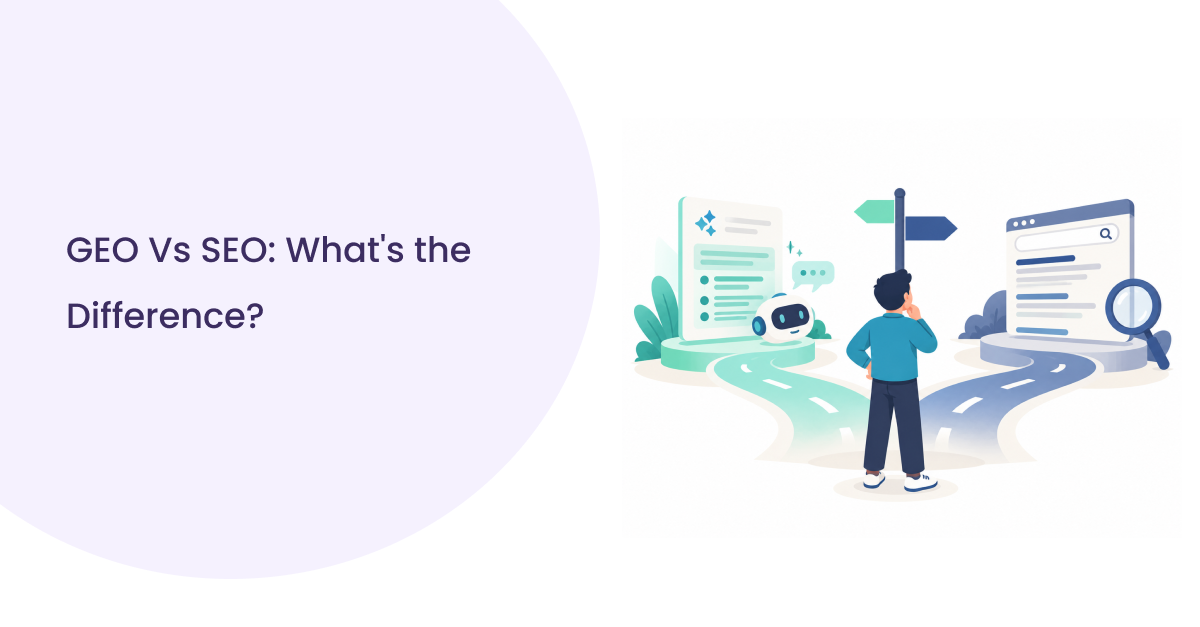
The discipline built around doing this well now has a name: generative engine optimization (GEO) the practice of shaping content so it gets retrieved and cited by AI systems, as distinct from traditional SEO’s focus on ranking a page in a list of links. It’s sometimes called answer engine optimization (AEO) instead, depending on which vendor is using the term. Neither is about geography; the “geo” here means “generative,” not “location.”
A traditional rank tracker checks a keyword against a location and device and hands back a number. AI visibility tracking checks a query against an AI system and hands back something messier: an AI Overview that may or may not appear, a citation that may point to your domain or a competitor’s, and a result that can change on a re-check an hour later with no movement in the organic rankings underneath it.
5 metrics are worth tracking as separate fields, not one blended score:
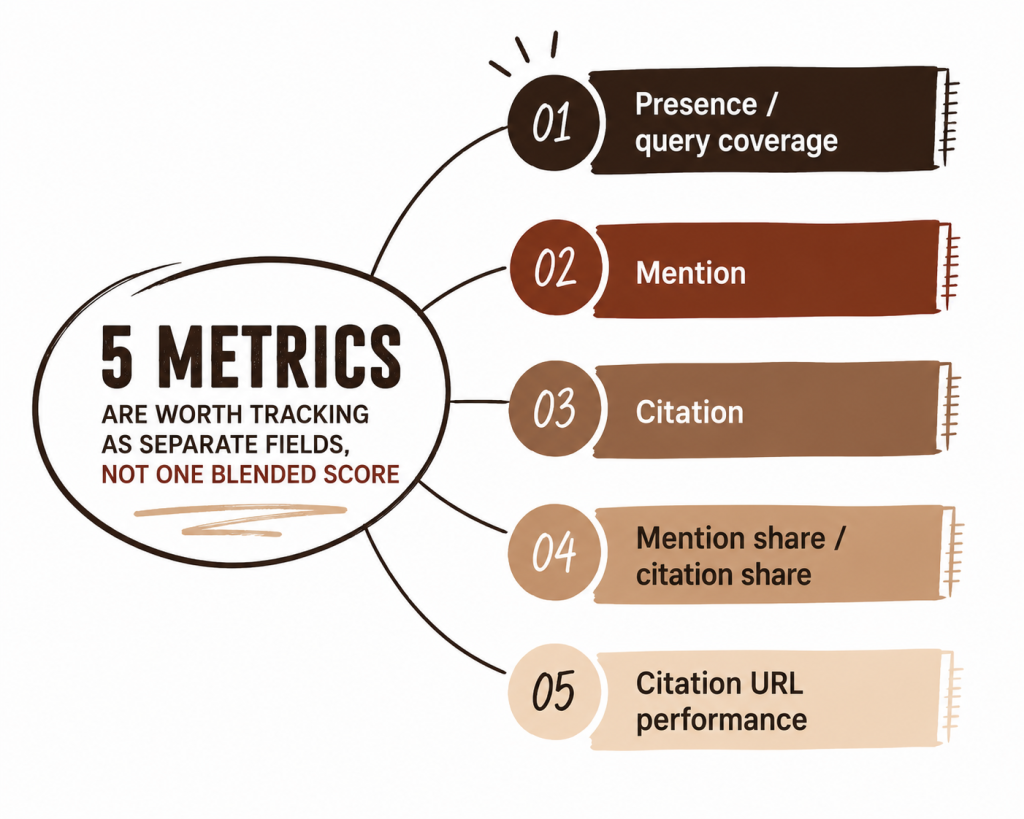
- Presence / query coverage: how often your brand appears at all across a tracked query set, expressed as a rate.
- Mention: your brand name shows up in the generated text, cited or not.
- Citation: a mention backed by an actual retrieved source URL, as opposed to a name the model recalled from training data. A citation reflects a page that was retrieved and read at the moment of the query. A training-data mention reflects what the model happened to learn at some point in the past, which could be stale.
- Mention share/citation share of the queries where your competitor set shows up at all, what portion of the mentions or citations are yours versus each named competitor’s.
- Citation URL performance: which specific pages earn citations, and how often. This is the most actionable line item in the set, since it points directly at content that’s already working.
Why Ranking #1 Doesn’t Guarantee an AI Overview Citation
A page generally has to be indexed and eligible for a normal organic listing before it can be pulled into an AI Overview as a supporting source. Clearing that bar doesn’t guarantee inclusion, though, and organic position isn’t what decides it.
Some AI Overviews cite pages ranking well outside the top ten. Others cite no page from the visible organic results at all. A team watching only position data will see a stable #1 and assume visibility is intact, while the AI Overview for that exact query has quietly started citing someone else.
Traditional rank tracking still confirms indexation health and remains the most stable long-run signal available in SEO reporting. It just isn’t sufficient by itself anymore.
Here’s what that gap looks like in practice. The table below is a hypothetical illustration, not real tracked data, but it’s the pattern worth watching for:
| Query | Organic position | AI Overview present? | Cited? | Citation URL |
| “best project management software for small teams” | #1 | Yes | No | A competitor’s comparison page is cited instead |
| “how to migrate from Trello to Asana” | #4 | Yes | Yes | Your migration guide |
| “project management software pricing 2026” | #14 | No | — | — |
The middle row is the pattern that matters most: a page outside the top three earning the citation that the #1 page in the same cluster didn’t. That’s the signal a rank tracker alone can’t surface.
How Google AI Overview Tracking Works
Google AI Overview tracking works by checking whether a specific query triggers an AI Overview, then recording whether your domain is cited inside it, which URL was cited, and how that citation changes across repeated checks over time. It’s a presence-and-citation check, not a position check.
In practice, running this means checking a defined query set on a schedule and logging, each time:
- Whether an AI Overview appeared at all for that query, location, and device.
- Which domains and URLs were cited, and where inline in the answer text versus a linked source list below it.
- Whether the citation set changed since the previous check, including citations that disappeared entirely.
- How results vary by location, since AI Overview presence and citation selection shift by country and city the same way traditional SERPs do.
Because AI Overviews render as a structured block inside the results page, they can be captured through repeated, structured queries against a SERP API rather than manual searching the same approach used for capturing any other SERP feature.
Google Search Console AI Performance Data
There’s also a newer, narrower data source worth knowing about. On June 3, 2026, Google introduced a dedicated Generative AI performance report inside Search Console, rolled out initially to a subset of properties for testing before wider availability. The report shows impressions, how often URLs from a site appeared in generative AI features in Search and Discover, broken down by page, country, device, and date.
That’s a genuinely useful confirmation signal, but its limits matter. There are no clicks, no average position, and no query-level breakdown. You can see that a page picked up AI-feature impressions; you can’t see which query triggered them or what the cited answer said. That gap is exactly why query-level AI Overview monitoring, run separately from Search Console, is still necessary if the goal is knowing which specific queries are citing you.
How ChatGPT Visibility Tracking Works (and Where It Breaks Down)
ChatGPT visibility tracking means running a defined set of prompts through ChatGPT’s search-enabled experience and recording whether your brand or domain is mentioned or cited. ChatGPT has no ranking position at all only mentions, citations, and source links that appear when a response is grounded in a live web search.
That distinction matters because a meaningful share of ChatGPT conversations never trigger a live search. When one does, the response may show inline citations or a source panel underneath it. When it doesn’t, the answer is generated purely from training data, and a brand name showing up there isn’t a citation and shouldn’t be reported as one.
This creates a few practical challenges traditional rank tracking never had to deal with:
Reproducibility is limited
The same prompt, run twice within seconds, can return different phrasing, a different set of cited sources, or no citations at all. A single check is a sample, not a stable measurement; tracking needs to run the same prompt set repeatedly over time to see a pattern instead of treating one result as fact.
Prompt phrasing moves the outcome more than keyword phrasing moves a Google result
“Best rank tracking tool” and “what’s a good tool for tracking keyword rankings” can surface entirely different brand mentions, even though a rank tracker would treat those as close variants of the same keyword. Build tracking around clusters of prompt variations for a topic, not one canonical phrase.
There’s no public, sanctioned rank-tracking API for consumer ChatGPT
Monitoring it currently means running prompts through the actual interface, or a configured model call where one is available, and logging what comes back a heavier, more manual process than pulling structured SERP data-and it shouldn’t be described as equally reliable.
ChatGPT’s search feature uses retrieval-augmented generation, pulling documents from the web via its own crawler and a Bing index partnership, then incorporating them into the generated answer. The same retrieve-then-generate pattern shows up in Google’s AI Mode. The citation behavior isn’t unique to ChatGPT; it’s a property of how retrieval-augmented systems work in general.
AI Visibility Tracking vs. Traditional Rank Tracking
| Data point | Traditional rank tracker | AI visibility tracker |
| Core output | Numeric position | Presence / mention / citation |
| Ranking URL | Exact URL per keyword | Citation URL, when one exists |
| Brand mention | Not applicable | Core metric |
| Competitor comparison | Position-based | Mention share / citation share |
| Query coverage | Implied by keyword list size | Explicit % of queries with any presence |
| Search engine / model | Google, Bing, etc. | Google AI Overviews, AI Mode, ChatGPT search, others; each behaves differently |
| Reproducibility | Highly stable over short windows | Lower; repeated checks can return different results |
This table isn’t a scorecard for which approach wins. AI visibility tracking adds a layer on top of position data; it doesn’t replace the fields a keyword tracker already reports. Dropping position tracking in favor of AI visibility tracking alone means giving up the longest-running, most stable signal in the whole measurement stack.
Building a Practical AI Search Tracking Workflow
A workable version of this, in order:
- Build a query set from the same keyword research feeding your rank tracker.
- Group queries into intent clusters, then expand each cluster into two or three prompt phrasing variations for the ChatGPT side.
- Run standard Google rank checks against the query set on your normal schedule.
- Check AI Overview presence for the same queries, on the same day, close together in time.
- Record brand and domain mentions inside any AI Overview that appeared, cited or not, along with the specific citation URLs, not just the citing domain.
- Run the same prompt clusters through ChatGPT’s search-enabled experience, logging mentions and citations as separate fields.
- Track which competitors appear in your place, by query, on both platforms.
- Compare against the previous cycle to spot new gains, new losses, and citations that vanished.
- Flag which of your own pages earn citations repeatedly, and treat that pattern as worth extending to adjacent pages in the same cluster.
- Prioritize content updates on queries where organic position is strong but AI presence is absent; that combination is the clearest content signal the workflow produces.
Comparing steps 3 and 4 side by side is what surfaces the position-without-citation gap, usually the single most useful finding this workflow produces.
One thing worth stating plainly, since teams new to this tend to over-read single checks: a morning run and an afternoon run of the same query returning different citations isn’t evidence that something broke. That’s expected variance in how these systems retrieve and generate, not a monitoring error and it’s exactly why this workflow runs on a repeated schedule rather than a one-time audit.
How Different Teams Use This Data
SEO agencies use it to explain a ranking report that no longer tells the full story to a client who’s already seen a competitor’s AI Overview screenshot.
SaaS companies watch citation share on “best tool for X” queries, where an AI answer naming three competitors and not them has pipeline impact before a prospect ever reaches the site.
Enterprise teams use query coverage and mention share to justify content budget at scale. A low coverage rate across a large query set is a cleaner argument than a handful of screenshots.
Content teams use citation URL performance to find which existing pages already earn citations, then study why. AI systems tend to cite pages that answer a query directly and concisely, not ones that bury the answer under a long introduction.
Publishers track citation share as a rough proxy for referral value, since a citation without a clickable link changes the economics of content that used to earn traffic through organic snippets alone.
Common Mistakes to Avoid
- The most common one is treating a single AI Overview or ChatGPT check as a stable result; both systems can return a different answer for the same query within the same day.
- Close behind it: reporting a text mention and a sourced citation as the same event, when they carry different weight and belong in separate fields. Dropping traditional rank tracking once AI visibility tracking starts is another; it throws away the most consistent long-run signal available. So is tracking one canonical keyword per topic instead of a cluster of phrasing variants, which undercounts visibility on topics where the model answers close variants differently.
- The last one is the easiest to fall into: assuming AI Overview inclusion correlates with organic position. It doesn’t reliably, and building a content strategy on that assumption misallocates effort toward pages that already rank well instead of the pages actually missing from AI answers.
Where SERPHouse Fits and Where It Doesn’t
SERPHouse covers two pieces of this workflow directly.
Its Rank Tracker handles traditional Google keyword position tracking, ranking URL, device, and location, run on a schedule with full history retained. Separately, its Google SERP API can extract the AI Overview block from a results page as structured data cited source URLs, domains, and anchor text pulled on a recurring schedule to detect when a tracked query’s AI Overview changes, expands, or disappears. That covers the Google-side checks in the workflow above.
What it doesn’t cover: ChatGPT prompt tracking, cross-platform mention-share scoring, or a packaged AI visibility score. A team building the full workflow needs a separate method for the ChatGPT half, and would assemble mention-share and citation-share metrics themselves from the structured Google-side data, something teams already running automated pipelines can do through the Web Search API or a RAG pipeline integration, with setup details in the documentation.
FAQ
Can you track Google AI Overview rankings?
There’s nothing to “rank” in the traditional sense, since AI Overviews don’t have a numbered position. What’s trackable is presence, citation, and placement within the answer, using structured SERP data pulled on a schedule against a defined query set.
How do you track ChatGPT visibility?
Run a defined set of prompts and phrasing variations through ChatGPT’s search-enabled experience on a repeated schedule, recording brand mentions, citations with source links when they appear, and competitor mentions. A single check isn’t a reliable result, since identical prompts can return different results between runs.
Is ChatGPT rank tracking the same as keyword rank tracking?
No. Keyword rank tracking reports a fixed position for a URL against a keyword. ChatGPT produces mentions and, when a response is based on a live search, citations with source links a different signal that needs a different tracking method.
Why should SEO teams track AI citations?
A citation shows which specific pages an AI system trusted enough to retrieve and reference, a stronger content-quality signal than a mention alone. Tracking citation URLs over time shows which content patterns earn that trust and which topics have no citation coverage at all.
Can AI search visibility replace traditional rank tracking?
No. Traditional rank tracking remains the more stable, longer-running signal, and organic results still drive most search traffic. AI visibility tracking adds a layer on top of position data; it doesn’t substitute for it.
How often should AI search visibility be monitored?
On a recurring schedule, not as a one-time audit. AI Overview and ChatGPT results can change without any change in underlying organic rankings. Weekly checks against a fixed query set are usually enough to catch citation changes before they compound into a larger visibility gap.