
Table of Contents
Table of Contents
TL;DR: A keyword rank tracker API turns manual SEO checks into a repeatable data pipeline. Teams that automate ranking pulls across markets and devices cut reporting time and catch visibility drops before revenue takes the hit. Choosing the right API comes down to data trust, not feature count.
Most teams buy a keyword rank tracker api for the wrong reason. They think it replaces a dashboard. It actually replaces a bottleneck. Manual rank checks break the moment you add a second market, a third device, or a client who wants daily updates. A programmatic API removes that ceiling entirely.
This guide explains where the value actually comes from, how to validate the data before you trust it, what it costs at real production volume, and how to decide if your team even needs one yet. By the end, you will know exactly how to shortlist a keyword rank tracker api without wasting a demo call on the wrong vendor.
What Makes Keyword Ranking Data Useful Beyond a Position Number?
The Minimum Data a Rank Tracking API Should Return
A position number by itself tells you almost nothing. A usable keyword rank tracker api returns the keyword, position, ranking URL, location, device, search engine, and timestamp together.
Reproducing an observation later depends on all seven fields. Drop the location or device field and your historical data becomes unreliable within weeks.
SERP Context Changes Search Visibility
- Position 3 today does not mean what position 3 meant last quarter. A keyword rank tracker api that ignores featured snippets, People Also Ask boxes, local packs, shopping results, and video carousels hands you a number without the story behind it.
- A page can hold the same spot while real clicks drop because three new SERP features pushed it below the fold.
- This is the gap most cheap tools miss, and it is why raw position tracking alone stopped being enough years ago.
- Teams that pair position data with SERP position monitoring across feature types make better content calls because they see what actually competes for the click.
5 High Value Use Cases for a Keyword Rank Tracker API
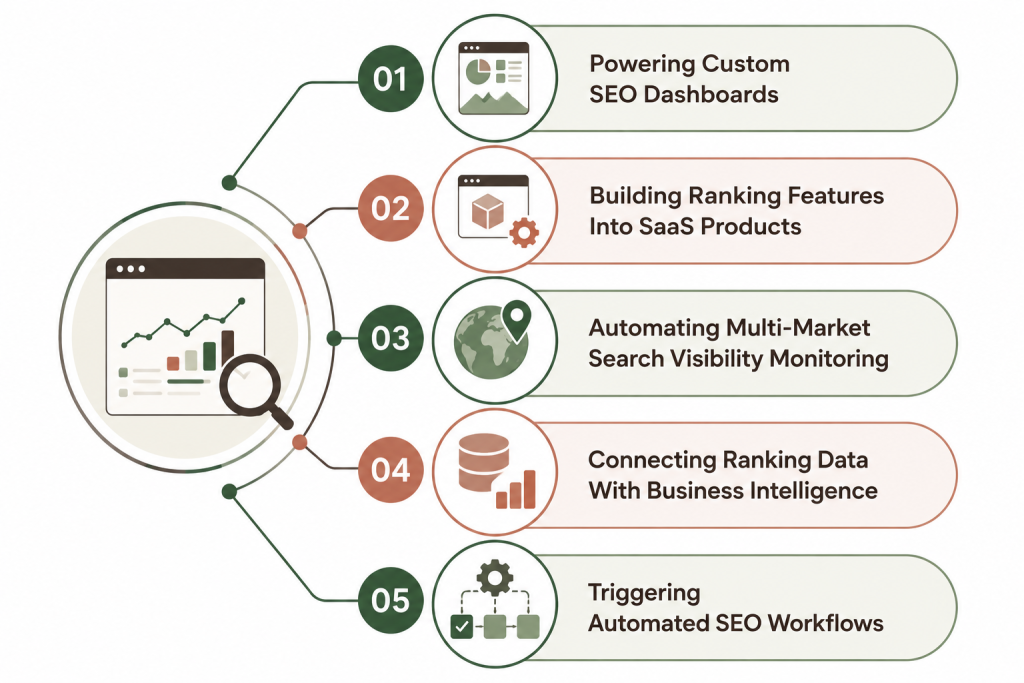
Powering Custom SEO Dashboards
- Agencies stop fighting third-party interface limits when they pull raw data through an automated keyword rank tracker api and build their own view.
- Client reports match the agency’s own branding and logic instead of a vendor’s template.
Building Ranking Features Into SaaS Products
- Product teams use a keyword rank tracker API as backend infrastructure for customer-facing features.
- Keyword monitoring, competitor visibility, ranking alerts, and automated reports become part of the product itself, not just an export feature.
Automating Multi-Market Search Visibility Monitoring
- Tracking rankings across countries, cities, languages, and devices by hand does not scale past a handful of markets.
- A centralized keyword rank tracker api handles the volume while keeping every market on the same refresh schedule.
Connecting Ranking Data With Business Intelligence
- Ranking data earns its keep when it sits next to organic traffic, conversions, and revenue inside a data warehouse.
- A keyword rank tracker api feeding a BI platform turns “we rank well” into “this keyword drove nine converting visits last week.”
Triggering Automated SEO Workflows
| Trigger | Action | Outcome |
| Ranking drop | Alert fires, page flagged | Content owner investigates same day |
| Competitor gain | Detected, SERP re-analyzed | Content gap identified |
| New ranking appears | Keyword added to monitoring | Coverage grows without manual entry |
| SERP feature shifts | Content review triggered | Page updated for the new format |
This is where an automated keyword rank tracker api earns more than a dashboard ever could. A dashboard shows you a problem after you go look for it. A workflow finds the problem and hands you the fix path automatically.
How Do You Validate the Accuracy of a Rank Tracking API?
Test the API Against Real Search Conditions
Run a mixed sample across country, city, mobile, desktop, and language settings before signing anything. Include a few brutally competitive keywords and a few hyper-local ones.
A keyword rank tracker api that performs well on easy sample queries and falls apart on real production keywords is a common trap buyers walk into during a demo.
Measure Consistency Over Time
Pull the same keyword set daily for two weeks and watch for ranking URL swaps, missing results, and unexplained jumps. A trustworthy keyword rank tracker api produces boring, consistent data most days.
Sudden gaps or repeated fluctuations on stable keywords are a warning sign, not noise. Accuracy is not a single correct answer once. It is the same correct answer showing up reliably across dozens of pulls and changing search conditions.
Which Ranking Data Dimensions Matter as You Scale?
Location, Device, Language, and Search Environment
International SEO, local SEO, and mobile-first audiences each demand granular tracking. A keyword rank tracker api built only for single-country desktop tracking will not stretch to cover competitor monitoring across five languages without real rework.
Historical Data and Refresh Frequency
Campaign monitoring needs daily pulls. Long-term SEO reporting can run on weekly snapshots.
A keyword rank tracker api priced around refresh frequency lets you match spend to actual monitoring need instead of paying for hourly updates on keywords nobody checks that often.
Keyword Rank Tracker API Cost: What Will You Actually Pay at Scale?
Calculate Your Real Tracking Volume
Multiply keywords by locations, by devices, by tracking frequency. That number, not the sticker price, tells you what an automated keyword rank tracker api truly costs. Add SERP depth, competitor tracking, retries, and any historical backfill on top.
Cost per tracked keyword market device combination is the number worth comparing across vendors evaluating an API for real production use.
Compare Pricing Models Correctly
| Model | How It Charges | Watch Out For |
| Request based | Per API call | Retries multiply cost fast |
| Credit based | Bundled usage | Unused credits often expire |
| Result based | Per returned data point | SERP depth inflates totals |
| Subscription based | Flat recurring fee | Overage fees outside the plan |
The effective production cost matters far more than the headline number. Factor in failed requests, reprocessing time, engineering hours, storage, and the pain of switching vendors later.
How to Measure ROI From a Rank Tracking API
Quantify Operational Savings: Compare hours spent on manual tracking, report prep, and data consolidation before and after automation.
A keyword rank tracker api typically removes days of analyst work every month once reporting runs on a schedule instead of a spreadsheet.
Connect Search Visibility to Business Outcomes: The real payoff shows up when ranking opportunities, losses, and competitor gains connect back to organic traffic, leads, conversions, and revenue.
ROI from a keyword rank tracker api should count both the hours saved and the faster decisions it enables.
KPIs to Measure After Implementing a Rank Tracking API
Search Visibility and Ranking KPIs: Track search visibility, ranking distribution, share of SERP, competitor visibility, and ranking volatility on a fixed schedule.
API and Cost KPIs: Watch API success rate, data freshness, cost per tracked keyword, request failure rate, and average processing time. An automated keyword rank tracker api slipping on any of these five quietly erodes the value case you built to justify buying it.
Business Impact KPIs: Where the data connects, track organic traffic, conversion rate, leads, and revenue influenced by organic search. Treat the keyword rank tracker api as infrastructure, not a line item on an SEO invoice.
Rank Tracking API vs SEO Rank Tracking Tool: Which Fits Your Business?
| Factor | Rank Tracking API | SEO Rank Tracking Tool |
| Data access | Programmatic | Interface based |
| Automation | High | Moderate to high |
| Custom reporting | Highly flexible | Platform dependent |
| Product integration | Strong | Limited |
| Scalability | Depends on API capacity | Depends on plan |
| Engineering involvement | Required | Lower |
| Best fit | Products, platforms, enterprise workflows | Teams needing ready made SEO workflows |
When an API Has the Stronger Business Case
High keyword volume, multiple markets, custom dashboards, SaaS integration, and data warehouse needs push the decision toward a keyword rank tracker api.
A small in-house team checking fifty keywords a month rarely needs one. A rank tracking api earns its cost when the volume and integration demands outgrow what a plan-based tool can flex to.
Can the API Handle Your Next Stage of Growth?
Evaluate Throughput and Concurrency
- Check rate limits, concurrent request caps, bulk processing support, and how large keyword sets move through the queue.
- Bulk testing exposes weak spots a small demo never shows. An automated keyword rank tracker api that chokes at ten thousand keywords will not survive your busiest reporting week.
Evaluate Reliability, Not Just Speed
- Review uptime history, error handling, retry behavior, and SLA terms before volume commits you to a vendor.
- A fast keyword rank tracker api that becomes unreliable under real production load creates more operational cost than a slower, dependable one ever will.
From Keyword Rankings to Search Visibility Intelligence
Aggregate Ranking Data Into Meaningful Signals: Analyzing thousands of individual keywords one by one wastes analyst time.
Organize the output of a keyword rank tracker api by topic, product, market, location, and competitor so patterns surface on their own.
Connect Visibility With Business Outcomes: Combine ranking data with organic traffic, conversions, and revenue so the question shifts from where a keyword ranks to what changed, why it changed, and what it cost or earned the business.
What Should Buyers Evaluate in a Keyword Rank Tracker API?
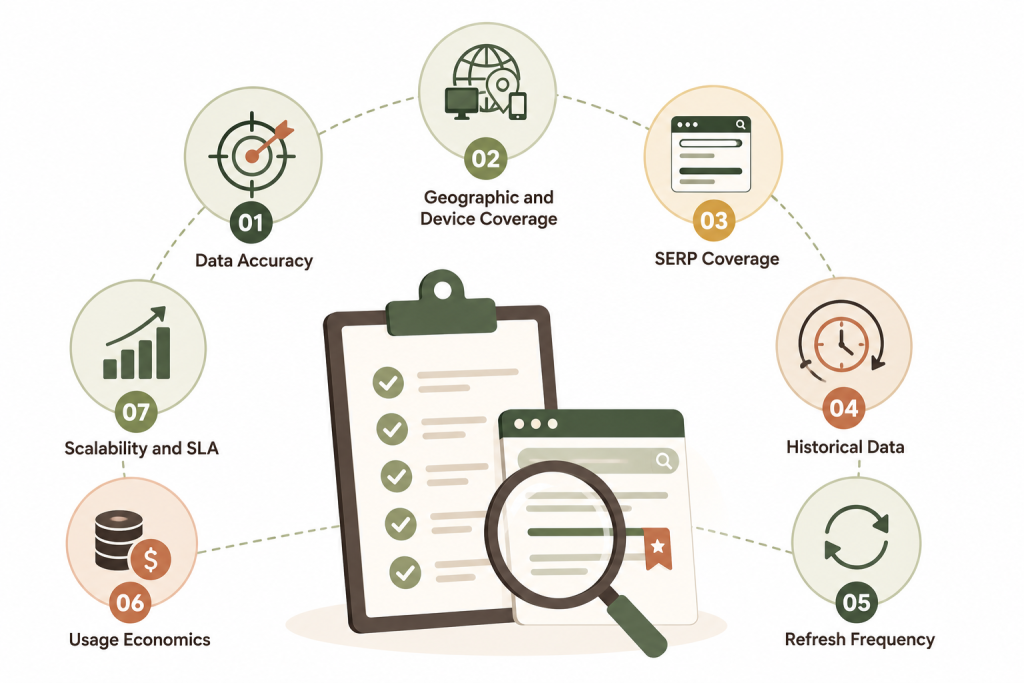
Data Accuracy: How consistently does the provider reproduce real search conditions across repeated pulls?
Geographic and Device Coverage: Does it support every country, city, language, and device your business needs?
SERP Coverage: Which SERP features and result types actually show up in the response?
Historical Data: How much history is stored, and how easy is retrieval?
Refresh Frequency: Can the provider match your required monitoring cadence?
Usage Economics: How are requests, credits, results, retries, and overages counted?
Scalability and SLA: Can a rank tracking api handle projected volume with acceptable uptime and support?
The Hidden Costs of Poor Ranking Data
Poor data can cost more than a higher-priced SEO rank tracking tool API. A low sticker price does not always mean lower overall costs.
Incorrect rankings can lead to bad SEO decisions. Inaccurate data can distort visibility reports and lead teams in the wrong direction.
Cheap data can create hidden operational costs. Constant reprocessing and manual validation can quickly eliminate the initial savings.
Unreliable output consumes engineering time. Teams may spend hours checking, cleaning, and validating ranking data.
Vendor migration can add further costs. Switching providers later becomes more difficult when workflows and systems depend on unreliable data.
Trust is a real cost factor. Ranking data becomes expensive when teams have to verify its accuracy every week.
When Is a Keyword Rank Tracker API Worth the Investment?
High keyword volume: An API becomes valuable when you track thousands of keywords regularly.
Multiple markets: Businesses managing several countries, cities, or locations benefit from automated tracking.
Frequent tracking: Daily or more frequent ranking checks are easier to manage programmatically.
Automated reporting: APIs can feed ranking data directly into reports and dashboards.
Custom dashboards: Teams building their own SEO platforms can pull ranking data into a central system.
SaaS integration: An API makes sense when ranking functionality needs to become part of a software product.
Smaller tracking needs: Teams with a short keyword list and no integration requirements may get better value from a standard SEO rank tracking tool.
Choose an SEO rank tracking tool API when the operational or business value of programmatic ranking data justifies both the cost and development effort.
Why SERPHouse Is the Right Keyword Rank Tracking API Partner
SERPHouse builds the integration layer between raw ranking data and the dashboards, products, and workflows teams actually use.
The platform connects ranking data to custom SEO platforms, client reporting systems, and internal BI stacks, reducing the need for manual spreadsheet work.
- Custom dashboard builds pulling live data from a rank tracking API.
- Automated alerting and workflow triggers tied to ranking movement.
- Data warehouse and BI pipeline integration for multi-market accounts.
If you’re looking to make your SEO workflow easier, SERPHouse can help you automate rank tracking, manage your data, and scale your SEO efforts without the manual work.
Conclusion
The right keyword rank tracker api is not simply the provider returning the most rankings. It is the one delivering trustworthy data with the geographic precision, SERP context, refresh frequency, and pricing model your business actually needs.
Before choosing a provider for an automated keyword rank tracker, validate the data against real search results, calculate expected usage, test reliability under load, and understand the total cost of running it at scale. Most importantly, connect ranking data to measurable SEO and business outcomes. A reliable API should make tracking easier, reporting faster, and decision-making more confident as your SEO efforts grow.
FAQ
Can a keyword rank tracker API track local rankings?
Local rankings can differ by city, country, device, and search context. Check whether the API supports the exact geographic targeting your SEO campaigns require before choosing a provider.
Does a keyword rank tracker API show which URL is ranking?
A useful API should return both the ranking position and the URL appearing in search results. This makes it easier to identify URL changes, keyword cannibalization, and unexpected pages gaining visibility.
Can a rank tracking API handle large keyword volumes?
Large-scale tracking depends on request limits, processing capacity, and API infrastructure. Test throughput, concurrency, and response times with a workload similar to your expected production volume.
What happens when ranking data is missing?
Missing results should be clearly distinguishable from genuine ranking changes. Look for useful error messages, status information, retry options, and consistent handling of unavailable search results.
Can a keyword rank tracker API monitor competitors?
Yes. You can track competitor rankings alongside your own when the SEO rank tracking tool API supports the required keywords, locations, and search volume. This helps uncover ranking gaps and changes in competitive visibility through an automated keyword rank tracker.
How important is SERP data in a rank tracking API?
Ranking position alone does not explain every visibility change. SERP context can reveal ranking URLs, search features, competitors, and other elements that help explain movement in search performance.