
Table of Contents
Table of Contents
Most content teams don’t have a creativity problem. They have a timing problem.
Every morning, dozens of newsletters land in your inbox, RSS feeds pile up, and Slack threads fill with “have you seen this?” links. By the time you’ve read enough to spot something worth writing about, three competitors have already briefed their writers. You find out on Tuesday. They published on Friday.
This article breaks down how Google News data and ChatGPT can work together to close that gap what the approach looks like, where it works well, and where it has real limitations worth understanding before you commit to building it.
The Problem With Manual Content Research in 2026
Here’s a scenario that most content managers recognize the moment they hear it.
A topic starts gaining traction on Monday. By Wednesday, three major publications have covered it. By Friday, your top competitor publishes a comprehensive guide. You spot it the following Tuesday during your weekly content audit and the moment has passed.
This isn’t a time management failure. The research process itself has a structural ceiling that manual effort can’t overcome.
News cycles have outpaced manual discovery
Trending topics now emerge, peak, and fade in roughly the time it takes a content team to brief a writer. The traditional approach checking a handful of bookmarked sites, skimming newsletters, running keyword searches when inspiration runs dry was never particularly efficient. In a faster news environment, it’s become actively costly.
Keyword tools measure demand that already exists
Platforms like Ahrefs or Semrush are genuinely excellent for understanding established search behavior. But they measure demand that has already formed. According to a 2023 analysis by SparkToro, search interest in a topic typically lags news coverage by three to six weeks, meaning that by the time a keyword appears in your research tool with meaningful volume, the early-authority window for ranking on it has often already closed.
If keyword data is your only input, you’re optimizing for conversations that have already happened.
The compounding cost
Teams that consistently react to trends rather than anticipate them produce more commodity content. Commodity content earns fewer backlinks, ranks lower, and attracts less qualified traffic. That gap doesn’t stay flat; it widens over time as teams with better intelligence systems build authority while reactive teams keep re-covering the same saturated ground.
What Is the Automated Content Idea Machine?
The approach we’re describing combines three tools, each handling a different layer of the problem:
| Layer | Tool | Role |
| Data | Google News API | Pulls structured, real-time headlines by topic |
| Analysis | ChatGPT | Identifies gaps, angles, and content opportunities |
| Automation | Make.com | Connects the two and routes output to your content database |
Together, they form a loop that surfaces content opportunities based on what’s actually happening in your niche right now not what was trending when your keyword tool last updated.
Here’s the basic flow:
Google News API → Trending Headlines → ChatGPT → Content Ideas → Content Calendar
What separates this from browsing Google News manually is structure. Instead of reading articles and hoping inspiration arrives, you’re pulling organized, queryable data and asking an AI to reason about it identifying gaps, flagging angles your audience hasn’t seen covered, and surfacing topics with SEO potential before the SERP gets crowded.
The output is a prioritized list of content opportunities, organized by topic pillar, ready to drop into your editorial calendar.
Worth noting: No coding is required for this workflow. The tools involved a news data API, ChatGPT, and a no-code automation platform are designed for non-technical users. That said, the quality of what you get out is directly proportional to the care you put into query design and prompt framing, which we’ll cover in the steps below.
Step 1: Connect Google News API to Your Niche
Every content intelligence system starts with data quality. Whatever you feed in shapes everything that comes out downstream.
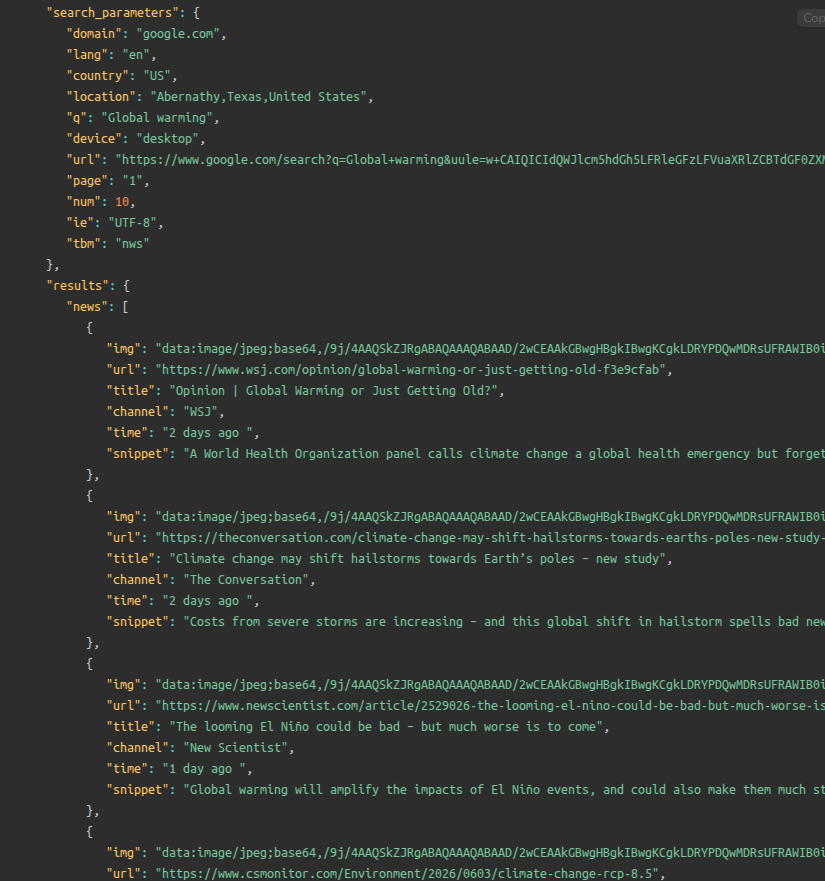
A Google News API gives you structured, queryable access to news coverage across thousands of sources simultaneously a fundamentally different input than manually browsing or cobbling together RSS feeds from individual publishers. SERPHouse’s Google News API returns clean, consistently structured results filterable by keyword, topic, language, and region, without scraping overhead or inconsistent formatting.
What good query design looks like
The logic is to define the topic clusters that represent your editorial focus and build a separate query for each one. For a SaaS marketing blog, that might look like this:
- “B2B content marketing” tracks editorial trends and publishing patterns
- “marketing automation 2026” captures product news, research announcements, and industry commentary
- “content operations” monitors ops-focused conversations and tooling coverage
- “AI content strategy” flags the emerging narratives your audience is forming opinions about
Running these as separate queries rather than combining them into one keeps your data segmented and easier to act on. You can see which areas are generating momentum and which are going quiet both are useful signals. A topic going quiet after sustained coverage often indicates market saturation; a reasonable signal to pivot toward adjacent angles rather than add to an already crowded SERP.
The most important filters are language, region, and recency. Headlines from the past 24–72 hours give you the freshest trend signals; older results blur the line between what’s emerging and what’s already established.
One honest limitation here: for very niche B2B topics, Google News coverage can be sparse. If you’re in a category that generates fewer than a dozen articles per week across major outlets, the signal-to-noise ratio improves significantly when you broaden your queries slightly and then filter by publisher quality afterwards.
The Google News API guide covers the full parameter set in detail particularly useful if you want to tune recency windows or filter by specific source domains.
Step 2: Pull Trending Topics Automatically
Raw news data is noisy. The value isn’t in reading every headline; it’s in recognizing patterns across them.
When a Google News API returns results for a keyword cluster, four signals tell you whether a topic has content potential:
| Signal | What to Look For | Why It Matters |
| Headlines | What angles publications are taking and which they’re avoiding | Reveals the dominant narrative and what’s been left unsaid |
| Publishers | Whether trade press or mainstream outlets are covering it | Trade coverage first = early trend; mainstream pickup = breakout momentum |
| Publish dates | Tight spike vs. sustained spread | 48-hour spike = breaking news; 2-week spread = SEO opportunity |
| Story clusters | Multiple unrelated outlets converging on the same angle | Signals broad audience demand, not just niche coverage |
Story clusters are the most valuable signal for content planning. When an industry trade publication, a major tech outlet, and a regional business site all cover the same topic within 72 hours, that convergence isn’t accidental; it’s an emerging mainstream narrative, and mainstream narratives mean broad, durable audience interest.
Timing is a strategic variable, not a detail
A tight cluster of stories published within 48 hours usually indicates breaking news. These are useful for timely, reactive takes, but hard to rank on quickly unless you already have domain authority in the space.
A cluster spread over two weeks indicates a sustained conversation a much better SEO target, because the topic has proven legs and you still have time to rank with depth before the first wave of articles matures into established competitors.
Understanding that distinction changes how you prioritize. The real-time monitoring guide covers how to set up notifications when clusters form so you catch them at the two-day mark rather than the two-week mark.
Step 3: Feed Headlines to ChatGPT for Content Angles
Raw headlines tell you what is being covered. ChatGPT’s role is to surface what hasn’t been the questions readers are still asking, the angles publishers haven’t taken, and the audience segments whose needs the existing coverage misses.
Why grounding matters more than prompting
The most common mistake teams make with this step is treating ChatGPT as a standalone idea generator. Ask it “give me blog ideas about marketing automation” and you’ll get the same ten generic suggestions every content team has seen. The ideas aren’t wrong; they’re just not differentiated.
The difference is grounding. When you feed ChatGPT a set of actual, current headlines and ask it to reason about what’s missing from the collective coverage, it’s working from a real competitive landscape rather than its training data. It can tell you what questions readers would still have after reading all five articles and those unanswered questions are often where genuine content opportunities live.
Think of it as the difference between asking a strategist “what should we write about?” and handing them a stack of this week’s trade coverage and asking “what are readers still wondering after reading all of this?”
Three lenses content teams use
Gap identification: Given a cluster of headlines, ChatGPT can infer what a curious, informed reader would still want to know after consuming all of them. Those gaps often map directly to underserved search intent topics people are actively searching for that no existing piece fully addresses.
Audience reframing: News articles are written for a general readership. Your content is written for a specific one. The same story about a regulatory change means something different to a startup founder than to an enterprise compliance manager. A single news event can generate multiple audience-specific content angles, each with different framing, emphasis, and practical implication.
Structural opportunity mapping: News coverage is inherently surface-level by design; reporters move fast and write short. A topic generating ten news articles but no comprehensive guide, no pillar page, and no in-depth analysis is a structural gap in the SERP. That’s the gap well-executed SEO content fills, and these gaps are far easier to spot when you’re reviewing a structured data set rather than browsing with a vague sense of what’s popular.
The Google News API functionality overview details the data fields available title, source, publish date, and story cluster ID, all of which can be passed as context to sharpen ChatGPT’s analysis.
Step 4: Automate the Entire Workflow
Running this process manually once a week is useful. Running it automatically every day is what makes it a real system rather than an occasional exercise.
Automation platforms like Make.com connect tools through a visual, no-code interface. You define what information moves where and when no programming required.
For this workflow, automation handles three things:
1. Triggering the data pull: Fresh news results are fetched on a schedule daily, twice daily, or hourly depending on how fast your industry moves. The system runs on its own; nobody has to remember to check.
2. Routing headlines to ChatGPT: Structured data passes to the analysis layer with the right context, topic cluster, target audience, and content goal so the output is focused rather than generic.
3. Storing and organizing the output: Generated ideas land wherever your team actually works: a Google Sheet sorted by topic pillar, a Notion database filtered by SEO potential, an Airtable view ready for sprint planning.
Google News API → Make.com → ChatGPT → Content Database
The result is that your team starts each day with a populated list of content ideas built from what happened in your industry overnight. The editorial work shifts from generating ideas to evaluating them, a more productive use of experienced judgment.
One practical caveat: the quality of the output degrades if the prompt context isn’t maintained carefully. If your Make.com workflow passes raw headlines to ChatGPT without audience framing or topical context, the ideas will be generic regardless of how good the news data is. The automation handles volume; the prompt design handles quality. Both matter.
The Google News Search API guide covers the response structure and parameters in detail, a useful reference when you’re configuring the data mapping in Make.com.
What This Looks Like in Practice
A content team at a marketing automation SaaS company pulls headlines using the query “marketing automation 2026.” The API returns:
“HubSpot Acquires AI Startup to Boost Email Personalization” “Marketo Releases Predictive Send-Time Feature for Enterprise Clients” “Survey: 67% of Marketers Say Automation Saves More Than 5 Hours Per Week” “CMOs Warn of Over-Automation Risk in Customer Journeys” “New Study Links Hyper-Personalized Campaigns to Higher Churn Risk”
Five headlines. All factual. All covering what happened. None of them answering the question every practitioner reading these stories is actually asking: what should I do about this?
That practitioner gap is what ChatGPT identifies when grounded in real coverage. The resulting content angles look like this:
| Content Idea | News Signal It Responds To | Why It Has SEO and Engagement Potential |
| How to audit your marketing automation stack before adding AI features | HubSpot acquisition | Gives buyers a decision framework before vendors pitch them |
| Calculating the real ROI of automation for your specific team size | 67% survey stat | Turns a generic statistic into a personalizable tool |
| 5 signs you’ve over-automated your customer journey | CMO warning trend | Counter-intuitive angle earns links precisely because it goes against vendor messaging |
| Where to draw the line between personalization and privacy in email | Churn risk study | Addresses the anxiety behind the trend rather than the trend itself |
| What vendor consolidation in martech means for mid-market buyers | Multiple M&A signals | Practitioner guide to a macro shift that affects procurement decisions |
Each idea responds to a real news signal but goes a level deeper than the news itself. They answer practitioner questions, “what should I actually do?” rather than journalist questions, “What just happened?” Most map to identifiable keyword targets. Several take counter-intuitive positions that consistently outperform straightforward explainers in engagement and link acquisition.
How Content Teams Scale This Across Multiple Topic Areas
Once the core workflow is running, expanding output means expanding inputs, not rebuilding the system.
Multiple topic streams running in parallel
Each content pillar gets its own query set. A team with four editorial pillars runs four parallel idea feeds, each populating its own section of the content database. The ideas stay organized by topic without any manual sorting.
Geographic variation as an early signal
Trends don’t always surface in all markets at the same time. Coverage that’s gaining momentum in the UK or APAC press may not hit US outlets for another two to three weeks. Region-specific queries give you early visibility into topics before they reach your primary market, with enough lead time to brief a writer and publish before local competitors have spotted the signal. The news monitoring API guide covers regional query setup in detail.
Competitor press coverage as intent signal
Queries built around competitor brand names and product terms surface what their customers are paying attention to. A wave of positive press about a competitor’s new feature is a signal that their customers, who may be your prospects, are actively evaluating the category. That’s a window for comparison content, alternative guides, or thought leadership that reaches readers in evaluation mode.
Topic clustering for content architecture
A second AI pass can group generated ideas into pillar-and-cluster structures, turning a flat list into a mapped content architecture. What starts as twelve individual ideas about marketing automation becomes a hub structure with a cornerstone guide and nine supporting articles. That architecture matters for both internal linking strategy and for signaling topical authority to search engines.
Breakout detection for time-sensitive opportunities
Tracking how often a topic appears across a 48-hour window surfaces breakout stories early before the SERP fills up. In our experience running this type of monitoring, the optimal window for publishing a deep-dive piece on a breakout topic is roughly days three through seven after it first appears in news clusters. Early enough to capture initial search interest, late enough to have something substantive to say. Any earlier and you’re writing news; any later and you’re writing the fifth take on a saturated topic.
The Google News Search API guide covers the query patterns relevant to high-volume, multi-stream monitoring setups.
Key Takeaways
- Manual content research has a structural ceiling. The combination of fast news cycles and keyword tool lag means reactive research consistently leaves the best opportunities to competitors who spotted them earlier.
- Google News API provides signal, not noise. Structured, queryable, filterable data across thousands of sources is a different category of input than browsing or RSS aggregation and it’s what makes automation reliable rather than random.
- ChatGPT performs best when grounded in real data. Generic prompts produce generic ideas. Coverage gaps, audience angles, and structural opportunities emerge from specific, contextualized inputs.
- Automation turns a process into a system. The difference between running this workflow occasionally and running it daily compounds over weeks. The teams that benefit most are those that treat it as infrastructure, not a tactic.
- The limiting factor should be writing quality, not idea volume. When editorial talent is spent generating ideas rather than developing them, something has gone wrong upstream.
FAQs
What is a Google News API?
A Google News API retrieves structured news data such as headlines, publishers, publish dates, and article URLs for specific keywords, topics, or regions. It helps automate news monitoring and content research workflows.
How is a news API different from RSS feeds?
RSS feeds depend on individual publishers and often have inconsistent formats. A news API provides standardized, searchable data across many sources with filtering options for keywords, regions, languages, and dates.
How do content marketers use Google News data in practice?
Content teams use Google News data to monitor trends, track competitor coverage, discover emerging topics, and identify content opportunities before they appear in traditional SEO tools.
Can a no-code platform like Make.com automate this entire workflow?
Yes. Make.com can connect a Google News API, ChatGPT, and tools like Google Sheets or Notion to create an automated content research and idea-generation workflow.
How do you evaluate whether a trending topic has SEO value?
Evaluate both topic growth and search competition. Topics gaining coverage quickly but facing limited in-depth content on Google often present the best opportunities. The Google News Search API guide can help identify these opportunities using real-time news coverage data.