

Table of Contents
Table of Contents
Most discussions around Google News APIs stop at definitions. They explain what an API is, how Google News works, or why accessing news data is useful. That context is important, but it rarely answers the question that matters once you move past the basics.
What can the API actually do?
When teams evaluate a solution like SERPHouse, the focus shifts from concepts to capabilities. Developers want to understand response structure. Analysts care about data consistency. Product teams look for filtering control, scalability, and reliability. The conversation becomes less about “why use a Google News API” and more about “which google news api features support real workflows”.
This is where feature-level clarity becomes critical.
SERPHouse’s Google News API is designed to provide structured access to Google News results, but its practical value lies in how those results can be queried, filtered, and integrated into systems. From real-time news retrieval to advanced query parameters and predictable JSON output, the details of implementation shape whether the API becomes a stable data source or another fragile dependency.
This article focuses specifically on those details.
Rather than revisiting high-level explanations, we break down the core google news api features, functionality, and architectural elements that define how SERPHouse delivers news data in production environments. The goal is to give developers and technical teams a clear understanding of what they can expect when building monitoring tools, analytics pipelines, or automated news-driven applications.

Understanding SERPHouse Google News API Architecture
Behind every reliable API is a structure that determines how requests are handled, how responses are delivered, and how consistently data can be consumed. With SERPHouse’s Google News API, the architecture is designed to keep this interaction predictable, even when Google News itself is constantly changing.
Rather than acting as a simple data fetcher, the API functions as a controlled interface between Google News results and your application logic. This foundation directly influences how developers experience performance, stability, and the practical value of Google News API features.
Endpoint Structure
SERPHouse organizes its Google News API around clearly defined endpoints. Each endpoint serves a specific role, allowing developers to request targeted datasets instead of processing broad, unfiltered responses.
For example, endpoints typically support:
- keyword-based news searches
- region and language filtering
- pagination for larger result sets
- structured metadata retrieval
This separation keeps requests efficient. Instead of over-fetching data and trimming it locally, developers can specify exactly what they need at the query level.
Well-designed endpoint structure also improves maintainability. As features evolve, new parameters or filters can be introduced without breaking existing integrations.
Request and Response Flow
The interaction model follows a straightforward pattern. A client sends a request with defined parameters. The API processes the query, retrieves relevant Google News results, and returns structured output.
In practice, this flow involves:
- Query submission with search parameters
- Backend processing and normalization
- Structured response generation
- Delivery in machine-readable format
This abstraction removes the complexity of handling dynamic page rendering, layout shifts, and parsing instability. Developers work with clean responses instead of unpredictable HTML structures.
For systems that rely on continuous news monitoring or automated alerts, this predictable request-response cycle is essential.
Data Format Consistency
One of the most critical architectural advantages is response consistency. SERPHouse delivers Google News data in a stable JSON format designed for programmatic use.
Each response follows a predictable schema, commonly including:
- headline or title
- publisher or source
- publication timestamp
- article URL
- snippet or summary
- ranking position
Consistent formatting allows teams to build downstream processes without defensive parsing logic. Data pipelines, dashboards, and analytics systems can rely on field stability rather than adapting to structural surprises.
Over time, this consistency reduces integration friction and long-term maintenance effort.
Core Features of SERPHouse Google News API
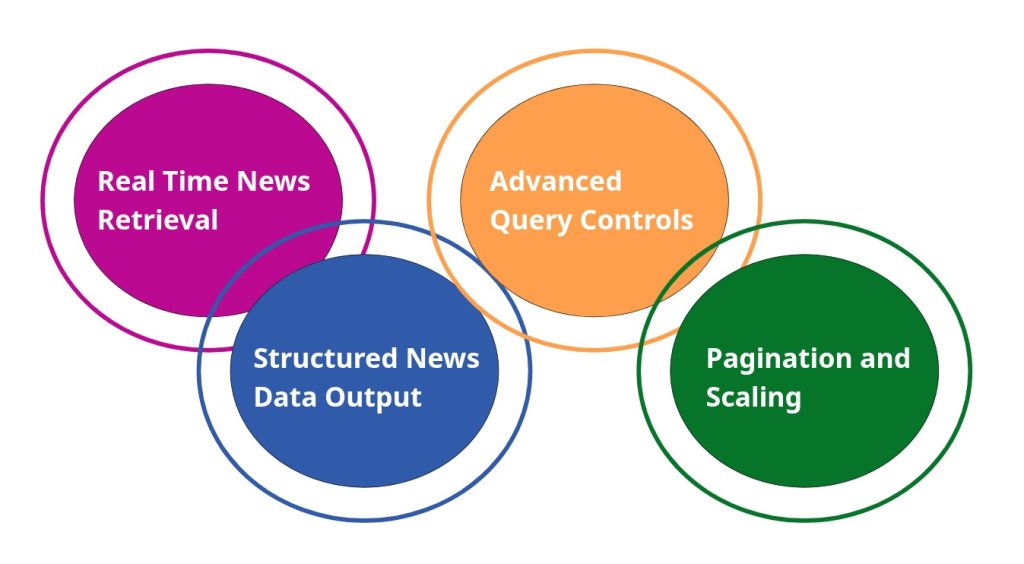
Once the architecture is understood, the real evaluation begins at the feature level. The practical value of any API is defined by how efficiently it retrieves data, how structured that data is, and how much control developers have over queries. SERPHouse is designed around these fundamentals, delivering a set of capabilities that directly support production-grade news data workflows.
Real Time News Retrieval
Google News is a fast-moving environment where new stories appear continuously. SERPHouse’s API is built to reflect these updates with minimal delay, allowing applications to access fresh headlines as they surface.
For teams running monitoring systems, alert engines, or trend analysis tools, retrieval speed is not a minor advantage. It determines whether insights arrive early or after the opportunity has passed.
Structured News Data Output
Raw news pages are designed for visual consumption. APIs, however, must deliver data in a format systems can process immediately. SERPHouse provides structured output that includes clearly defined fields such as headlines, publishers, publication timestamps, article URLs, snippets, and ranking positions.
This structured delivery removes the need for HTML parsing and reduces the risk of inconsistencies across requests. It also enables clean integration into dashboards, databases, and analytics pipelines.
Advanced Query Controls
Effective news analysis depends on precision. SERPHouse supports flexible query controls that allow developers to refine searches using keywords, language filters, and regional targeting.
This level of control helps teams:
- isolate specific topics or entities
- Monitor news within defined markets
- filter results by language relevance
- tailor datasets to application logic
Query flexibility is one of the most important google news api features, particularly for systems that rely on continuous data collection rather than occasional searches.
Pagination and Scaling
News datasets can expand quickly, especially when queries span multiple keywords or regions. SERPHouse supports pagination mechanisms that allow applications to navigate large result sets without overloading a single response.
This is critical for:
- historical data storage
- bulk analysis workflows
- large-scale monitoring systems
- research-oriented data collection
By structuring responses across pages, the API maintains performance stability while supporting high-volume data access patterns.
Supported Data Fields
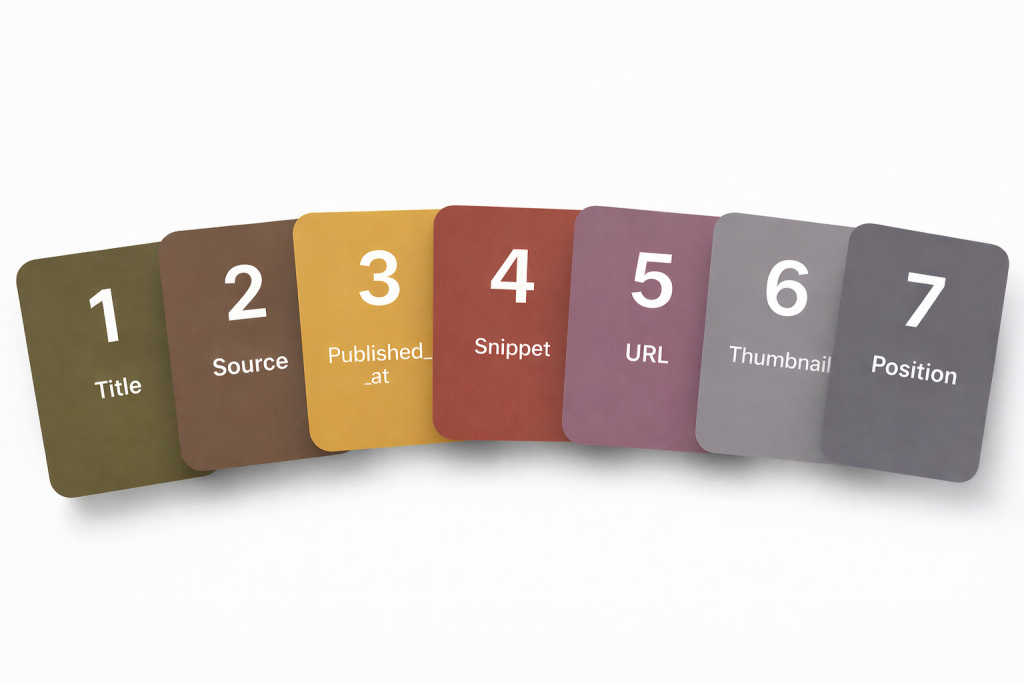
The usefulness of any news API depends heavily on the structure and clarity of its response fields. SERPHouse’s Google News API is designed to return consistently formatted data that applications can process without additional interpretation layers.
Rather than delivering loosely organized content, the API exposes clearly defined fields that map directly to how Google News results are displayed.
Title
The title field contains the headline of the news article. This is often the first element used in monitoring dashboards, alert systems, and analytics tools since it captures how a story is framed at a specific moment.
Headlines are commonly analyzed for:
- trend detection
- keyword extraction
- sentiment evaluation
- topic classification
Source
The source field identifies the publisher or news outlet associated with the article. This allows teams to evaluate coverage distribution, publisher credibility, and media diversity within a dataset.
Source data is particularly useful for:
- media monitoring
- competitor visibility tracking
- reputation analysis
Published_at
The published_at field provides the article’s publication timestamp. This enables freshness analysis, chronological sorting, and historical tracking.
Timestamps help answer questions like:
- When did the story first appear
- How quickly did coverage expand
- Which publishers reported earliest
Snippet
The snippet field includes a short summary or preview of the article. This is often used for quick context in dashboards or for natural language processing tasks such as entity recognition or sentiment scoring.
URL
The url field links directly to the original article. This supports verification workflows, content review, and reference tracking without requiring additional search steps.
Thumbnail
The thumbnail field contains the preview image associated with the article when available. While not always critical for analysis, it improves visual presentation in user-facing applications and news interfaces.
Position
The position field indicates the ranking or placement of the article within Google News results. This is one of the most valuable google news api features, especially for systems tracking visibility, prominence, and ranking shifts over time.
Position data is commonly used for:
- news ranking analysis
- trend momentum tracking
- publisher visibility measurement

Query Customization Capabilities
The real strength of a news API is not just in retrieving data, but in precisely controlling that data. SERPHouse’s Google News API is designed to give developers the ability to shape queries in a way that reflects actual analytical intent. Instead of pulling broad datasets and filtering them later, queries can be refined at the source.
Keyword Precision
Effective news tracking begins with accurate keyword targeting. SERPHouse allows developers to construct queries that go beyond simple single-word searches. Exact phrases, multi-keyword combinations, and exclusion logic can be applied to narrow results to a very specific scope.
This becomes particularly important when monitoring entities with ambiguous names or when separating closely related topics. A well-defined query reduces noise at the retrieval stage, which improves both data quality and downstream processing efficiency.
Language and Region Filtering
News relevance is often shaped by geography and language context. SERPHouse supports filtering that allows datasets to be aligned with a specific market, audience, or region. Rather than manually discarding irrelevant coverage, developers can instruct the API to return results that match defined localization parameters.
For international monitoring systems or multilingual platforms, this control ensures that data remains contextually accurate. It also prevents analytical distortions that occur when unrelated regional coverage enters a dataset.
Sorting and Freshness Control
Different use cases require different perspectives on news ordering. SERPHouse enables sorting based on recency or relevance, allowing developers to decide whether the latest updates or the most contextually significant stories should appear first.
Sorting by date is commonly used in alerting and monitoring environments where timing is critical. Relevance-based sorting is more suitable for research, analysis, and narrative evaluation workflows. This flexibility represents one of the most practical google news api features, as it directly influences how information is interpreted inside dashboards, reports, and automated systems.
Practical API Request Examples
Seeing how requests and responses work in real code helps developers quickly evaluate a solution. Below are clean, realistic examples using the SERPHouse Google News API based on documented usage patterns.
Example: cURL Request
This example shows how to fetch the latest news results with a specific query using the SERPHouse API. It uses the correct endpoint and structure.
This request instructs the API to return Google News results for the keyword “artificial intelligence” in English for the United States. The serp_type parameter specifies that news search results are requested.
If you’d like to validate or experiment with live SERP data, you can use the API Playground. It allows you to enter any query and instantly view the returned SERP results.
Example: Python Request
For developers who prefer Python, here’s a minimal example using the same endpoint.
This Python snippet sends the same request as the cURL example and prints key fields from the response.
Sample JSON Response Structure
Here’s a short illustration of how the returned JSON might look. This format is designed to be predictable and easy to parse.
Each article object contains fields like title, url, time, and snippet, which developers can process directly or load into analytics and monitoring systems.
Why These Examples Matter
Using actual request patterns and the documented endpoint gives developers confidence that integration will be straightforward and reliable. The API’s structured responses mean you don’t need to build scrapers or handle unstable HTML parsing you work with a consistent JSON schema designed for automation.
Performance and Reliability Considerations
When integrating a Google News API into a real application, performance and reliability quickly become practical concerns. It is not just about retrieving news data. It is about whether that data arrives consistently, quickly, and without disrupting downstream systems.
Response Stability
Automated systems depend on predictable responses. SERPHouse delivers Google News results using a consistent JSON structure, allowing developers to process headlines, publishers, timestamps, and URLs without constantly adjusting parsing logic.
This stability becomes critical when:
- dashboards refresh continuously
- alerts trigger automatically
- data pipelines run at scale
Without response consistency, even a well-built system can become fragile.
Latency Expectations
News data is highly time-sensitive. Delayed responses can reduce the value of monitoring systems, especially when tracking breaking stories or rapidly evolving topics.
Low latency influences how fast:
- alerts are triggered
- interfaces update
- decisions are made
SERPHouse is designed for retrieval scenarios where timing directly impacts usability.
Uptime Implications
Production workflows assume availability. Monitoring platforms, analytics systems, and automated trackers rely on uninterrupted access to Google News data.
Short disruptions can lead to:
- missed updates
- incomplete tracking
- unreliable historical records
Infrastructure reliability helps maintain continuity across long-running systems.
Scaling Behavior
As projects expand, query volume often increases. Keywords multiply. Regions broaden. Monitoring frequency rises.
SERPHouse supports this growth by maintaining stable performance across larger request loads, preventing common issues such as slowdowns, failed queries, or inconsistent outputs.
For teams building long-term solutions, this scaling stability represents one of the most valuable google news api features.
Why Developers Prefer SERPHouse for Google News Data
Choosing how to access Google News data often comes down to long-term practicality. While multiple approaches exist, developers typically prioritize solutions that reduce friction rather than introduce new layers of complexity.
Stability Over Fragility
Scraping-based systems can work in controlled environments, but they tend to become unstable as layouts change or blocking mechanisms evolve. SERPHouse provides a more predictable alternative by delivering structured responses that remain consistent across requests.
For developers, this stability means fewer unexpected failures and less time spent debugging data collection issues.
Structured Output by Design
SERPHouse returns Google News results in a clean JSON format built for programmatic use. Headlines, publishers, timestamps, URLs, and ranking positions are clearly defined, allowing applications to consume data without additional parsing logic.
Structured output simplifies:
- dashboard integration
- analytics processing
- alert generation
- database storage
Reduced Maintenance Burden
Maintaining scrapers often requires continuous adjustments. Changes in page structure, response behavior, or access restrictions can quickly break pipelines.
By abstracting these challenges, SERPHouse allows teams to focus on building features and analysis workflows instead of maintaining extraction logic.
Easier Scaling
As monitoring needs grow, query volume naturally increases. SERPHouse supports scalable usage patterns without forcing developers to redesign their infrastructure.
This makes it easier to expand:
- keyword coverage
- geographic targeting
- monitoring frequency
- data collection volume
Getting Started with SERPHouse Google News API
Getting started with SERPHouse is designed to be straightforward, especially for teams already familiar with API-based workflows. The goal is to move quickly from account setup to live data access without unnecessary complexity.
The process typically begins by creating a SERPHouse account. Once registered, users receive access to the dashboard, where API credentials and usage details are managed.
After authentication, an API key is generated. This key acts as the access token that authorizes requests and connects your application to SERPHouse’s Google News data endpoints.
From there, developers can begin sending queries and receiving structured news results in JSON format. Integration can be handled using any preferred language or framework.
For a practical implementation example, the Python setup guide walks through how to connect, send requests, and handle responses in a real development environment.
Final Thoughts
Working with Google News data is less about access and more about sustainability. The method you choose must hold up under changing news cycles, shifting result structures, and growing query demands. Short-term solutions often work at the beginning but introduce friction as systems scale.
SERPHouse’s approach focuses on stability, structured delivery, and predictable integration. Instead of dealing with parsing failures or layout changes, developers receive clean, machine-readable responses designed for automation. This consistency becomes especially valuable for teams running monitoring tools, analytics workflows, and data-driven applications that rely on uninterrupted news retrieval.
For developers, analysts, SEO teams, and data engineers, these capabilities define the practical value of modern google news api features. Reliability, structured output, and scaling flexibility matter far more than initial setup convenience.
If you want a broader understanding of how Google News APIs, scraping strategies, limitations, and use cases connect, the Google News API Guide provides a complete overview of the landscape.
Choosing the right data access strategy early can prevent months of maintenance overhead later. That decision ultimately shapes how effectively Google News data supports your workflows over time.