
Table of Contents
Table of Contents
Teams start looking for a Scrapingdog alternative for a variety of reasons. Some hit a rate limit during a busy week. Others realize their workload is really search data, not general webpage scraping, and the tool they picked no longer fits. Not every web scraping api alternative solves the same problem, so a fair serp api vs scraping api comparison has to separate pricing, reliability, and rate limits from the deeper question of what kind of data you actually need.
This guide compares SERPHouse, Apify, Oxylabs, Zyte, and ScrapingBee against Scrapingdog on real production criteria: pricing at scale, API rate limits, proxy infrastructure, geographic targeting, and how each platform behaves once a demo turns into a live pipeline.
Best ScrapingDog Alternatives for SEO & SERP Data
SERPHouse
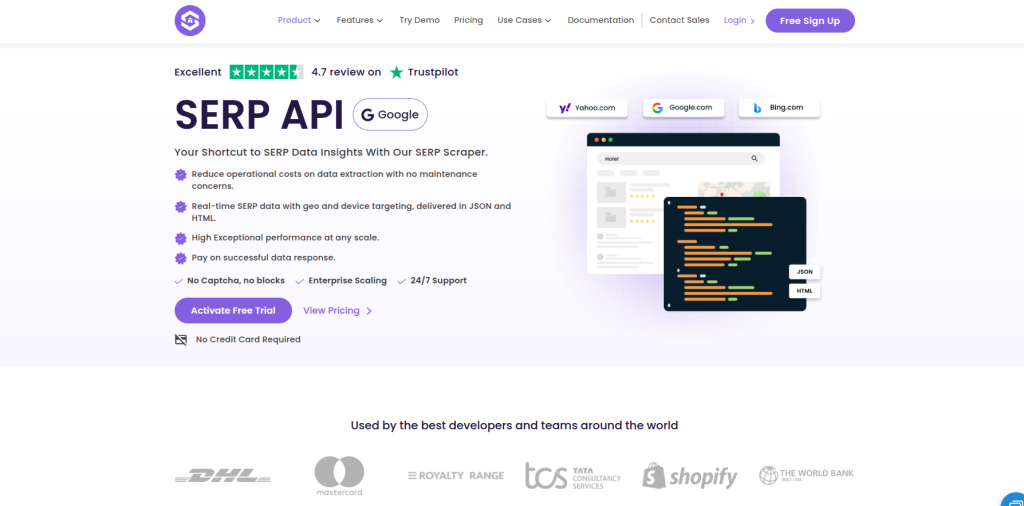
What it does: SERPHouse is a dedicated SERP data API built around the Google search results API with Bing Search API and Yahoo layered on top.
Coverage: Supports search data across 100+ countries and multiple SERP use cases, including SEO, search monitoring, news, images, and shopping.
Performance: SERPHouse publishes a 99.9% uptime SLA. Its current materials report sub-second latency for some endpoints, while broader materials cite response times under five seconds.
Best for: Rank tracking, search visibility monitoring, SEO platforms, and applications that need structured SERP data.
Why consider it: A strong option when you need a dedicated SERP API rather than a general-purpose scraping platform.
Alternative fit: Suitable for teams evaluating a ScrapingDog alternative for structured search data.
Apify
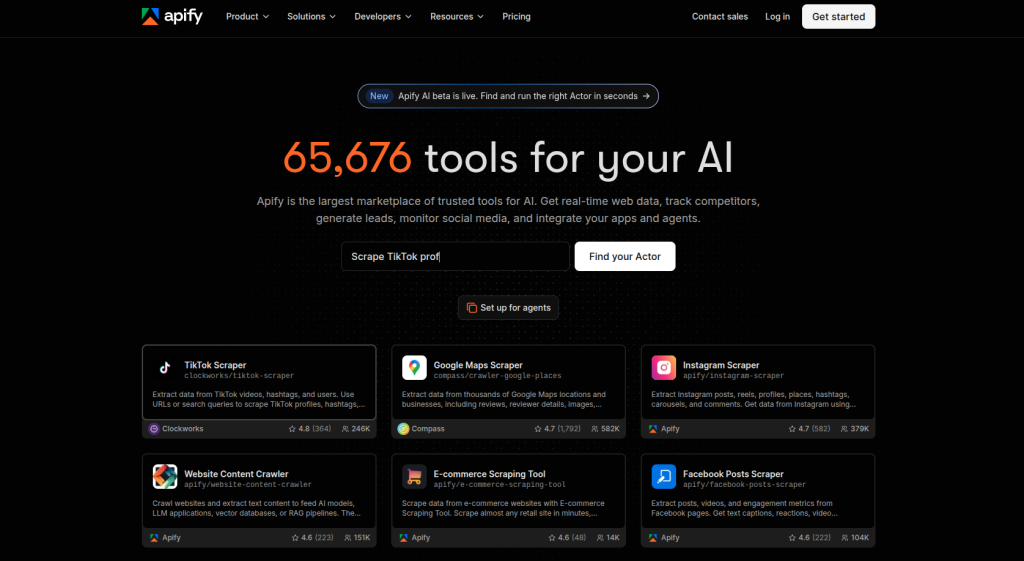
What it does: Flexible web-scraping and automation platform built around Actors, which can be prebuilt or custom scraping tools.
Capabilities: Supports custom scraping workflows, browser automation, scheduled jobs, and a marketplace of ready-made scrapers.
Pricing: Apify offers a free plan with $5 of monthly platform credit. Paid pricing varies by plan, with its current pricing pages showing plans around the $29+ range.
Best for: Teams that need customizable scraping workflows rather than a single-purpose SERP endpoint.
Why consider it: Provides considerably more flexibility for teams combining web scraping, automation, and data collection.
Alternative fit: A useful web scraping API for a scrapingdog alternative when customization matters more than dedicated SERP functionality.
Oxylabs
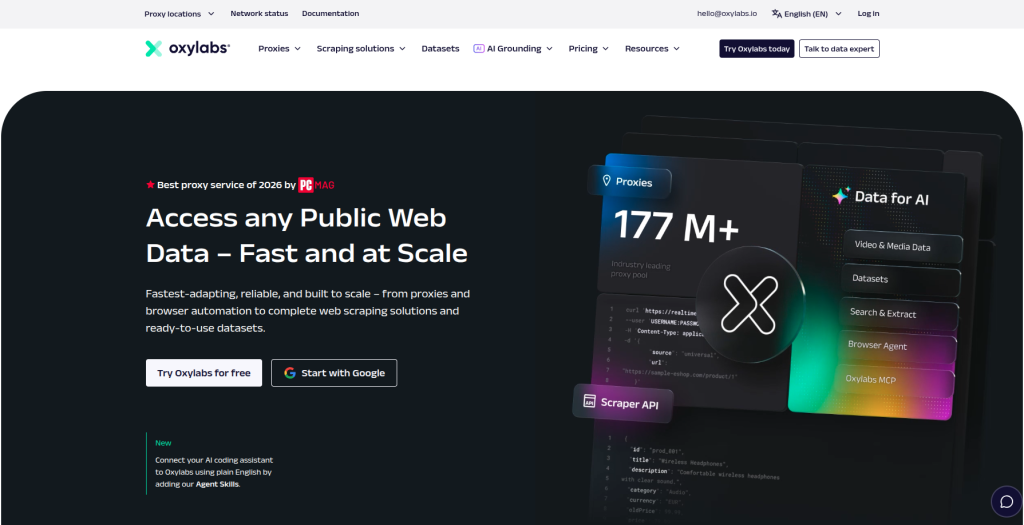
What it does: Enterprise-focused proxy and web-scraping provider with dedicated SERP and Web Scraper APIs.
Network: Its current materials advertise more than 177 million IPs across its global proxy infrastructure.
Capabilities: Supports large-scale web data collection, SERP scraping, geographic targeting, and enterprise scraping workflows.
Best for: Organizations handling high-volume extraction and requiring extensive geographic coverage need a web scraping api alternative.
Why consider it: Combines SERP scraping with broader proxy and web-data infrastructure.
Alternative fit: Better suited to enterprise workloads than teams looking for a lightweight ScrapingDog alternative.
Zyte
What it does: Managed web-scraping platform centered on Zyte API for website access, proxy management, browser rendering, and automated extraction.
Capabilities: Supports HTTP requests, browser automation, screenshots, JavaScript rendering, and structured data extraction.
Automation: Handles much of the proxy and anti-blocking infrastructure for developers.
Product update: Smart Proxy Manager is being phased out as a standalone product, with its proxy functionality moving into Zyte API.
Best for: Teams that want managed scraping infrastructure without maintaining their own proxy and browser systems.
Alternative fit: A broader scraping platform rather than a direct SERP-only replacement.
ScrapingBee
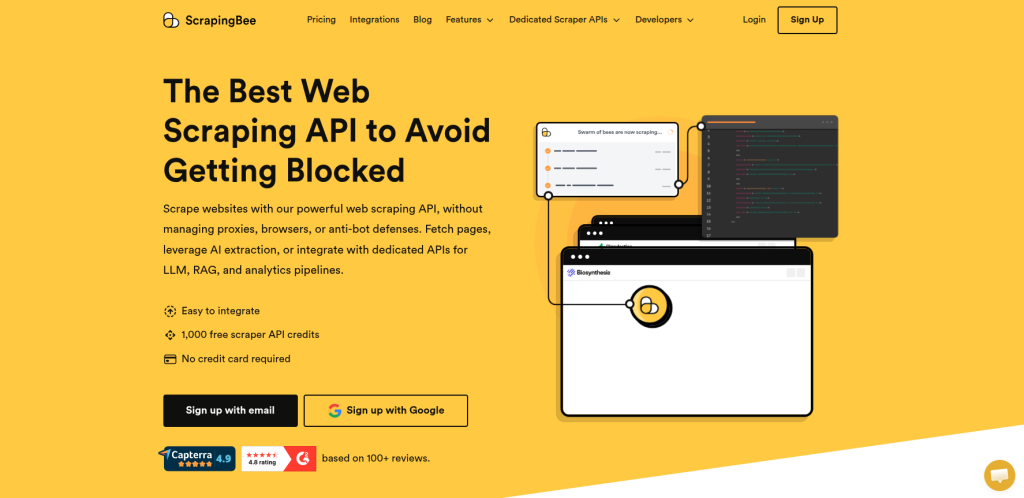
What it does: Developer-focused scraping API that handles proxies, headless browsers, JavaScript rendering, and anti-bot requirements.
Search support: Offers a dedicated Google Search API in addition to general web-scraping capabilities.
Pricing: Its current pricing page lists the Freelance plan at $49/month for 250,000 API credits.
Free access: New users can access 1,000 free API credits.
Best for: Developers looking for a straightforward API with both general scraping and Google search capabilities.
Why consider it: Easier to integrate than a full scraping platform while still supporting browser-based and search-related workflows.
Alternative fit: A practical ScrapingDog alternative for teams that want both web scraping and search API functionality.
What Should You Look for in a ScrapingDog Alternative?
Data Type and Extraction Capability
Decide first whether you need full webpage data or structured SERP data, since serp api vs scraping api are different jobs.
Full webpage extraction covers HTML, dynamic content, and product data, while structured search result features need a purpose-built parser rather than raw markup.
Getting this wrong is the most common reason a scrapingdog alternative disappoints a team six months into using it.
Proxy and Anti-Bot Infrastructure
Compare serp api vs scraping api based on IP rotation, residential versus datacenter proxies, CAPTCHA handling, bot detection bypass, and geographic targeting depth, since these determine whether requests actually succeed against protected sites rather than just how the API is priced.
Oxylabs, for instance, backs its proxy network with over 177 million IPs across 195 countries, a figure worth comparing against any scrapingdog alternative you shortlist for geo-heavy workloads.
API Rate Limits and Scalability
Look at requests per second, concurrent request caps, monthly limits, bulk processing support, and retry behavior under load, since a provider that looks fast in a demo can still choke once real production volume hits it.
Integration Requirements
Review API documentation quality, JSON output structure, available SDKs, webhook support, authentication methods, and error handling, since these decide how many engineering hours a migration to any scrapingdog alternative actually costs beyond the sticker price.
Web Scraping API vs SERP API: Which One Do You Need?
When a Web Scraping API Makes More Sense
- Full webpage extraction fits competitor websites, product pages, real estate listings, and market research- the classic use case for teams approaching it with web scraping with AI tools in the pipeline.
- This is the classic use case for a web scraping api alternative rather than a SERP focused product.
- Proxy-based scraping, JavaScript rendering, and anti-bot handling matter most here, since the target is any page on the open web rather than a structured search result.
When a SERP API Is the Better Choice
- Keyword rankings, search visibility, competitor SERP monitoring, rank tracking, and SEO dashboards all need structured SERP data rather than raw HTML.
- A dedicated SERP API automatically parses featured snippets, local packs, and shopping results. Teams building on this pattern often start by learning to scrape AI snippets before expanding to full SERP pipelines.
- This distinction is exactly what a serp api vs scraping api decision comes down to in practice, not a feature checklist.
When You Need Both
- Some workflows genuinely require both halves of the pipeline: search a keyword, identify the target page from the results, scrape that page, enrich the data, then send it to analytics.
- This is the clearest way to frame serp api vs scraping api as a real-world question rather than a feature list, since the two tools solve different steps of the same pipeline.
How Much Does a Scrapingdog Alternative Cost at Scale?
Compare Pricing Models
Providers split roughly into four pricing styles: flat monthly subscriptions, usage-based platform credit, credit-based scraping plans, and pure pay-as-you-go. Whichever web scraping api alternative you shortlist, price it on this structure first, since the model matters more than the sticker number.
Scrapingdog itself runs on credits, starting at $40 a month for 200,000 credits, with a basic request costing 1 credit, JavaScript rendering costing 5, and combined JavaScript plus a premium proxy costing 25.
Calculate Effective Cost
Advertised monthly prices rarely match real spend. Use effective cost equals total monthly spend divided by successful requests, multiplied by 1,000, and apply it separately for SERP workloads as cost per 1,000 SERP queries and for general scraping as cost per 1,000 successful page extractions.
This is the single most useful calculation when comparing any scrapingdog alternative against its actual production bill rather than its homepage price.
What Can Increase Your Actual Cost?
| Factor | Typical Impact |
| Premium or residential proxies | Multiplies credit cost per request. |
| JavaScript rendering | Adds 5 to 10 credits on most credit-based plans. |
| Google or Bing targets specifically | Often billed at a much higher multiplier than a plain page. |
| CAPTCHA handling | Adds cost on protected targets. |
| Overage beyond plan limits | Charged at a higher per-unit rate. |
| Higher concurrency | Usually requires an upgraded tier. |
The cheapest ScrapingDog alternative starting plan on paper is rarely the cheapest option once production volume hits these multipliers.
How Do These Alternatives Handle API Rate Limits and Scale?
API Rate Limits
Scrapingdog’s entry Lite plan allows 5 concurrent requests, scaling up to 150 or more on its highest published tiers.
Oxylabs publishes a rate limit near 50 requests per second on entry SERP plans.
Apify scales concurrency by plan, with 25 concurrent runs included on its free tier.
Latency and Response Consistency
Few providers publish a guaranteed response time. Where independent figures were not available, no specific latency claim is made here, since manufactured numbers would be worse than no number at all.
Bulk and High Volume Processing
SERPHouse, Oxylabs, and Apify all document batch or queued processing for large keyword or page collections.
For scrapingdog alternative, Scrapingdog and ScrapingBee handle bulk work through higher concurrency tiers rather than a dedicated batch endpoint.
Production Reliability
Uptime commitments and published success rates vary by provider and are often self-reported rather than independently audited, so treat any specific percentage as a starting point to verify directly before signing a contract tied to it.
This applies to SERPHouse too, whose own published SLA of 99.9 percent uptime is a vendor figure worth testing against your own traffic before you commit, the same standard any scrapingdog alternative should be held to.
Proxy Based Scraping vs Structured SERP Data
Proxy Based Scraping
Proxy-based scraping matters for geo restricted content, bot protected websites, and high-volume URL scraping where the target changes constantly. Rotating residential and datacenter IPs keeps requests from getting blocked across thousands of different domains.
Structured SERP Data
Structured search data serves rank tracking, competitor monitoring, and SEO analytics better than raw HTML, since the SERP features you actually care about arrive as parsed fields instead of markup you have to interpret yourself.
Which Approach Fits Your Workload?
If you need the webpage itself, prioritize a web scraping api alternative with scraping infrastructure and API rate limits built for general page volume.
If you need search results, prioritize a SERP focused API. If you need both, choose a stack that pairs a scraping platform with a dedicated SERP endpoint rather than forcing one scrapingdog alternative to do both jobs poorly.
Which Scrapingdog Alternative Is Best for Your Use Case?
Best for Structured SERP Data: SERPHouse
SERPHouse fits SERP monitoring, rank tracking, search visibility, and SEO platforms needing structured search results.
It also supports custom workflows, multi-engine coverage, location targeting, and enterprise-scale processing, making it a strong choice for growing search-data applications.
Teams new to the category often benefit from an easier SERP tracking guide before deciding whether a dedicated API or a scraping platform better fits their workflow.
Best for Custom Scraping and Automation: Apify
Apify fits custom scrapers, browser automation, and complex extraction pipelines where developer-led automation and a large Actor marketplace save build time.
Best for Enterprise Proxy Infrastructure: Oxylabs
Oxylabs fits large scale extraction and proxy heavy workloads where enterprise data collection and deep geo-targeting justify a higher budget.
Best for Managed Web Data Extraction: Zyte
Zyte fits enterprise teams comparing serp api vs scraping api who want automated extraction and ban handling managed for them rather than self-built and maintained.
Best for Straightforward Developer Scraping: ScrapingBee
ScrapingBee fits API first scraping on JavaScript heavy pages for smaller to mid sized projects that want simple integration over platform depth.
Why Is SERPHouse a Strong Scrapingdog Alternative?
Purpose-Built for Search Data
SERPHouse is built specifically around structured SERP results across multiple search engines rather than general webpage scraping, making it less suited as a web scraping api alternative for teams needing arbitrary page content.
Designed for Scalable Search Workflows
Verified capabilities include bulk processing, documented batch requests, and support for multiple search environments including Google, Bing, and Yahoo, which lets a single pipeline pull from several search engines through one API.
Better Fit When Search Intelligence Is the Goal
Best suited for: Rank tracking platforms, SEO dashboards, and competitor monitoring tools that need structured SERP data.
Core advantage: SERPHouse provides structured search-result data that can integrate directly into these workflows.
As a ScrapingDog alternative: A strong option when structured SERP data is the primary requirement rather than general webpage scraping.
Potential limitation: It may not be the best fit when your main requirement is broad webpage extraction across arbitrary domains.
Before switching: Run a direct ScrapingDog vs. SERPHouse test using your own keyword set, as demo results may differ from production performance.
What Should You Test Before Switching From Scrapingdog?
Test Data Compatibility
Compare response structure, JSON field names, and SERP or page fields side by side, since output shape rarely matches exactly between a general web scraping api alternative and a dedicated SERP API.
Test Accuracy Across Real Conditions
Run the same query set across countries, cities, languages, mobile, and desktop targeting, plus a batch of competitive queries, before trusting any provider’s demo results.
Test API Rate Limits
Measure concurrent request handling, requests per second, failure rates, and retry requirements when comparing serp api vs scraping api. Test under conditions that match your real traffic pattern, not a light test run.
Recalculate Production Cost
Multiply your actual monthly requests by the effective cost per successful request, not the advertised entry plan price, before deciding a switch to any scrapingdog alternative actually saves money.
SERPHouse Benefits for High-Volume SERP Scraping
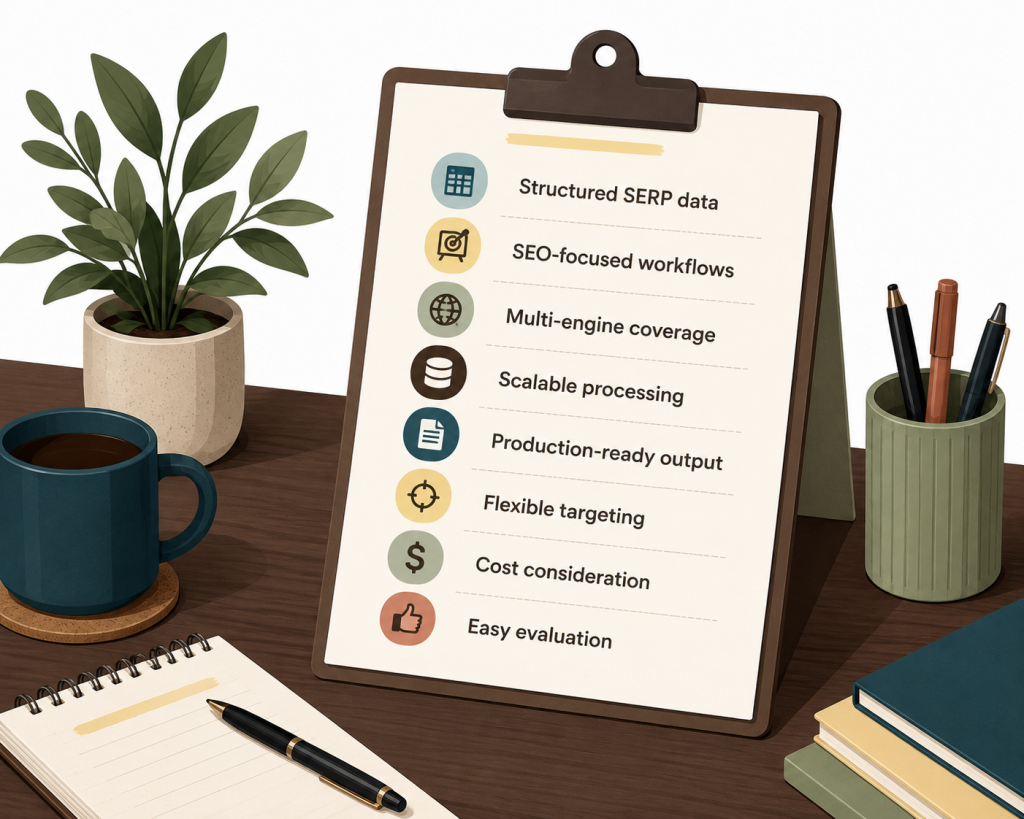
- Structured SERP data: Get organized search results instead of parsing raw HTML.
- SEO-focused workflows: Suitable for rank tracking, competitor monitoring, and search visibility platforms.
- Multi-engine coverage: Supports major search engines and multiple SERP features.
- Scalable processing: Designed for teams handling growing keyword and search volumes.
- Production-ready output: JSON responses make integration with dashboards and applications easier.
- Flexible targeting: Supports location-based search requirements for more relevant results.
- Cost consideration: Compare actual costs at your monthly query volume rather than entry-level plans.
- Easy evaluation: Test SERPHouse against your existing provider using real production keywords.
SERPHouse can be a strong primary keyword-focused option for teams seeking a reliable ScrapingDog alternative without building their own SERP scraping infrastructure.
Conclusion
Selection of the right ScrapingDog alternative depends on SERP coverage, customization, scalability, pricing, latency, and your specific data requirements.
SERPHouse stands out as a strong option for teams that need structured SERP data with the flexibility to support customized search workflows and enterprise-scale workloads. Its capabilities make it suitable for rank tracking, SEO dashboards, competitor monitoring, search visibility platforms, and large keyword datasets.
Apify, Oxylabs, Zyte, and ScrapingBee each serve different scraping needs, but SERPHouse offers a focused balance for teams seeking a web scraping api alternative with SERP functionality, customization, and scalability.
Before switching, test your real keywords, locations, volumes, and required SERP features to identify the best fit.
FAQ
Is SERPHouse suitable for large-scale keyword tracking?
Yes. SERPHouse is designed for high-volume SERP collection, making it suitable for rank trackers and SEO platforms monitoring large keyword sets across multiple locations and search engines.
Can SERPHouse be customized for enterprise SEO workflows?
Yes. SERPHouse can support customized SERP data requirements, allowing enterprise teams to build workflows around specific search engines, locations, SERP features, and data collection needs.
What SERP features can SERPHouse collect?
SERPHouse supports structured data from key SERP features, making serp api vs scraping api comparisons easier for SEO monitoring across organic results, images, news, shopping, local results, and other search-result elements.
Can SERPHouse support location-based rank tracking?
Yes. SERPHouse supports location targeting, allowing teams to collect search results for specific markets and locations. This is useful for local SEO, regional campaigns, and international rank tracking.
Is SERPHouse suitable for building SEO SaaS products?
Yes. Its structured JSON output and SERP-focused infrastructure make SERPHouse suitable for SaaS products such as rank trackers, SEO dashboards, competitor monitoring platforms, and search visibility tools.
What should enterprises consider before adopting SERPHouse?
Enterprises should evaluate expected query volume, required SERP features, locations, refresh frequency, API limits, response consistency, customization requirements, and total production costs before deployment.