
Table of Contents
Table of Contents
TLDR: SERPHouse and SearchApi.io both provide search data APIs, but they are built around different priorities. SearchApi.io documents more than sixty distinct search products, including deep coverage of Google Trends, Google Scholar, Google Maps, and dozens of non-Google platforms. SERPHouse focuses on structured Google, Bing, and Yahoo SERP data with a Live/Scheduled retrieval split and pay-on-success billing. Developers should choose based on the search engines, result types, geographic requirements, and pricing model their application actually needs.
A SERP API comparison becomes misleading when two platforms are judged by the number of search engines listed on a features page. A developer building rank-tracking software needs different data than a team collecting Google Trends or Google Scholar results, and a wide product catalogue does not automatically make an API a better fit for either job.
SERPHouse Vs SearchApi.io overlap in core search data use cases, but their product focus differs in a way that is verifiable directly from both companies’ documentation. The right choice depends less on which API has the longest feature list and more on the search engines, result types, location requirements, and data structure a specific application requires. This comparison examines those differences from a developer and production workflow perspective. The pricing and features were confirmed on each vendor’s own website at the time of writing.
The Short Answer: SERPHouse vs SearchApi.io
SearchApi.io documents more than sixty distinct search products, spanning Google, Bing, Yahoo, and platforms like Amazon, YouTube, and TikTok, including deep Google sub-products such as Trends, Scholar, Maps, Flights, and Patents.
SERPHouse documents a focused set of APIs for Google, Bing, and Yahoo SERP data, covering thirteen Google verticals along with dedicated Bing and Yahoo endpoints. It also offers pay-on-success billing and a synchronous/asynchronous retrieval model. The main decision factor is whether an application needs breadth across many search products or focused, structured SERP data from the three major web search engines.
Comparing these two platforms by feature count alone produces a misleading answer, because the platform with more supported search products is not automatically the better API for a given job. Developers usually care about whether an API returns the exact data their application needs in a format their code can consume easily. They also consider whether the cost scales with their actual query volume. A rank tracker consuming Google organic and local results all day has no use for a Zillow or Airbnb endpoint, no matter how well documented it is.
What actually separates these two products is scope. SearchApi.io built a horizontal platform: one authentication pattern and one response structure applied across dozens of search engines and consumer platforms. SERPHouse built a narrower platform: Google, Bing, and Yahoo SERP data specifically, with a retrieval architecture (synchronous for live lookups, asynchronous for batch jobs) designed around how SEO and rank tracking workloads actually run.
What Does Each Platform Actually Provide?
Both platforms return search result data as structured JSON over an authenticated HTTP API, but they differ in which search engines and result types are covered and how requests are billed.
SERPHouse
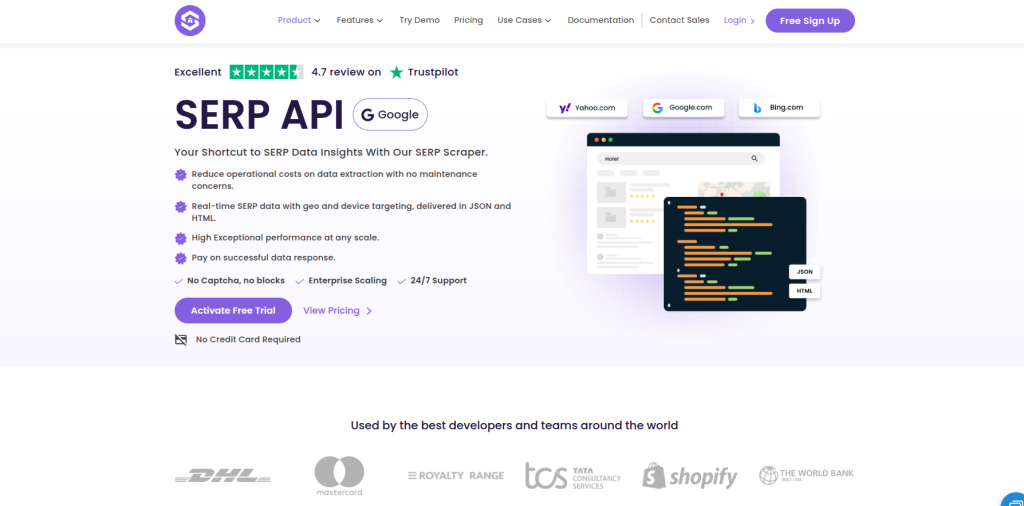
SERPHouse provides real-time search result data from Google, Bing, and Yahoo, returned as JSON by default, with Markdown and HTML output also available per endpoint. Its documentation organizes Google coverage into thirteen distinct verticals, including Google Search, Google Lite Web Search, a dedicated Top 100 Results endpoint, News, Images, Shopping, Jobs, Videos, Short Videos, Local, Forums, and Autocomplete, alongside separate Bing and Yahoo SERP APIs.
Requests can target desktop or mobile devices and a specific location, using a loc or loc_id parameter tied to a documented Locations list. Two retrieval models are available: a Live API that returns results synchronously in one request, and a Scheduled API that issues a task ID for asynchronous polling, aimed at large batch jobs. Billing is pay-on-success: SERPHouse’s documentation states that credits are deducted only for successful responses, with no charge for retries, blocks, or errors.
For a rank tracking application, the relevant question is not simply whether Google is supported. The application needs consistent ranking positions, result URLs, result types, and location parameters returned the same way on every call, which is what SERPHouse’s per-vertical endpoint structure is built to provide.
SearchApi.io
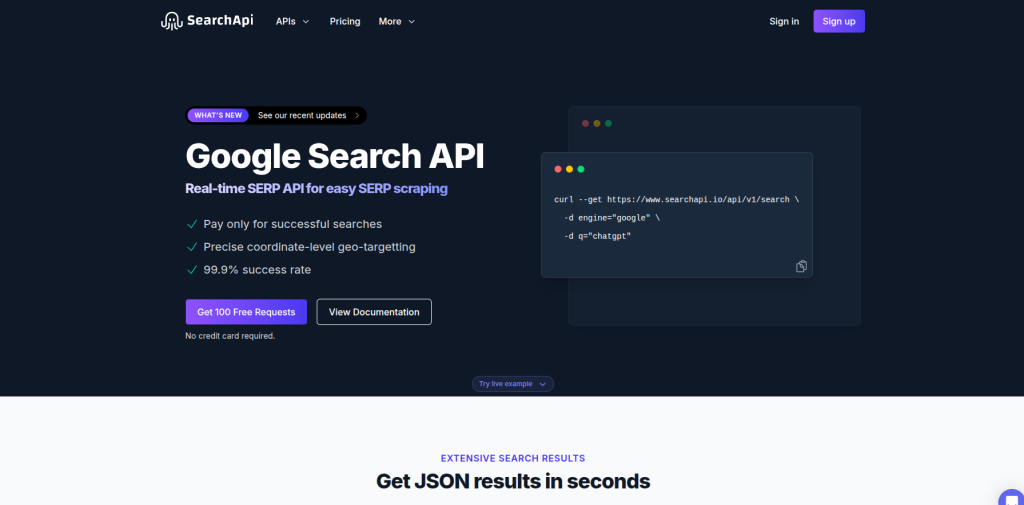
SearchApi.io provides real-time search results from a much wider set of engines and platforms, documented under a single engine parameter that switches which product a request targets. Its Google coverage alone spans more than a dozen distinct product families, several with multiple sub-endpoints: Google Shopping includes separate endpoints for products, offers, specs, reviews, and shopping filters; Google Maps includes place details, reviews, photos, and directions; Google Trends includes trending topics and autocomplete; and Google Scholar includes author profiles, citations, and case law search.
Beyond Google, SearchApi.io documents Bing, Yahoo, Baidu, Yandex, DuckDuckGo, and Naver, plus dedicated endpoints for Amazon, Walmart, eBay, YouTube, TikTok, Google Play, Apple App Store, and several ad-library and travel platforms (Zillow, Airbnb, Booking.com).
Authentication uses an api_key parameter or Bearer token, and responses return as structured JSON with a consistent search_metadata and search_parameters wrapper across engines. Billing is also pay-on-success: SearchApi.io’s own FAQ states that only successful searches returning a 200 status code incur charges.
For a research or market intelligence application that needs Google Trends data alongside Google Scholar citations, SearchApi.io’s documented breadth removes the need to integrate a second or third vendor for those specific products.
Engine and Search Product Coverage Compared
The table below covers only the categories most likely to affect a real integration decision, not a full inventory of either vendor’s documentation.
| Search Product | SERPHouse | SearchApi.io | Why It Matters |
| Google Search (organic, ads) | Supported | Supported | Core web search data for both platforms |
| Bing Search | Supported (dedicated API) | Supported (dedicated engine) | Relevant for multi-engine rank tracking or SEO tools |
| Yahoo Search | Supported (dedicated API) | Supported (dedicated engine) | Relevant for multi-engine coverage beyond Google and Bing |
| Google Local / Local Pack | Supported (local business results with ratings and addresses) | Supported (Google Local and Google Maps Place, with reviews, photos, directions) | Local SEO and map pack tracking; SearchApi.io’s Maps family goes deeper into place-level detail |
| Google Maps (directions, place reviews, photos) | Not listed as a separate product in current documentation | Supported (Google Maps Place, Reviews, Photos, Directions) | Applications needing full Maps data beyond the local pack should verify this against SERPHouse directly |
| Google Trends | Not listed in current documentation | Supported (Trends, Trending Now, Trends Autocomplete) | Trend monitoring and demand research depend on this being available |
| Image Search | Supported | Supported | Visual search and image-based monitoring workflows |
| Shopping results | Supported | Supported (with additional sub-endpoints for offers, specs, and reviews) | E-commerce price and listing monitoring |
For applications that need broad Google product access beyond core web search, such as Trends or Scholar data, SearchApi.io’s documented coverage is more directly relevant. For applications built specifically around Google, Bing, and Yahoo SERP data with a narrower, more predictable set of result types, SERPHouse’s structure is closer to a purpose-built fit. Local search workflows can use either platform’s core local-pack data, though SearchApi.io’s documentation shows more granular Maps sub-endpoints (photos, directions, individual place reviews) for applications that need more than ranking position and address.
SERP Result Types and Data Depth
More endpoints do not automatically mean more useful data for a given application; what matters is whether the specific result types an application depends on are returned consistently.
SERPHouse’s Google Search endpoint documentation lists organic results, ads, local business results, carousel, top stories, knowledge panel, People Also Ask, related searches, Google’s AI Overview panel, and inline images, videos, product, and shopping results, all returned within a single request’s response object.
SearchApi.io’s Google engine documentation returns a comparable set from a single call, including organic results, knowledge graph data, related searches, discussions and forums, inline videos, and pagination metadata, with dedicated separate endpoints available for AI Overview, related questions, and About This Result data when an application needs those specifically rather than as part of the main response.
A rank tracker typically needs a narrow, consistent set of fields: ranking position, ranking URL, result title, result type, location, and device. Both platforms return this from their core Google Search endpoint.
An AI research tool or market intelligence application often needs broader source diversity: multiple Google products, structured content beyond organic listings, and metadata that supports downstream filtering. This is where SearchApi.io’s separated engine structure, one product per documented endpoint, gives an application more precise control over which specific data source it queries, at the cost of potentially needing multiple calls where SERPHouse would return several result types from one request.
JSON Response Structure and Developer Experience
Both platforms return authenticated, structured JSON with a documented request/response schema, and neither requires parsing raw HTML for standard result types.
SERPHouse’s Google Search response wraps results inside a search_metadata object (request ID, status, timestamps), a search_parameters object (the applied query settings), and a results object containing arrays for each present SERP feature, with organic listings under results.organic.
SearchApi.io’s response follows a similar pattern, with search_metadata and search_parameters at the top level and result arrays such as organic_results, knowledge_graph, and related_searches at the root of the response rather than nested under a results key.
Here is a verified SERPHouse request, taken directly from its documentation:
This request returns Google organic results for the query, localized to New York, as desktop results, structured under results.organic in the response, which is the data path a rank tracker or SEO dashboard would parse for position and URL fields.
SearchApi.io’s equivalent request, from its own documentation, uses a GET request with query parameters instead of a POST body:
GET https://www.searchapi.io/api/v1/search?engine=google&q=chatgpt
with api_key passed as a query parameter or Bearer header. The response returns organic results under organic_results at the root level, along with knowledge graph, related searches, and discussion data in the same call.
The practical difference for integration work is the request pattern (SERPHouse’s Google Search endpoint uses POST with a JSON body; SearchApi.io uses GET with query parameters) and where result arrays live in the response tree, both of which affect how much adapter code is needed on the receiving end.
Neither pattern is inherently more complex; the choice mostly affects which existing HTTP client patterns in a codebase map more directly onto each vendor’s format. Reviewing the SERP API documentation or testing a request directly in the SERP API playground is a faster way to judge fit than reading a comparison table alone.
Geo Targeting and Device Targeting
Geographic targeting is a production requirement for local SEO, competitor monitoring, and search visibility work, not an optional bonus feature, because the same query returns different results depending on where the search is made from.
A company tracking a query like “best coffee shop” will see different organic and local pack results in New York, London, and Mumbai, and the same principle applies to e-commerce price research, local ranking checks, and any workflow where “the top result” only means something in the context of a specific place.
Both platforms document location targeting: SERPHouse uses loc (a free-text location string) or loc_id tied to a documented locations list, with support described as covering 245 countries and city or state-level targeting in supported markets.
SearchApi.io uses a location parameter that is resolved through its own Locations API. Developers can also use the uule parameter to provide a precise, pre-encoded Google location string directly. This avoids relying on text-based location resolution. Separate gl and hl parameters are available for country and language settings.
Device targeting differs slightly: SERPHouse’s documented device parameter supports desktop and mobile. SearchApi.io’s documented device parameter supports desktop, mobile, and tablet, a third option not confirmed in SERPHouse’s current documentation.
For SEO applications specifically, location accuracy directly affects the usefulness of ranking data, since a keyword position pulled without a matching location parameter does not represent what a real searcher in that market would see, a distinction covered in more general terms by Google’s own search documentation.
Pricing Per 1,000 Requests
API pricing cannot be evaluated by the monthly subscription price alone. The useful comparison is the effective cost of the successful requests an application actually needs, calculated from each vendor’s own published numbers.
| Pricing Factor | SERPHouse | SearchApi.io |
| Billing model | Monthly plan with included credits; billed only on successful responses | Monthly plan with included searches; billed only on successful (200 status) responses |
| Free plan or trial | Free plan: $0/month, 4,000 API credits | 100 free requests, no credit card required |
| Entry paid plan | Basic: $29.99/month, 400,000 API credits | Developer: $40/month, 10,000 searches, $4 per 1,000 searches |
| Mid-tier plan | Regular: $49.99/month, 800,000 API credits | Production: $100/month, 35,000 searches, $3 per 1,000 searches |
| Higher-volume example | Custom (contact sales) | Octo 1M: $1,500/month, 1,000,000 searches, $1.50 per 1,000 searches |
| Published overage rate | $0.75 per 1,000 SERP requests (Basic), $0.62 per 1,000 (Regular), for usage beyond the included credit allowance | Not published as a separate overage rate distinct from the plan’s per-1,000 price |
How Per-Request Costs Compare at Different Volumes
SearchApi.io publishes its cost as a direct per-1,000-searches figure on each plan, which declines from $4 per 1,000 on its entry Developer plan to $1 per 1,000 on its largest published Octo 5M plan.
SERPHouse does not publish a single blended per-1,000 figure for its included credits; dividing the plan price by the included credit allowance gives an effective rate of $0.075 per 1,000 on the Basic plan ($29.99 ÷ 400,000 × 1,000) and $0.0625 per 1,000 on the Regular plan ($49.99 ÷ 800,000 × 1,000), assuming the full monthly allowance is used.
This calculation only reflects usage within the included allowance. SERPHouse also publishes a separate overage rate for requests beyond that allowance. On the Basic plan, the rate is $0.75 per 1,000 requests. As a result, the effective cost depends heavily on how closely actual usage matches the monthly allowance.
Pricing should be checked directly on the provider’s current pricing page because API plans and request allowances change. Review SERPHouse’s pricing page and SearchApi.io’s pricing page directly against a realistic monthly request estimate before committing to a plan.
Which API Fits Different Use Cases?
| Use Case | Better Fit | Why |
| Rank tracking | SERPHouse | Structured, consistent result types (organic, local, Top 100) and a Scheduled API built for batch keyword runs |
| SEO monitoring | Depends on requirements | SERPHouse fits Google/Bing/Yahoo-focused monitoring; SearchApi.io fits monitoring that also needs Trends or Scholar signals |
| AI agents | Depends on requirements | Both return structured JSON suitable for LLM context; the deciding factor is whether the agent needs narrow SERP data or broader source variety |
| Market research | SearchApi.io | Broader product access (Trends, Scholar, Maps, multiple non-Google platforms) supports research spanning several data sources |
| Local search | Depends on requirements | Both return local pack data; SearchApi.io’s Maps sub-endpoints go deeper into place-level detail (reviews, photos, directions) |
| Google Trends research | SearchApi.io | SERPHouse does not list a dedicated Trends product in current documentation |
| Academic research | SearchApi.io | Dedicated Google Scholar, Scholar Author, and Case Law endpoints are documented; SERPHouse does not list Scholar coverage |
| Competitor monitoring | Depends on requirements | Both support ads, shopping, and organic result tracking; the choice depends on which specific engines and result types the competitor set requires |
| E-commerce monitoring | Depends on requirements | SearchApi.io documents more granular Shopping sub-endpoints (offers, specs, reviews); SERPHouse’s Shopping API covers core product listing and pricing data |
SERPHouse for Rank Tracking and Search Intelligence
Rank tracking and SERP monitoring systems need the same core fields returned consistently across thousands of keyword checks: ranking position, result URL, result type, location, and device, checked on a repeatable schedule.
SERPHouse’s structure fits this pattern directly. Its Live API handles on-demand checks for dashboards and other interactive tools. The Scheduled API is designed for asynchronous workflows. It returns a task ID that can be used to poll for results. This model fits the batch pattern used by rank tracking systems. Large keyword lists can be submitted first, with results retrieved as they become available instead of keeping connections open.
Combined with loc/loc_id location targeting, the API supports the geographic parameters needed for keyword monitoring. Desktop and mobile device targeting are also available. This provides the key controls needed to track search visibility without integrating unrelated endpoints.
Competitor monitoring and keyword visibility tracking can benefit from this structure. The pay-on-success billing model is particularly useful for these workflows. Monitoring systems may run thousands of scheduled checks over time. Queries that fail or get blocked are not charged, which can help control costs.
SearchApi.io for Broader Search Product Coverage
SearchApi.io’s main advantage is its documented breadth of search products. More than sixty distinct search products are available through one authentication pattern and a consistent response structure. This includes several Google products that SERPHouse’s current documentation does not list.
Google Trends, with sub-endpoints for trending topics and autocomplete, supports demand and interest monitoring that a Google-organic-only API cannot provide. For academic and legal research, Google Scholar offers author profiles, citation data, and case law search.
Beyond local-pack ranking data, Google Maps provides place details, reviews, photos, and turn-by-turn directions for broader location intelligence.
Beyond Google, SearchApi.io also documents coverage for Amazon, YouTube, TikTok, and several ad-library platforms. This can be useful for market research applications that need data from multiple consumer platforms. Competitive intelligence workflows can benefit from similar coverage. Using one vendor can reduce the need to integrate several separate data providers.
For a team whose application depends on any of these specific products, SearchApi.io’s documented coverage is a genuine, verifiable strength that a narrower SERP API cannot match without building a second integration.
When SERPHouse Is the Better Fit
SERPHouse is a stronger fit when an application’s data requirement is centered on structured Google, Bing, and Yahoo SERP data rather than broader search product access.
Choose SERPHouse when the application needs a specific and verified set of SERP result types. These include organic, local, shopping, ads, and AI Overview results from a small number of search engines. This approach may be more suitable than working with dozens of specialized products.
Applications built around keyword rank tracking benefit from the Scheduled API’s task-based batch model, which fits large keyword lists better than a purely synchronous request loop.
Workflows that depend on precise city or state-level geographic targeting can use SERPHouse’s documented location parameters directly.
Teams evaluating costs based primarily on high-volume usage may find SERPHouse’s included credits cost-effective. The effective per-1,000 rate can be favorable when usage stays within the monthly allowance. However, the calculation changes when usage regularly exceeds that allowance. In that case, teams should also factor in the applicable overage rate.
When SearchApi.io Is the Better Fit
SearchApi.io is a stronger fit when an application’s data needs extend beyond core web search. This includes specific Google products that SERPHouse does not currently document, as well as non-Google platforms.
Applications that need Google Trends data should evaluate SearchApi.io. The same applies to projects requiring Google Scholar citations or detailed Google Maps place information. Teams working with platforms like Amazon, YouTube, or TikTok should also consider its documented coverage. These are capabilities listed by SearchApi.io that SERPHouse’s current product pages do not list.
Teams can use one vendor across many different search products. This means they do not need to integrate separate tools for different data sources. SearchApi.io’s broader documented catalog can support this approach.
Its published per-1,000-searches pricing, declining from $4 to $1 per 1,000 as volume increases, also gives cost predictability that is easier to project at scale than calculating an effective rate from a credit allowance.
A Practical Decision Framework
Four questions narrow this decision in a few minutes.
1. Which search engines or products does the application require?
If the answer is limited to Google, Bing, and Yahoo web search, local, and shopping results, SERPHouse’s documented scope covers it directly.
If the answer includes Google Trends, Google Scholar, Google Maps detail, or non-Google platforms, SearchApi.io’s broader catalog is the more direct fit.
2. Which SERP elements must be extracted?
Confirm the specific result types, such as organic results, ads, local packs, knowledge panels, and AI Overviews, against each vendor’s current documentation. Do not assume that both platforms support the same result types. Each vendor documents its supported result types explicitly.
3. How important are location and device parameters?
Applications needing tablet-specific results should note that SearchApi.io documents this device option; SERPHouse’s current documentation lists desktop and mobile.
Both platforms support location targeting through a comparable text-based location parameter.
4. How many requests will the production system make each month?
Estimate your real monthly search volume first. Then compare it with SearchApi.io’s published per-1,000 pricing and SERPHouse’s plan-based credit allowance and overage rate. The better value depends on where your actual usage falls within each vendor’s pricing structure.
SERPHouse vs SearchApi.io: Final Verdict
SERPHouse and SearchApi.io serve overlapping search data requirements. The better choice depends on what the application is actually trying to collect, not on which vendor has more logos on its homepage.
For applications built around structured Google, Bing, and Yahoo SERP data, SERPHouse makes sense when rank tracking, SEO monitoring, or search intelligence is the core workload. It also offers a Live/Scheduled retrieval split and pay-on-success billing designed around this use case.
SearchApi.io makes sense when an application needs access to a broader range of search products. This includes Google Trends, Google Scholar, and detailed Google Maps data. It also covers several non-Google platforms. A consistent API pattern across this wider catalog can reduce the need to integrate multiple specialized tools.
Select the API based on the search engines, result types, and pricing model a specific application actually requires, verified against each vendor’s current documentation, rather than on marketing claims from either side.
Reviewing SERPHouse’s SERP API directly, alongside SERPHouse’s competitor comparisons, is a reasonable next step for teams narrowing a shortlist; a SERP API alternatives comparison and a look at SERP API alternatives for developers cover other vendors worth the same direct verification.
FAQs
Is SERPHouse Better than SearchApi.io?
It depends on usage.
SERPHouse’s effective rate within its included monthly credit allowance is $0.075 per 1,000 on the Basic plan. This is lower than SearchApi.io’s published entry rate of $4 per 1,000. However, SERPHouse’s overage rate beyond the allowance is $0.75 per 1,000. This is higher than SearchApi.io’s rate at comparable volume tiers.
Compare actual projected usage against both pricing pages directly.
What is the main difference between SERPHouse and SearchApi.io?
SearchApi.io documents more than sixty search products, including deep Google Trends, Scholar, and Maps coverage plus dozens of non-Google platforms.
SERPHouse focuses on structured Google, Bing, and Yahoo SERP data with a synchronous/asynchronous retrieval split built around rank tracking and SEO monitoring workloads.
Which API is better for rank tracking?
SERPHouse’s structure, including its Scheduled API for batch keyword processing and consistent organic, local, and Top 100 result types, is built more directly around rank tracking workflows.
SearchApi.io also supports this use case and adds a dedicated Rank Tracking API, but its broader catalog is not specific to this single workload.
Which SERP API is better for developers?
Neither is objectively better for developers in general; both return authenticated, structured JSON with documented parameters.
SERPHouse uses a POST request with a JSON body for its Google Search endpoint; SearchApi.io uses a GET request with query parameters.
The better fit depends on which search products and result types the specific application needs.
Can I test SERPHouse before integrating it?
Yes. SERPHouse offers a free plan with 4,000 API credits and a SERP API playground for testing requests directly, and developers can create a SERPHouse account to run real queries before committing to a paid plan.