
Table of Contents
Table of Contents
Selection of a SerpApi alternative usually starts after a billing surprise, not before one. Teams open their invoice, see a number that does not match the demo pricing page, and start comparing five vendors in one afternoon. A SerpApi vs. SERPHouse breakdown usually settles the question fastest, since the two sit closest on features but furthest apart on price at scale.
This guide lines up five SerpApi alternatives, SERPHouse, ScraperAPI, DataForSEO, Zenserp, and Serper, on the same criteria: entry pricing, cost at real volume, latency, SERP coverage, and how each Google search results API actually behaves once you move past a trial account.
Every pricing figure below comes from each provider’s own published pricing page. This search API comparison reflects those published rates, but confirm current rates before you commit, since providers update plans often.
Comparing the Leading SerpApi Alternatives
SERPHouse
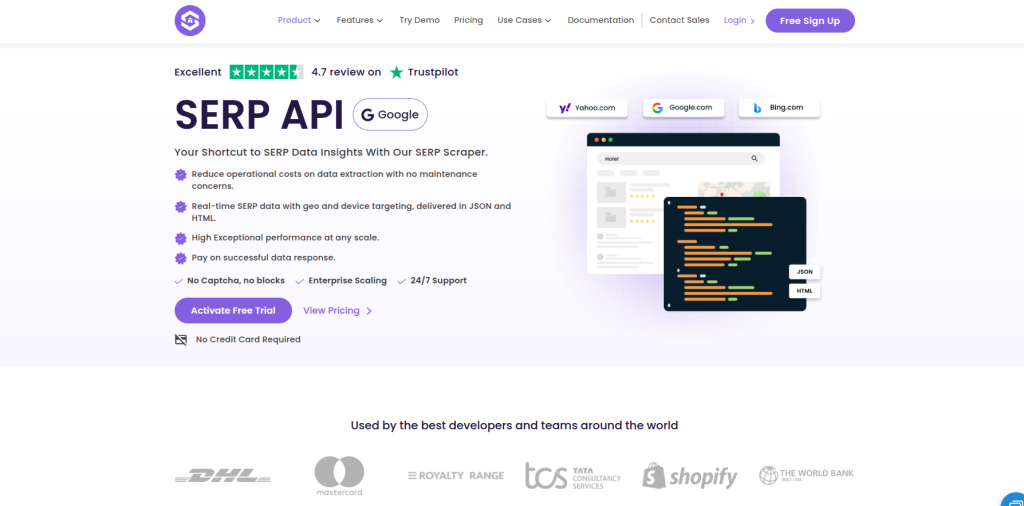
- SERPHouse is a dedicated SERP scraping API built for teams running Google, Bing, and Yahoo queries at production volume.
- It covers organic search, images, news, shopping, jobs, local packs, and video results through a single API, with JSON output and batch-processing capabilities.
- For teams building rank trackers, SEO platforms, search monitoring tools, or AI applications, its dedicated SERP infrastructure can simplify access to structured search data.
- This makes SERPHouse a best SerpApi alternative for organizations that need multi-engine coverage and a search-focused API rather than a general web scraping solution.
ScraperAPI
- ScraperAPI is a general purpose scraping and proxy API rather than a dedicated SERP product, so it fits a narrower slice of serpapi alternative searches than a purpose-built SERP endpoint.
- It handles JavaScript rendering, premium proxies, geotargeting, and CAPTCHA handling, which makes it useful for teams that need Google result pages alongside other scraping targets in one account.
- It routes requests through a pool of over 40 million IPs across 50+ countries and publishes a 99.9% uptime guarantee.
- Credit cost is domain-based rather than flat: a standard page costs 1 credit, but Google and Bing pages cost 25 credits each, so a Google SERP pull uses far more of your monthly allowance than the headline credit count suggests.
DataForSEO
- DataForSEO runs on pure pay-as-you-go pricing with no subscription and no unused credit penalty, making it one of the more flexible serpapi alternative picks for spiky workloads.
- It also bundles backlink, keyword, and domain data alongside SERP results, which matters for teams that need more than rankings from one vendor.
- Coverage spans 249 countries with three delivery speeds to choose from: a standard queue, a priority queue, and a live mode, backed by a 99.95 percent uptime figure.
Zenserp
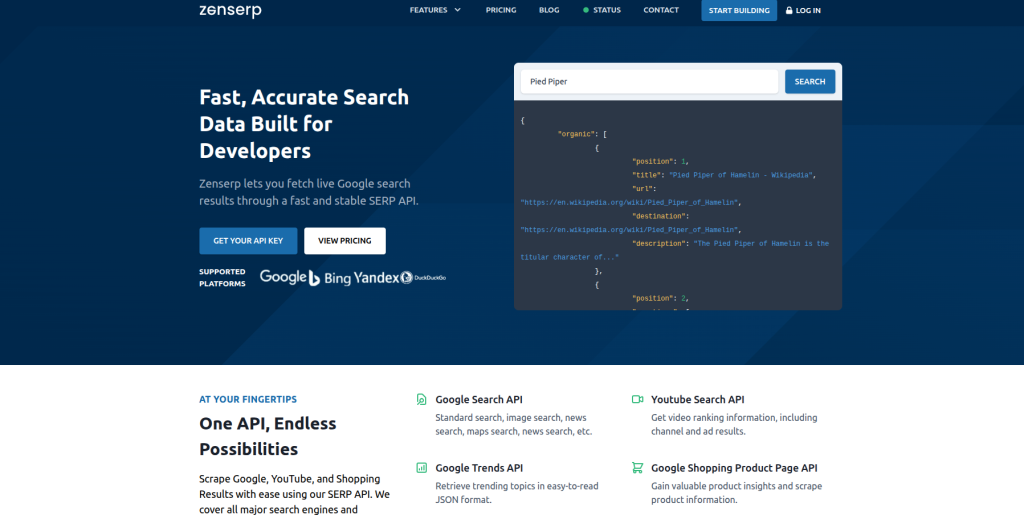
- Zenserp positions itself as a lightweight serpapi alternative for smaller projects.
- It covers Google, Bing, YouTube, and shopping results with real-time delivery and a straightforward request builder, making it approachable for teams that do not need a large feature set.
- Published coverage extends across 200+ countries, with a 99.9% uptime SLA. For teams prioritizing simplicity and broad geographic coverage, Zenserp is worth considering alongside other serpapi alternative providers.
Serper
- Serper is a Google-focused SERP API designed for developers who need structured search data without managing their own scraping infrastructure.
- It provides JSON results and supports integrations commonly used in AI applications, including a LangChain integration.
- The platform uses prepaid credits rather than a traditional monthly subscription, with free queries available for new users and purchased credits remaining valid for six months.
- The narrower engine coverage is the tradeoff: Serper is a strong fit when Google is the primary search source, while platforms such as SERPHouse and DataForSEO are better suited to multi-engine requirements.
How We Compared These SERP APIs
Pricing and Cost at Scale: Published plan prices only tell part of the story, so every SerpApi alternative on this list gets measured on effective cost per 1,000 requests at three volume tiers.
SERP Coverage and Data Quality: Coverage counts organic results, images, news, shopping, local packs, and any engine beyond Google, since a best SerpApi alternative that only returns organic Google links limits what you can build on top of it.
Latency and Reliability: Response time and uptime get reported only where a vendor publishes real figures or independent benchmarks exist in this search API comparison. Nothing here is estimated.
Scalability and API Limits: Rate limits, concurrency caps, and batch processing support determine whether an API survives a real production spike, not just a demo call.
Integration and Flexibility: JSON structure, MCP and AI agent support, and documentation quality decide how fast a team actually ships with the API once pricing looks acceptable.
SERP API Comparison: Features, Pricing, and Performance
The table below is a fast reference for a search api comparison across the five providers covered in this guide. Details follow in the sections after it.
| Factor | SERPHouse | SerpAPI | ScraperAPI | DataForSEO | Zenserp |
| Google Search | Yes | Yes | Yes | Yes | Yes |
| Bing | Yes | Yes | Limited | Yes | Yes |
| Yahoo | Yes | Yes | No | Yes | No |
| Images | Yes | Yes | Limited | Yes | Yes |
| News | Yes | Yes | No | Yes | Limited |
| Shopping | Yes | Yes | No | Yes | Yes |
| Maps/Local | Yes | Yes | No | Yes | Limited |
| Location targeting | Yes | Yes | Yes | Yes | Yes |
| Device targeting | Yes | Yes | Yes | Yes | Limited |
| Historical data | On request | No | No | Yes | No |
| Batch processing | Yes | Limited | Yes | Yes | Limited |
| JSON output | Yes | Yes | Yes | Yes | Yes |
| AI/MCP integration | Yes | Limited | No | Yes | No |
| Pricing model | Subscription plus custom | Subscription only | Credit based | Pay as you go | Subscription only |
| High volume support | Strong | Expensive at scale | Moderate | Strong | Limited |
Coverage marked Limited or No reflects each provider’s own published documentation as of August 2026, not a full production test across every account tier.
How Do the Pricing Models Compare at Scale?
Entry Level Pricing
Entry pricing varies widely across the market. SerpApi starts at $25 per month, and SERPHouse starts around $29.99.
Zenserp’s entry paid plan begins at $49.99, while DataForSEO uses a pay-as-you-go model with a $50 minimum deposit instead of a monthly subscription.
Serper follows a prepaid credit model, making it another option for teams evaluating a serpapi alternative.
Cost at 100K Searches
At 100,000 monthly searches, DataForSEO remains one of the lowest-cost options based on its published per-request pricing. SerpApi costs rise significantly as volume increases, while Serper remains competitive through prepaid query packs.
SERPHouse positions itself as a cost-effective option for higher-volume workloads, whereas ScraperAPI and Zenserp typically require larger plans to support this search volume.
Cost at 1M Searches
At 1 million searches, pricing differences become more noticeable. DataForSEO maintains one of the lowest published per-search costs, while SerpApi moves into substantially higher spend ranges.
SERPHouse, ScraperAPI, and Zenserp generally shift toward custom or enterprise pricing at this scale, making direct vendor quotes necessary for an accurate API pricing comparison.
Hidden Usage Costs
When comparing a serpapi alternative, look beyond the advertised monthly plan. Unused searches may expire on subscription-based platforms, while credit-based providers can consume credits faster for SERP-specific requests.
A complete API pricing comparison should include overages, feature-specific charges, and actual search volume requirements rather than relying solely on entry-level pricing.
How Do the Alternatives Compare on Latency and Scalability?
API Response Time
Few of these providers publish a guaranteed response time on their public pricing pages. Independent third-party benchmarking has measured ScraperAPI averaging under 5 seconds per request across mixed targets.
Still, comparable independent figures were not found for the other four providers in this search API comparison, so no response time claim is made for them here.
Concurrent Requests and Rate Limits
SERPHouse publishes a standard rate limit near 60 requests per minute, with higher throughput available on request. SerpApi caps hourly throughput near 20 percent of a plan’s monthly allowance.
DataForSEO and ScraperAPI both scale concurrency with plan tier rather than publishing one fixed number.
Batch and Bulk Processing
SERPHouse, DataForSEO, and ScraperAPI all document a batch processing mode for large keyword sets. SerpApi and Zenserp support bulk requests with more limited published tooling around it.
Reliability at Production Volume
Uptime commitments are published by some providers and not others, so treat any specific uptime percentage as a claim to verify directly with the vendor before signing a contract tied to it.
Why Is SERPHouse the Best SerpApi Alternative in 2026?
Built for High-Volume Search Data
- SERPHouse is built around bulk processing and scalable request handling rather than a single search box use case.
- Its infrastructure targets teams pulling tens of thousands of keywords a week across multiple engines, not a handful of ad hoc lookups.
More Than a Basic SERP Endpoint
- Beyond raw rankings, SERPHouse supports search data workflows for analytics platforms, SEO tools, and AI applications, including documented support for MCP style agent integration.
- That flexibility matters for teams building a product on top of the data rather than reading it in a dashboard once a week.
Better Economics for Growing Workloads
- At the volumes most growing teams actually hit, SERPHouse’s published pricing avoids the steep per-request jump that shows up on SerpApi past the entry tier.
- Request efficiency matters more than headline price once a team scales past a few thousand searches a month, and this is where SERPHouse earns serious consideration as a SerpApi alternative rather than just a cheaper option on paper.
What Should You Check Before Switching From SerpApi?
Validate Data Compatibility
Compare a sample response from your new provider against your current SerpApi output field by field, since JSON structure and SERP feature naming rarely match exactly across vendors.
Test Accuracy and Latency
Run the same keyword set on both providers for a week before migrating, and compare ranking URLs, missing results, and response times under your own real conditions.
Calculate Actual Production Cost
Multiply your real monthly search volume by each provider’s published unit rate, not the entry plan price, before assuming a best SerpApi alternative 2026 pick actually saves money at your scale.
Check Migration Requirements
Confirm parameter names, authentication method, and rate limit behavior match your existing integration code, since a mismatched field name can silently break a production pipeline.
Which Is the Best SerpApi Alternative?
SERPHouse stands out as the best overall SerpApi alternative for teams needing scalable SERP and search data infrastructure without an enterprise contract.
SerpApi remains a solid pick for established workflows already built around its wide engine list.
ScraperAPI fits teams needing general web scraping alongside occasional SERP pulls.
DataForSEO suits teams wanting SERP data bundled with broader SEO datasets.
Zenserp works best for simpler implementations at lower volume where subscription pricing is not a concern.
Conclusion
Selection of a SerpApi alternative means comparing real search volume, pricing, coverage, and integration requirements rather than selecting the cheapest entry plan. DataForSEO stands out for usage-based pricing, SerpApi offers broad search engine coverage, while SERPHouse provides a dedicated SERP data solution for teams managing growing search workloads.
The right choice depends on your required engines, SERP features, request volume, and budget. Before switching, test the same queries across providers and compare accuracy, response structure, scalability, and total cost in this search API comparison under your expected production workload.
FAQ
How does SERPHouse compare with SerpApi for high-volume workloads?
The SerpApi vs. SERPHouse comparison becomes more relevant as query volume increases. Compare effective cost per 1,000 searches, included quotas, SERP coverage, processing options, and API limits rather than entry pricing alone.
Which is the best SerpApi alternative for variable search volumes?
DataForSEO can be suitable for variable workloads because its pay-as-you-go model links spending to actual usage. SERPHouse is another option for teams seeking dedicated SERP infrastructure and multi-engine coverage.
What should I include in a SERP API pricing comparison?
A useful API pricing comparison should account for search volume, cost per 1,000 queries, included credits, overages, SERP features, geographic targeting, and whether unused credits expire.
What makes a Google search results API suitable for production?
Evaluate data accuracy, geographic targeting, SERP feature coverage, response consistency, throughput, batch processing, documentation, and pricing at your expected production volume.
Can a SERP scraping API support AI search and agent workflows?
Yes. Structured SERP data can feed AI applications, agents, and retrieval workflows. The important factors are response structure, search coverage, freshness, and whether the API provides the fields required by your workflow.
When should you consider switching to a SerpApi alternative?
Consider switching when pricing, search volume, engine coverage, SERP features, API limits, or integration requirements no longer fit your needs. Test the alternative against real queries before migrating.