
Table of Contents
Table of Contents
A financial analyst covering a mid-cap software company might open 15 browser tabs before 9 a.m.: one for the earnings call transcript, several for competitor press releases, a few for industry news, one for Google Trends, and a couple for checking whether a product launch actually shipped. None of this is difficult work; it’s just slow, repetitive, and hard to keep consistent across a coverage list of thirty or fifty names. As that list grows, or as the research cadence moves from monthly to daily, manual search-based research stops scaling.
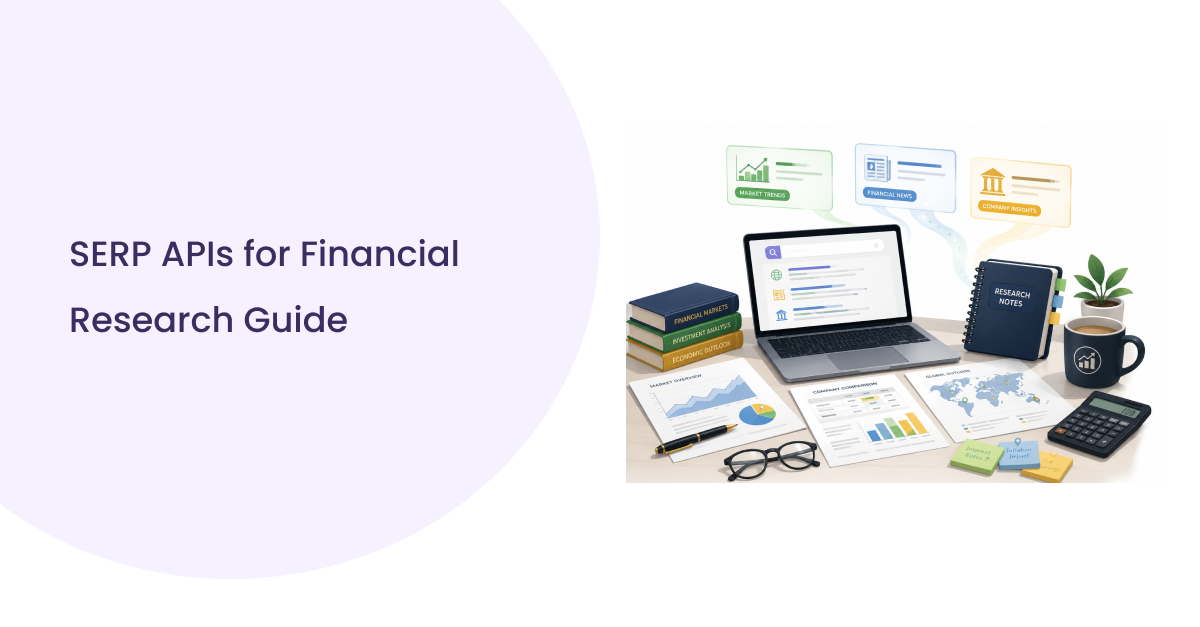
SERP APIs solve a narrow but useful piece of that problem: they turn a Google search into a structured, machine-readable response that can be scheduled, logged, and fed into the rest of a research stack. This guide covers what that looks like in practice: the architecture, the code, the failure modes, and where a provider like SERPHouse fits into a production financial research pipeline.
What Is a SERP API?
A SERP API (Search Engine Results Page API) is a programmatic interface that submits a search query to a search engine and returns the results as structured data, typically JSON instead of an HTML page meant for a browser. Rather than rendering a results page for a human to scroll through, the API returns organic listings, news results, knowledge panels, and other result types as parsed fields: titles, URLs, snippets, publish dates, and source domains.
For financial research, this distinction matters for three reasons:
- Structure: A JSON response can be parsed directly into a dataframe or database row; an HTML page cannot, without additional scraping logic that search engines actively work to block.
- Automation: An API call can be scheduled, retried, and logged like any other data pipeline step. A manual search cannot.
- Consistency: API results are captured the same way every time, which matters when comparing search visibility or sentiment across a watchlist over weeks or months.
In short, a SERP API replaces “someone searches Google and reads the results” with “a script searches Google and stores the results,” which is the precondition for almost everything else in this guide.
Why Search Data Matters in Financial Research
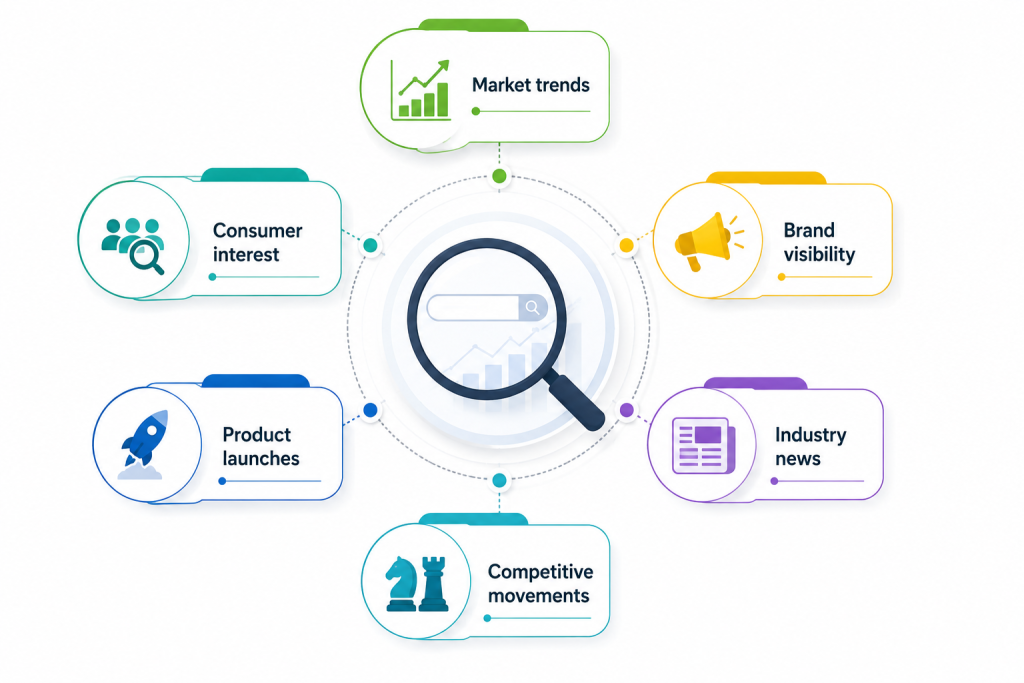
Search engine results are a live index of what the internet is currently saying about a company, sector, or trend. That makes them a useful, though not sufficient, complement to traditional financial data sources like filings, price data, and analyst reports.
Search data can surface:
- Market trends: rising search interest in a product category often precedes revenue changes by a quarter or more.
- Consumer interest: spikes in branded search volume frequently correlate with product launches, marketing campaigns, or recalls.
- Brand visibility: how often and how prominently a company appears for category-defining queries is a rough proxy for market position.
- Product launches: new SKUs, features, or services usually generate a detectable wave of press and retailer coverage before they show up in earnings.
- Industry news: aggregated news results reveal the current narrative around a sector faster than most delayed newsfeeds.
- Competitive movements: hiring pages, product pages, and press coverage indexed in search often reveal a competitor’s strategy before it’s formally announced.
None of this replaces SEC filings, earnings transcripts, or price and volume data. It supplements them. Search data is directional and observational; it tells you where attention is moving, while filings and financial statements tell you what actually happened. Treating SERP data as one input among several, rather than a standalone signal, is the difference between using it well and overfitting a model to noise.
Financial Research Workflows Powered by SERP APIs
Earnings Monitoring
- Problem: Analysts need to know when earnings coverage, guidance revisions, or analyst reactions appear online, often before aggregators pick them up.
- API workflow: Schedule a news-focused SERP query per ticker around known earnings dates; parse headlines and snippets for guidance language, analyst commentary, and sentiment-carrying terms. SERPHouse’s real-time news monitoring use case covers how this pattern scales across a full watchlist.
- Business value: Faster reaction time to market-moving coverage without manually monitoring dozens of tickers.
Competitor Tracking
- Problem: Competitive intelligence teams need to track competitor product pages, pricing changes, and press mentions without manually revisiting each site.
- API workflow: Run recurring branded and product-line queries for each competitor; diff results week over week to flag new pages, pricing language, or announcements. For monitoring competitor rankings and coverage with a SERP API across multiple entities at scale, see the agency tracking implementation guide.
- Business value: Earlier visibility into competitor moves, feeding both equity research and internal product strategy.
Brand Sentiment
- Problem: Understanding how public sentiment toward a brand is shifting, beyond formal analyst coverage.
- API workflow: Pull news and organic results for a brand name, classify snippet sentiment with a lightweight NLP model, and track sentiment trend over time.
- Business value: An early, if noisy, signal that can flag reputational risk or emerging positive momentum.
Market Expansion Research
- Problem: Assessing whether a company is entering a new geography or vertical based on public signal rather than official announcements.
- API workflow: Run localized SERP queries by country or language for the company plus expansion-related terms. See worldwide location targeting for geo-specific queries for the full list of supported countries, languages, and regional domains before building location-parameterized queries.
- Business value: Earlier detection of expansion activity than waiting for a press release or earnings call mention.
Sector Trend Analysis
- Problem: Identifying which companies are gaining or losing share of voice within a sector narrative.
- API workflow: Run category-level queries (e.g., “enterprise observability platform”) and track which companies appear, and how prominently, over time.
- Business value: A share-of-search proxy that can complement share-of-market analysis.
Investment Screening
- Problem: Screening a watchlist for early qualitative signals of leadership changes, lawsuits, and regulatory mentions that don’t show up in structured financial data yet.
- API workflow: Run a standing set of risk-flag queries (executive name + “resigns,” ticker + “lawsuit,” ticker + “investigation”) on a schedule and alert on new matches.
- Business value: An early warning layer that supplements standard risk monitoring tools.
Alternative Data Collection
- Problem: Building a proprietary, hard-to-replicate dataset from public search signal for quantitative strategies.
- API workflow: Continuously log SERP features (result counts, ranking volatility, News/Shopping result presence) per ticker as time-series features for a model.
- Business value: A differentiated alternative data input that isn’t dependent on a single licensed vendor.
Architecture of an Automated Financial Research Pipeline
A production-grade pipeline generally follows the same shape regardless of which workflow it supports:
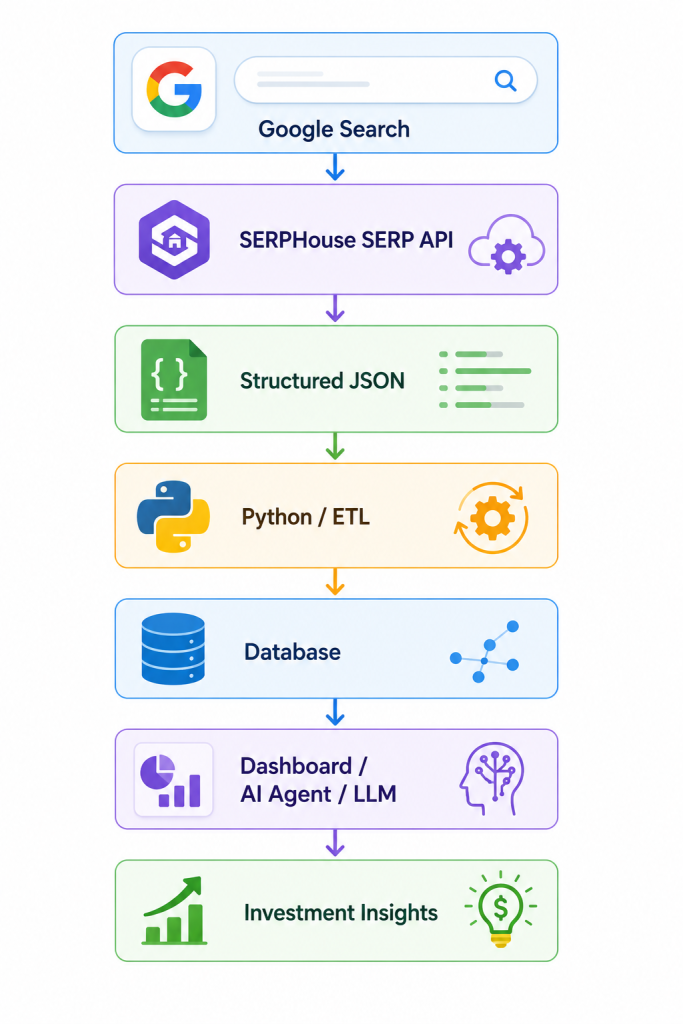
Google Search is the source of truth: the live, ranked view of the web for a given query at a given moment.
SERPHouse SERP API submits the query and returns the rendered results as structured JSON, handling the underlying request infrastructure, geolocation, and result parsing so the pipeline doesn’t have to.
Structured JSON is the normalized output of organic results, news results, and metadata like position, domain, and timestamp, ready for programmatic use without HTML parsing.
Python / ETL is where raw JSON gets cleaned, deduplicated, enriched (e.g., sentiment scoring, entity tagging), and mapped to a consistent schema.
Database stores the processed records, typically time-indexed by ticker or entity, so historical trends can be queried rather than re-fetched.
Dashboard / AI Agent / LLM is the consumption layer a BI dashboard for human analysts, or an LLM-based agent that summarizes, flags anomalies, or drafts research notes.
Investment Insights is the output: a research note, an alert, a screened watchlist, or a feature in a broader quantitative model.
The important design decision is where processing happens: heavy computation (sentiment models, deduplication logic) belongs in the ETL layer, not in the API call itself or in the dashboard layer, to keep each stage independently testable and replaceable.
Code Examples
Comparison Table – Choosing an Integration Approach
| Approach | Best For | Tradeoff |
| Direct REST calls (cURL/Python requests) | Simple scheduled jobs, prototypes | More boilerplate for retries/pagination |
| SDK or client library | Production services with many query types | Adds a dependency to manage |
| Serverless function (e.g., AWS Lambda) | Event-driven or low-volume monitoring | Cold start latency, execution time limits |
| Workflow orchestrator (Airflow, Dagster) | Multi-step pipelines with dependencies | Higher setup and operational overhead |
Python — scheduled news query for a ticker watchlist
cURL — quick manual check
API Response Example — simplified organic result
SERPHouse nests results under results.results, with the relevant array named for the serp_type requested (organic for web, news for news, and so on):
For news queries (serp_type=news), the equivalent array is results.results.news, with fields like title, url, time (a relative string such as “2 days ago”), channel, and snippet rather than link/date. This is a meaningful implementation detail: parsing code has to branch on serp_type rather than assuming one flat schema across web and news queries.
Each of these examples is intentionally minimal: a real pipeline adds retry logic, response validation, and storage, covered in the Best Practices section below. Full parameter references (including verbatim, gfilter, date_range, and location lookups via loc_id) are in SERPHouse’s Live (HTTP GET) documentation.
Pro Tip: Store the raw JSON response alongside the parsed fields. When a downstream schema changes or a bug is found in the parsing logic, having the original payload means historical data can be reprocessed instead of re-fetched, which matters when working against rate limits and API cost.
AI Agents & Financial Research
AI agents extend a SERP API pipeline from “collect data” to “act on data.” A typical agent built on top of a SERP feed can:
- Monitor companies continuously against a watchlist, without a human initiating each check.
- Summarize financial news by clustering related headlines and generating a short digest rather than a raw link list.
- Detect competitor activity by comparing current SERP snapshots against prior ones and flagging meaningful diffs a new product page, a pricing change, a leadership announcement.
- Build investment reports by combining SERP-derived qualitative signal with structured financial data already in the pipeline.
- Trigger alerts when specific conditions are met a risk-flag query returns a new result, or sentiment on a tracked entity crosses a threshold.
- Generate dashboards by pushing structured, tagged data into a BI layer that updates on the same schedule as the underlying queries.
The practical integration point is straightforward: the SERP API’s structured JSON becomes the tool-call output an LLM reasons over, rather than raw HTML the model would need to parse itself. This keeps the model’s context focused on relevant fields (title, snippet, date, source) instead of consuming tokens on page markup.
Common Mistake: Feeding raw, unfiltered SERP results directly into an LLM prompt at scale. This burns context window on noise and increases the chance of the model treating an unrelated result as relevant. Filtering and deduplicating at the ETL layer before the data reaches the model produces materially better agent output than relying on the model to do that filtering itself.
Common Challenges
Production use of SERP APIs in a financial context surfaces a consistent set of operational issues:
- Rate limits. High-frequency monitoring across a large watchlist can hit provider rate limits quickly; query batching and prioritization are necessary at scale.
- Duplicate searches. Overlapping queries (e.g., ticker name and full company name) can return substantially the same results, inflating both cost and noise if not deduplicated.
- Data freshness. Search results reflect a point-in-time crawl and index state, not a live feed; freshness varies by result type, with news results typically updating faster than organic listings. What real-time SERP data actually delivers vs. cached responses explains this crawl-vs-index distinction in detail in important context before designing query schedules around specific freshness expectations.
- Localization. Financial research on multinational companies often requires geo-specific queries, since search results and relevant local coverage vary meaningfully by country and language.
- Search personalization. Because SERP APIs query from provider infrastructure rather than a logged-in user’s browser, results are generally de-personalized, which is desirable for consistency but means they may not reflect what any specific human searcher sees.
- Error handling. Timeouts, malformed responses, and partial failures need explicit handling; a pipeline that silently drops failed queries will produce quietly incomplete datasets.
- Caching. Re-fetching identical queries within a short window wastes quota; a caching layer with a sensible TTL (e.g., hourly for news, daily for organic) reduces both cost and latency.
Common Mistake: Treating SERP data as real-time. It is near-real-time at best, gated by crawl and indexing cycles. Pipelines that assume sub-minute freshness for organic results will misattribute lag as a data quality issue rather than an inherent property of search indexing.
Best Practices
- Batch processing: Group watchlist queries into scheduled batches rather than firing requests continuously, to smooth load and simplify rate-limit management.
- Scheduling: Align query frequency to the actual decay rate of the signal news queries hourly or daily, broader trend queries weekly.
- Logging: Log every request and response status, not just parsed output, to make debugging pipeline failures tractable.
- Retry logic: Use exponential backoff for transient errors (timeouts, 5xx responses) and fail fast on client errors (invalid query, auth failure).
- Monitoring: Track success rate, latency, and result-count anomalies per query type as operational metrics, not just business metrics.
- Data validation: Validate that expected fields are present before writing to the database; a partially parsed response is worse than a failed one if it silently corrupts downstream tables.
- Cost optimization: Deduplicate overlapping queries, cache aggressively where freshness requirements allow, and review query volume against actual usage in dashboards and models; it’s common for legacy queries to keep running long after the workflow that needed them has changed.
Why SERPHouse Fits Financial Research
Financial research pipelines put specific demands on a SERP API: consistent structured output, reliable uptime during market hours, coverage across geographies for multinational research, and documentation clear enough that an engineering team can integrate it without extensive trial and error.
SERPHouse is built around those requirements:
- Reliable structured JSON: consistent schema across query types (organic, news, and other result formats), reducing parsing overhead in the ETL layer.
- Global search locations: geo-targeted queries support the localization needs of multinational coverage and expansion research.
- Automation-friendly API design: built for scheduled, programmatic use rather than one-off manual lookups.
- Developer documentation: reference material intended to support production integration, not just a quickstart demo.
- Scalable infrastructure: designed to support watchlists that range from a handful of tickers to sector-wide coverage.
SERPHouse is one input into a financial research stack, not a replacement for financial data providers, filings, or analyst judgment. Its role is to make the search-data layer of that stack structured, automatable, and consistent enough to build on.
Conclusion
SERP APIs for Financial Research help transform search engines into structured, automation-ready data sources that complement traditional financial research. While financial statements, earnings reports, and market data remain essential, search data adds valuable context by uncovering news coverage, competitor activity, product launches, and emerging market trends as they happen.
By using SERP APIs for Financial Research, analysts and engineering teams can automate data collection, streamline monitoring workflows, and build AI-powered research systems with greater consistency and speed. Whether you’re tracking a watchlist, monitoring competitors across global markets, or enriching investment research with alternative data, SERP APIs provide timely search insights that support more informed analysis alongside conventional financial data.
FAQ
How are SERP APIs used in financial research?
They automate the collection of search-based signals news coverage, competitor activity, product launches, and sentiment that feed research pipelines, dashboards, and AI agents, complementing traditional financial data.
What data can a SERP API provide?
Typical outputs include organic search results, news results, result rankings, source domains, snippets, and publish dates, depending on the search engine and query type used.
Why use SERP APIs instead of manual searches?
APIs make search data structured, repeatable, and schedulable, which manual searching cannot offer at scale, especially across large watchlists monitored on a recurring basis.
Can AI agents use SERP APIs?
Yes. AI agents commonly use SERP API output as a tool-call result, reasoning over structured fields like titles and snippets to summarize news, detect changes, or generate alerts.
What are common technical challenges with SERP APIs in finance?
Freshness expectations, localization for multinational research, and building proper error handling, caching, and deduplication into the pipeline.