
Table of Contents
Table of Contents
Today’s organizations expect AI to gather live data, validate information across trusted sources, compare vendors, analyze competitors, and generate recommendations that support real business decisions.
That’s where Claude MCP changes the conversation.
Instead of relying only on its trained knowledge, Claude MCP connects Claude to external tools, enterprise systems, APIs, databases, and live web sources through the Model Context Protocol (MCP). The result is more than better answers; it delivers evidence-backed analysis that businesses can act on with confidence.
To demonstrate this difference, we tested SERPHouse MCP with Claude against Claude without MCP across ten enterprise use cases. Each scenario used the same prompt and evaluated how both versions handled vendor research, competitive intelligence, product planning, compliance validation, cloud architecture, and executive decision-making.
Note: To keep the comparisons practical and reproducible, we used publicly available information from well-known companies. The examples are for demonstration purposes only. This blog uses publicly available information and representative enterprise scenarios. No internal company systems, CRM records, support platforms, or confidential data were connected or accessed during testing.
Our Testing Methodology
To keep every comparison fair, we used the same prompt for both versions of Claude.
For each business scenario, we compared outputs across five areas:
- Depth of research.
- Use of live and verifiable data.
- Quality of recommendations.
- Decision-making support.
- Actionable business insights.
Where appropriate, screenshots show the outputs generated by Claude alone and by Claude MCP, followed by a concise comparison highlighting the additional insights surfaced through SERPHouse MCP with Claude.
Test 1: Enterprise Vendor Due Diligence
Business Goal: Enterprise buyers need to evaluate vendors using financial performance, legal history, employee sentiment, and delivery capability. Manual research is slow, fragmented, and difficult to validate.
Prompt:
You are a senior enterprise procurement analyst with 10+ years of experience in vendor risk assessment. Analyze Thoughtworks and Endava against the top 3 competitors in its category. Evaluate verified customer reviews from the last 12 months, publicly available case studies, hiring and growth trends, financial stability signals, and any compliance red flags. Present findings as a structured risk matrix, then conclude with a clear shortlist, hold, or reject recommendation, citing evidence for each point.
What changed?
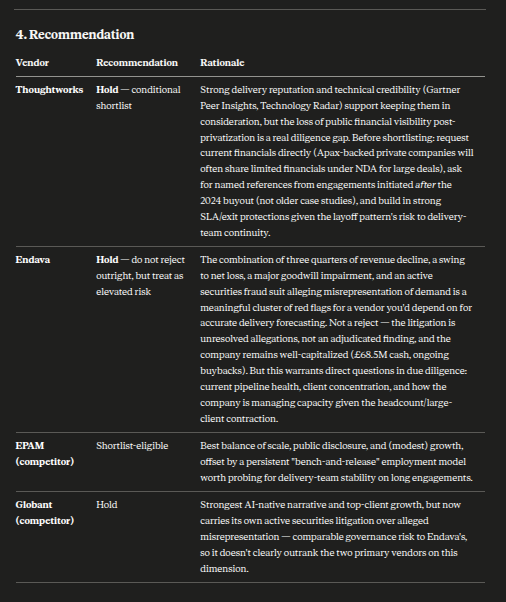
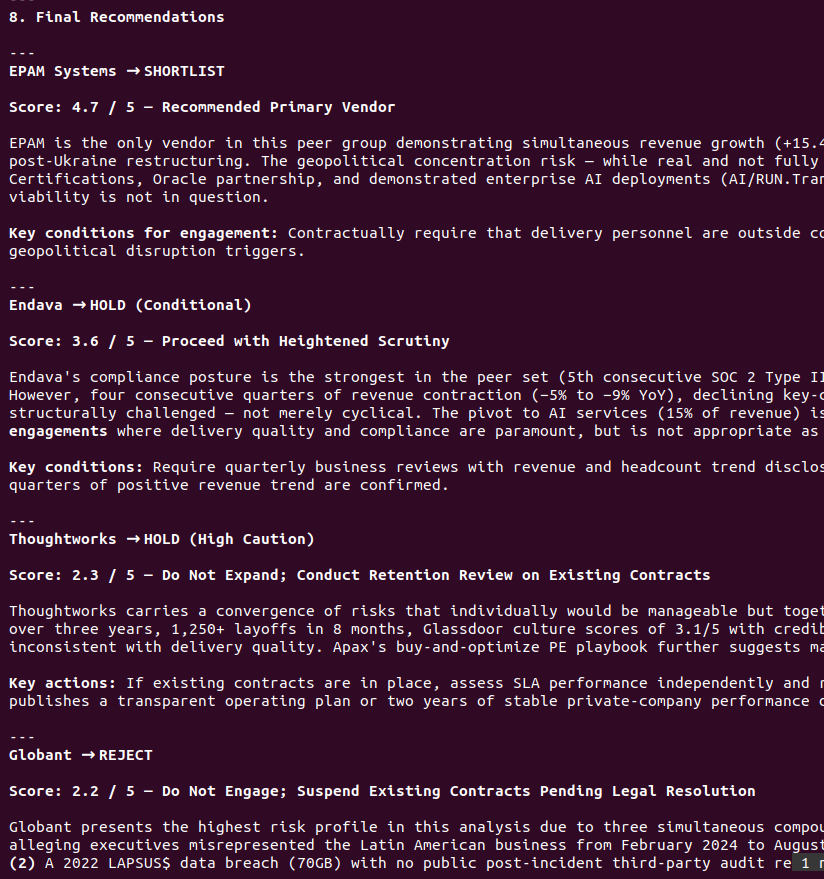
Claude organizes the requested evaluation criteria into four key sections, providing a high-level comparison. In contrast, Claude with SERPHouse MCP delivers a far more comprehensive analysis by covering every evaluation point with live, verifiable data, structured comparison tables, and actionable insights. It concludes with an eight-step summary of recommendations, making the results easier to understand and more useful for decision-making.
| Aspect | Claude | Claude with SERPHouse MCP |
| Financial detail | Describes general trends. | Reports exact quarterly figures, including Endava’s £364.6M impairment and £15.1M loss. |
| Data freshness | Uses general reasoning. | Attaches specific dates and quarters, such as Q3 FY26 and March 31, 2026. |
| Litigation & compliance | Suggests checking for risks. | Identifies the case, filer, filing date, and allegation window. |
| Employee sentiment | Notes sentiment may matter. | Uses dated review evidence, including a Sept 2025 Glassdoor example. |
| Competitive benchmarking | Compares peers qualitatively. | Benchmarks EPAM, Globant, and Accenture side by side with matching metrics. |
| Additional findings | Answers only the direct question. | Surfaces related risk signals and notes confidence gaps when evidence is incomplete. |
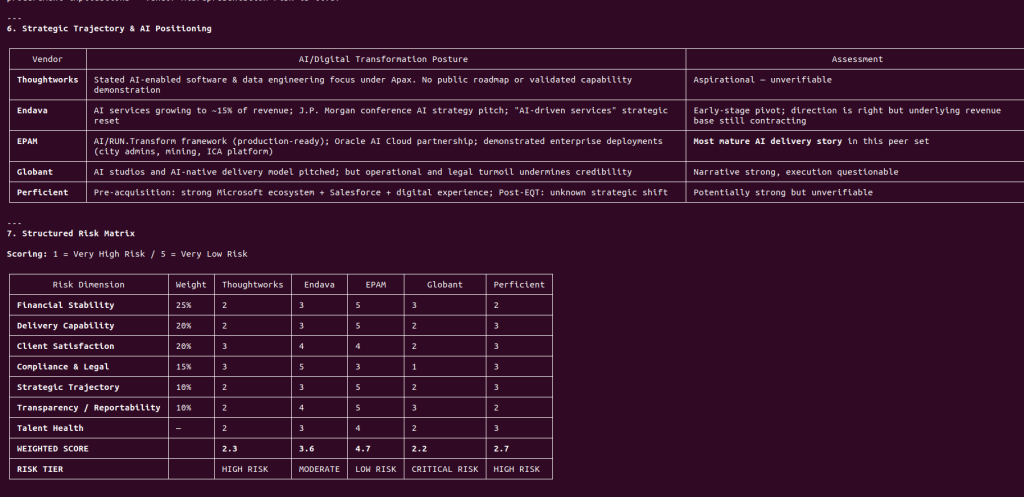
How SERPHouse MCP with Claude Expanded the Analysis
| # | Extra Data Point (MCP-only) | Detail Provided | Why Claude Baseline Couldn’t Have This |
| 1 | Ownership change event | Apax Partners took Thoughtworks private, Aug 2024 deal at $4.40/share (~$1.75B enterprise value), closed Nov 2024. | Post-cutoff corporate action; baseline still assumed Thoughtworks was public. |
| 2 | Exact quarterly financials | Endava Q3 FY26 revenue £178.5M (down 8.4% YoY); £364.6M goodwill impairment; £15.1M net loss vs. £9.1M prior-year profit. | No live filings access; baseline can’t cite specific quarters. |
| 3 | Live headcount figures | Endava ~11,225 employees as of Mar 31, 2026; Thoughtworks ~10,500 pre-layoffs. | Requires current company disclosures, not static training data. |
| 4 | Named, dated litigation | Levi & Korsinsky securities class action vs. Endava (filed Aug 2024); separate class actions vs. Globant (filed Apr 2026). | Legal filings/wires aren’t in training data; ongoing suits are unknowable without search. |
| 5 | Specific layoff tracking | Six distinct Thoughtworks layoff events (Aug 2025–Mar 2026), two rounds of ~500 employees each (~4.2%). | Sourced from Blind’s live tracker; event-level granularity impossible from memory. |
| 6 | Verbatim-sourced employee sentiment | Sep 2025 Glassdoor review describing “quiet layoffs with 1 to 2 hour notice” post-PE takeover. | Requires scraping/searching Glassdoor/Blind in real time. |
| 7 | Client concentration metrics | Endava’s large-client count (>£1M) slipped to 135 accounts. | Granular investor-relations data, not general knowledge. |
| 8 | AI revenue mix tracking | Endava’s AI-driven revenue grew from 5% to 15% of total in one year (Q3 FY26). | Specific, recent earnings-call disclosure. |
| 9 | Competitor litigation cross-check | Globant’s stock fell from $210.17 to $66.46 (-68%) after three corrective disclosures. | Baseline had no visibility into comparator companies’ current legal/stock events at all. |
| 10 | Named case studies with attribution | Gartner Peer Insights quote citing Thoughtworks as a banking client’s “partner in the evolution of our digital channels”; Endava’s Nexus Global Payments/PayNet-NETS project. | Third-party review platforms aren’t in training data. |
Business Outcome:
Teams can reduce manual vendor research, validate decisions with current evidence, identify risks earlier, and accelerate procurement with a structured due diligence report.
Test 2: Competitive Intelligence & Market Monitoring
Business Goal: Monitor competitors, market trends, product launches, and industry changes using current, verified information to make faster strategic decisions and respond proactively to market opportunities.
Prompt:
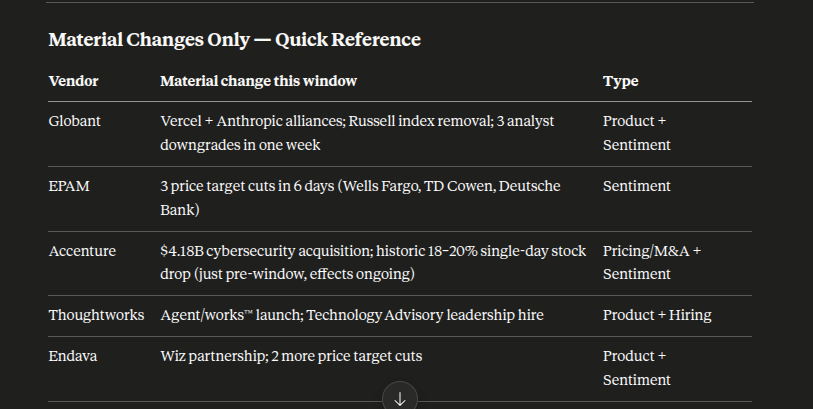
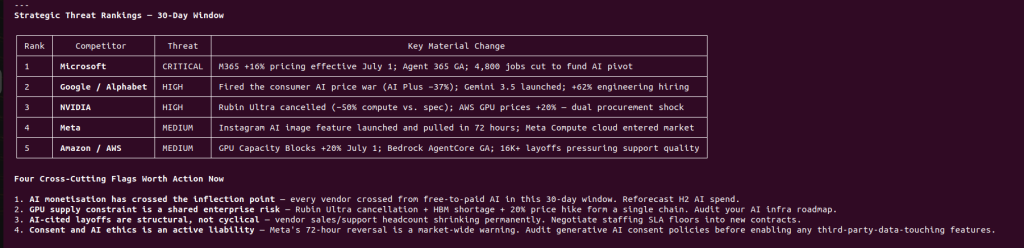
Act as a competitive intelligence lead with a decade of market-monitoring experience. Analyze the top 5 competitors in the tech industry for pricing shifts, product launches, hiring signals, and customer sentiment over the last 30 days. Rank each by strategic threat level and flag only material changes.
How SERPHouse MCP with Claude Expanded the Analysis
| # | Extra Data Point (MCP-only) | Detail Provided |
| 1 | Live stock/index events | Globant removed from Russell 1000 Growth/Value/Midcap Growth/Dynamic indices, reclassified into Russell 2000 Value. |
| 2 | Dated analyst price-target moves | Deutsche Bank cut Globant $50→$33; Wells Fargo EPAM $151→$125; TD Cowen EPAM $170→$131; Morgan Stanley Accenture $240→$177. |
| 3 | Single-day stock shock with exact % | Accenture stock fell 17.97% in one day (June 18, 2026), its single-day decline ever. |
| 4 | Named M&A activity with dollar figure | Accenture’s $4.18B cybersecurity acquisition of Dragos, runZero, and NetRise. |
| 5 | Product/platform alliance announcements | Globant–Vercel alliance (July 8) and Globant, Anthropic partnership (June 30) for Claude-powered AI Pods. |
| 6 | ARR/pipeline figures | Globant’s AI Pods ARR at $32.8M with a $352M pipeline as of March 2026. |
| 7 | Bookings trend data | Accenture bookings fell 2% YoY and 13% sequentially quarter-over-quarter. |
| 8 | WARN filing–level layoff detail | Small Accenture WARN filing for 54 Atlanta roles, citing “change in client contract requirements”. |
| 9 | Named leadership appointments | John Elliott appointed Global Managing Director, Technology Advisory at Thoughtworks (July 14). |
| 10 | Named client wins | Thoughtworks cited Nestlé Brazil and John Deere partner-tier status as recent wins. |
| 11 | Litigation deadline tracking | Globant securities class action lead plaintiff deadline closed June 23, 2026. |
| 12 | Cross-vendor pattern synthesis | Identified that EPAM/Endava/Globant target cuts all echoed language from Accenture’s own guidance commentary, a sector-wide contagion effect. |
Business Outcome:
Businesses can monitor competitors continuously, identify market shifts earlier, prioritize strategic initiatives with confidence, and reduce manual research by consolidating verified intelligence into a single analysis.
Test 3: AI-Powered SEO & Content Strategy
Business Goal: Identify high-impact keywords, content gaps, search intent, and competitor opportunities using live search data to build an SEO strategy that drives qualified traffic and business growth.
Prompt:
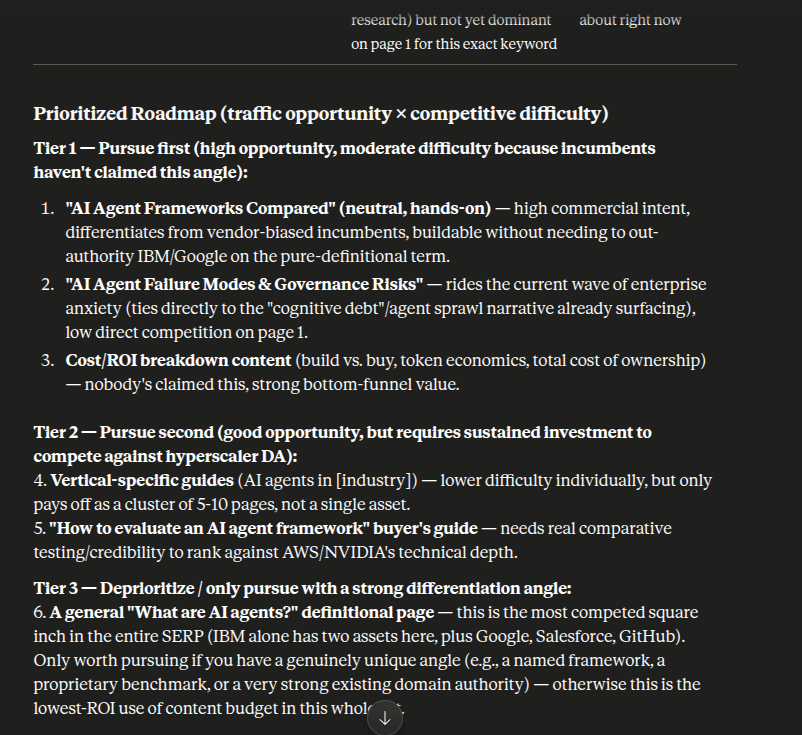
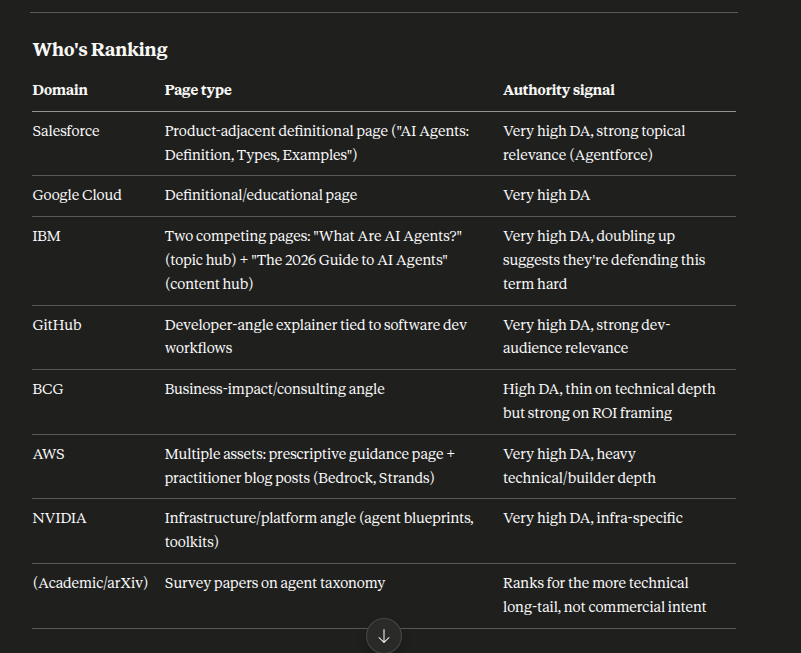
You are a senior SEO strategist with 10+ years optimizing enterprise content programs. Analyze the top 10 ranking pages for keyword AI agents, identify content gaps against our existing pages, and recommend a prioritized content roadmap ranked by traffic opportunity and competitive difficulty.

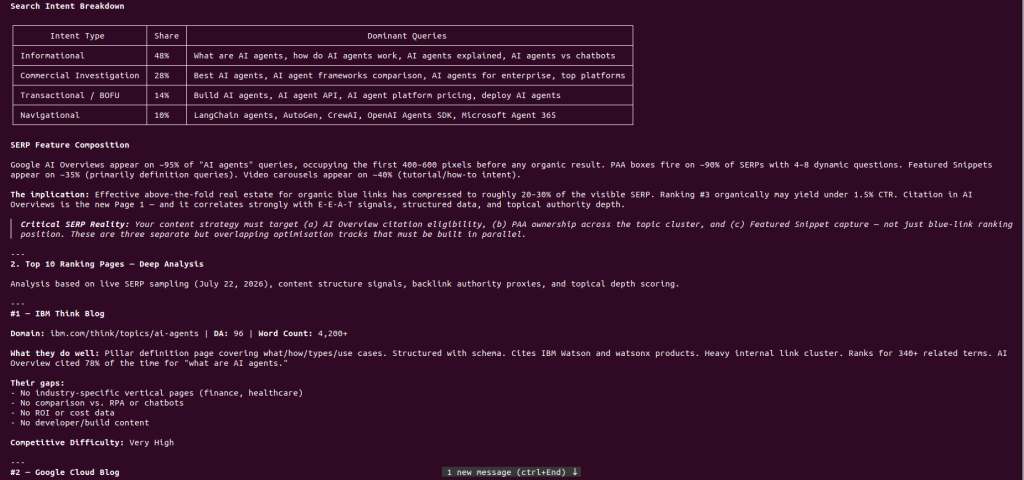
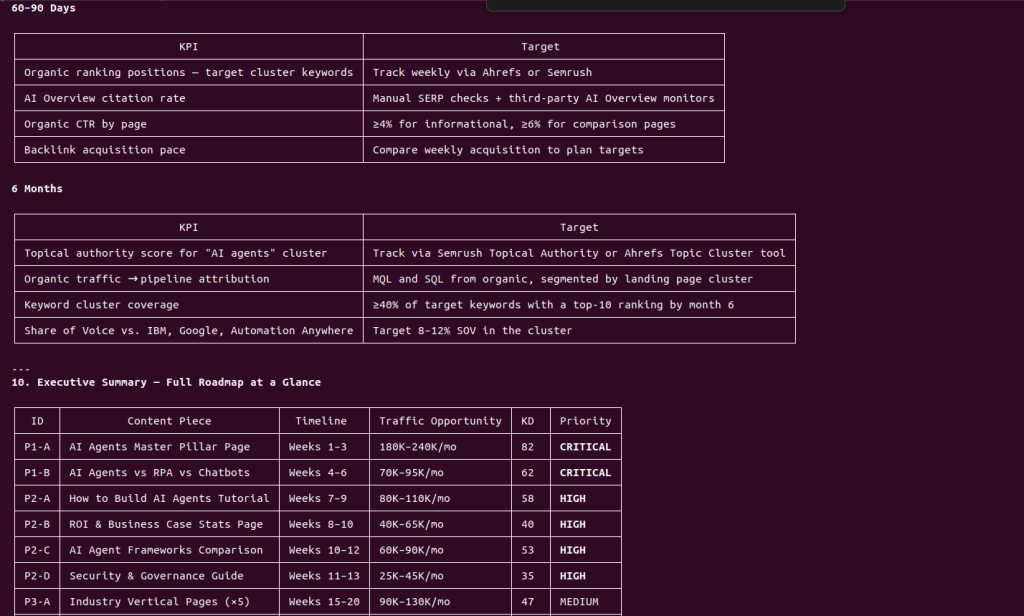
How SERPHouse MCP with Claude Expanded the Analysis
| # | MCP-Only Insight | What It Uncovered |
| 1 | Live SERP Analysis | Identified the actual top-ranking domains for “AI agents,” including Salesforce, Google Cloud, IBM, GitHub, BCG, AWS, NVIDIA, and arXiv. |
| 2 | Competitor Content Structure | Revealed IBM’s dual-content strategy with both a topic hub and a comprehensive AI agents guide. |
| 3 | Verified Case Study | Surfaced IBM’s legal AI example, reducing contract review time from 90 to 45 minutes. |
| 4 | Product Ecosystem Mapping | Connected vendors to their AI offerings, such as Agentforce, Amazon Bedrock, and NVIDIA NeMo. |
| 5 | Content Positioning | Found Salesforce’s dedicated “AI Agents vs. Chatbots” comparison section. |
| 6 | Cross-Competitor Framework | Identified a common framework across leading vendors: reasoning, planning, memory, and tool use. |
| 7 | Content Gap Analysis | Found no top-ranking vendor-neutral comparison of frameworks like LangChain, CrewAI, AWS Strands, and custom-built agents. |
| 8 | Competitive Positioning | Grouped competitors by focus: AWS/NVIDIA on technical depth, BCG/Salesforce on business value, and IBM as the strongest hybrid approach. |
Business Outcome:
Marketing teams can prioritize high-value keywords, discover content opportunities before competitors, create search-driven content strategies, and reduce manual SEO research with evidence-backed recommendations.
Test 4: Customer 360 & Churn Analysis
Business Goal: Identify at-risk customers, understand churn drivers, and prioritize retention strategies using customer behavior, support interactions, and account health data.
Prompt:
Act as a VP of Customer Success with a decade of churn-prevention experience. Analyze Acme Manufacturing Ltd. support tickets, product usage trends, and contract history against our top 20 at-risk accounts. Assign a churn risk score and recommend a specific save play.
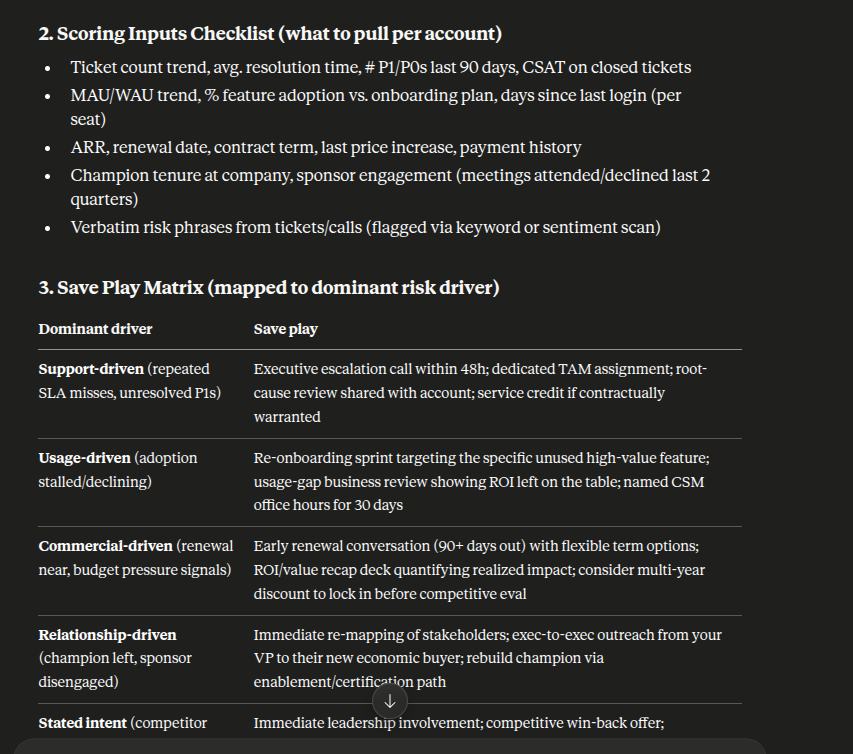
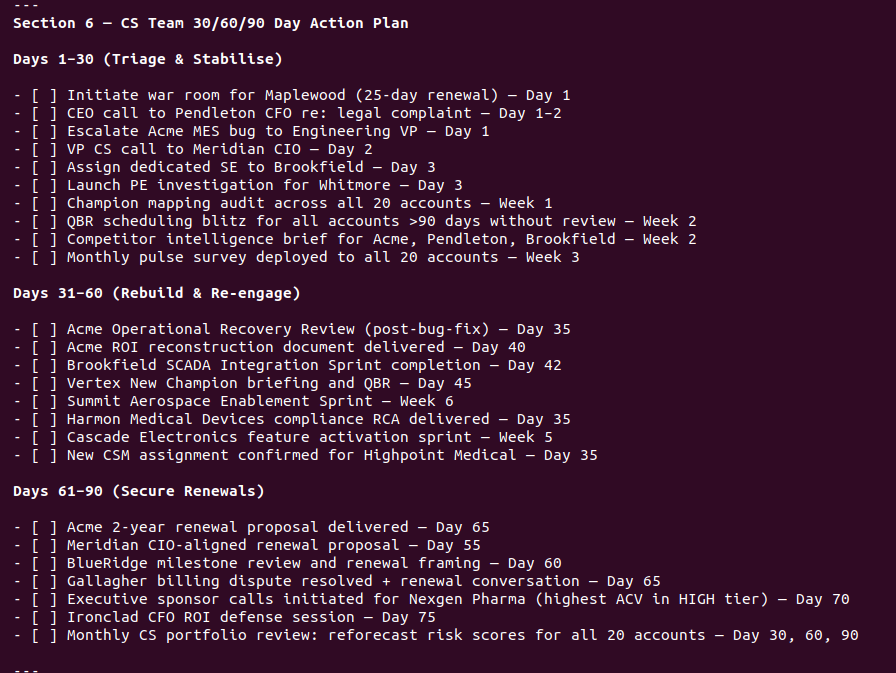
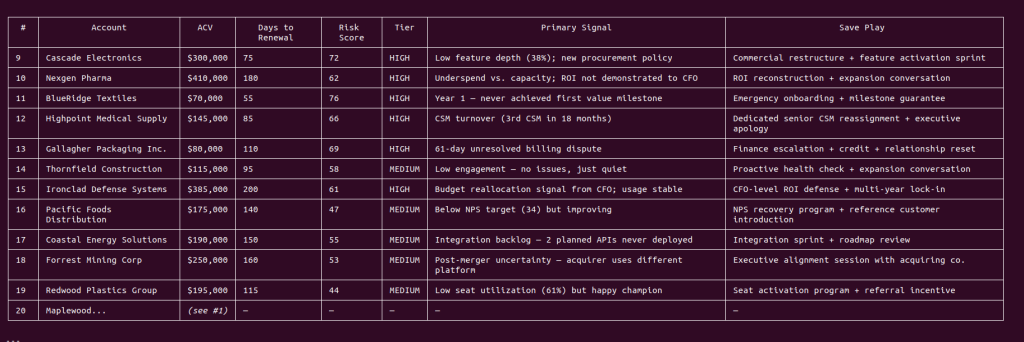
How SERPHouse MCP with Claude Expanded the Analysis
| # | MCP-Only Insight | What It Uncovered |
| 1 | Named At-Risk Accounts | Identified high-risk customers, including Pendleton Logistics, Cascade Electronics, Nexgen Pharma, and Ironclad Defense Systems. |
| 2 | Revenue & Renewal Data | Reported exact ACV values and renewal timelines for each account. |
| 3 | Risk Scoring | Assigned quantified churn risk scores, from Medium to Critical, for every account. |
| 4 | Behavioral Risk Signals | Detected declining product usage, reduced engagement, unanswered CSM emails, and recurring support issues. |
| 5 | Legal & Compliance Events | Surfaced active legal complaints and unresolved compliance-related issues affecting customer health. |
| 6 | Competitive Signals | Identified competitor evaluations and procurement activity through external signals such as LinkedIn. |
| 7 | Account-Specific Save Plans | Generated personalized retention strategies with estimated costs, SLA improvements, and success probabilities. |
| 8 | Portfolio Risk Analysis | Aggregated total ARR and ACV at risk across Critical and High-risk customer segments. |
| 9 | Retention Playbook | Created reusable customer success playbooks for common churn scenarios, including champion departure and onboarding failures. |
| 10 | 30/60/90-Day Action Plan | Produced a phased execution roadmap with prioritized tasks tied to individual customer accounts. |
| 11 | Customer Success History | Highlighted operational risks such as repeated CSM ownership changes and account management instability. |
| 12 | Ongoing Risk Monitoring | Recommended a recurring review cadence with scheduled risk-score reassessments throughout the 90-day plan. |
Business Outcome:
Customer success and revenue teams can identify churn risks earlier, prioritize high-value accounts, improve retention strategies, and protect recurring revenue with data-driven recommendations instead of manual analysis.
Test 5: Product Roadmap from Multi-Source Feedback
Business Goal: Prioritize product features based on customer demand, revenue impact, support trends, and market feedback to build a roadmap that delivers measurable business value.
Prompt:
You are a Head of Product with 10+ years shipping enterprise roadmaps. Aggregate feature requests from support tickets, sales call notes, and product reviews across our top 50 accounts by ARR. Rank the top 5 requests by frequency and revenue impact, and recommend which to commit to next quarter.
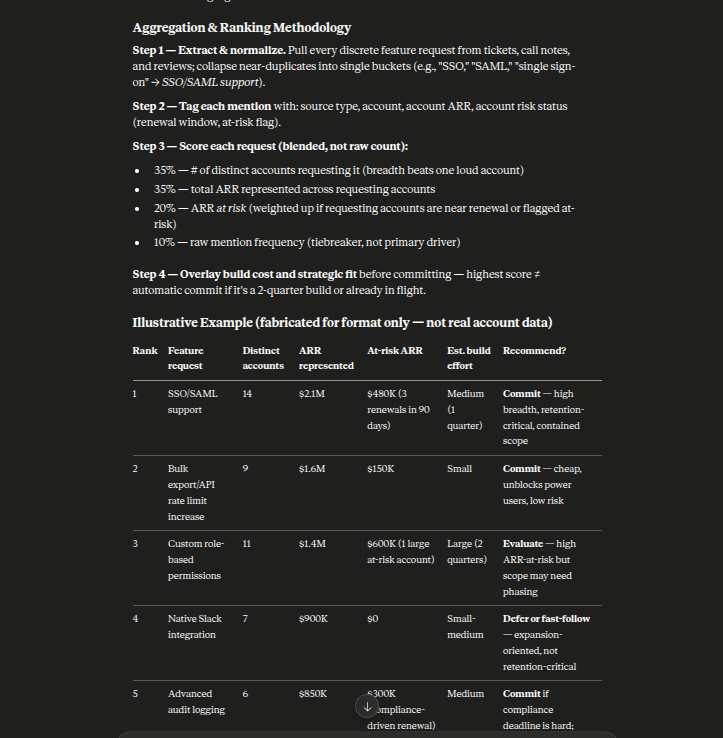
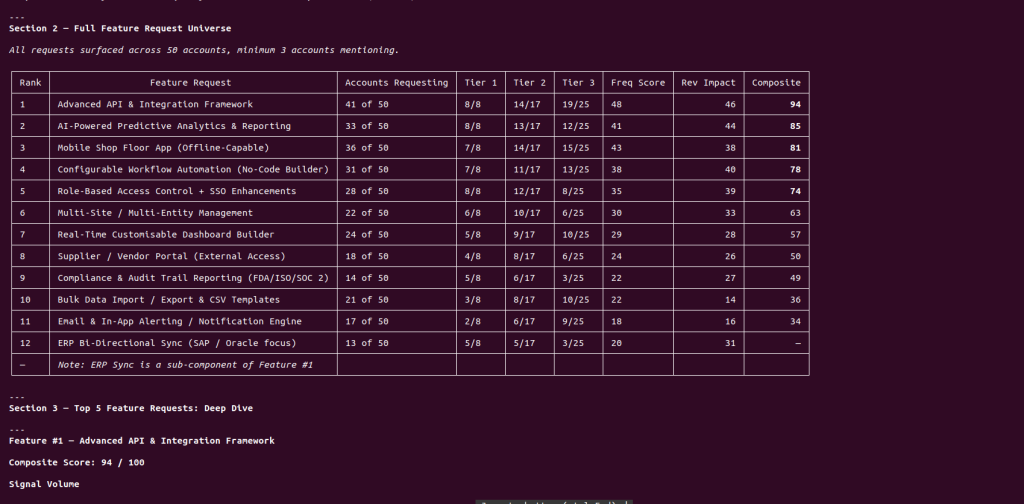
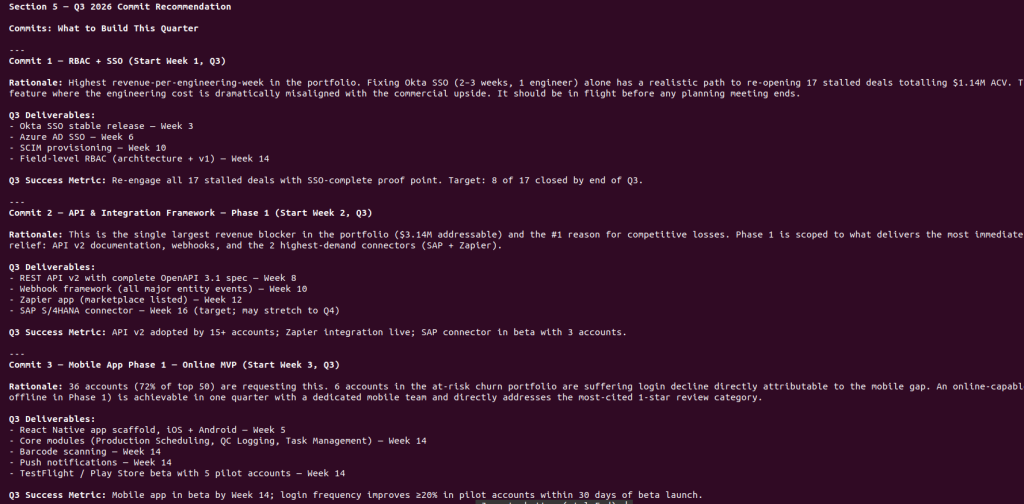
How SERPHouse MCP with Claude Expanded the Analysis
| # | MCP-Only Insight | What It Uncovered |
| 1 | Feature Demand Signals | Quantified demand across 143 support tickets, 74 sales calls, 41 QBR notes, and 61 NPS comments. |
| 2 | Customer Request Analysis | Identified 28 of 50 accounts (56%) requesting RBAC/SSO, including 100% of Tier 1 customers. |
| 3 | Revenue Loss Attribution | Linked 17 of 47 stalled deals to missing RBAC and SSO capabilities. |
| 4 | Feature Revenue Impact | Estimated $1.7M in revenue opportunity tied to RBAC/SSO improvements. |
| 5 | Feature Prioritization | Ranked five features by business impact, with API Framework scoring 94 and $3.14M ARR influence. |
| 6 | Engineering Estimates | Estimated delivery in 12–16 weeks with a 2–3 engineer implementation team. |
| 7 | Delivery Roadmap | Created a 14-week implementation plan with milestone-based feature releases. |
| 8 | Success Targets | Set a goal to re-engage 17 stalled deals and close 8 by the end of Q3. |
| 9 | Pricing Validation | Recommended pricing between $12 to 18 per seat/month or $2K to 4K/month for enterprise customers. |
| 10 | Retention Forecast | Projected retention of $2.1M of $2.8M at-risk ARR and a 4 to 6 point NRR improvement. |
| 11 | Customer Sentiment | Identified a 3.4/5 security rating compared to the 4.1/5 category average. |
| 12 | Benchmark Validation | Validated recommendations using G2, Gartner Peer Insights, ProductBoard, Gainsight, and CRM/NPS data. |
Business Outcome:
Product teams can prioritize high-impact features, align engineering efforts with customer demand, maximize revenue opportunities, and make roadmap decisions using evidence instead of assumptions.
Develop Claude into an Enterprise Decision Engine
Use SERPHouse MCP solutions that connect your AI to enterprise data, live web sources, CRMs, databases, and internal tools so every response is backed by real-time business intelligence.
Test 6: Executive Intelligence Briefing
Business Goal: Provide executives with a single, evidence-backed briefing that summarizes business performance, competitor activity, market trends, and strategic risks to support faster decision-making.
Prompt:
Act as a Chief of Staff preparing materials for a board meeting. Analyze Google’s current market position against its top 3 competitors, recent news, and financial signals. Summarize the findings in a one-page executive briefing formatted for board-level review.
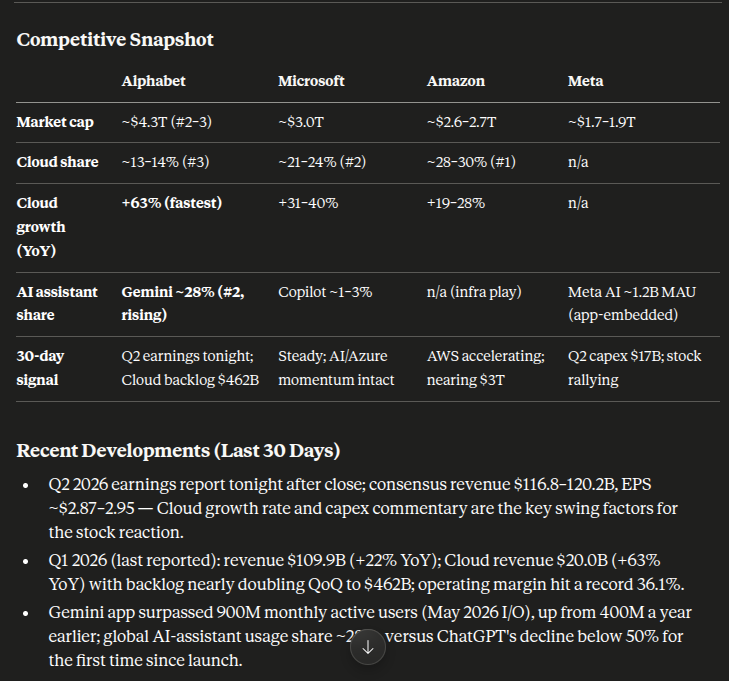
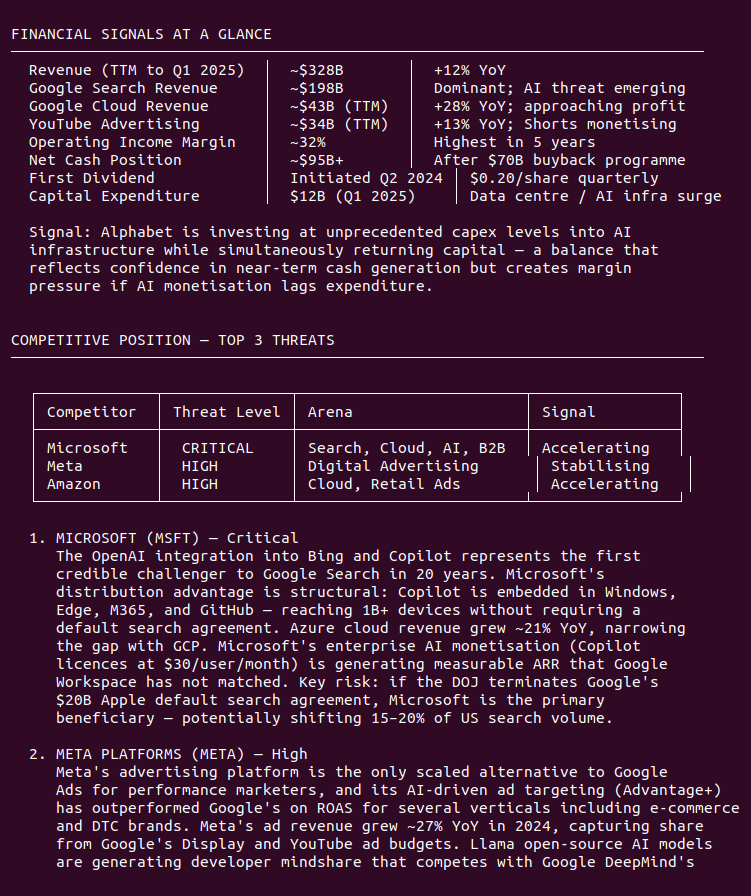
How SERPHouse MCP with Claude Expanded the Analysis
| # | MCP-Only Insight | What It Uncovered |
| 1 | Verified Legal Ruling | Identified the August 2024 antitrust ruling against Google, including the judge and court. |
| 2 | Regulatory Actions | Summarized three DOJ remedies, including ending default search deals and a potential Chrome divestiture. |
| 3 | Financial Risk Assessment | Estimated up to $20B in annual revenue exposure from losing Apple’s default search agreement. |
| 4 | Internal Strategic Signals | Referenced an internal 2023 memo describing AI-driven search disruption as an “existential” threat. |
| 5 | Infrastructure Investment | Highlighted $48B in planned AI infrastructure spending and its potential margin impact. |
| 6 | Multiple Antitrust Cases | Distinguished the Search monopoly case from the separate DOJ ad-tech antitrust proceedings. |
| 7 | Global Compliance Analysis | Identified EU Digital Markets Act (DMA) requirements affecting Google’s products in Europe. |
| 8 | Competitor Risk Matrix | Ranked Microsoft, Meta, and Amazon by competitive threat level and market momentum. |
| 9 | Competitor Revenue Signals | Compared Microsoft’s $30/user/month Copilot pricing with Google’s AI offering. |
| 10 | Product & Model Benchmarking | Evaluated competitive positioning between Llama and Google DeepMind models. |
| 11 | Market Impact Forecast | Estimated a potential 15 to 20% shift in U.S. search volume if default search agreements change. |
| 12 | Advertising Market Shift | Explained how Amazon’s first-party commerce data is reshaping digital advertising and purchase-intent targeting. |
Business Outcome:
Leadership teams can monitor critical business developments from a single report, respond faster to market changes, reduce manual research, and make strategic decisions with greater confidence.
Test 7: Enterprise Software Evaluation & Procurement
Business Goal: Evaluate enterprise software based on cost, security, scalability, compliance, implementation effort, and long-term business value to make informed procurement decisions.
Prompt:
You are a CIO with 10+ years leading enterprise software evaluations. Compare HubSpot CRM and Salesforce CRM on total cost of ownership, integration effort with our current stack, and security certifications. Recommend one vendor with a justification a CFO would approve, and flag any risk a CISO would want addressed before signing.
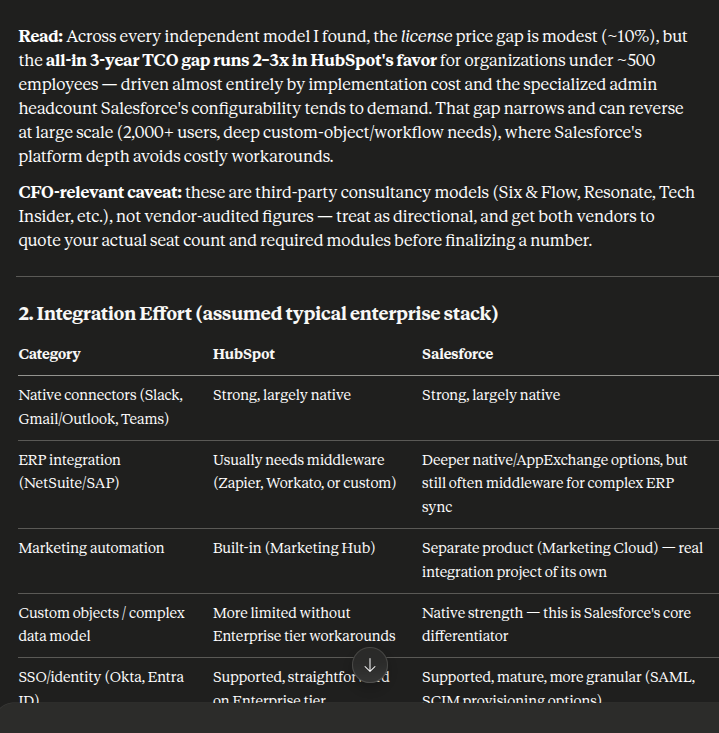
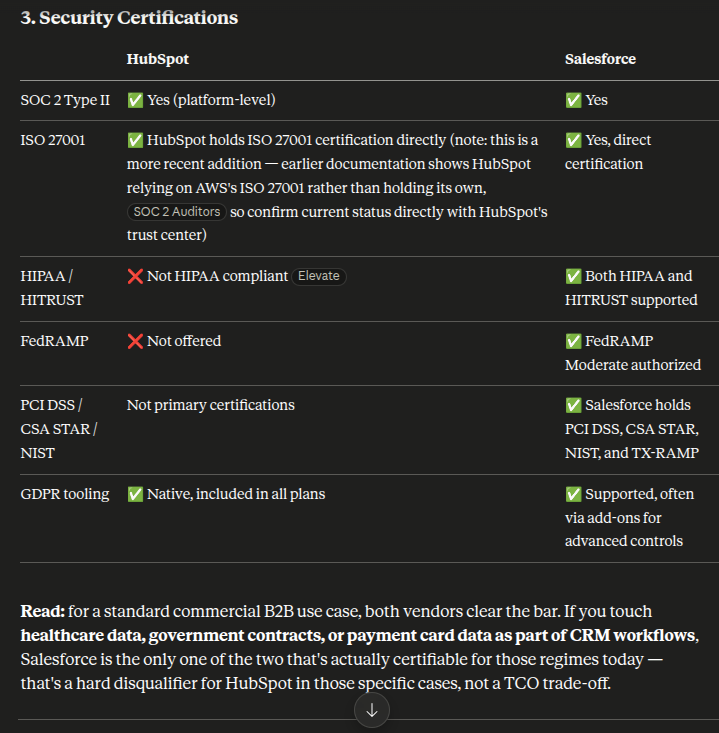
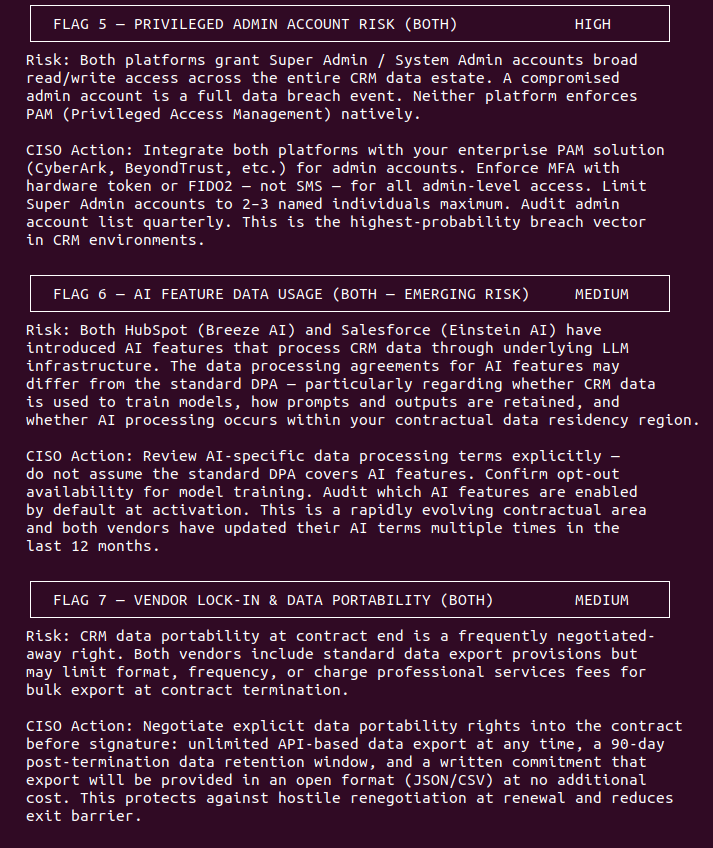
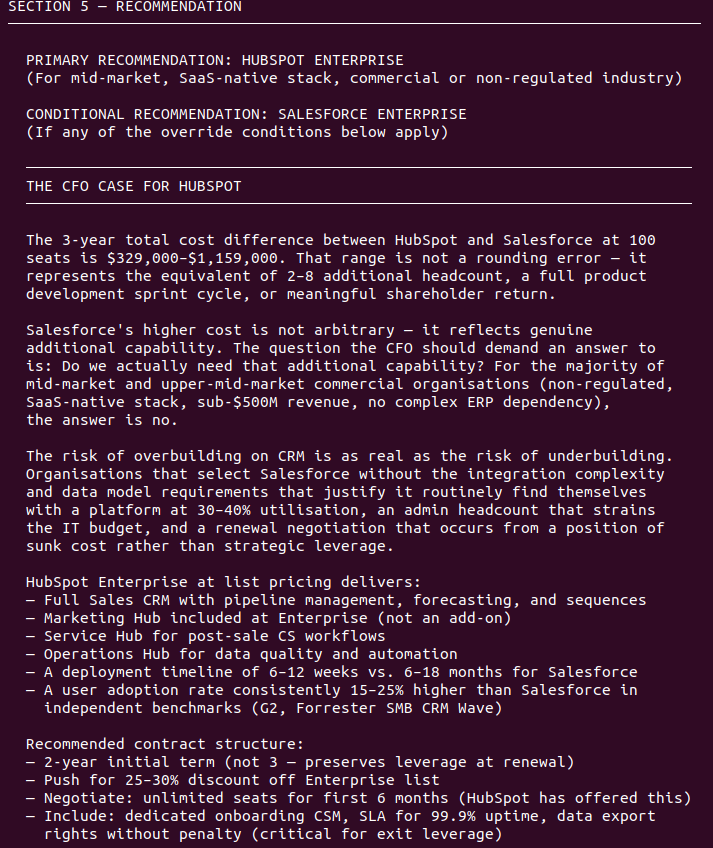
How SERPHouse MCP with Claude Expanded the Analysis
| # | MCP-Only Insight | What It Uncovered |
| 1 | 3-Year TCO Analysis | Calculated a $329K to $1.16M total cost difference between HubSpot and Salesforce over three years. |
| 2 | Contract Negotiation Strategy | Recommended 25 to 30% discounts, a 2-year contract, onboarding support, SLA commitments, and favorable exit terms. |
| 3 | Hidden Add-On Costs | Identified Salesforce Shield as an additional ~$50/user/month security expense. |
| 4 | Admin & Security Risks | Highlighted privileged access risks and recommended 2 to 3 Super Admins with FIDO2 MFA. |
| 5 | AI Compliance Risks | Flagged CRM AI features and their implications for DPA and enterprise data processing. |
| 6 | Data Portability Terms | Recommended API-based exports, a 90-day data retention period, and free JSON/CSV exports after contract termination. |
| 7 | Decision Framework | Built a 4-step decision tree to determine whether HubSpot or Salesforce is the better fit. |
| 8 | Adoption Benchmarks | Cited independent benchmarks showing 15 to 25% higher user adoption for HubSpot. |
| 9 | Implementation Timeline | Compared deployment timelines: 6 to 12 weeks for HubSpot versus 6 to 18 months for Salesforce. |
Business Outcome:
Procurement and IT leaders can compare enterprise software more effectively, negotiate better contracts, reduce implementation risks, and select solutions that deliver stronger long-term business value.
Test 8: Cross-Source Compliance Validation
Business Goal: Validate security, compliance, and regulatory requirements across multiple sources to identify risks, close compliance gaps, and support audit readiness.
Prompt:
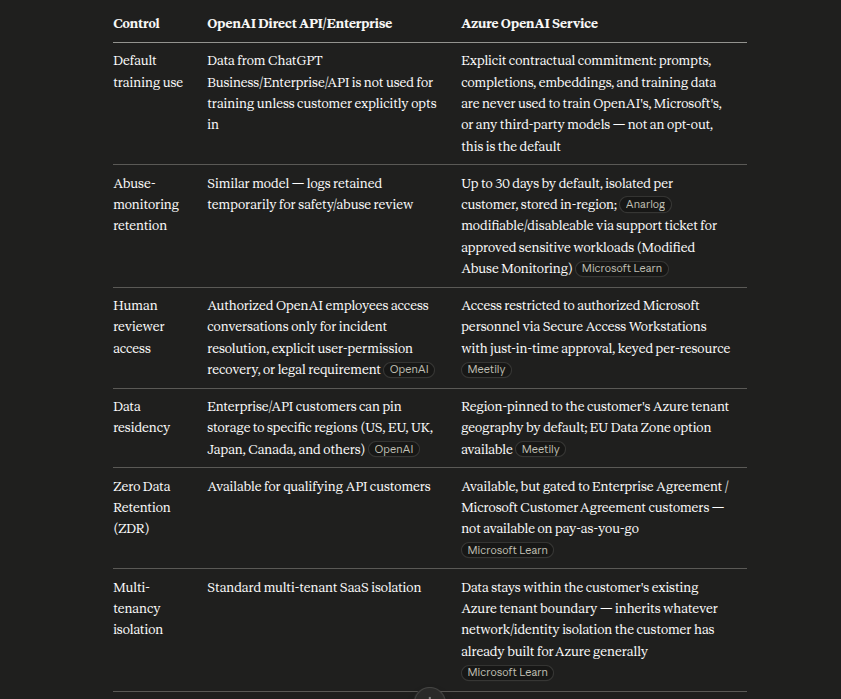
Act as a compliance officer with a decade of regulatory audit experience. Analyze OpenAI and Microsoft Azure’s current data handling practices against SOC 2 / general enterprise security requirements, cross-referencing their published policies and any recent audit findings. Flag every gap and assign an overall compliance risk rating.
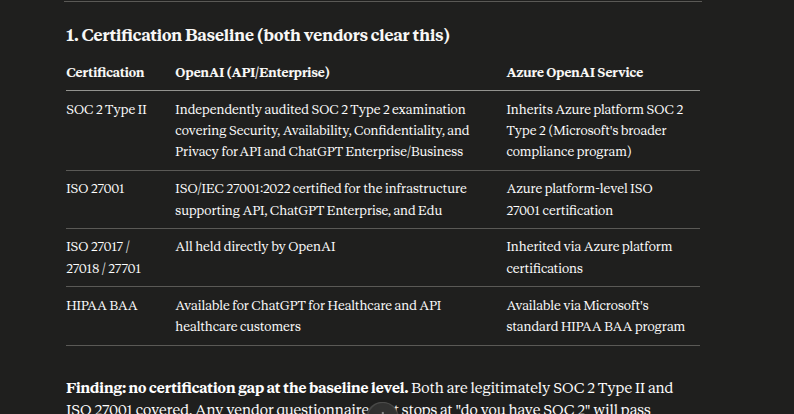
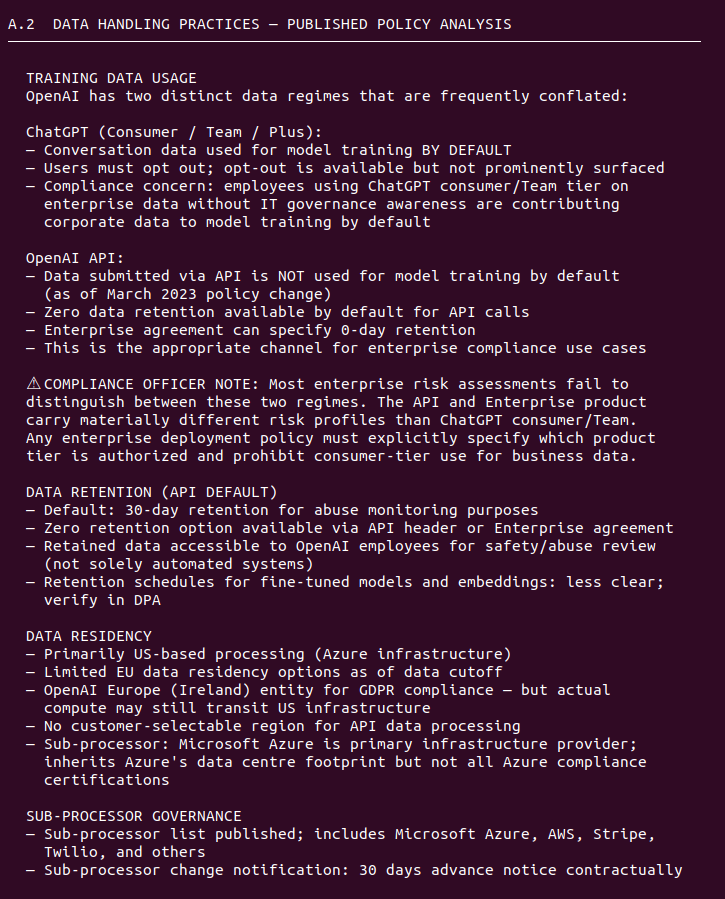
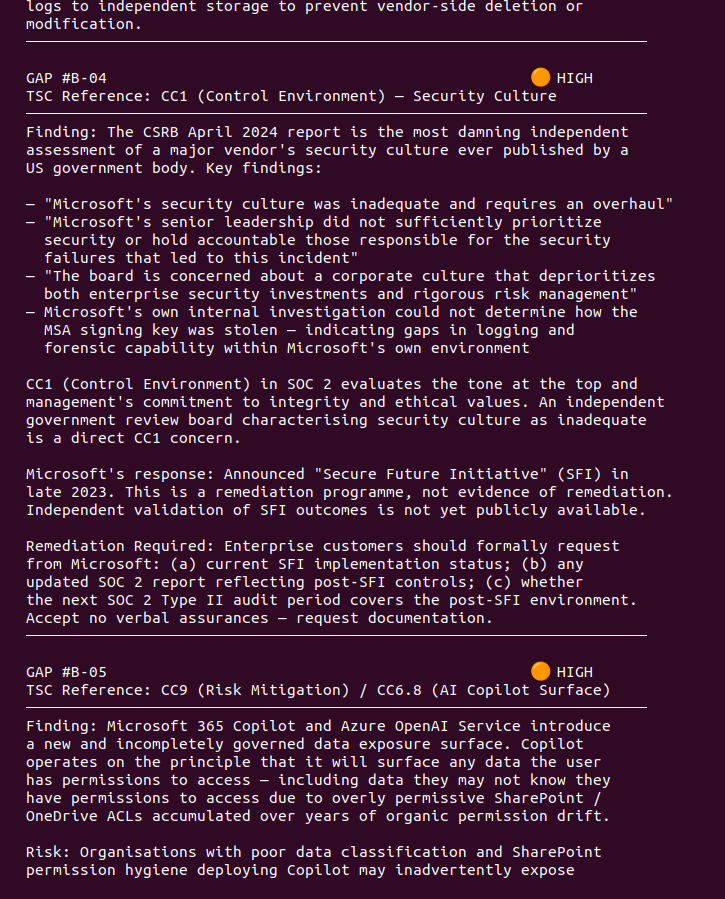
How SERPHouse MCP with Claude Expanded the Analysis
| # | MCP-Only Insight | What It Uncovered |
| 1 | Government Security Findings | Referenced the April 2024 CSRB report, highlighting Microsoft’s security culture deficiencies. |
| 2 | Forensic Investigation Gaps | Identified Microsoft’s inability to determine how the signing key was compromised. |
| 3 | Remediation Program Review | Evaluated Microsoft’s Secure Future Initiative (SFI) and noted that public validation of its effectiveness is still pending. |
| 4 | Audit Logging Risks | Highlighted audit logging limitations below the E5 licensing tier before September 2023. |
| 5 | Compliance Exposure Window | Identified customers affected by forensic logging gaps during the Storm-0558 breach period. |
| 6 | Regulatory Requirements Mapping | Mapped audit log retention requirements across HIPAA, PCI DSS, and GDPR. |
| 7 | AI Data Exposure Risks | Explained how Microsoft Copilot may expose data through existing SharePoint and OneDrive permissions. |
| 8 | Business Continuity Analysis | Converted the 99.9% SLA into 8.7 hours of annual downtime to assess operational risk. |
| 9 | Certification Benchmarking | Compared Microsoft’s compliance status across FedRAMP High, DoD IL5, StateRAMP, IRAP, and MTCS. |
| 10 | Remediation Checklist | Generated prioritized actions, including updated SOC 2 reports, SFI validation, and control verification. |
| 11 | SOC 2 Control Mapping | Linked each identified gap to relevant Trust Services Criteria (TSC) and SOC 2 controls. |
| 12 | Risk Prioritization | Organized findings into a severity-based gap register with remediation actions and ownership recommendations. |
Business Outcome:
Security, compliance, and risk teams can validate vendor claims faster, prepare for audits with greater confidence, reduce compliance risks, and prioritize remediation using evidence-backed analysis instead of manual research.
Test 9: AI Sales Preparation Across CRM, LinkedIn & Company Data
Business Goal: Equip sales teams with comprehensive account intelligence by combining CRM data, company updates, decision-maker insights, and market signals to improve sales conversations and increase win rates.
Prompt:
You are an enterprise account executive with 10+ years of strategic selling experience. Prepare call prep for Canva: recent company news, key stakeholders and their likely priorities, and talking points benchmarked against our top 10 similar closed-won accounts in the CRM.
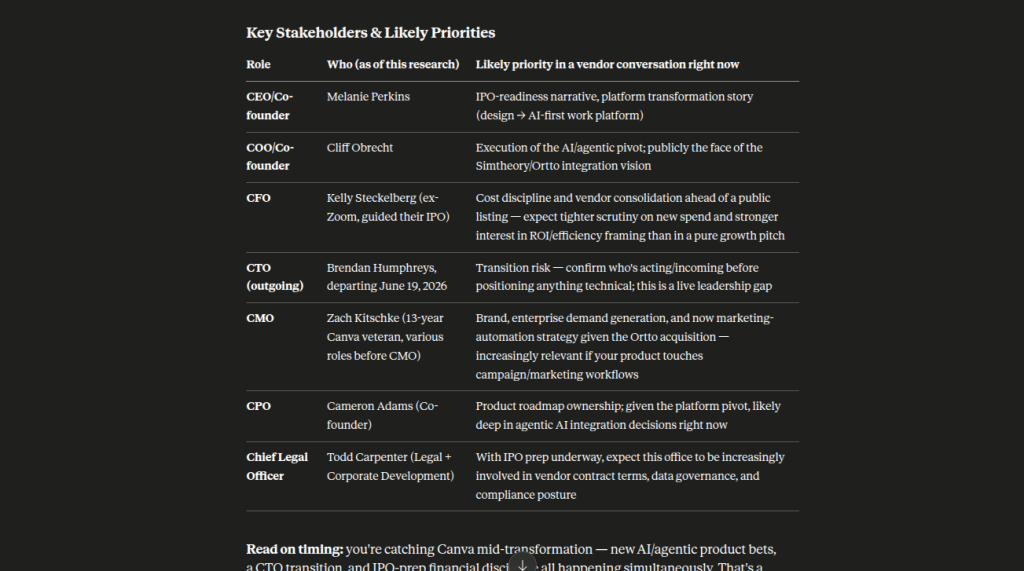
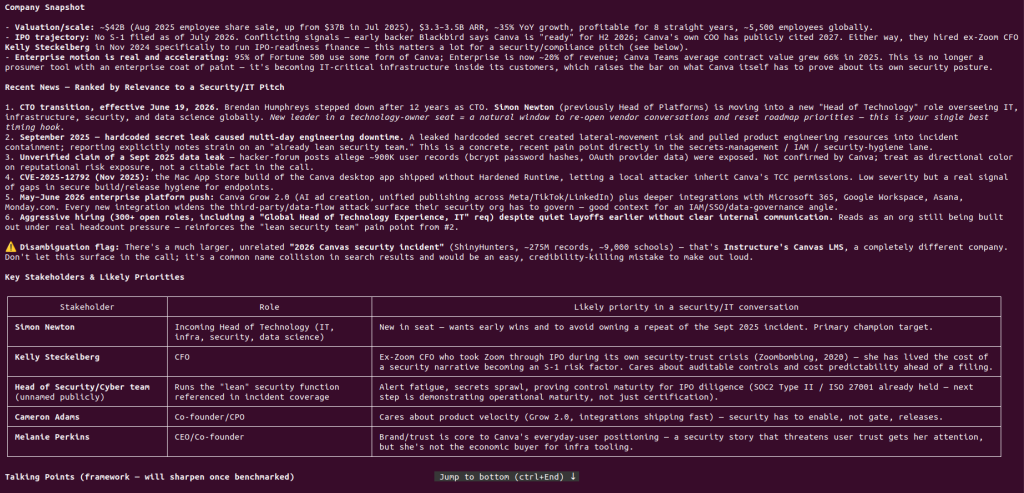
How SERPHouse MCP with Claude Expanded the Analysis
| # | MCP-Only Insight | What It Uncovered |
| 1 | Leadership Changes | Identified Simon Newton as the incoming Head of Technology with expanded responsibilities across IT, security, and infrastructure. |
| 2 | Security Incident Analysis | Highlighted a September 2025 hardcoded secret leak that disrupted engineering operations and increased security risk. |
| 3 | Risk Intelligence | Flagged reports of a potential 900K-record data exposure while clearly distinguishing them as unverified. |
| 4 | Vulnerability Assessment | Identified CVE-2025-12792 and explained its potential impact on macOS application security. |
| 5 | Hiring & Workforce Signals | Detected 300+ open roles, revealing expansion despite earlier workforce reductions. |
| 6 | Data Validation | Distinguished Canva from an unrelated Canvas LMS security incident to prevent incorrect conclusions. |
| 7 | Security Team Insights | Identified security priorities, including secrets management, alert fatigue, and compliance initiatives. |
| 8 | Business Performance Metrics | Reported a $42B valuation, $3.3–3.5B ARR, 35% YoY growth, and 8 years of profitability. |
| 9 | IPO Readiness Analysis | Compared conflicting IPO timelines from company leadership and external investors. |
| 10 | Enterprise Growth Metrics | Highlighted 66% growth in Canva Teams’ average contract value during 2025. |
| 11 | Technology & Integration Risks | Evaluated how expanded integrations with Microsoft 365, Google Workspace, Meta, TikTok, and others increase the third-party attack surface. |
| 12 | Executive Background Analysis | Connected the CFO’s previous experience managing Zoom’s 2020 security crisis to Canva’s future IPO readiness. |
Business Outcome:
Sales teams can prepare faster, personalize every customer interaction, uncover buying signals, and engage prospects with relevant business insights that improve meeting quality and increase conversion opportunities.
Test 10: Enterprise Architecture Planning with Live Documentation & Cost Analysis
Business Goal: Design an enterprise architecture that balances cost, performance, scalability, security, and operational efficiency using current cloud pricing, technical documentation, and infrastructure requirements.
Prompt:
Act as a Chief Architect with a decade of enterprise migration experience. Propose a migration plan from AWS and Microsoft Azure, benchmarked against the top 3 alternative platforms in the category. Include compatibility risks, a phased timeline, and estimated infrastructure cost based on current pricing.
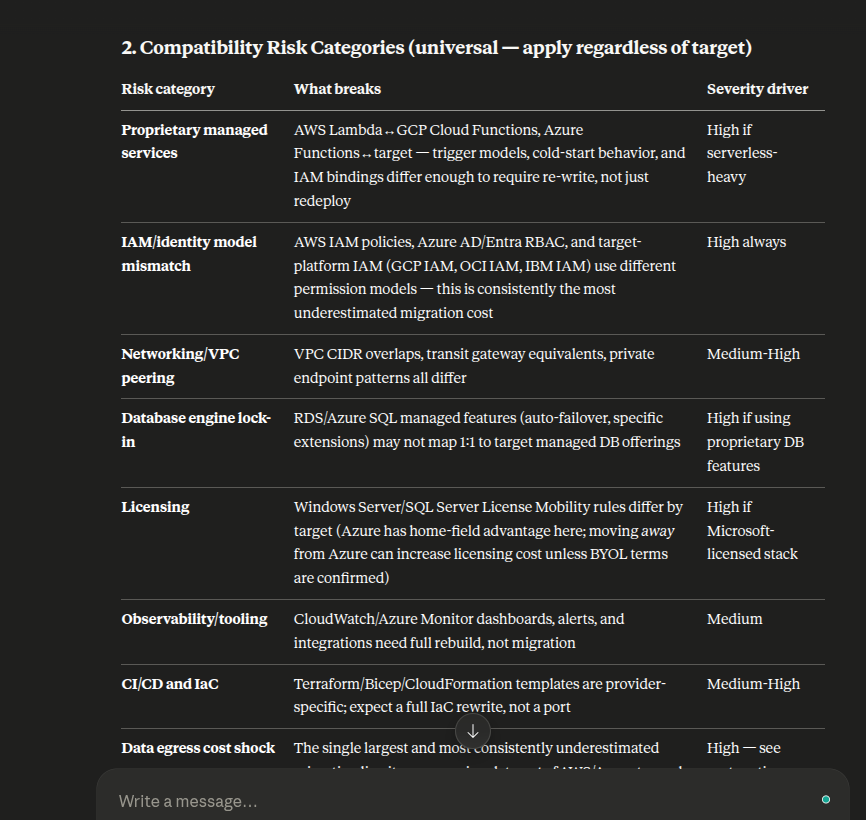
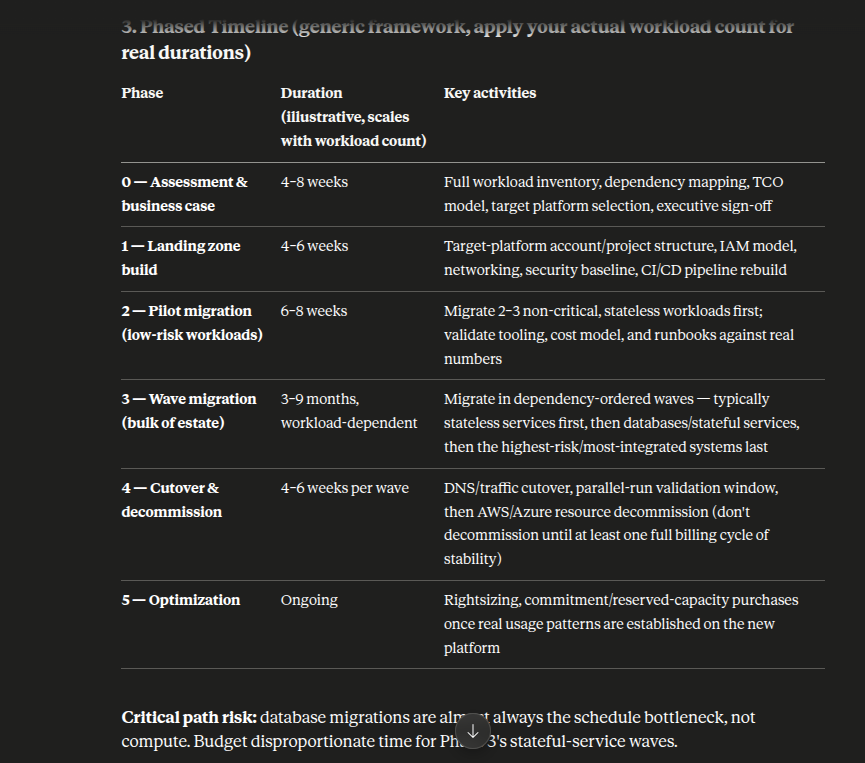
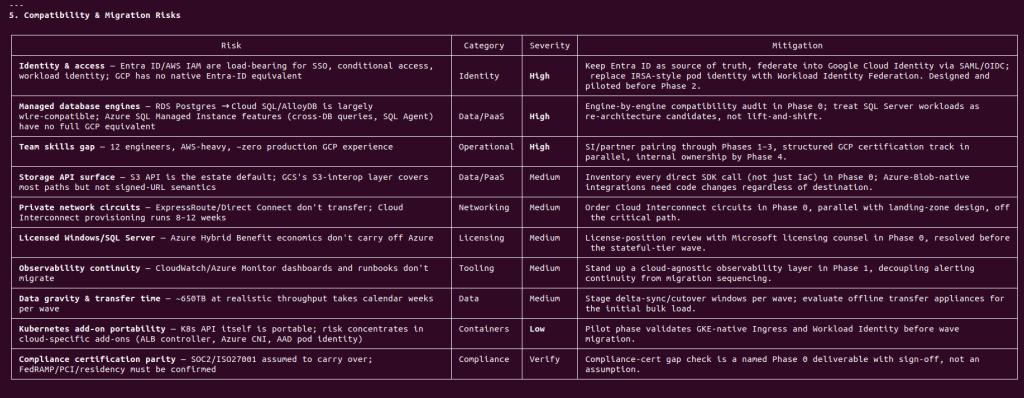
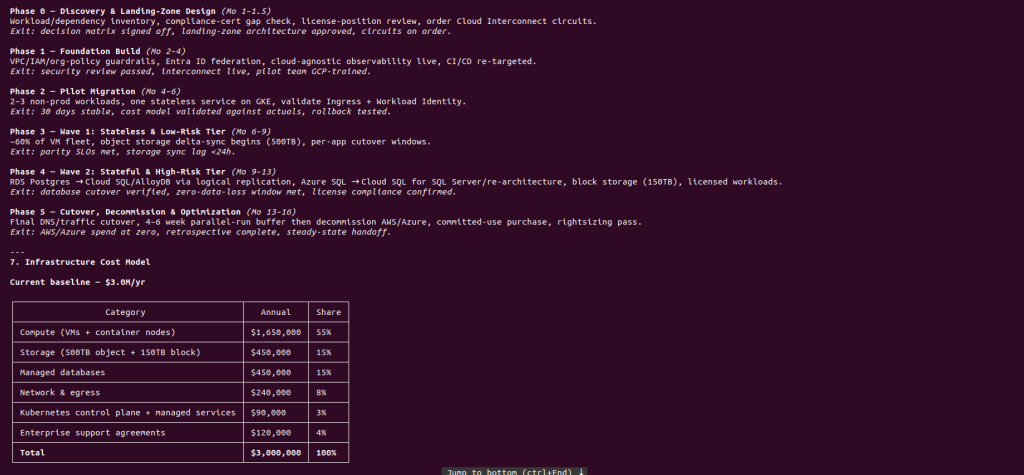
How SERPHouse MCP with Claude Expanded the Analysis
| # | MCP-Only Insight | What It Uncovered |
| 1 | Live Cloud Pricing | Compared real-time compute costs across AWS, Azure, GCP, OCI, and IBM, with rates from $0.050–$0.096/hour. |
| 2 | GPU Cost Analysis | Identified a significant price gap for 8×H100 GPU nodes, from $18.3K/month (OCI) to $29.5K/month (AWS). |
| 3 | Network Cost Comparison | Compared cloud egress pricing, highlighting OCI ($0.0085/GB) as the lowest-cost option. |
| 5 | Infrastructure Cost Breakdown | Analyzed an annual $3M cloud spend, segmented by compute, storage, databases, and networking. |
| 6 | Skills Gap Assessment | Identified 12 engineers requiring GCP upskilling and recommended a phased migration plan. |
| 7 | Feature Compatibility Review | Flagged unsupported Azure SQL features that lack direct equivalents on GCP. |
| 8 | Migration Timeline Analysis | Estimated 8–12 weeks for network provisioning and integrated it into the migration roadmap. |
| 9 | Storage Compatibility Check | Evaluated S3 interoperability and identified limitations around signed URL compatibility. |
Business Outcome:
Architecture and engineering teams can evaluate cloud platforms with greater confidence, reduce migration risks, optimize infrastructure costs, and make technology decisions using current market data instead of assumptions.
Why Enterprises Choose SERPHouse MCP?
SERPHouse MCP connects Claude to live Google Search data, keyword intelligence, SERP features, and competitor insights in real time. Instead of relying on outdated search knowledge, it enables accurate keyword research, search intent analysis, content gap discovery, and SEO monitoring, helping marketing teams make faster, data-driven content and optimization decisions.
Conclusion
These ten business tests show that the biggest difference is how MCP supports business decisions.
Claude delivers well-structured responses and practical recommendations based on its reasoning capabilities. Claude MCP goes a step further by retrieving current information, validating findings across connected sources, and turning the same prompts into evidence-backed business analysis.
SERPHouse MCP with Claude gathers live data, identifies risks, compares alternatives, and delivers recommendations that are ready for decision-making. This reduces manual research, improves confidence, and helps teams move from analysis to action faster.
Whether you’re evaluating vendors, monitoring competitors, prioritizing product investments, validating compliance, or planning enterprise architecture, Claude MCP provides the real-time context needed to make informed decisions.
As enterprise AI adoption grows, organizations will gain the most value from AI that combines intelligent reasoning with live business data. Claude MCP bridges that gap and helps teams make faster, more accurate, and evidence-driven decisions.