
Table of Contents
Table of Contents
TL;DR: MCP for SEO Automation connects your keyword tools, CMS, and content workflow into one system, so tasks that took days now take minutes. Teams running this setup cut manual SEO work by more than half and publish faster without losing quality control at the editing stage.
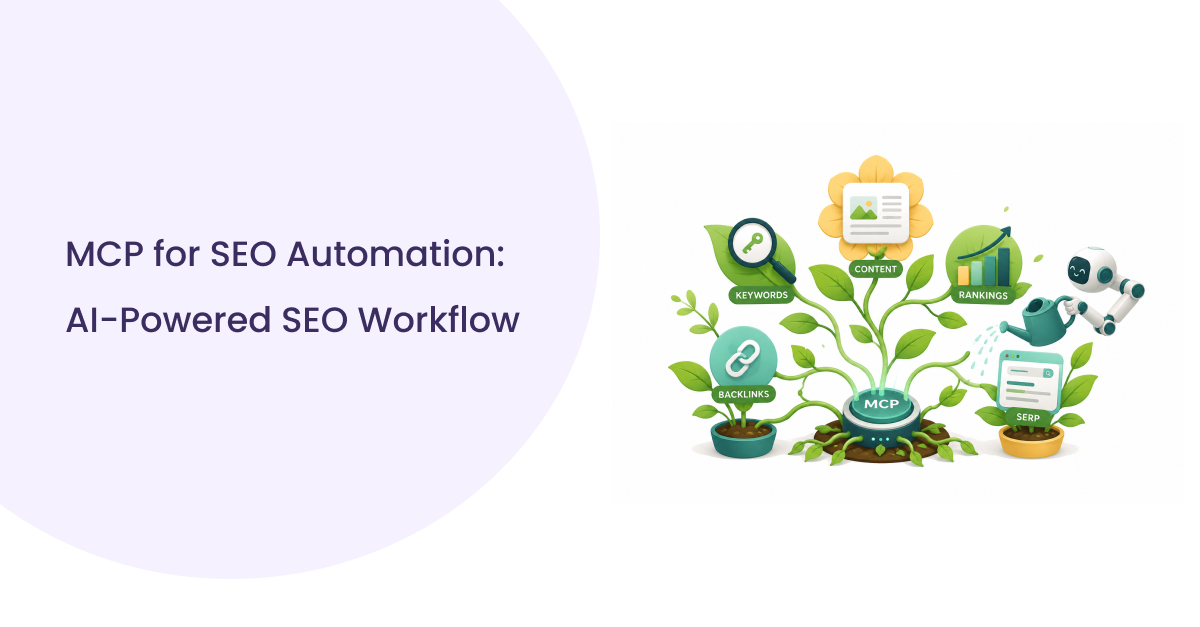
Most marketing teams still run SEO like it is 2015, jumping between six tabs to pull keywords, write briefs, and publish content. MCP for SEO Automation fixes this by linking every tool your team already uses into one working pipeline. Model Context Protocol lets a single system pull data, draft content, and push it live without you copying anything by hand.
This changes how SEO AI Agents operate inside a real workflow, not as separate scripts nobody maintains. A properly connected MCP for SEO Automation setup turns a scattered process into an actual AI content strategy your team can repeat every week. This guide explains the workflow, the agents worth building, and the servers that make it work.
Why does SEO automation still feel manual
Stop Switching Between SEO Tools
Content writers export keyword lists from one tool, paste them into a doc, then hand that off to a writer who opens a separate CMS to publish. Every handoff adds delay, and every copy-paste step adds room for error. Teams lose hours weekly just moving data between disconnected platforms built without each other in mind.
Why AI Alone Does Not Create an Automated SEO Workflow
Adding a chatbot to write drafts does not fix a broken pipeline. Without an MCP for SEO Automation connecting these tools, your SEO AI Agents still need a human to move data manually between each step, so the bottleneck shifts location without disappearing.
What Is MCP for SEO Automation?
Connecting SEO AI Agents with Marketing Tools
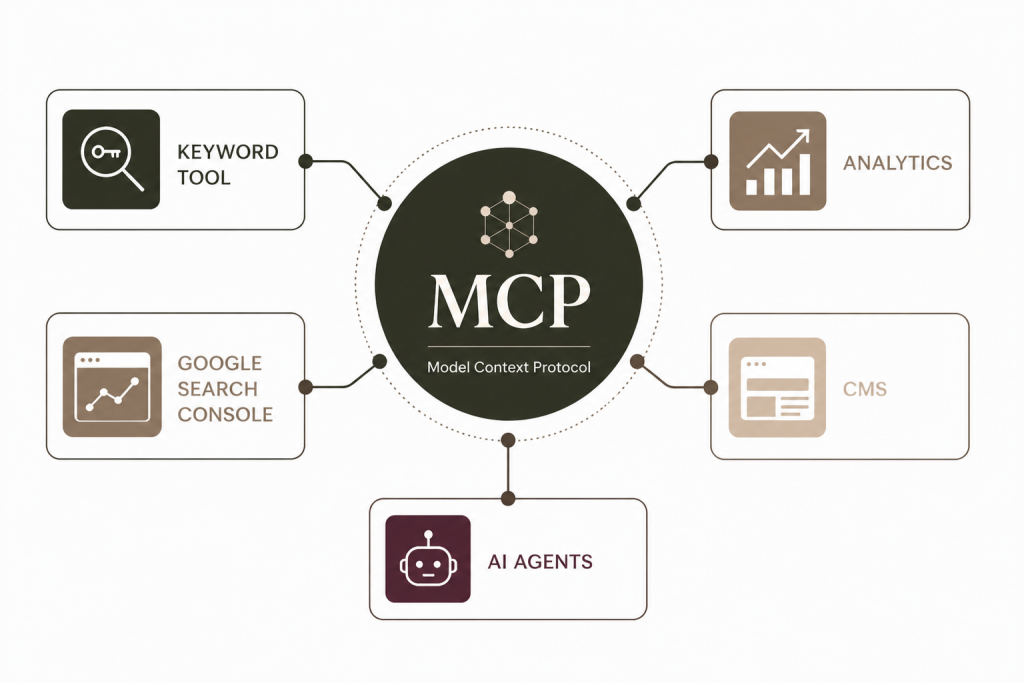
Model Context Protocol acts as a standardized connection layer between your SEO tools and AI agents. For the full request-flow architecture behind how MCP web search works inside AI agent workflows, including tool discovery, SERP retrieval, and structured response handling, see the complete technical guide.
The result is a workflow that keeps running even as your tool stack evolves. Marketing teams no longer need engineering support every time an API changes or a new platform is added. Instead of spending time fixing integrations, they can focus on publishing content, improving rankings, and scaling SEO operations.
How MCP Improves AI Content Strategy
A connected system means your AI content strategy stops living in spreadsheets and starts running as an actual process. For the full enterprise architecture, security, distributed orchestration, and rollout KPIs, see MCP Integration for enterprise tool stacks.
MCP for SEO Automation lets research, drafting, and publishing pass data automatically between stages, so your AI content strategy updates itself based on real ranking data, not a quarterly guess. This is what makes MCP for SEO Automation different from a single AI writing tool bolted onto your CMS.
Automate Your Entire SEO Workflow with MCP
Keyword Research
- MCP pulls search volume, keyword difficulty, and related terms straight from connected data sources. Understanding what a real-time SERP API delivers for keyword research, including how live results differ from cached data at scale, is what separates accurate keyword intelligence from a snapshot that’s already stale
- A single query returns clustered opportunities ranked by traffic potential and competition, cutting a task that used to take four hours down to about twenty minutes for most content teams.
Keyword Clustering
- Once raw keywords are pulled, the system groups terms by shared search intent so one article targets ten related queries, not ten thin pages competing against each other.
- This clustering step is what stops content teams from publishing pages that cannibalize their own rankings, and it is one of the fastest wins any MCP for SEO Automation setup delivers in the first week.
Search Intent Detection
- The system checks whether searchers want a guide, a product page, or a comparison before a single word gets written. AI Overview visibility and SERP feature tracking extend this further, surfacing which queries trigger AI-generated answers that absorb clicks before any organic listing is seen.
- Matching intent early means your AI content strategy stops guessing and starts building pages that match what searchers actually click first.
Competitor Analysis
- Connected crawlers pull competitor headings, word counts, and content gaps automatically. For a structured approach to integrating search APIs into your SEO strategy, including recurring competitive monitoring patterns and reporting workflows, see the implementation guide.”
- Competitor research moves from a manual audit to a five-minute reference pull inside your MCP for SEO Automation setup.
Content Brief Creation
- SEO briefs are generated automatically using insights from the research stage, including target headings, important entities, and common search questions.
- Your SEO AI Agents then send the finished brief directly to the writing stage, removing repetitive manual work.
AI Content Writing
- The drafting agent writes a first version based on the approved brief, following your tone and structure rules, not producing filler.
- This is where MCP for SEO Automation saves the most hours, since a draft that took a writer half a day now takes minutes to generate for review.
Human Review and SEO Optimization
- No draft is published without a human checking facts, tone, and accuracy first. Editors adjust for readability, add real expertise, and confirm nothing sounds robotic before it moves to the CMS, keeping quality control exactly where it belongs.
CMS Publishing
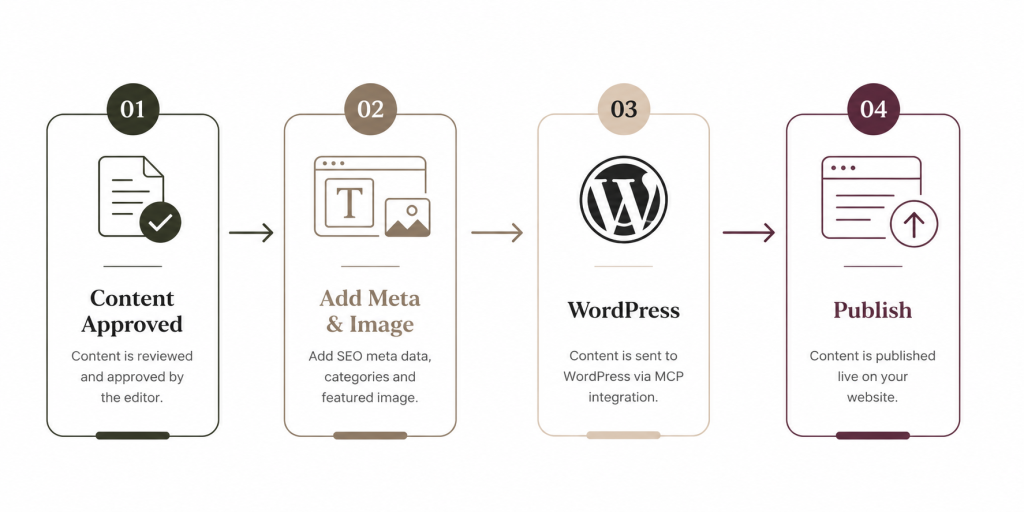
- Approved content pushes directly into WordPress with metadata, categories, and images attached automatically. This removes the manual copy-paste step that used to eat thirty minutes per article inside every MCP for SEO Automation rollout.
Internal Linking
- The system scans your existing content library and suggests contextual links to relevant pages, strengthening topical authority without a strategist manually searching old posts. Strong internal linking is one of the fastest wins inside any AI content strategy.
Rank Tracking and Content Refresh
- Once your content is live, MCP for SEO Automation continuously monitors keyword rankings and identifies pages that start losing visibility.
- This helps your team update the right content before traffic declines, turning SEO into a continuous optimization cycle instead of a one-time publishing task.
SEO AI Agents Every Marketing Team Should Build
Keyword Research Agent
This agent automatically collects fresh keyword data on a scheduled basis, eliminating the need for manual research.
It identifies rising search queries in your niche as they emerge, helping your team target new opportunities before competitors gain an advantage.
This makes it the starting point of every MCP for SEO Automation pipeline, because every successful SEO workflow depends on accurate keyword data.
Competitor Monitoring Agent
Tracks when competitors publish new pages or jump ranking positions, sending an alert without requiring a manual check every week. For teams running this at agency scale across multiple client accounts, how agencies use SERP APIs for competitive monitoring covers the portfolio-level implementation.
Content Brief Agent
Builds a full brief with headings, entities, and target questions pulled from the research stage, eliminating the blank-page problem writers face when starting from scratch.
Among all SEO AI Agents in a working MCP for an SEO Automation stack, this one saves editors the most planning time.
Content Writing Agent
Generates a structured first draft based on the approved brief and your house style. Connecting this agent to RAG pipelines for content grounding, pulling live search data and existing site content into the context window before generation, is what prevents drafts that sound plausible but miss current search intent.
SEO Editor Agent
Reviews drafts for readability, internal linking, metadata completeness, and entity coverage before a human opens the file, catching basic issues automatically so editors focus on judgment calls. This is one of the SEO AI Agents teams to add first because it protects quality at scale.
Technical SEO Agent
Scans your site for crawl errors, broken schema, redirect chains, and Core Web Vitals problems repeatedly.
Catching these issues early prevents ranking losses that often take months to reverse once search engines notice them, which is why this agent belongs in every serious MCP for SEO Automation build.
Internal Linking Agent
Suggests contextual links across your existing content library based on topic relevance, strengthening site structure without a strategist digging through old posts for opportunities.
Publishing Agent
Pushes approved content live in WordPress, attaching metadata, categories, and images automatically. This is where MCP for SEO Automation removes the final manual bottleneck that most teams still face.
Rank Monitoring Agent
Tracks keyword positions daily and flags significant drops before they become a full traffic problem, giving your team a head start on fixing pages that are slipping.
Daily tracking like this is what separates a real MCP for SEO Automation system from a monthly report nobody reads.
Content Refresh Agent
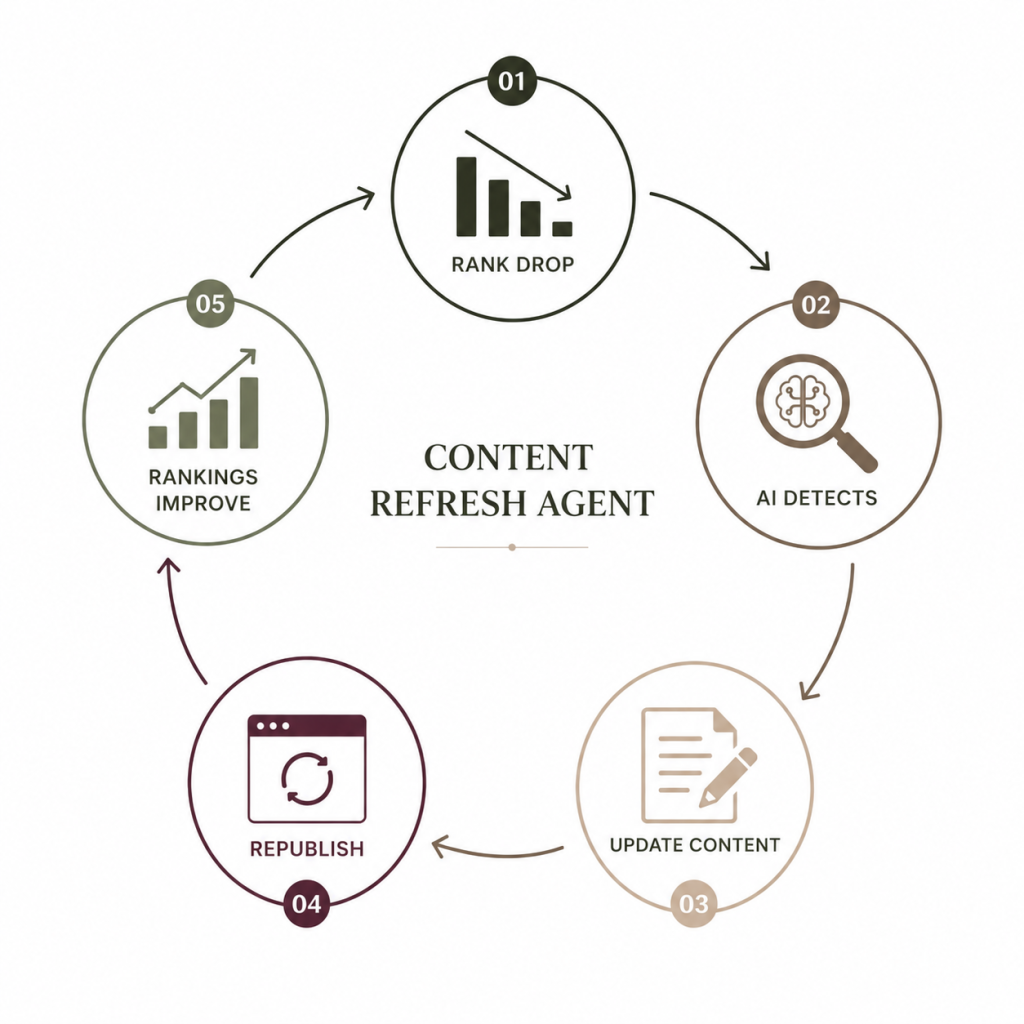
Identifies pages losing rank and recommends specific updates based on current search intent and competitor coverage, keeping your AI content strategy current, not static.
Building these ten SEO AI Agents together as an AI-powered content pipeline is what makes MCP for SEO Automation work as one full system, not a set of isolated tools.
Best MCP Servers for SEO Automation
| Server | Best For | Core Function |
| SERPHouse MCP | Enterprise keyword research and SERP data | Google Search, News, Images, Maps, Shopping APIs |
| Firecrawl MCP | Competitor content analysis | Website crawling and structured extraction |
| Browserbase MCP | SERP validation | Browser automation |
| WordPress MCP | Publishing | Scheduling, media, taxonomy automation |
| GitHub MCP | Workflow version control | Prompt and pipeline management |
SERPHouse MCP
SERPHouse connects your SEO AI Agents to Google Search, News, Images, Maps, and Shopping data through one AI-ready MCP server built for scale.
Best For: Enterprise teams running large-scale keyword research and SERP tracking across multiple markets.
Pricing: Free trial available, paid plans scale with query volume.
Review: 4.8/5, teams cite live SERP accuracy as the top reason they stay.
Firecrawl MCP
Firecrawl crawls competitor sites and extracts headings, word counts, and page structure for fast gap analysis inside your MCP for SEO Automation stack.
Best For: Content teams tracking two or three dominant competitors every week.
Pricing: Free tier for light crawling, paid plans scale with page volume.
Review: 4.6/5, strategists praise the speed of the competitor reports.
Browserbase MCP
Browserbase runs real browser sessions to confirm how a page renders in search results, a useful check inside any MCP for SEO Automation stack.
Best For: Teams tracking SERP features like snippets, local packs, or shopping results.
Pricing: Usage-based, billed per session.
Review: 4.5/5, valued for catching rendering issues before rankings drop.
WordPress MCP
WordPress MCP automates publishing, scheduling, media uploads, and taxonomy tagging directly inside your CMS.
Best For: Editorial teams publishing five or more articles every week.
Pricing: Free for self-hosted WordPress; the cost depends on your hosting plan.
Review: 4.7/5, editors highlight the zero copy-paste publishing flow.
GitHub MCP
GitHub MCP manages prompts, workflow versions, and collaborative changes across your setup, keeping your AI content strategy documented and reversible.
Best For: Teams with more than one person editing prompts or automation logic.
Pricing: Free for public repositories, paid tiers for private use.
Review: 4.6/5, teams trust the version history when something breaks.
Real-World Use Cases of MCP for SEO Automation
Publishing 100+ SEO Articles Every Month
Agencies running high-volume content calendars use MCP for SEO Automation to move briefs through drafting, review, and publishing without adding headcount for every new client account. One editor now oversees output that used to require three separate writers.
Monitoring Thousands of Keywords Automatically
Enterprise sites with large keyword sets need constant tracking, not a weekly spot check. Automated monitoring flags ranking drops the same day they happen, not a month later when traffic has already dropped.
Enterprise teams running MCP for SEO Automation rely on SEO AI Agents here because manual checks simply cannot cover this much volume.
E-commerce Category Page Optimization
Category pages update automatically based on inventory changes and seasonal search trends, keeping thousands of product pages relevant without a strategist rewriting each one by hand every quarter.
Multi-Location SEO at Scale
Franchise and multi-location businesses generate location-specific content and track local rankings across every market at once. Localized rank tracking for multi-location businesses covers the city-level query construction and domain-location combinations that make this work past twenty locations.
AI-Powered Content Refresh Pipelines
Declining pages get flagged and updated based on current search intent, keeping an AI content strategy current, not letting old content quietly lose rank for months before anyone notices, all inside one MCP for SEO Automation cycle.
Enterprise Technical SEO Monitoring
Large sites catch crawl errors, broken schema, and Core Web Vitals issues through continuous monitoring. At enterprise scale, API rate limits and production-scale query management determine whether that monitoring runs reliably or quietly throttles at peak traffic.
ROI of MCP for SEO Automation
MCP for SEO Automation cuts time spent on repetitive SEO tasks by more than half for most teams that fully connect their workflow, based on internal timing comparisons across research, writing, and publishing stages.
| Activity | Traditional Workflow | MCP Workflow |
| Keyword Research | 4 Hours | 20 Minutes |
| Content Brief | 2 Hours | 5 Minutes |
| Content Writing | Manual | AI Assisted |
| Publishing | 30 Minutes | Automated |
| Internal Linking | Manual | Automated |
| Weekly Reporting | 5 Hours | 10 Minutes |
KPIs to measure success:
- Organic traffic growth.
- Content production velocity.
- Publishing frequency.
- Time saved per article.
- Cost per published article.
- Ranking improvements.
- Lead generation.
- Team productivity.
These numbers only hold up when your AI content strategy includes a real human review stage, because speed without accuracy just produces more content to fix later. Teams that skip review lose the time savings that MCP for SEO Automation was built to create.
Why Growing Businesses Choose SERPHouse MCP
SERPHouse provides an enterprise-ready MCP server for SEO Automation that gives AI agents secure, real-time access to Google Search, News, Images, Maps, and Shopping data.
Instead of stitching together multiple APIs and maintaining custom integrations, businesses get a single MCP layer that fits into their existing SEO workflow and scales as their content operations grow.
- Enterprise MCP infrastructure built to deliver reliable Google data for AI-powered SEO workflows.
- Direct integration with your existing AI agents and content pipeline without rebuilding every connection.
- High-performance architecture designed to process thousands of keyword and SERP requests every day.
- Secure, standardized MCP access that reduces engineering effort and simplifies long-term maintenance.
- Production-ready implementation that helps teams move from pilot projects to large-scale SEO automation faster.
Want to build an SEO workflow that runs on real-time search data instead of manual work? Talk to our MCP experts and see how SERPHouse can power your AI-driven SEO operations.
Conclusion
Connecting your research, writing, and publishing tools through MCP for SEO Automation transforms SEO from a series of manual tasks into a scalable, repeatable workflow. Instead of switching between platforms, your AI agents can discover trends, analyze keywords, monitor competitors, generate content, and publish updates with consistent context across every step.
The workflows, agents, and MCP servers covered in this guide provide a practical foundation you can build on today. Start by automating one high-impact process, measure the time and quality improvements, and expand as your team gains confidence.
If you’re ready to see how an MCP-powered SEO workflow fits into your existing stack, schedule a walkthrough with SERPHouse and test it with your own data before investing in a complete installation.
FAQs
Does Google allow content created using MCP and AI?
Yes. Google evaluates content based on its quality, originality, and usefulness. As long as your content demonstrates expertise and provides value, using MCP for research and workflow automation is consistent with Google’s guidance.
Can MCP work with custom SEO tools or internal databases?
Yes. If your organization uses proprietary SEO dashboards, keyword databases, or internal CMS platforms, custom MCP servers can connect AI agents directly to those systems, creating a unified workflow.
Is MCP secure enough for enterprise SEO teams?
MCP itself is a communication protocol. Security depends on how your MCP servers are configured, including authentication, access controls, encrypted connections, and permissions for connected tools and data sources.
What skills does a team need to implement MCP for SEO automation?
Basic MCP implementations can often use existing servers, but advanced workflows may require developers familiar with APIs, AI agents, and MCP server development to build custom integrations.
Can small businesses benefit from MCP, or is it only for enterprises?
Small businesses can start with a single automated workflow, such as keyword research or content publishing, and expand over time. Enterprise teams typically see greater value because they manage larger volumes of content and more complex marketing stacks.