
Table of Contents
Table of Contents
TLDR: An AI News Monitoring Agent runs on MCP, real-time search, and RAG to read every source continuously, cut duplicate noise, and alert your team only when something genuinely changed, replacing hours of manual scanning with one running pipeline.
AI, startup, and tech news now breaks across a dozen channels at once. Blogs publish a story, X reacts within minutes, Reddit threads pile on, research papers drop quietly, and press releases land on top of all of it. A person checking even three of these sources misses the fourth one entirely, and the fifth one usually matters most.
Manual filtering simply cannot keep pace, so decisions slip by hours or days while the real signal gets buried under repeated noise from ten outlets saying the same thing. This is the noise versus signal problem every fast-moving AI ecosystem runs into eventually. Traditional monitoring systems were built for a slower world. That gap is exactly why an AI News Monitoring Agent exists, an autonomous system that reads everything continuously so your team only sees what actually changed.
What is an AI News Monitoring Agent?
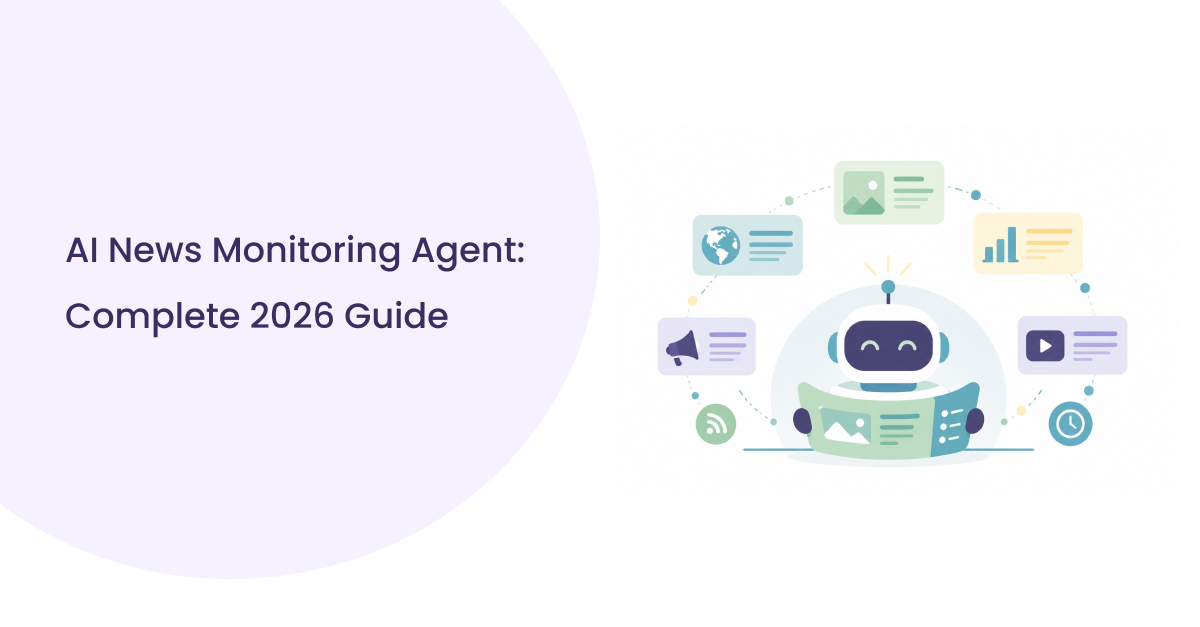
An AI News Monitoring Agent is one of the core AI monitoring tools, acting as an autonomous system that continuously searches, retrieves, filters, and summarizes real-time news monitoring data from the web using LLMs, APIs, and structured retrieval tools. It runs entirely on its own; no person has to trigger each cycle manually.
Key Characteristics
- Continuous real-time web search that runs around the clock.
- LLM-powered reasoning and summarization that grasps actual relevance.
- Multi-source aggregation with automatic deduplication built in.
- Automated alerts and insight generation once relevance crosses a threshold.
How It Differs From Traditional Systems
Unlike an AI News Monitoring Agent, RSS feeds pull everything without judging relevance, manual prompts answer only one request at a time, and scrapers collect raw text without understanding context or importance.
Core Agent Loop
Search → Retrieve → Filter → Reason → Summarize → Alert.
Each stage of the AI News Monitoring Agent feeds the next, combining what used to take three separate tools and a person stitching the output into a continuous pipeline.

Why is MCP the Backbone of Modern AI Agents
MCP gives a language model a standardized way to call outside tools, replacing the custom glue code every team used to write for each new API.
MCP server tools for AI agents typically include web search tool execution, SERP API integrations, structured response handlers, and a multi-tool orchestration layer that decides which tool to call next.
This standardization removes the integration tax, enables plug-and-play AI monitoring tools and tool systems, keeps agents modular and scalable, and supports multi-tool reasoning workflows that survive a source change without a rebuild. This is the core infrastructure layer of your AI News Monitoring Agent.
Core Architecture of an AI News Monitoring Agent
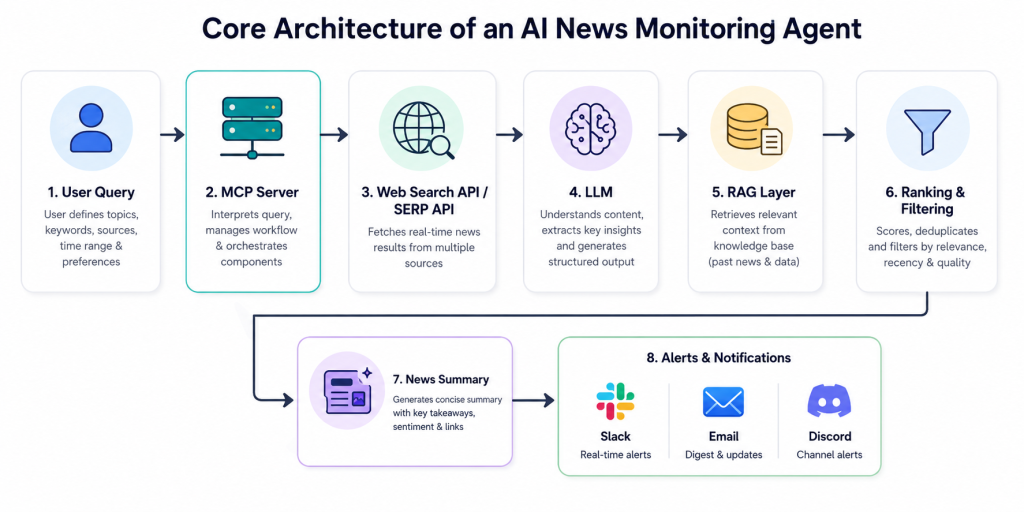
High-Level System Flow
User Input → MCP Agent → Web Search Tool → SERP API → LLM Processing → RAG Layer → Insights & Alerts Generation.
Each stage of the AI News Monitoring Agent owns one job, which keeps debugging simple when a result looks off, since a problem usually traces back to a single identifiable stage. A real-time web search API for AI agents sits right in the middle of this chain, feeding fresh data into the LLM before anything reaches the RAG layer.
LLM-Based Web Search Agent Architecture
- The LLM acts as the decision engine, deciding what and when to search.
- MCP handles tool execution behind the scenes.
- Web search returns structured data that the model can parse cleanly.
- The LLM performs reasoning and summarization on that structured input.
This division of labor keeps an LLM-based web search agent architecture stable as query volume grows, and it is what lets you swap a search provider later while leaving the reasoning logic untouched. This same separation is what makes an AI News Monitoring Agent maintainable past the first month of use.
Real-Time Web Search Layer Using MCP and SERP APIs
Role of Real-Time Search
This layer in AI monitoring tools ensures the AI News Monitoring Agent always retrieves fresh, current information beyond what the LLM learned during training. Fresh retrieval keeps the agent honest about what is happening right now and quietly builds trust with every accurate answer.
SERP API Integration for AI Applications
- Structured JSON responses covering titles, snippets, and URLs.
- Query optimization strategies built around named entities for stronger relevance.
- Rate limiting, caching, and cost control to keep spending predictable.
SERP API integration for AI applications is essential for retrieving relevant, real-time information. Well-structured queries using named entities and dates improve search accuracy, while optimized API usage helps an AI News Monitoring Agent avoid unnecessary search calls and keep costs under control.
What matters most is not pricing, but predictable freshness of results and well-defined rate limits that hold up under production load.
Retrieval Augmented Generation (RAG) News System
Why RAG is Essential
- Prevents hallucinations in AI-generated summaries.
- Ground responses in the real world, retrieved data.
- Improves factual accuracy across every summary produced.
A RAG pipeline makes an AI News Monitoring Agent trustworthy enough to act on, especially when a summary feeds a real decision that someone downstream will take action on.
How RAG Works in News Monitoring
- Fetch articles from web search results.
- Chunk and preprocess content into smaller, manageable pieces.
- Retrieve relevant context dynamically based on the current query.
- Generate grounded summaries using the LLM, anchored to that narrow retrieved set.
Teams that skip the chunking and narrow retrieval step in AI monitoring tools end up with summaries that drift off topic, because the model starts filling gaps from memory once retrieval stops doing its job. This is usually the first thing worth auditing if a summary ever feels slightly off.
Data Normalization and Aggregation Layer
Why It Matters
Raw web data arrives noisy, duplicated, and inconsistent. The same story shows up across five outlets with five different headlines, mismatched timestamps, and author fields that may or may not exist. This noise reaches the reader directly without cleanup, defeating the entire point of automation.
What This Layer Does
- Deduplication of similar or near-identical articles
- Normalization of metadata, including source, timestamp, and author
- Ranking by relevance and authority, pushing credible reporting above aggregators
Skip this layer, and even strong AI monitoring tools start triggering alert fatigue, where the same event pings a Slack channel five separate times. That single failure mode gets an entire AI News Monitoring Agent muted by its own users within the first week of launch.
Intelligent News Summarization Engine
Multi-Source Summarization
This engine combines multiple articles into a single coherent insight, sparing the reader from piecing together five fragments manually. If three outlets report a funding round at slightly different valuations, the engine weighs source credibility and timestamp recency to settle on the figure it presents.
Key Extraction System
| Extracted Element | What It Captures |
| Entities | Companies, models, named people |
| Events | Key events and claims, including launches and lawsuits |
| Impact | Relevance scoring tied to why it matters to the reader |
Output Formats
- TL;DR summaries for a quick daily read.
- Bullet point insights formatted for a Slack channel.
- Structured JSON outputs for apps and downstream dashboards.
An intelligent news summarization engine matches the format to the audience, the detail that most off-the-shelf tools get wrong. This single piece is often what readers notice first about a working AI News Monitoring Agent.
Step-by-Step Implementation of the AI Agent
Step 1: MCP Setup
Configure the MCP server first, since every later step depends on it. This step wires up the standard interface between your language model and outside tools, covering search, retrieval, and alerting. MCP server tools for AI agents make this configuration step a one-time, valuable investment.
Step 2: Web Search Integration
Connect a SERP API or an equivalent search provider through your MCP server. Confirm responses return structured fields that the model can use directly. Test with a handful of real queries early, since a broken connection here breaks every downstream step immediately.
Step 3: Agent Orchestration
Let the LLM decide when and how often to call the search tool through the MCP server tools for AI agents based on the actual query. This is where the LLM-based web search agent architecture earns its name. AI News Monitoring Agent in basic guardrails, so the model calls search only when a query genuinely needs a fresh lookup.
Step 4: RAG Layer Setup
Store retrieved articles in a structure built for fast, relevant retrieval in AI monitoring tools, not just raw storage. Chunk content sensibly so retrieval pulls focused context from each article. This layer keeps later summaries grounded; treat it as a core build step from day one.
Step 5: Summarization Pipeline
Feed retrieved, chunked content into the AI News Monitoring Agent with clear instructions on format, tone, and length. Test outputs against the source to confirm the summary stays accurate. A pipeline that drifts even slightly from source text compounds that drift across every digest it produces.
Step 6: Alert System
Trigger notifications only when content crosses a relevance or trend threshold, never on every single result returned. This single design choice decides whether your team trusts the channel or mutes it within days. Tune thresholds gradually based on real feedback.
Ranking and Filtering News Using AI
Before generating summaries, AI monitoring tools evaluate source credibility, rank results based on actual query intent, automatically filter spam and low-quality content, and prioritize authoritative domains over aggregator sites repeating the same story.
This ensures an AI News Monitoring Agent works with reliable, relevant information from the start.
Done well, this step stays invisible to the reader, which is exactly why it gets overlooked until it is missing. Any serious AI News Monitoring Agent applies these checks before summarization runs, since ranking weak input first wastes processing on content nobody should see in the final digest.
AI Trend Detection and Alert System
How Trend Detection Works
- Frequency spike detection across unrelated sources.
- Topic clustering over time, grouping related coverage by meaning.
- Sentiment and narrative shift analysis to catch turning points early.
An AI trend detection and alert system powered by MCP server tools for AI agents spots a story before it becomes obvious, the real value over a person scanning headlines each morning. This combination is where an AI News Monitoring Agent earns its keep, catching stories building momentum well before they hit a mainstream headline.
Alert Mechanisms
- Email alerts for daily summaries.
- Slack or Discord notifications for real-time pings that a team actually sees.
- Webhook-based integrations for systems that need to react automatically.
Pick the channel that matches how your team actually checks news in the AI News Monitoring Agent.
Context Engineering for News AI Agents
An AI News Monitoring Agent improves accuracy through well-designed prompts, balances long-term memory with real-time retrieval, reduces hallucinations using tighter context structures, and organizes retrieved information to help LLMs reason more effectively over relevant content.
Teams that treat this as an ongoing tuning job see meaningfully fewer hallucinated claims over time, since prompt drift tends to creep in gradually. Reviewing flagged summaries weekly catches that drift early, long before a reader notices an AI News Monitoring Agent is getting something wrong.
Scalable Architecture Considerations
Scalable AI monitoring tools use distributed agent systems for parallel processing at scale, queue-based ingestion pipelines similar to Kafka, cost optimization across SERP and LLM calls, and intelligent caching of frequently accessed news data to reduce latency and operating costs as the AI News Monitoring Agent grows.
This combination matters once usage scales past a few hundred daily queries, when a single bottleneck starts slowing every request behind it. Teams running serious MCP server tools for AI agents plan for this stage before it arrives, not during an outage.
Limitations and Challenges
- API rate limits and cost scaling that need a budget plan.
- Latency in real-time search pipelines, so alerts land seconds late.
- Data inconsistency across sources, even with strong normalization.
- Paywalls and restricted content that stay out of reach.
- Hallucination risks in summarization, exactly why RAG grounding matters.
Plan for these limits up front. No AI News Monitoring Agent avoids tradeoffs entirely, and pretending otherwise sets the wrong expectations for whoever signs off on the budget.
Use Cases of AI News Monitoring Agent
| Use Case | What the Agent Tracks | Who Benefits |
| Startup and funding tracking | New rounds, valuations, investor activity | VCs, founders, analysts |
| Competitive intelligence | Rival launches, pricing changes, hires | Product and strategy teams |
| Financial and stock monitoring | Market-moving headlines, earnings news | Traders, finance desks |
| Research automation | New papers, citations, methodology shifts | Research teams |
| Media intelligence | Brand mentions, sentiment shifts | Enterprise comms teams |
Startup and funding tracking: The AI News Monitoring Agent catches a competitor’s funding announcement the same hour it posts, putting that information in front of a founder well before it surfaces in a status meeting the next morning.
Competitive intelligence: Teams watch pricing pages, hiring posts, and product launches from one dashboard. Spotting a rival’s price change the day it happens beats finding out from a customer three weeks later.
Financial and stock monitoring: A trading desk running this AI monitoring tools architecture catches an earnings surprise as it breaks, capturing the move before analyst commentary fully shapes the narrative around it.
Research automation: The agent flags a new paper citing a competitor’s methodology the day it publishes, long before that citation surfaces in a quarterly literature review.
Media intelligence: Enterprise comms teams track brand sentiment across a product launch automatically, replacing five manual platform checks with one running feed.
Across every case, the architecture stays the same. Only the source list, the ranking weights, and the alert thresholds shift, which is why a well-built AI News Monitoring Agent usually serves several teams inside the same company.
Future of AI News Monitoring Systems
Future AI monitoring tools will use autonomous agents, MCP-based multi-agent workflows, personalized real-time intelligence feeds, and self-improving ranking systems to make every AI News Monitoring Agent faster and more accurate.
The next generation of MCP server tools for AI agents closes the gap between what a system surfaces and what a reader actually needs, learning from which alerts get opened and which get muted. Human judgment stays in the loop. The next wave of AI monitoring tools just clears the noise so that judgment lands on the right stories.
Why Choose SERPHouse as Your SERP API Provider
SERPHouse provides the SERP API layer that powers reliable real-time retrieval for an AI News Monitoring Agent, built to handle the rate limit pressure that smaller providers struggle under.
- Structured JSON responses arrive ready for an LLM to parse, cutting integration time.
- Built-in caching and rate control keep search costs predictable as volume scales.
- Coverage spans the major search engines, which a monitoring agent actually needs.
Teams building MCP server tools for AI agents get a search layer that stays stable as usage grows, even during the moments when traffic spikes the most.
Conclusion
MCP, real-time search, RAG, and disciplined ranking are the four pillars of a reliable AI News Monitoring Agent. Skip any one, and the system risks hallucinating summaries or overwhelming users with irrelevant alerts. Successful teams using MCP server tools for AI agents continuously refine normalization, retrieval quality, ranking, and alert thresholds as data sources evolve. Before building your first version, define your news sources, update frequency, and delivery channels so your AI News Monitoring Agent delivers timely, actionable insights from day one.
Ready to build an AI News Monitoring Agent for your business? Contact SERPHouse to explore how our real-time search APIs and MCP-ready infrastructure can help you launch faster and scale with confidence.