
Table of Contents
Table of Contents
TL;DR: AI Agents for Marketing are systems that read live campaign data and act on it, shifting budget, drafting content, or updating a CRM record without a person clicking through five tools first. MCP for marketing is the protocol layer that lets one agent talk to your CRM, ad platform, and CDP through a single connection instead of five separate integrations. This guide covers how the two fit together in a real enterprise stack, not a demo environment.
Automation improved marketing execution. AI Agents for Marketing improve marketing decisions. Instead of following fixed rules, they continuously monitor performance, reason over data, identify opportunities or issues, and take the next best action across your marketing ecosystem. This shifts marketing operations from reactive workflows to intelligent, always-on execution.
The foundation behind this capability is MCP marketing automation, which provides a standardized way for AI agents to interact with every marketing tool without relying on countless custom integrations. As a result, agents can access data, coordinate workflows, and automate decisions across platforms more efficiently. This guide explores the business value, architecture, real-world use cases, and implementation best practices of MCP for marketing for enterprise teams adopting AI-powered marketing automation.
Why Marketing Operations Are Entering the Agentic AI Era
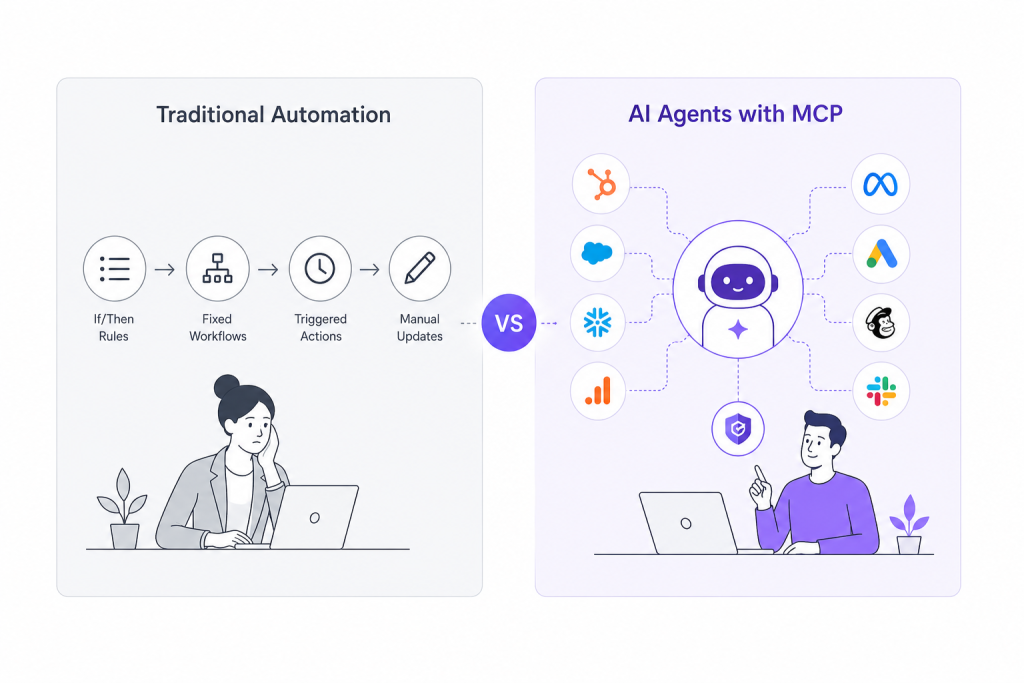
AI Agents for Marketing exist because rule-based automation hit a ceiling that more rules cannot fix. A workflow with forty branches still only handles the forty scenarios someone predicted, and real campaigns generate scenarios nobody predicted every week.
The Evolution from Automation to AI Agents
Traditional automation follows predefined steps regardless of outcomes. AI Agents for Marketing evaluate results after every action, adapt decisions in real time, pause underperforming campaigns, and prioritize high-intent leads. This ability to assess before acting is what makes AI agents fundamentally different from automation.
How MCP for Marketing Eliminates Integration Silos
Traditional martech stacks rely on multiple point-to-point integrations that often fail when APIs change, creating operational silos and campaign disruptions. MCP for marketing replaces fragile point-to-point connections with a standardized protocol. For the complete technical breakdown of MCP Integration architecture and use cases, including security, distributed orchestration, and enterprise deployment patterns, see the full guide.
Why CMOs Are Investing in AI Agents
Board conversations have shifted from impressions and clicks to pipeline and revenue, and that shift is what is actually funding AI Agents for Marketing budgets right now.
A CMO who can show a straight line from an agent’s action to a closed deal wins the next budget cycle faster than one presenting a slide of engagement metrics. That is not a marketing trend; it is a finance conversation marketing finally has the data to join.
The Building Blocks of AI Agents for Marketing
Five components have to work together for AI Agents for Marketing to function, and most failed deployments are missing one of them rather than all five.
AI Agents
The decision layer. An agent holds a goal, checks results after every action, and decides the next move without waiting for a person to open a dashboard. The AI agents use case page covers the full implementation pattern, from tool registration to grounded response generation across OpenAI, Anthropic, and LangChain.
MCP Servers
The connection layer. An MCP server exposes a specific system, like a CRM or an ad account, through a standard set of tools that an agent can call. This is the piece that turns AI Agents for Marketing from a concept into something that can actually touch your CRM safely, since the server controls exactly what the agent is allowed to read or write.
Marketing Platforms
The execution layer. Your ad platforms, CMS, and email tools still run the actual send, bid, or publish. In MCP marketing automation, the agent decides and instructs, the platform executes, and that separation is what keeps a misbehaving agent from directly corrupting a production system.
LLMs
The language and reasoning layer that drafts copy, summarizes a week of performance data into three sentences, or reads a batch of support tickets and surfaces the recurring complaint a campaign should address before launch.
Enterprise Data Sources
The memory layer. Your CRM, CDP, and data warehouse ground every decision in a real customer’s actual history. When combined with RAG pipelines for knowledge retrieval, this same data layer also feeds unstructured context from past proposals, support tickets, and sales call notes into the model’s decision window.
Simple architecture flow: Enterprise Data Sources feed MCP Servers, which expose that data to AI Agents, which use LLMs for reasoning and content generation, which then instruct Marketing Platforms to execute, with results flowing back to Enterprise Data Sources for the next decision cycle.
How Enterprise Marketing Teams Use AI Agents with MCP
Five functions inside a marketing org are already running AI Agents for Marketing in production, and each one reveals something different about what MCP marketing automation is actually good for.
Content Marketing
Agents pull the top-ranking pages for a target query, draft a brief with headings and an angle already outlined, and flag where the current site content has a gap. Understanding how MCP web search powers AI agent decisions at this research layer is what separates an agent that drafts from one that validates.
A writer starts from that brief instead of a blank page, and the agent checks internal linking and keyword coverage against competing pages before the draft goes to review.
This is where AI Agents for Marketing save the most raw hours, since research and structuring used to eat half a writer’s week. The mistake teams make here is letting the agent publish without a human pass.
Content quality still needs a person with judgment about tone and accuracy, even when the research and structure came from an agent.
Performance Marketing
An agent connected through MCP for marketing checks bid performance hourly instead of daily, and shifts the budget away from a fatiguing ad set before a human would have noticed the click-through rate dropping.
Creative testing runs continuously because the agent retires a losing variant on its own rather than waiting for a weekly review meeting to decide.
Email Marketing
Static send schedules and rule-based email journeys are once defined in marketing automation. AI Agents for Marketing make these journeys adaptive by determining the best send time and subject line for each subscriber based on individual engagement patterns.
They also identify high-intent behaviors, such as pricing page visits, and, with MCP for marketing, automatically move prospects into more relevant nurture sequences across connected platforms.
With MCP marketing automation, the result is highly personalized customer journeys that improve engagement, increase conversions, and scale one-to-one marketing without additional manual effort.
Social Media
Publishing still requires human approval in most enterprise organizations, but AI Agents for Marketing significantly reduce manual effort by generating platform-specific copy, adapting creative assets for different formats, and identifying comments that require immediate attention.
They also monitor social channels continuously, enabling brands to respond quickly to customer concerns and prevent issues from escalating outside business hours.
Revenue Marketing
Attribution used to live in a spreadsheet that someone rebuilt every Monday morning by hand.
Agents now stitch touchpoints across channels automatically and update pipeline forecasts continuously. For the enterprise data architecture that makes multi-system attribution possible at scale, see MCP for enterprise AI data analytics, specifically how a Model Context Protocol Server connects ERP, CRM, and analytics into one decision layer.
Mapping AI Agents Across the Marketing Funnel
AI Agents for Marketing behave differently at each funnel stage, and matching the right agent to the right stage is what separates a deployment that pays for itself from one that just adds another dashboard.
Awareness
Agents handle campaign research, content planning, and SEO recommendations by pulling competitor content gaps directly from search data. SERPHouse’s Web Search API for live marketing intelligence is the data layer that makes this search-grounded content planning possible without a custom scraping build.
Consideration
Here, agents score leads against patterns from past closed deals, personalize nurture sequences per account, and refine audience segments on a weekly cycle instead of a quarterly one.
This stage is where AI Agents for Marketing typically show the fastest lift in lead quality, since segmentation updates weekly instead of sitting stale for a full quarter. A prospect who downloaded a pricing sheet gets a different next email than one who only read a single blog post.
Decision
Agents draft a first pass proposal directly from CRM deal data, surface the case study most relevant to that account’s industry, and update CRM fields the moment a call ends. That last part alone reclaims real time, since reps typically lose a meaningful chunk of a workday to manual data entry that an agent now handles in seconds.
Retention
After the sale, agents monitor product usage for early churn signals, recommend upsell timing based on actual account behavior, and flag renewal risk before the conversation starts rather than after it is too late to act.
MCP marketing automation connects this usage data back to the same agent that ran the original acquisition campaign, so a retention team sees full account history in one place instead of stitching it together from three systems.
AI Marketing Workflows That Deliver the Highest ROI
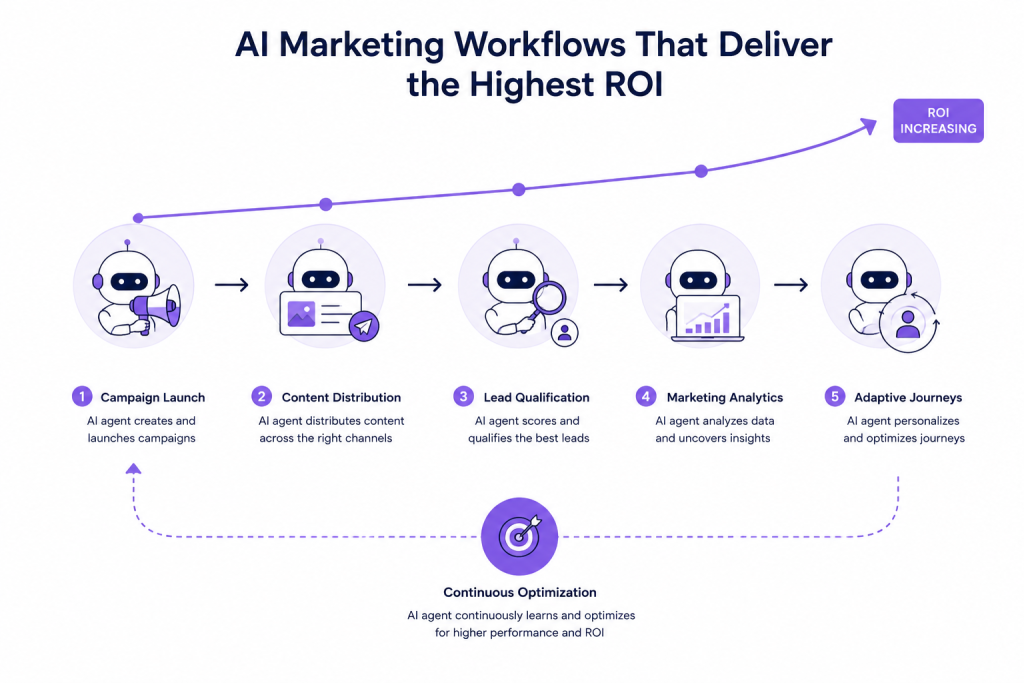
The fastest ROI from AI Agents for Marketing comes from workflows where decisions must be made continuously. AI agents monitor signals, adapt actions in real time, and optimize campaigns based on changing customer behavior, enabling marketing teams to execute faster and more effectively.
Campaign Launch Automation
- When a new product or offer is ready, AI Agents for Marketing accelerate the entire launch process by generating audience segments, creating campaign messaging, drafting ad copy, and building launch timelines.
- What typically takes marketing teams weeks of coordination can be completed in hours, helping campaigns reach the market faster.
Multi-Channel Content Distribution
- Publishing content is only the beginning. AI agents automatically transform a single blog, whitepaper, or webinar into channel-specific assets, including social posts, email campaigns, sales enablement content, and ad copy.
- They tailor the tone, format, and length for each platform while maintaining consistent messaging across every channel.
Intelligent Lead Qualification
- AI Agents for Marketing analyze behavioral signals, historical conversion patterns, and engagement data to prioritize prospects in real time.
- High-intent leads are routed immediately to the appropriate sales representative, reducing response times and improving conversion opportunities.
Automated Marketing Analytics
- AI agents continuously collect and analyze performance data across advertising, email, CRM, and analytics platforms.
- Beyond generating dashboards, agents detect campaign anomalies, identify emerging trends, and surface optimization opportunities. For teams adding an AI news monitoring agent implementation to this analytics layer, the same MCP and RAG architecture covers competitive and industry signal detection alongside internal campaign data.
Adaptive Customer Journey Automation
- Customer journeys become dynamic and responsive to buyer behavior. When prospects revisit pricing pages, engage with product content, or return after a sales conversation, AI Agents for Marketing immediately adjust nurture sequences, recommend relevant content, and personalize the next interaction.
- MCP for marketing enables this real-time adaptability, delivering more relevant customer experiences and improving conversions throughout the buying journey.
AI Agents vs Marketing Automation: A Business Perspective
AI Agents for Marketing and traditional marketing automation solve different problems, and the table below shows exactly where the line sits between them.
| Business Capability | Traditional Automation | AI Agents |
| Decision Making | Rule based | Goal driven |
| Context | Limited to one system | Shared across systems |
| Optimization | Manual review cycle | Continuous |
| Personalization | Segment level | Individual level |
| Collaboration | Single workflow | Multi-agent handoff |
| Adaptability | Low | High |
Traditional automation still earns its place for simple, high-volume tasks like a welcome email series, where the logic never needs to change. The gap opens once a task requires judgment across shifting contexts, since AI Agents for Marketing read new data and adjust course without anyone rebuilding a workflow diagram.
A rule-based tool breaks the moment buyer behavior shifts. With MCP marketing automation, an agent adjusts inside the same cycle, which is the real argument for making the switch on anything that touches live customer behavior.
Designing an Enterprise AI Marketing Stack
A working AI Agents for Marketing stack has seven layers, and a gap in any single layer is usually the reason a deployment stalls, rather than any flaw in the agent itself.
CRM:
Holds account and deal history, records every one of the AI Agents for Marketing in your stack checks against before acting. An agent working from stale CRM data will personalize based on an outdated job title or a deal that closed months ago but was never marked shut.
CDP:
Unifies customer identity across devices and channels so the agent sees one person, not five disconnected profiles across five tools. This is the layer that stops an agent from emailing the same lead twice under two different addresses because two systems never agreed on who that person was.
Analytics:
Feeds performance signals back to the agent so every optimization decision is grounded in current numbers instead of last quarter’s report.
This is one of the layers MCP marketing automation touches most often, since analytics data is what triggers the majority of agent decisions across the rest of the stack.
An agent checking analytics hourly catches a dropping conversion rate long before a scheduled weekly review would surface it.
CMS:
Publishes and stores the content the agent drafts, tests, and updates based on live performance, including swapping a headline that is underperforming without waiting for the next content sprint to start.
Advertising Platforms:
AI Agents for Marketing continuously optimize ad spend across search, social, and programmatic channels based on real-time performance.
They automatically shift budgets toward the channels generating the highest-quality pipeline, helping marketing teams improve campaign efficiency and maximize ROI throughout the campaign lifecycle.
MCP Layer:
MCP for marketing connects every layer above through one shared protocol, so an agent built for content can query CRM data without a custom integration built just for that one purpose. This is the layer most teams underbuild, and the one that determines how far the rest of the stack can scale.
AI Agents:
Sit on top of all six layers, reading data, making decisions, and triggering execution across the stack in one continuous loop rather than a series of disconnected manual steps.
Executive Checklist Before Deploying AI Agents
Six decisions determine whether an AI agent for Marketing rollout succeeds or stalls, and CIOs and CMOs should settle every one of them before the first agent goes live rather than mid-rollout.
Business Objectives
Name the exact metric the agent needs to move, such as cost per lead or launch time, before scoping the build.
This single step is what separates AI Agents for Marketing rollouts that get renewed budget from ones that quietly get shelved, since a rollout with no target metric almost always stalls in a budget review.
Data Readiness
Confirm CRM and CDP records are clean before connecting an agent to them, because bad data produces bad decisions faster than a human ever could.
Duplicate contacts and stale fields are the single most common reason a first deployment underperforms.
Governance
Set explicit rules for what an agent can change without approval, and what always routes to a person first, such as any budget shift above a set dollar threshold or any message going to a regulated audience.
Governance is the item most teams skip early and the one that causes the most damage when it gets skipped.
Human Approval
Keep a manual review step on anything customer-facing until the agent has a track record, then loosen that gate gradually as accuracy holds steady across a full reporting cycle rather than a single good week.
Most AI Agents for Marketing rollouts that skip this step end up rolling back autonomy after one bad customer-facing mistake, which costs more trust than the gate ever cost in speed.
Security
Confirm every MCP marketing automation connection uses scoped access tokens rather than full account credentials, so a compromised agent cannot touch every system at once.
Log every agent action the same way you would log a human user’s activity, so an audit trail exists if something breaks.
Vendor Independence
Choose an MCP-based architecture over a single vendor’s closed agent ecosystem, so switching platforms later does not mean rebuilding every integration from the ground up.
Industry Examples of AI Agents for Marketing
AI Agents for Marketing apply differently by industry, shaped by each sector’s sales cycle, compliance load, and typical buyer behavior.
SaaS agents run product-qualified lead scoring and trial nurture sequences tied directly to in-app behavior rather than generic time-based drip logic.
Healthcare agents draft compliant patient education content while a human reviews every claim before it publishes, since regulatory risk here is too high for full autonomy.
eCommerce agents adjust bid strategy and creative by the hour based on live inventory and conversion rate shifts, a pace no manual team can sustain during a sale event.
Financial services agents personalize outreach inside strict compliance guardrails, routing anything regulated to a review step automatically rather than leaving that judgment to the agent.
In manufacturing, agents run account-based campaigns across long sales cycles, tracking engagement across an entire buying committee instead of one contact.
In the creative industry, agents can be especially helpful in speeding up production-heavy work like video, design, and content variations that would otherwise take a creative team days to turn around. For example, invideo Agent can generate and edit videos from a simple text prompt, automatically matching brand style and format requirements across platforms, cutting turnaround from days to minutes.
Measuring Success: KPIs for AI Marketing Agents
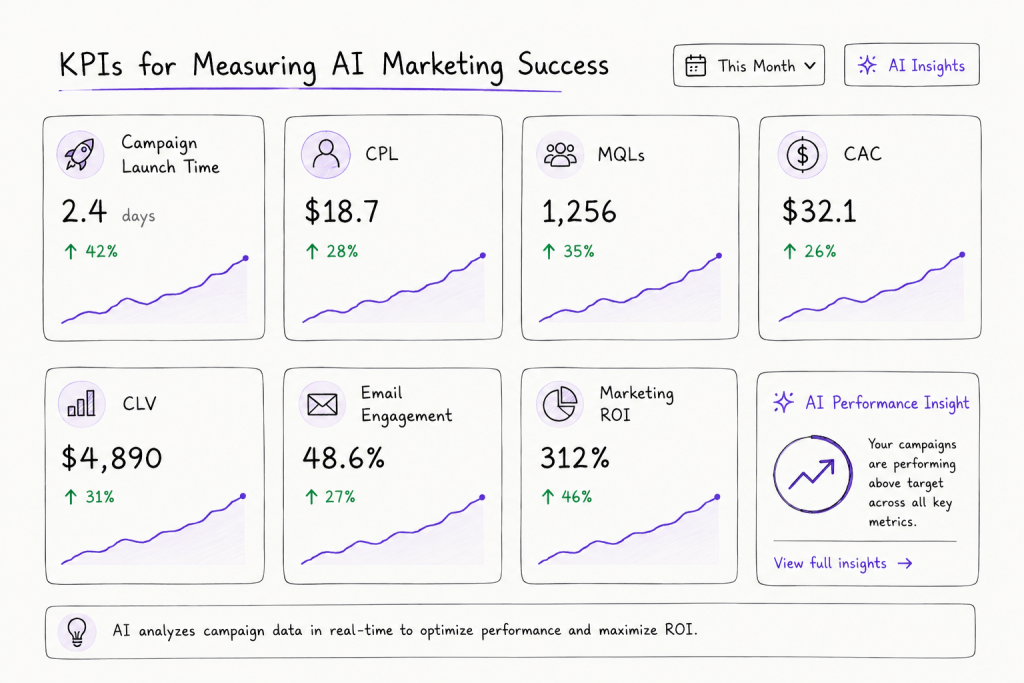
- Campaign Launch Time: Measures how quickly campaigns move from planning to execution after introducing AI agents.
- Cost per Lead (CPL): Tracks whether AI-driven targeting and optimization reduce the cost of acquiring qualified leads.
- Marketing Qualified Leads (MQLs): Evaluates whether AI-powered lead scoring and segmentation increase the volume of sales-ready prospects.
- Customer Acquisition Cost (CAC): Indicates whether AI agents are helping acquire customers more efficiently.
- Customer Lifetime Value (CLV): Measures whether AI-driven personalization and customer journeys improve long-term customer value.
- Email Engagement Rate: Monitors improvements in open rates, click-through rates, and conversions resulting from personalized messaging.
- Marketing ROI: Combines campaign costs and revenue generated to determine the overall financial impact of AI Agents for Marketing. Compare performance over several months rather than week to week to account for optimization cycles.
AI Agent Adoption Roadmap
A five-phase rollout keeps AI Agents for Marketing from becoming a pilot project that never reaches production, which is the most common outcome when a team tries to deploy everything at once.
Phase 1: Identify Repetitive Marketing Work
Audit where the team spends hours on tasks with a clear, repeatable pattern, like report compilation or lead routing, since these are the easiest and lowest risk first targets for an agent.
Phase 2: Connect Systems Through MCP
Set up MCP for marketing connections to the CRM, CDP, and ad platforms before building any agent logic on top of them, since a poorly connected agent fails on data access long before it fails on intelligence.
Phase 3: Deploy a Single AI Agent
For MCP marketing automation, Launch one agent against one workflow, such as lead qualification, and measure it against the KPI set before launch, rather than a general sense that things feel better. A narrow scope makes it easy to prove exactly what the agent changed.
Phase 4: Expand to Multi-Agent Workflows
Once the first agent proves value, add a second agent that hands work to the first, such as a content agent feeding a distribution agent, and start managing the handoff between them as its own process. Multi-agent handoffs are where AI Agents for Marketing start compounding, since each additional agent makes the ones already running more useful.
Phase 5: Optimize Using Performance Data
Feed campaign results back into agent logic every month, refining scoring models and content guidelines based on what actually converted rather than what was assumed to convert at launch. Mature MCP marketing automation deployments treat this phase as ongoing, not a one-time cleanup step.
Why Businesses Choose SERPHouse
SERPHouse builds AI Agents for Marketing that connect directly into an existing CRM, CDP, and ad stack through secure MCP marketing automation infrastructure, so a team gets a working agent inside its current tools in weeks instead of a year-long platform migration.
- Enterprise AI solution design mapped to a client’s actual funnel structure, not a generic template.
- Custom AI agent development for content, performance, and revenue marketing workflows specifically.
- MCP integration is built on scoped, auditable access rather than broad account credentials.
- CRM integration that preserves the existing data model instead of forcing a migration to a new one.
- Multi-agent systems are designed to expand in phases as a team proves value at each step.
If your team is buried in disconnected tools and still missing pipeline targets, let’s talk through where an agent actually fits your stack first.
Conclusion
AI Agents for Marketing move a team from executing tasks to running coordinated, adaptive campaigns across every channel at once. Paired with MCP for marketing, they connect a CRM, CDP, and ad platforms into one decision layer without forcing a rebuild of the stack already in place.
The teams winning budget approval right now are the ones that can trace a straight line from a specific agent action to a specific pipeline number, not the ones with the most dashboards. The biggest AI wins come from solving one high-impact workflow first. Talk to the SERPHouse team to identify where your first AI marketing agent can deliver measurable ROI.