
Table of Contents
Table of Contents
TL;DR AI models go stale the day training stops, and that’s the core problem web search APIs solve. The right one feeds live, structured results straight into your model, so answers stay current instead of confidently wrong. For teams shipping AI agents, choosing the best one is the difference between a tool people trust and one they quietly stop using.
Your AI is only as current as the information it can access. Even the most advanced models can’t answer questions about today’s news, market updates, or newly published content unless they retrieve live data first. That’s why web search APIs have become a core part of modern AI systems.
A reliable real-time search API for developers provides fresh search results on demand, helping AI deliver accurate, relevant, and up-to-date results. In this guide, you’ll compare the leading providers and learn how to choose the right solution for production-ready AI systems.
What Makes a Good Web Search API for AI?
A good web search API returns fresh, structured, low-latency results that an LLM can parse without extra cleanup work, and it stays stable when your traffic spikes, which is the baseline test for any real-time search API for developers.
Most teams evaluating web search APIs focus only on price and miss the parts that actually break in production. Here’s what separates a usable option from a liability.
Real-time results. An API that serves yesterday’s index passes its mistakes straight to your AI agent. These tools refresh on every query instead of pulling from a stale cache layer.
Structured JSON output. An LLM doesn’t want raw HTML. It wants clean, parsed fields it can drop straight into a prompt, which is the whole point of a proper structured search data API.
Full SERP access. Answer boxes, AI overviews, People Also Ask, and organic listings all carry signal. A web search API for LLM applications that only returns ten blue links is leaving context on the table.
Low latency at scale. Agents often fire multiple queries per task. If each call takes three seconds, a 5-step workflow turns into a 15-second wait, which kills the user experience fast.
Global geo-targeting. Localized results matter for research assistants, news monitoring tools, and market intelligence platforms built on web search APIs that need country-specific data.
Stability under load. Rate limits and downtime during peak hours quietly break agent pipelines, and most teams only discover this after launch.
Not every web search API is built for production. These six criteria will help you identify the ones that consistently deliver under real-world workloads.
Top 5 Web Search APIs for AI Applications
Every web search API has its own strengths, trade-offs, and ideal use cases. The right choice depends on your data needs, latency requirements, budget, and integration workflow.
Below are five providers that stand out for teams building a web search API for LLM applications in 2026.
1. SERPHouse
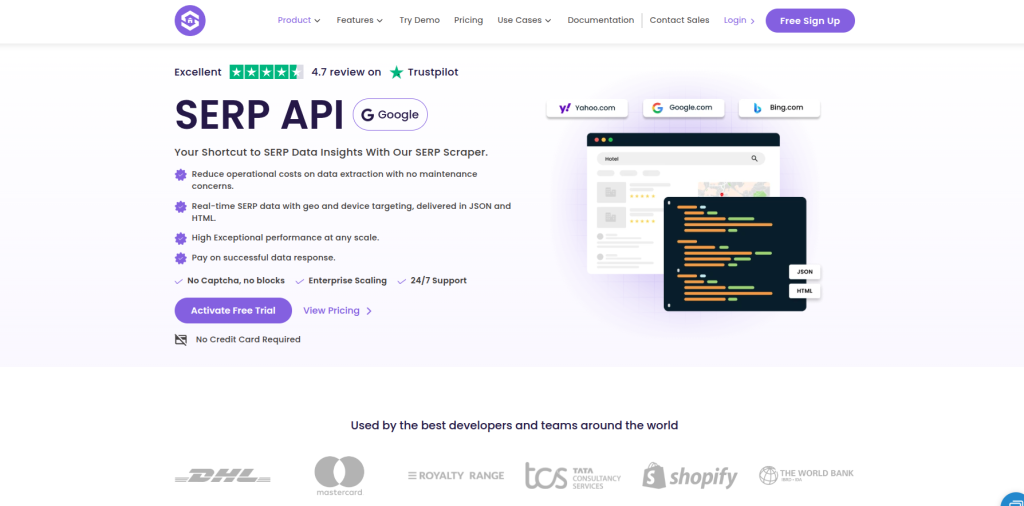
SERPHouse is built specifically for AI workloads, returning clean JSON across multiple search engines with full SERP coverage, including AI overviews and PAA blocks.
Best for: AI agents, RAG pipelines, and teams that need a dependable real-time search API for developers without managing scraping infrastructure.
Strengths:
- Real-time results are pulled fresh per request.
- Full SERP access, including AI overviews, featured snippets, and PAA.
- Clean, consistent JSON formatted for direct LLM ingestion.
- Multi-engine support across Google, Bing, and others.
Weakness: Newer player compared to legacy providers, so the documentation library is still growing.
Pricing: Usage-based tiers that scale with query volume.
Client Review: 4.7/5.
2. SerpApi
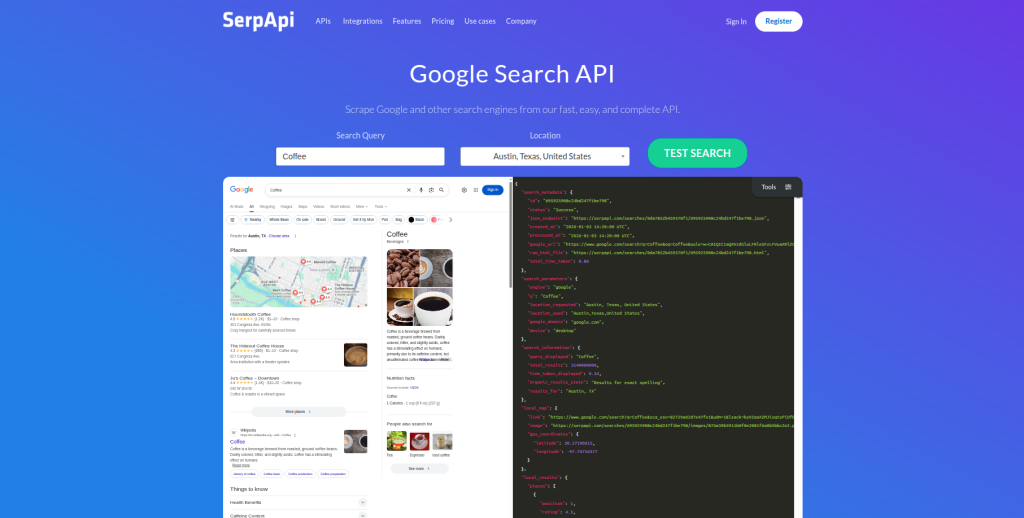
Overview: SerpApi is one of the most established web search APIs on the market, with a mature ecosystem built for developers who want flexibility.
Best for: Developers who need broad engine coverage and detailed documentation.
Strengths:
- Wide engine support beyond Google.
- Long track record and active developer community.
- Extensive parameter options for custom queries.
Weakness: Pricing climbs fast at scale, and the tier structure is genuinely confusing for new users.
Pricing: Tiered, often the most expensive option on this list.
Client Review: 4.4/5.
3. Bright Data
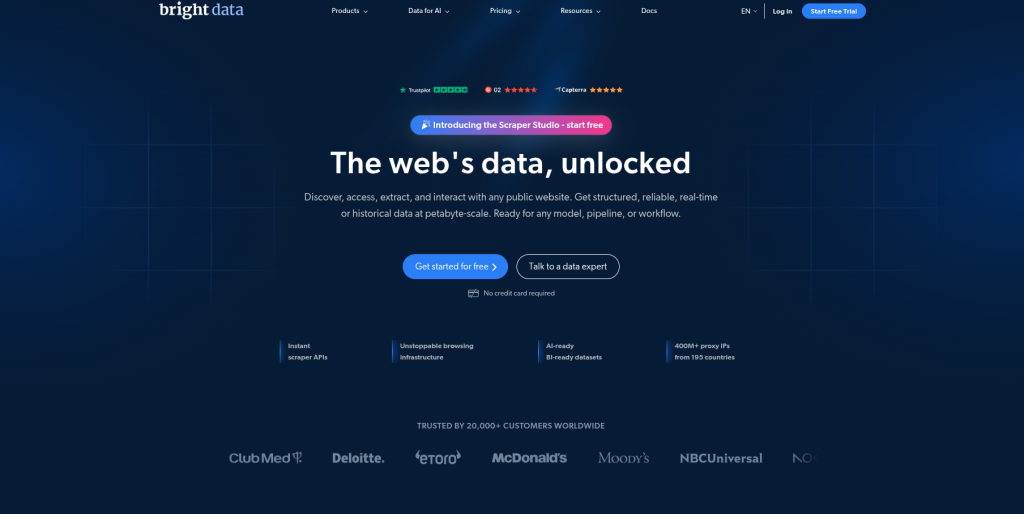
Overview: Bright Data is a heavyweight scraping platform that doubles as one of the more powerful enterprise-grade web search APIs, built for massive data extraction jobs.
Best for: Enterprise scraping operations with large data engineering teams.
Strengths:
- Massive proxy network for high-volume extraction.
- Enterprise-grade reliability and support contracts.
Weakness: Setup is heavy, and the platform is overkill for a typical AI app that just needs search grounding from web search APIs.
Pricing: Enterprise pricing, custom contracts.
Client Review: 4.3/5.
4. Zenserp
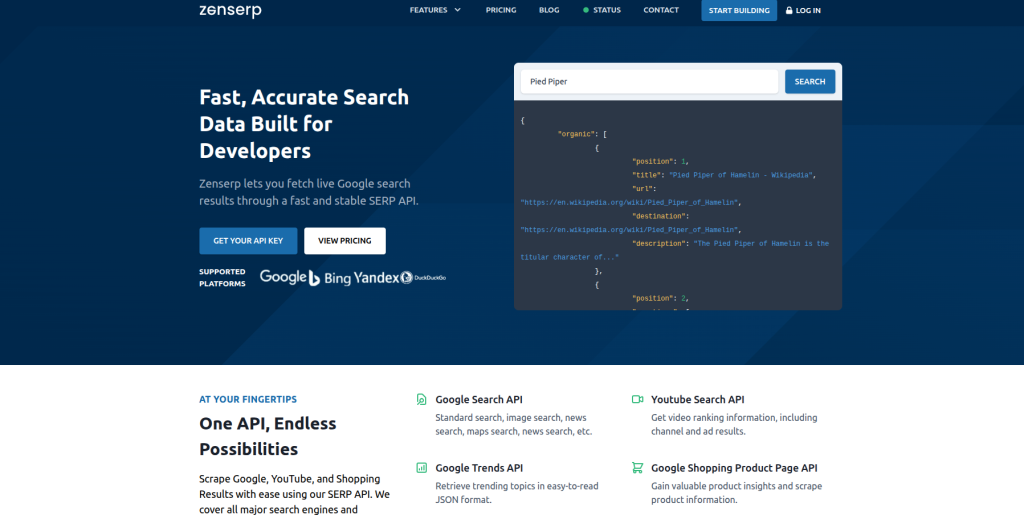
Overview: Zenserp is a lightweight option among web search APIs, aimed at smaller projects that need basic search data without enterprise complexity.
Best for: Simpler use cases and smaller-scale applications that don’t need a full enterprise feature set.
Strengths:
- Straightforward setup and easy onboarding.
- Lower entry cost for small projects.
Weakness: Feature set is limited compared to the rest of this list, especially around AI overview extraction.
Pricing: Budget-friendly, lower-tier plans available.
Client Review: 4.1/5.
5. Google Cloud
Overview: Google’s own Custom Search offering provides basic integration but was never built as a dedicated real-time search API for developers working on AI agents.
Best for: Teams that only need basic Google integration for a narrow use case.
Strengths:
- Direct access to Google’s index.
- Familiar setup for teams already in the Google ecosystem.
Weakness: Limited result counts, no AI overview access, and pricing gets expensive fast once you scale queries.
Pricing: Pay per query, expensive at volume.
Client Review: 3.8/5.
Comparing every option side by side makes the decision faster than reading five separate pricing pages for five separate web search APIs.
Cost, Subscriptions, and Free Tiers
| Provider | Free Trial / Tier | Pricing Structure | Billing Flexibility | Best Fit | Scaling Cost |
| SERPHouse | Free tier available | Usage-based | Pay only for the queries you use | Startups, AI products, and growing LLM applications | Predictable as usage grows |
| SerpApi | Limited free tier | Monthly subscription tiers | Fixed plans with usage limits | Teams with steady query volumes | Can become expensive at higher volumes |
| Bright Data | No | Enterprise contracts | Custom pricing and negotiated plans | Large-scale enterprise data operations | High, depending on the contract |
| Zenserp | Limited free tier | Affordable monthly plans | Budget-friendly entry point | Small projects and prototypes | Requires plan upgrades as usage increases |
| Google Cloud Custom Search | Daily free quota | Pay-per-query | Usage-based with quota limits | Basic Google Search integrations | Costs increase quickly with frequent requests |
The right web search API should match your expected query volume, growth plans, and billing preferences. Usage-based pricing works well for products with fluctuating demand, while subscription tiers suit predictable workloads.
Enterprise contracts make sense for organizations handling large-scale data extraction, but they often introduce higher upfront commitments. Evaluating pricing alongside scalability helps avoid unexpected costs as your AI application grows.
ROI of Using Web Search APIs
The return on web search APIs shows up in three places: fewer hallucinations, faster development time, and lower engineering overhead, all of which matter more once you’re running a real-time search API for developers at production volume.
Building an in-house scraper that survives CAPTCHA changes, IP blocks, and layout updates costs far more engineering time than most teams budget for. A managed web search API removes that maintenance burden entirely.
- Accuracy gains: Grounded answers reduce the support tickets and trust issues that come from hallucinated responses.
- Speed to launch: Teams skip months of scraper maintenance and ship the actual product instead.
- Lower total cost: One subscription replaces a proxy network, a parsing layer, and an on-call engineer babysitting uptime.
- Scalability: Query volume scales with usage instead of requiring new infrastructure every time traffic grows.
Every dollar spent on a reliable web search API for LLM applications is a dollar not spent rebuilding scraping infrastructure from scratch.
How to Select a Vendor for Web Search APIs
Choosing among web search APIs gets easier when you evaluate providers against consistent technical criteria instead of marketing claims. Here are the five factors that matter most:
Latency Under Real Load: Fast demo results don’t always translate to production. Test response times during high request volumes, since AI agents often send multiple queries simultaneously, and delays can quickly add up.
Full SERP Coverage: Ensure the API returns complete search results, including AI Overviews, featured snippets, and People Also Ask (PAA) sections. Rich search data gives LLMs better context and improves response quality.
Pricing Model: Look beyond the starting price and review how costs scale. Usage-based pricing is generally easier to predict than fixed plans with strict query limits or expensive overage charges.
Geo-Targeting Accuracy: If your application serves multiple regions, verify that the API delivers accurate, localized search results. This is especially important for market research, SEO tools, and AI assistants.
Reliability and Uptime: Check the provider’s uptime history and service reliability instead of relying on marketing claims. Consistent availability is essential for production AI systems that depend on uninterrupted search access.
Use Cases for AI Applications
Web search APIs show up everywhere an AI system needs to know something it wasn’t trained on, and that list keeps growing for every web search API for LLM applications built this year.
AI agents built on frameworks like LangChain or AutoGPT rely on a real-time search API for developers to complete multi-step tasks that require current information, from booking research to competitive analysis.
RAG pipelines use a retrieval augmented generation (RAG) search layer to pull fresh context before the model generates an answer, which is exactly how tools like LlamaIndex ground their responses in real data instead of training memory.
Research assistants depend on a real-time search API for developers to pull citations, summaries, and current sources without a human manually opening twenty browser tabs.
Market intelligence tools poll search results on a schedule to track competitor pricing, product launches, and positioning changes as they happen, which is a textbook web search API for LLM applications use case.
News monitoring systems use a real-time search API for developers to flag breaking stories the moment they’re indexed, which is impossible with a static model alone.
Across every one of these categories, the pattern repeats: any AI system that needs to know what’s happening right now depends on web search APIs to get there.
How to Choose the Right Web Search APIs
The right choice among web search APIs depends on what you’re actually building, separate from whichever vendor has the loudest marketing.
- If you need real-time grounding for an AI agent, prioritize a real-time search API for developers with full SERP access and clean JSON, since that’s what keeps agent responses accurate.
- If you’re an enterprise running massive extraction jobs, a heavyweight scraping platform with dedicated infrastructure makes more sense than a lightweight search API.
- If budget is the main constraint, start with a lower-tier plan and scale up once your usage patterns are clear.
- If you’re building AI applications powered by search, test latency, and AI Overview access before signing any contract.
Most teams overbuy on features they don’t need and underbuy on latency, which is the one metric that actually breaks an agent in production. A solid real-time search API for developers beats a feature-heavy one on this point every single time, and the same logic applies to any web search API for LLM applications you’re piloting this quarter.
Example Workflow: How an AI Agent Uses a Web Search API
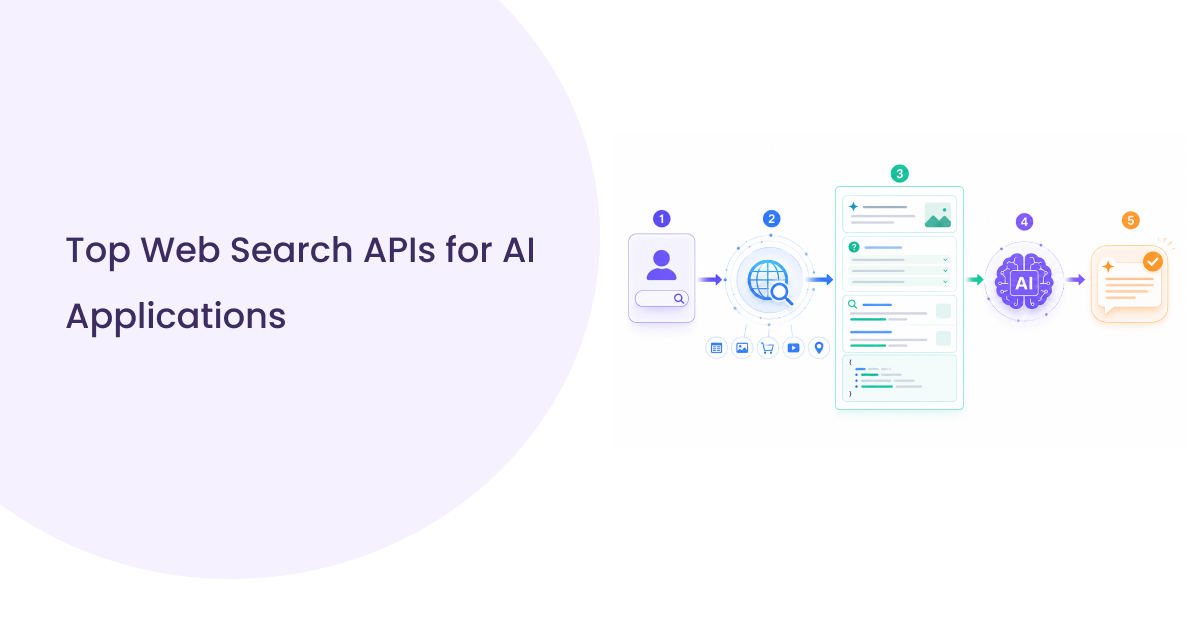
Here’s the actual sequence most AI agents follow when they call a web search API mid-task, the same loop that runs underneath any real-time search API for developers’ integration.
Query sent. The agent detects it needs current information and sends a structured query to the web search API.
API returns JSON. The provider responds with parsed results, including titles, snippets, and any available AI overview content.
Results get injected into the prompt. The agent formats the top results into a context that the model can read directly.
The LLM generates a grounded answer. Instead of guessing, the model reasons over real, current data pulled through the structured search data API layer.
This loop repeats for every step in a multi-step agent task, which means latency and JSON quality compound fast across a single session. Slow web search APIs don’t just cost seconds; they cost the entire chain of reasoning that depends on them.
Why Choose SERPHouse for Web Search APIs
SERPHouse is built around one job: feeding AI systems clean, real-time search data without the maintenance overhead of running your own scraper. It works as both a web search API for LLM applications and a dependable real-time search API for developers out of the box.
- Full SERP coverage, including AI overviews and PAA blocks that most lightweight web search APIs skip entirely.
- Multi-engine support so your agent isn’t locked into a single search index, a must for any real-time search API built to last.
- JSON formatted for direct LLM ingestion, which cuts integration time down to hours instead of weeks.
If your team is evaluating web search APIs for an agent or RAG pipeline, SERPHouse is built to plug in without the usual scraping headaches. Try SERPHouse free and run it against your real workload before you commit to anything else.
Conclusion
Every AI system that answers questions about the current world needs a live data source, and that’s the entire case for web search APIs. The vendor you pick decides whether your web search API for LLM applications reasons over fresh, structured facts or guesses based on a frozen training set.
The five options covered here solve different problems. Bright Data fits bulk extraction, Google Cloud fits a narrow Google-only lookup, and Zenserp fits a small budget project that won’t scale much further. SERPHouse and SerpApi sit closer together on paper, but latency, full SERP access, and clean JSON formatting are what separate a tool your agent can rely on from one that quietly slows it down.
Test latency, SERP coverage, and JSON quality against your actual workload before signing anything. Pull a few real queries from your own product, run them through a free tier, and compare the raw output side by side instead of trusting a feature list. Book a quick walkthrough with SERPHouse and see how it performs against your real queries.
FAQs
What should I look for in a web search API?
Choose a web search API that offers fresh results, low latency, full SERP coverage, clean JSON responses, reliable uptime, and pricing that matches your expected query volume.
Can LLMs access the internet?
Not on their own. LLMs need a search layer connected on top to pull live data from the web, since the base model only knows what it learned during training and nothing after.
Is Google Search API free?
No. Google’s Custom Search API includes a small daily free quota, then switches to a strict pay-per-query model that scales fast once an AI agent fires multiple queries per session.
How do AI agents use search APIs?
Agents send a structured query, receive parsed JSON back, and inject the top results into the prompt so the model reasons over current data instead of guessing, then generates a grounded response.
What’s the difference between a web search API and a scraper?
An API returns structured, parsed results instantly through a clean endpoint, while a scraper requires you to build, host, and maintain your own extraction, parsing, and proxy infrastructure over time.
Why do RAG pipelines need real-time search?
RAG pipelines retrieve context before generating an answer, and without real-time search, that context goes stale the moment new information appears online, leading to outdated or simply wrong responses.