
Table of Contents
Table of Contents
AI agents are now an established part of the internet. These agents search for and compare products, and are now commonly acting on behalf of human users. They’re no longer just crawling.
The scale of this new technology is already alarming. DataDome’s 2026 State of Bot & Agent Security Report showed that between July 2025 and June 2026, bad bot traffic grew 124% and AI traffic increased 82.3%. The company detected 52.7 billion AI agent and large language model (LLM) crawler requests in that period.
The question for businesses is: which agents should be trusted, and what exactly should they be allowed to do?
What is agent trust management?
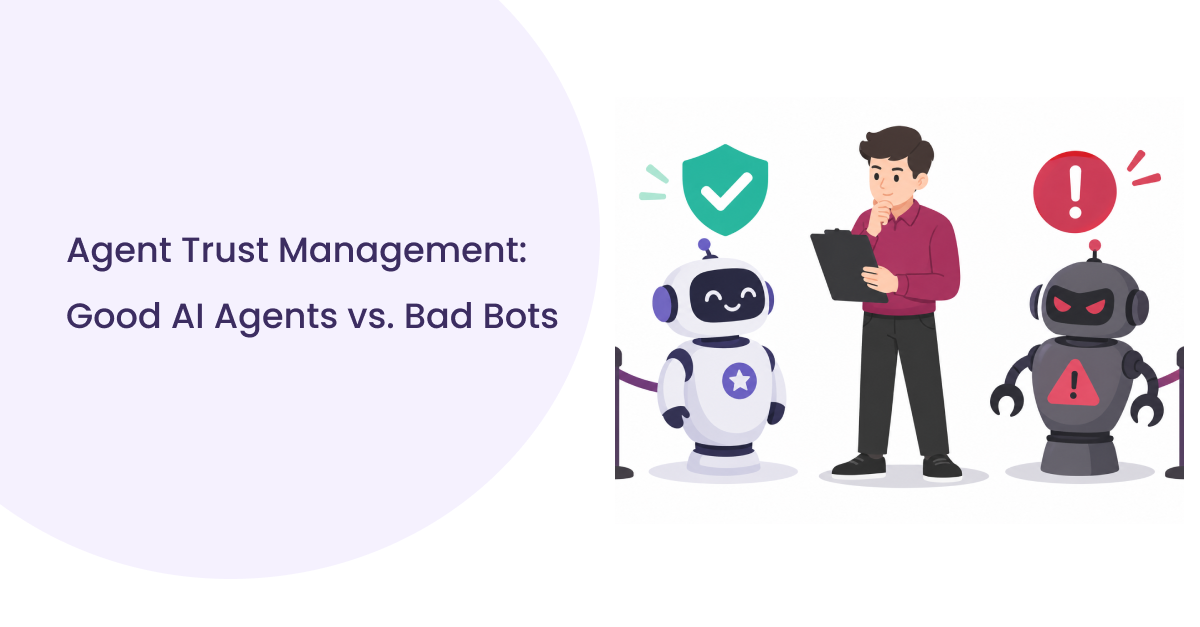
Agent trust management is the process of identifying AI agents, verifying those identities, assessing their intentions, and controlling what they can access or do. This is important for organizations to allow legitimate agents and limit or block malicious automation.
Rather than a binary human-or-bot decision, agent trust management evaluates identity, intent, and behavior continuously.
A verified search crawler reading public product information might be allowed; an agent repeatedly trying to create accounts might be restricted.
Policies can be applied to individual agents, their functions, or specific actions. So an organization can allow an agent to read content and restrict it from submitting forms, for example.
The discipline is an extension of, and a necessary update to, traditional bot management. LLM crawlers, agentic browsers, AI assistants and custom-built agents can all be managed.
Why agent trust management matters now, and the data
The major companies are taking different approaches in how they manage an AI shopping journey. Each has implications for bot and agent trust management.
OpenAI is focusing on discovery and influencing purchase decisions through ChatGPT, with advertising as a commercial model.
Google is focusing more on transaction execution, using its Universal Commerce Protocol (UCP) to connect product discovery, shopping carts and checkout within Search and Gemini.
Anthropic is taking a more retailer-centric approach, providing tools and blueprints for businesses to build their own shopping agents while keeping checkout and payment under retailer control.
Meanwhile, Visa and Mastercard are developing trust and payment infrastructure, including agent identity, authentication, permissions and transaction verification.
The changing nature of AI traffic is arguably more important than the fact that it’s growing.
DataDome’s Q3 2026 AI Traffic Report recorded nearly 25 billion AI agent requests during the quarter, up 41.5% from Q2. Agentic browser traffic increased 4.7 times in September alone, showing the progression from automated systems that simply retrieve pages to agents that interact with websites to complete user tasks.
Perhaps the most prominent example is Meta’s Muse. During its first 12 days of full availability, Muse generated 29.1 million requests in DataDome’s observed traffic.
Approximately 99.3% originated from cloud and CDN infrastructure (rather than consumer internet connections). 8.9% of those requests touched sensitive functionality: forms, logins, payments, account creation and shopping carts.
Legitimate AI agents can be harder to distinguish from malicious. A cloud-hosted agent acting for a real user may not exhibit the device, browser or network signals that conventional bot detection tools use to classify automated traffic.
How to tell a good agent from a bad bot
A good approach will cover three layers of verification for AI agent security: identity, intent and behavior, and function. None of these alone are enough to establish trust.
Cloud-hosted agents like Muse do not show residential-IP or device signals, so security teams can’t use traditional device techniques alone to identify and assess AI agents.
1. Identity: establish who is making the request
AI agent identity is a starting point but not proof.
A request might identify itself through a user-agent string claiming to originate from a recognized AI company. However, these strings can be copied or spoofed. IP reputation and published IP ranges provide more evidence, but neither are definitive authentication.
Cryptographic request signing is a stronger approach. The IETF’s Web Bot Auth working group is developing a mechanism that allows automated clients to sign HTTP requests using cryptographic signatures. Origin servers can then verify that a request genuinely originates from the entity controlling the associated signing key.
The IETF is developing Web Bot Auth, a cryptographic mechanism that would allow sites to verify the identity of automated clients through signed HTTP requests. The work is still in progress, but it points towards a more reliable way to authenticate AI agents than just relying on self-declared user-agent strings or IP addresses.
2. Intent and behavior: understand what the agent is doing
Identity does not establish whether an agent’s actions are appropriate.
A legitimate AI assistant could retrieve a product page, compare specifications and submit a search query. Another automated client might retrieve thousands of pages, enumerate account identifiers or repeatedly submit login attempts.
- Useful behavioral signals include:
- Request frequency and volume across sessions.
- Navigation patterns and session progression.
- Form interactions and submission sequences.
- API calls and their order of execution.
- Access to sensitive endpoints.
- Deviations from the expected behavior of a particular agent.
3. Function: determine why the agent exists
Not all agents from the same organization serve the same purpose. A “know your agent” approach means understanding what each agent is designed to do, what data it needs to access, and which actions it’s authorized to perform.
OpenAI, Anthropic and Amazon operate different automated systems for activities such as model training, search indexing and user-triggered information retrieval.
These functions have different implications for website owners.
So policies need to distinguish between:
- Training: collecting information for model development.
- Search and indexing: discovering and organizing publicly available content.
- User-triggered retrieval: fetching information in response to a specific request.
- Agentic actions: interacting with sites, forms, accounts and transactions.
What should organizations allow, limit or block?
Agent policies should reflect the sensitivity of the action being performed (not just the identity of the agent).
Here are agent behaviors and some appropriate policies that an organization might set:
| Surface | Example agent behavior | Policy |
| Public content | Reading product descriptions or articles | Allow verified agents within reasonable rate limits |
| Search and catalog | Comparing products or retrieving listings | Allow with rate limits and scraping controls |
| Forms | Submitting contact or inquiry forms | Limit to authorized, identifiable interactions |
| Login | Attempting authentication | Require appropriate authorization and risk checks |
| Account creation | Registering new accounts | Restrict and apply verification and velocity controls |
| Shopping cart | Adding or reserving inventory | Limit according to user authorization and inventory rules |
| Checkout and payment | Completing purchases | Require transaction-level authorization and fraud controls |
OWASP’s Automated Threats to Web Applications taxonomy helps to classify these activities. The categories include credential stuffing, scraping, scalping, account creation and denial of inventory.
Recent research makes it clear why endpoint-level controls are important: DataDome recorded 605.6 million AI-agent requests to high-risk endpoints during H1 2026. Login pages accounted for 51.7%.
An authenticated or cryptographically verified agent should not automatically receive permission to perform every action. Identity establishes who is making a request; authorization determines what that identity is permitted to do.
How to evaluate vendors
The market is developing from traditional bot management toward broader bot and agent trust platforms. DataDome, HUMAN and Kasada are some notable vendors; DataDome was named a Leader in The Forrester Wave: Bot and Agent Trust Management Software, Q2 2026.
The right choice of vendor depends on an organization’s applications, threat profile, existing security architecture and requirements for agent visibility.
Here is an overview of those three vendors for bot and agent trust management.
1. DataDome
DataDome combines bot detection and mitigation with capabilities for identifying and governing AI agents and automated traffic. It includes behavioral analysis, agent identity, intent visibility and granular policy enforcement. The platform is used for AI agent authentication, distinguishing legitimate automation from malicious activity across digital properties and transaction flows.
Forrester awarded it the highest possible scores in 12 evaluation criteria, including AI agent trust management and intent visibility.
2. HUMAN Security
HUMAN offers bot and fraud protection through its Human Defense Platform, combining automation detection, threat intelligence and protection against malicious digital activity.
Its capabilities address the distinction between legitimate users, beneficial automated systems and malicious traffic. The company emphasizes its threat research and intelligence capabilities, which support the detection of evolving automated attacks.
3. Kasada
Kasada provides bot management and anti-automation capabilities, with its AI Agent Trust offering extending its focus to legitimate AI-driven interactions.
The company emphasizes verified agent access and policy-based control, allowing organizations to manage which agents can interact with their digital properties and what actions they can perform.
Here is how an organization might compare the three solutions, or any other options:
| Evaluation criterion | What to ask vendors |
| Agent identity verification | Can the platform distinguish verified agents from spoofed identities? Does it support cryptographic authentication and IP validation? |
| Intent visibility | Can it explain what an agent is trying to accomplish, rather than simply identifying its source? |
| Behavioral analysis | Does it analyze sessions, API sequences, form interactions and changes in behavior? |
| Granular policy enforcement | Can teams allow, limit or block individual agents and specific actions? |
| Application coverage | Does protection extend across websites, mobile applications, APIs and MCP servers? |
| Performance and latency | What is the additional request-processing latency? How does performance change at peak traffic? |
| Analyst validation | Has the vendor been independently evaluated? What do customer references and technical tests reveal? |
| Operational usability | Can security, fraud and business teams understand decisions, investigate incidents and manage policies without excessive manual work? |
A good solution should fit into the organization’s existing security architecture. Businesses might review compatibility with web application firewalls, CDNs, API gateways, fraud platforms, SIEM and SOAR systems. They can ask how the solution handles policy conflicts and whether teams can distinguish between detection events and actual enforcement decisions.
For organizations building agentic applications, coverage should extend to relevant Model Context Protocol (MCP) servers and other agent-facing interfaces.
FAQ
Which vendors lead the Forrester Wave for bot and agent trust management?
Forrester’s Q2 2026 Wave evaluated eight vendors. DataDome, HUMAN and Kasada have publicly announced that they were named Leaders.
What are bot and agent trust solutions?
Bot and agent trust solutions identify, authenticate, analyze and govern automated traffic, including traditional bots, LLM crawlers and autonomous AI agents. They help organizations distinguish beneficial automation from malicious activity and apply policies that control access to content, applications, APIs and sensitive transactions.
What tools help distinguish good AI agents from bad bots?
Useful tools combine agent authentication, IP and reputation intelligence, behavioral analysis, intent visibility and granular policy enforcement. These help determine whether an automated client is legitimate, what it’s doing and whether it should be allowed to continue.
Which platform provides the best visibility into AI agent intent?
No one platform is universally agreed upon as the best for every organization. DataDome, HUMAN and Kasada are highly rated solutions to evaluate. Buyers should validate intent reporting using their own agent traffic and application workflows.
Which solutions manage both malicious bot traffic and emerging AI agent traffic?
DataDome, HUMAN and Kasada are among the vendors that manage both. Their platforms extend traditional bot and fraud protection toward managing legitimate AI agents and automated interactions. Selection should depend on application coverage, authentication methods, behavioral visibility and enforcement requirements.