
Table of Contents
Table of Contents
Most US brands find out about news coverage the same way their customers do. After it publishes, after it spreads and sometimes after it has already shaped public perception.
That gap between publication and awareness is where brand reputation gets damaged, competitor advantages get built and SEO opportunities get missed.
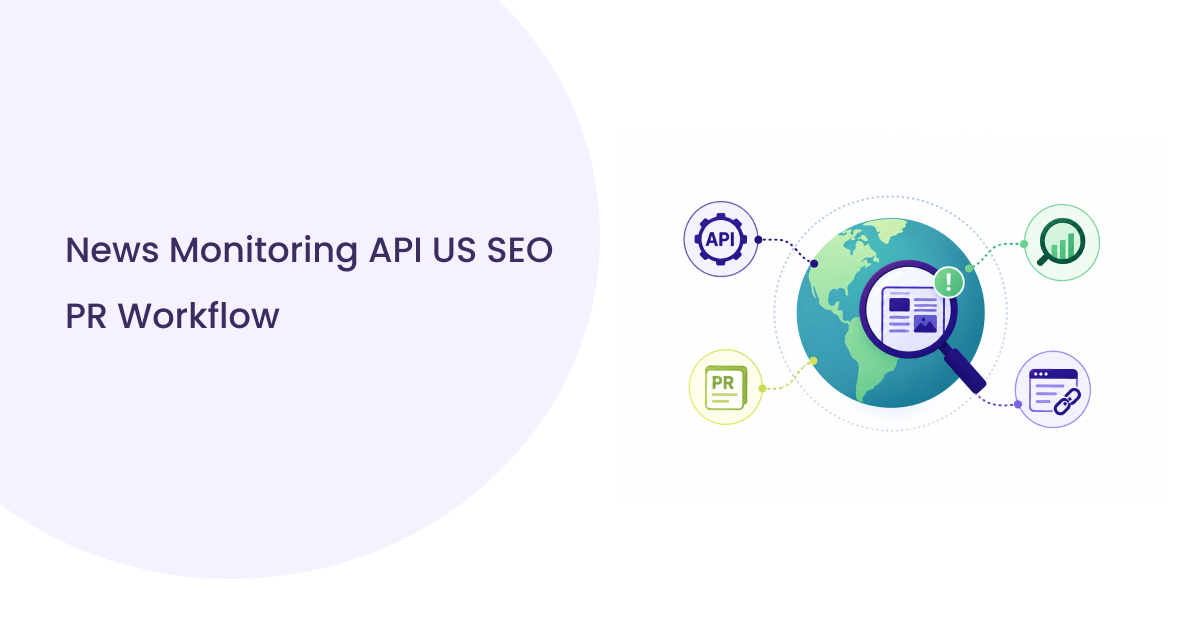
A News Monitoring API closes that gap by delivering structured, real-time news data directly into your workflows. For US marketing teams managing presence across national and regional markets, that means faster decisions, cleaner intelligence and fewer blind spots across the publications that actually matter to your audience.
This guide breaks down how it works, where it fits inside real US brand and SEO operations and what to look for before choosing a solution.
What a News Monitoring API Does for US-Based Brands and SEO Teams
Most brands assume they know when something gets published about them. They don’t. A story runs in a Denver outlet, a competitor gets featured in a Texas business journal, and your team finds out two days later from a client email.
A News Monitoring API fixes that at the infrastructure level. It pulls structured news data directly into your stack, your reports, your alerts. No manual searching. No missed stories.
For US brands managing presence across multiple markets, this is less about convenience and more about staying competitive.
How Real-Time News Data Is Collected and Delivered
The API continuously crawls thousands of US publishers, parses every article, tags it by keyword, source, location and publish time, then delivers it to your endpoint within minutes of publication. Your team stops chasing coverage and starts acting on it.
Push Alerts vs. Pull Queries – What Works for US Workflows
Pull queries handle scheduled work like weekly competitor audits or monthly brand reports. Push alerts handle real time response when a mention surfaces in the LA Times or a regional Midwest outlet at 7am, before your team is even online.
Most US agencies use both. The setup depends on how your team actually works, not how a vendor demo presents it.
Why US Brands Can’t Rely on Manual News Tracking Anymore
Manual tracking made sense when news moved slowly. Today a single regional story can pick up national backlinks, trigger a Google News feature and shift brand sentiment before your morning standup is done.
The US news ecosystem covers thousands of active publishers across national wires, state outlets, city papers, trade journals and hyperlocal blogs. No spreadsheet, no intern, no Google Alerts setup keeps up with that volume at the speed it moves.
The brands still running manual processes are not saving time. They are losing ground.
National Coverage Gaps That Cost Brands Their Reputation
Reputation damage rarely starts with a viral moment.
National brands are especially exposed because they assume size equals visibility. It does not. Coverage gaps exist in secondary markets precisely because nobody thinks to look there until it is too late.
How Competitor Press in States Like California and New York Shapes SERPs
California and New York drive a disproportionate share of US media coverage, especially in tech, finance, retail and professional services.
Here is what that means for your search rankings:
| What Competitors Are Earning | What It Builds Over Time |
| Coverage in SF Chronicle, TechCrunch | Topical authority in Google |
| Mentions in New York Post, Bloomberg | High authority backlink signals |
| Consistent state-level press | Brand entity recognition in SERPs |
| Regional syndication across CA and NY | Indexed content that ranks for your keywords |
You are both targeting the same terms. But if your competitor is consistently earning press in these high authority markets and you are not tracking it, they are building SEO equity you cannot see and cannot counter.
By the time it shows up in your rank tracker, the gap is already six months wide.
What Agencies in Chicago, Houston, and Atlanta Are Losing Without It
Mid-market agencies in these cities are working hard. That part is not the problem.
The problem is the tooling gap.
They are managing clients with serious regional brand exposure, sending monthly reports built on incomplete data and missing competitor coverage nobody knew existed because nobody had the infrastructure to find it.
The real cost shows up in three places:
Client renewals: Competing agencies walk into review meetings with cleaner, more complete intelligence. The contrast is immediate.
Campaign reporting: PR and content results look thinner than they actually are because mentions in regional outlets never made it into the report.
Competitive strategy: Without visibility into what press competitors are earning in Dallas, Miami or Nashville, recommendations are built on assumptions instead of actual market data.
The agencies closing that gap are not necessarily bigger or better resourced. They just stopped relying on manual processes that were never built for this scale.

Key Use Cases for US Companies and Marketing Teams
Knowing what a News Monitoring API does is one thing. Knowing exactly where it fits inside a real US marketing operation is where most buying decisions actually get made.
These are not theoretical applications. These are the workflows US brand teams, SEO leads, PR managers and agency strategists are actively running right now.
Brand Mention Monitoring Across National and Local US Outlets
Most brand monitoring setups are built around the obvious sources. The national wires, the major trade publications, the platforms everyone already watches.
The problem is that brand perception in the US does not form at the national level. It forms in layers.
A mention in the Boston Globe carries different weight than one in a Massachusetts regional business journal. Both matter. Both shape how local audiences, potential partners and search engines understand your brand. Most monitoring setups catch one and miss the other.
Here is what a properly configured brand mention workflow actually covers:
| Coverage Layer | Examples | Why It Matters |
| National Outlets | AP, Reuters, USA Today | Broad reach, high authority signals |
| State Level Press | Texas Tribune, SF Chronicle | Regional brand perception and local SEO |
| City Newspapers | Chicago Tribune, Miami Herald | Hyperlocal audience trust and citations |
| Industry Publications | AdWeek, TechCrunch, Forbes | Niche authority and competitor context |
| Syndicated Content | Yahoo News, MSN aggregators | Amplified reach from original sources |
When all five layers feed into one API pipeline, your team stops guessing where your brand stands and starts working from a complete picture.
SEO Intelligence – Tracking News Coverage That Drives Rankings
Most SEO teams track rankings, backlinks and on-page signals. Very few track news coverage as an SEO input. That is exactly where the opportunity sits.
What that looks like in practice:
Trending topic detection: A cluster of news stories around a topic in your industry signals rising search demand. Your content team has a window to publish before the SERP gets crowded.
Link opportunity identification: Journalists covering your space are active sources. Stories they publish today become outreach targets tomorrow.
SERP displacement tracking: When news results start appearing in positions your pages used to hold, you need to know immediately. Not at the next monthly review.
Entity and brand signal monitoring: Consistent news mentions strengthen your brand entity in Google’s knowledge systems. Tracking that coverage tells you whether your entity signals are growing or stalling.
This is not a vanity metric exercise. For SEO teams competing in high volume US markets, news intelligence is a direct input into content strategy, link building and SERP defense.
Competitor Monitoring Across US Industry Publications
Competitor analysis in most US marketing teams stops at their website, their ads and their social content. That covers maybe thirty percent of what is actually happening.
The other seventy percent lives in industry press.
Which publications are covering them and how often. Which journalists keep quoting their leadership. Which product launches earned coverage in verticals you had not considered. Which regional markets they are actively building presence in through earned media.
A structured competitor monitoring setup surfaces all of that automatically.
What a typical competitor press workflow tracks:
Share of voice: How often competitors appear in your industry publications versus how often you do. Over a rolling 90 day period this becomes one of the most honest performance benchmarks available.
Coverage geography: If a competitor is earning consistent press in the Southeast while your coverage stays concentrated in the Northeast, that is a market gap signal worth acting on.
Narrative tracking: The language journalists use to describe a competitor tells you how the market positions them. That intelligence feeds directly into messaging strategy.
Launch and announcement monitoring: New product coverage, partnership announcements and executive quotes all surface before they show up in a competitor’s backlink profile or rank movement.
The brands that treat competitor press monitoring as an ongoing workflow rather than a quarterly research task are the ones that stop being surprised by market shifts.
PR Tracking for Multi-Location Brands Across US States
For brands operating across multiple US states, PR measurement is genuinely complicated. A campaign that performs well in the Pacific Northwest might land completely differently in the South. Coverage volume in one state tells you almost nothing about what is happening two states over.
This is where most multi-location PR reporting breaks down.
What state-level PR tracking enables:
Market by market campaign measurement: Compare coverage volume and sentiment across states to understand where a campaign landed and where it fell flat.
Regional spokesperson performance: Which markets respond to which voices and messages. This is intelligence most PR teams currently have no clean way to gather.
Crisis containment by geography: When a negative story breaks in one market, monitoring tells you immediately whether it is staying regional or spreading to other state outlets.
Local outlet relationship mapping: Over time, coverage data reveals which publications consistently cover your brand in each state. That becomes the foundation for a smarter media relations list than any purchased database provides.
Multi-location brands that build state-level PR tracking into their monitoring stack stop reporting on averages and start reporting on reality.
What Data You Can Extract From a News Monitoring API
Before committing to any monitoring setup, you need to know exactly what comes out of the pipeline. Here is what a well-built API actually delivers.
Mention Volume, Sentiment, and Source Authority by Region
These three signals only make sense together.
| Data Point | What It Tells You |
| Mention Volume | How often your brand appears across tracked publications |
| Sentiment Score | Whether coverage is positive, negative or neutral |
| Source Authority | Editorial credibility and SEO link value of the outlet |
| Regional Breakdown | Which US states and cities are generating coverage |
A brand earning high volume mentions in low authority outlets tells a completely different story than moderate mentions in high authority state press. The raw number alone never shows you that difference.
State and City-Level Publication Filtering
National data is useful for headline metrics. State and city filtering is where real decisions get made.
A campaign running across the Southeast needs to know whether Florida is outperforming Georgia or sitting flat compared to Tennessee. Without geo-filtering at the publication level, that question has no clean answer.
This level of filtering is what separates a proper News Monitoring API from a basic news aggregator.
Keyword Co-occurrence for US Market Content Strategy
Every article mentioning your brand contains surrounding language. That surrounding language is a content intelligence signal most SEO teams ignore.
Co-occurrence data shows which terms and topics appear alongside your tracked keywords most frequently across US news coverage. When journalists consistently pair your topic with terms your content has never addressed, those become your next content priorities because they already carry editorial momentum in indexed sources.
Historical Archive Access for US News Sources
Archive access is not a nice to have. It is how you build pre-campaign benchmarks, understand how a competitor narrative developed and spot seasonal coverage patterns before they repeat.
Monitoring that only starts from signup date is missing the context that makes current data meaningful.

What to Evaluate Before Choosing a News Monitoring API for the US Market
The wrong API does not just waste budget. It creates a false sense of coverage while real stories slip through. Here is what actually matters before you commit.
Does It Cover US Regional and Local News Sources?
National wire coverage is table stakes. The real test is whether the API indexes state level outlets, city newspapers and regional trade publications across markets like Texas, Florida and the Midwest. Ask vendors for a source list before signing anything.
How Fast Do Mentions Surface From US Publications?
Latency kills the value of real time monitoring. If mentions from a Chicago outlet take four hours to surface, your team is still reacting late. Anything beyond 15 to 30 minutes for indexed US sources is worth questioning.
Filtering for Brand, Competitor, and Topic Mentions Across US Regions
Volume without filtering is just noise. A capable API lets you isolate brand mentions from topic mentions, separate competitor coverage by region and clean out irrelevant syndications that inflate your numbers without adding intelligence.
Final Thought
Most US brands do not have a news monitoring problem. They have a visibility problem that news monitoring solves.
The difference between teams that catch reputation shifts early, spot competitor momentum and turn news coverage into SEO intelligence is not budget or team size. It is having the right data infrastructure in place before something important happens.
A well chosen News Monitoring API does not add another tool to your stack. It fills the gap everything else was working around.
SERPHouse is worth evaluating if structured US news data, regional filtering and clean API delivery matter to your workflow. The best way to know if it fits is to test it against your actual use case, not a vendor demo.