
Table of Contents
Table of Contents
Crawling a website is one thing. Crawling a list of URLs is a completely different challenge.
In many real-world projects, there’s no need for discovery. You already have the exact pages you want product URLs, landing pages, job listings, article links, or SERP results. The task isn’t finding pages. The task is learning how to crawl a list of URLs efficiently, without slowdowns, wasted requests, or unexpected blocks.
This is where many teams hit friction.
What looks simple at first “just loop through the URLs”, quickly turns into performance issues, duplicate requests, inconsistent responses, and crawling jobs that take hours instead of minutes. As the URL list grows from hundreds to thousands (or more), inefficiencies compound fast.
Efficient URL list crawling isn’t just about speed. It’s about:
- Managing request concurrency
- Avoiding duplicate crawls
- Handling failures gracefully
- Respecting rate limits
- Keeping data structured and usable
Whether you’re running SEO monitoring, large-scale data extraction, competitive tracking, or automation workflows, the difference between a naïve crawler and an optimized one is massive.
This guide breaks down how to crawl a list of URLs in a way that’s stable, scalable, and production-ready.
Why Crawling a URL List Is Different From Crawling a Website
At first glance, crawling may seem like a uniform process. Requests are sent, pages are retrieved, and data is extracted. In practice, however, crawling an entire website and crawling a list of URLs involve very different strategies, priorities, and technical challenges.
Failing to recognize this distinction often leads to inefficient crawlers, unnecessary requests, and scaling problems that could have been avoided with a more targeted approach.
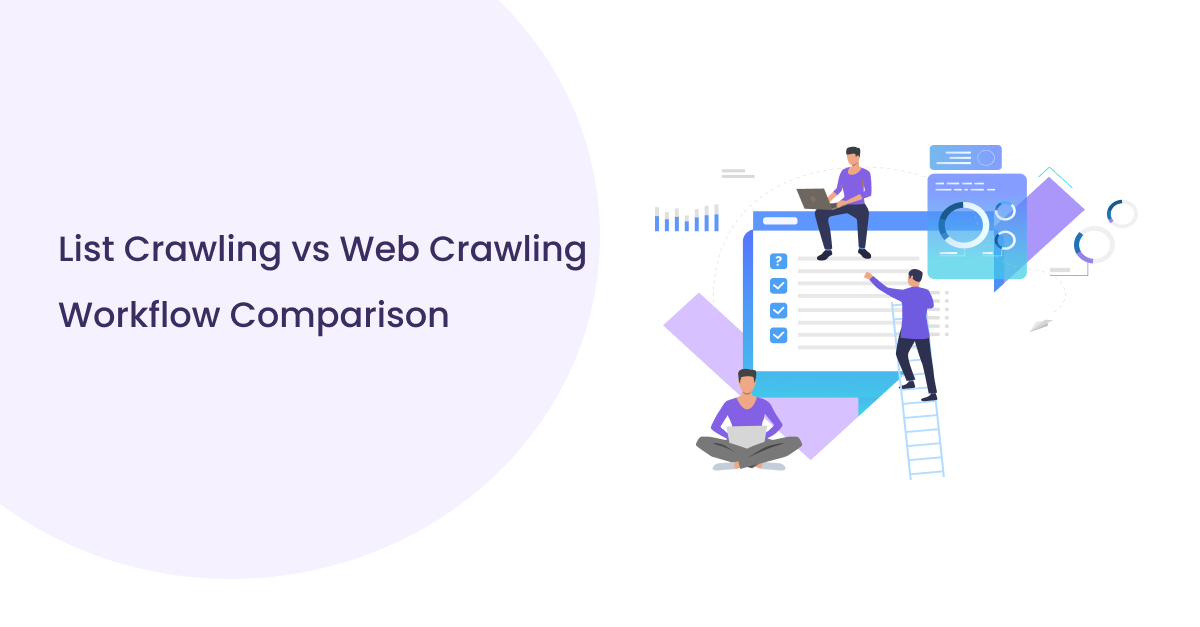
Website Crawling vs URL List Crawling
Traditional website crawling is centered around discovery. A crawler begins with a seed URL, follows internal links, maps relationships between pages, and gradually builds a representation of the site’s structure. The system continuously decides what to crawl next based on newly found links.
When you crawl a list of URLs, discovery is no longer the goal.
The target pages are already known. Instead of exploring a site, the crawler executes against a predefined set of URLs. This seemingly small change alters the entire crawling logic.
There is no need for link-following algorithms or crawl-depth decisions. Site mapping becomes irrelevant. The focus shifts toward execution efficiency, queue processing, concurrency control, and failure management.
In website crawling, efficiency often depends on smart navigation.
In URL list crawling, efficiency depends on smart execution.
The main questions are no longer “What page should be crawled next?” but rather:
- How quickly can the URL list be processed?
- How can duplicate requests be avoided?
- How should timeouts and failures be handled at scale?
When a URL List Becomes the Better Strategy
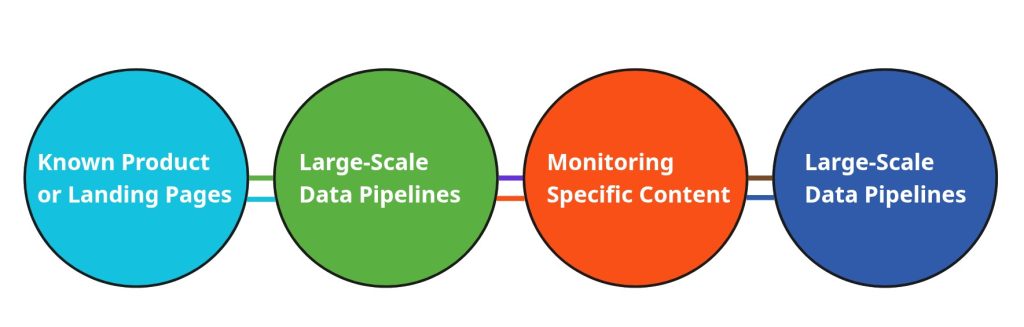
A URL list approach becomes the logical choice when the crawl targets are already defined. Attempting to rediscover pages that are known in advance introduces unnecessary overhead and wasted requests.
Several practical scenarios illustrate this clearly.
Known Product or Landing Pages
E-commerce teams, price monitoring systems, and analytics pipelines often maintain structured lists of product or landing page URLs. Crawling the full website adds little value when only specific pages matter.
SEO Audits and Monitoring
SEO professionals frequently work with lists of indexed URLs, sitemap exports, Search Console data, or competitor page sets. The objective is validation, change tracking, or data extraction rather than exploration.
Monitoring Specific Content
Projects involving news articles, blog posts, job listings, or regulatory pages typically rely on targeted checks. Crawling only the required URLs results in faster cycles and predictable workloads.
Large-Scale Data Pipelines
When datasets already contain thousands or millions of URLs collected through APIs, feeds, or internal systems, website discovery logic becomes unnecessary complexity.
Choosing to crawl a list of URLs reflects a more controlled and intentional crawling strategy. It prioritizes relevance, efficiency, and scalability over broad exploration.
Common Problems When Crawling Large URL Lists
Problems rarely appear when crawling 200 URLs.
They surface when the list grows to 5,000, 50,000, or more.
At that scale, small inefficiencies compound quickly. Crawl jobs slow down, failure rates climb, and resource usage becomes unpredictable. What looked like a stable crawler starts behaving inconsistently.
In most cases, the issue is not complex bugs or exotic edge cases. The real causes are structural mistakes that quietly erode crawl efficiency.
Duplicate URLs and Dirty Data
Duplicate URLs are one of the most common performance killers in URL list crawling.
Large datasets often contain repeated entries, inconsistent formatting, broken links, and parameter variations that point to the same content. Query strings such as tracking tags, session IDs, or referral parameters can multiply crawl volume without introducing new pages.
Without proper URL hygiene, crawlers end up:
- Requesting identical pages multiple times
- Inflating crawl duration
- Wasting bandwidth and computing resources
- Polluting extracted datasets
Dirty URL lists also create avoidable instability. Invalid or malformed URLs trigger unnecessary failures, while inconsistent structures complicate batching and queue management.
Clean inputs directly influence crawl speed, stability, and data reliability.
Slow Crawls Due to Sequential Requests
Sequential crawling is easy to build and deceptively inefficient at scale.
Processing URLs one at a time introduces an artificial bottleneck where each request waits for the previous response. Network capacity remains underused while crawl duration expands dramatically.
The slowdown is not just about time. Sequential execution also:
- Masks available throughput
- Creates misleading performance metrics
- Amplifies latency effects
- Delays downstream processing
Efficient crawlers rely on concurrent requests. Parallelizing fetch operations allows multiple pages to be processed simultaneously, significantly improving crawl efficiency without increasing architectural complexity.
Rate Limits and Temporary Blocks
Large-scale crawling naturally interacts with defensive mechanisms.
Websites may respond with explicit restrictions such as rate limiting, throttling, captchas, or temporary IP blocks. In other cases, the signals are subtle. Requests succeed, but latency spikes, responses degrade, or returned data becomes incomplete.
These disruptions create cascading effects:
- Failed requests accumulate
- Retry volumes increase
- Crawl queues become unstable
- Data consistency suffers
Stable crawling strategies require controlled request pacing, retry logic, and infrastructure capable of distributing load responsibly across large URL lists.
Wasted Requests on Irrelevant Pages
Not every URL contributes equal value to a crawling workload.
Unfiltered URL lists frequently include outdated pages, redirect chains, low-content endpoints, or pages that rarely change. Crawling them repeatedly consumes resources without improving dataset quality.
Crawl waste leads to:
- Longer crawl cycles
- Higher infrastructure costs
- Increased failure exposure
- Reduced data freshness for critical pages
Efficient crawling strategies prioritize relevance. High-value URLs receive attention, while redundant or low-impact targets are excluded or crawled less frequently.
Precision almost always outperforms volume.
Preparing Your URL List Before Crawling
Many crawling inefficiencies originate before the crawler even runs. Slow execution, unstable queues, and inflated request volumes are frequently symptoms of problems embedded in the URL list itself rather than failures in crawling logic.
Input quality directly shapes crawl efficiency. Duplicate entries, invalid targets, poorly structured datasets, and the absence of prioritization quietly erode performance as URL volumes grow. A crawler can only be as effective as the workload it receives.
Careful preparation of the URL list establishes predictability, improves throughput, and prevents avoidable resource waste.
Remove Duplicates and Invalid URLs
Duplicate URLs are a persistent source of hidden inefficiency, particularly when lists are aggregated from sitemaps, databases, exports, or third-party tools. Query parameters, tracking tags, and session tokens often create multiple URL variations that resolve to the same content. Without deduplication or canonicalization, crawlers repeatedly request identical pages while crawl duration expands unnecessarily.
Invalid URLs introduce a different type of disruption. Broken links, outdated endpoints, and malformed structures trigger avoidable failures that clutter logs and destabilize crawl workflows. These errors consume retries, distort performance metrics, and slow queue processing.
Validation and cleaning are not cosmetic improvements. They reduce redundant requests, stabilize crawl workloads, and preserve dataset accuracy.
Group URLs Into Logical Batches
Large URL lists rarely perform well when processed as a single uninterrupted stream. Logical batching introduces structure into the crawl, making workloads easier to manage, retry, and monitor. Smaller batches isolate failures, simplify recovery, and prevent localized disruptions from destabilizing the entire crawling job.
Batching strategies may be organized by domain, page type, priority tier, or update frequency. This segmentation improves control over request pacing, concurrency allocation, and retry behavior. It also allows teams to scale crawling operations incrementally rather than exposing infrastructure to sudden load spikes.
Batching functions as both an efficiency mechanism and a stability safeguard.
Prioritize High-Value URLs
Equal crawl frequency across all URLs is one of the fastest ways to waste resources while delaying updates on pages that genuinely require attention. Some pages change frequently and influence analytics, pricing, SEO visibility, or competitive monitoring. Others remain stable for extended periods.
Prioritization aligns crawling effort with business value. Frequently updated pages, revenue-critical endpoints, and time-sensitive content naturally deserve higher crawl priority, while static references can be revisited less often. This approach shortens crawl cycles, improves data freshness, and reduces unnecessary request volume.
Precision consistently outperforms indiscriminate coverage.
Techniques for Crawling URL Lists Efficiently
Once the URL list is clean, structured, and prioritized, crawl efficiency becomes a matter of execution strategy. At this stage, performance is shaped less by what you crawl and more by how requests are issued, managed, and recovered.
Inefficient crawling patterns often remain invisible at small scale but become costly when URL volumes increase. Optimizing request behavior, failure handling, and resource utilization is what separates a functional crawler from a scalable one.
Use Concurrent Requests Instead of Sequential Processing
Sequential crawling introduces an avoidable bottleneck. Processing URLs one by one forces each request to wait for the previous response, dramatically increasing crawl duration and underutilizing available network capacity.
Concurrent request execution allows multiple pages to be fetched simultaneously. This improves throughput, reduces idle time, and shortens crawl cycles without requiring complex architectural changes.
Well-balanced concurrency settings help maintain speed while avoiding excessive load on either the crawler or the target website. The objective is controlled parallelism, not aggressive flooding.
Implement Intelligent Retry and Timeout Logic
Failures are inevitable in large-scale URL list crawling. Network instability, temporary throttling, slow responses, and intermittent server errors all introduce disruptions that must be handled gracefully.
Blind retries can amplify problems rather than resolve them. Intelligent retry logic considers:
- Error type
- Response codes
- Retry limits
- Backoff intervals
Timeout controls are equally critical. Requests that hang indefinitely block queue progress and distort performance metrics. Proper timeout thresholds preserve crawl momentum and prevent resource lockups.
Respect Rate Limits and Request Pacing
Efficiency does not mean sending requests as fast as possible. Excessive request frequency increases the likelihood of throttling, captchas, or temporary IP restrictions.
Controlled pacing improves crawl stability. Adaptive delays, distributed request scheduling, and measured concurrency levels reduce friction with defensive systems while maintaining consistent throughput.
Stable crawling sessions almost always outperform erratic high-speed bursts.
Cache and Reuse Previously Crawled Results
Repeatedly fetching unchanged pages wastes crawl capacity. Caching mechanisms allow crawlers to skip redundant requests when content is stable or when refresh intervals have not yet elapsed.
Effective caching strategies:
- Reduce unnecessary traffic
- Shorten crawl cycles
- Lower infrastructure strain
- Improve overall efficiency
Caching becomes particularly valuable in monitoring workflows, SEO validation, and recurring extraction pipelines.
Monitor Crawl Health and Performance Metrics
Efficiency cannot be maintained without visibility.
Tracking request success rates, latency, error patterns, retry volumes, and queue throughput helps detect emerging inefficiencies before they escalate. Crawl monitoring transforms reactive troubleshooting into proactive optimization.
Key indicators often include:
- Rising failure rates
- Increasing response latency
- Retry spikes
- Queue stagnation
Sustained efficiency requires continuous observation and adjustment.
Manual Scripts vs API-Driven Crawling
Most crawling workflows start with scripts. They are quick to implement, flexible, and ideal for validating extraction logic or running small URL batches. For limited workloads, scripts often provide the fastest path from idea to execution.
As the crawling scope expands, however, the operational dynamics begin to shift. What performs smoothly across a few hundred URLs can become slower, less predictable, and increasingly demanding to maintain when scaled to thousands.
This transition is not unusual. It reflects the natural boundaries of script-based crawling rather than poor engineering decisions.
When Simple Scripts Work Fine
Manual scripts remain a practical choice in scenarios such as:
- Processing small URL lists
- Running occasional crawl jobs
- Testing selectors and parsing logic
- Prototyping crawling workflows
At this stage, simplicity works in your favour. Minimal infrastructure, direct request control, and fast iteration cycles often outweigh the benefits of heavier crawling systems.
Where Scripts Start Failing
Scaling introduces friction that scripts are not always designed to absorb gracefully.
Maintenance Overhead Increases: Website structure changes, header adjustments, and evolving defensive mechanisms require continuous updates to prevent extraction errors.
Blocking and Throttling Become More Frequent: Static request patterns and limited traffic distribution increase the likelihood of rate limits, captchas, and IP restrictions.
Scaling Adds Architectural Strain: Concurrency management, retries, proxy rotation, queue handling, and failure recovery become progressively harder to stabilize through incremental script modifications.
Over time, scripts shift from lightweight tools to systems that demand active supervision.
Why APIs Reduce Crawl Complexity
API-driven crawling restructures how crawling workloads are handled.
Instead of individually managing infrastructure components, teams interact with a controlled interface that centralizes:
✔ Request handling
✔ Retry logic
✔ Rate limit management
✔ Proxy rotation
✔ Structured outputs
This abstraction reduces maintenance demands while improving crawl stability and predictability, particularly in large-scale or recurring crawling workflows.
For production-oriented environments, APIs often replace fragile script ecosystems with a more controlled operational model.
Crawling URL Lists Using SERPHouse
When crawling large URL lists, teams often spend more time managing infrastructure than working with the data itself. Request handling, retries, proxy rotation, parsing logic, and failure recovery quickly turn into ongoing maintenance tasks.
An API-first approach changes that dynamic. Instead of engineering every layer of the crawling stack, SERPHouse allows teams to focus on defining targets and consuming structured results.
This shift does not remove the need for a thoughtful crawl strategy. It simply reduces operational friction and improves execution stability.
Submitting URL Targets Programmatically
SERPHouse enables programmatic submission of URL targets through a structured API interface. Rather than looping through URLs manually inside custom scripts, workloads can be defined as API requests and triggered directly from applications or backend systems.
This approach becomes particularly useful when URLs originate from multiple sources such as:
- Internal databases
- CSV or dataset exports
- Monitoring pipelines
- Automated workflows
By integrating crawling at the API level, teams can centralize execution, simplify request logic, and maintain better control over crawl operations.
Receiving Structured Data Instead of Raw HTML
Raw HTML introduces variability. Page structures differ, parsing logic becomes brittle, and edge cases multiply.
SERPHouse returns structured responses, typically JSON, which removes much of the manual extraction overhead. Consistent output formats simplify downstream processing, analytics integration, and storage workflows.
Structured data responses help teams:
- Reduce parsing complexity
- Improve data consistency
- Speed up integration
- Minimize transformation layers
The result is a cleaner pipeline from crawl request to usable dataset.
Automating Recurring URL Crawls
Large-scale crawling projects rarely run once. They involve repeated execution cycles for monitoring changes, validating updates, or refreshing datasets.
SERPHouse supports automation by allowing crawl requests to be triggered programmatically at defined intervals. This removes the need to maintain scheduled scripts, background workers, or ad hoc job runners.
API-driven automation improves:
- Crawl stability
- Execution predictability
- Failure recovery
- Workflow scalability
For recurring URL list crawling, automation is often a reliability requirement rather than a convenience.
Final Thought
Efficient URL list crawling is rarely about clever scripts or aggressive request speeds. In most real-world scenarios, performance gains come from disciplined fundamentals: clean inputs, structured batching, controlled concurrency, and stable execution logic.
As crawling workloads expand, inefficiencies that once seemed negligible begin to accumulate. Duplicate URLs inflate request volume, sequential processing slows throughput, and poorly managed retries destabilize crawl cycles. These issues are predictable and, more importantly, preventable.
A reliable crawling strategy prioritizes precision over volume. Crawling exactly what is needed, at the right frequency, with controlled request behaviour consistently produces better outcomes than broad, unfocused extraction.
Whether the workflow relies on manual scripts or an API-driven system, the underlying principle remains the same. Stability, efficiency, and data quality are built through thoughtful design decisions rather than tooling alone.