

Table of Contents
Table of Contents
“Free SERP API” is one of those phrases that suddenly blew up among developers, and honestly, it makes sense. Everyone wants to search for data without pulling out a credit card. Most devs expect a free API to give them enough room to run tests, build small tools, or experiment with SERP monitoring without worrying about limits or downtime.
But here’s the truth most people don’t say out loud: free SERP APIs are built for light work, not high-volume scraping. They’re great for learning how SERP requests behave, testing endpoints, or building early prototypes. They’re not built to handle thousands of calls, bulk keyword checks, or anything that requires aggressive monitoring.
No drama, no hype just the reality. Free tiers are helpful, but they’re still entry-level. Once you know that, it becomes much easier to pick the right solution and avoid unrealistic expectations.
What a Free SERP API Actually Is
A free SERP API gives you a simple way to pull search results from Google and similar engines without paying for access. Instead of doing everything by hand, you send one request and get back clean, structured data that’s ready to use in your project.
The API takes care of the messy parts in the background. You don’t have to deal with proxies, captchas, or running a real browser just to grab results. You get the data in JSON, plug it in, and move on with your work.
The difference between free and paid versions is mostly about scale and reliability. A free API gives you the basics a few queries, standard parameters, and enough room to test things out. A paid API, on the other hand, is designed for real workloads. You get higher rate limits, more stable uptime, full parameter control, and support that doesn’t disappear when traffic spikes.
Developers usually turn to free SERP APIs for three main reasons:
- to learn how SERP data works,
- to test early versions of tools,
- or to build small side projects where heavy data usage isn’t required.
Most providers offer a free tier for a practical reason: it’s the easiest way for devs to try the API without commitment. It’s essentially a sampling layer good enough for experimentation, not meant to replace full-scale scraping. For hobby projects and lightweight workflows, it gets the job done without any friction.
Core Features You Can Expect From Any Free SERP API
Free SERP APIs usually offer a solid starter pack of features. Nothing extreme, but enough to help you learn, test, and build small tools without friction.
Real-Time SERP Snapshots
Most free APIs return live search results, not outdated caches.
So if you’re checking how a keyword ranks at this moment, you get the actual SERP layout.
For devs running quick experiments or comparing keyword shifts during the day, this is more than enough.
Basic Parameters: Location, Device, and Engine
You don’t get full segmentation, but you do get the fundamentals:
- Choose a search engine
- Pick a location
- Switch between desktop and mobile
Example:
If you’re testing rank differences for “best running shoes” in Los Angeles (mobile), a free API can handle that without any drama.
Limited Parsing
Free tiers usually return:
- Titles
- URLs
- Snippets
- A few simple SERP elements
Don’t expect fully structured data for every feature on the page.
But for someone learning how SERP responses are formatted, this lighter parsing actually makes things easier.
Normal Reliability, Not Enterprise Stability
You’ll see:
- Mostly consistent results
- Occasional slowdowns
- Minor rate throttling during heavy usage
Nothing that breaks a hobby project, but not something you’d rely on for a client dashboard with real traffic.
Simple, Clean Response Formats
The JSON output is intentionally minimal:
- Easy to read
- Easy to debug
- No overwhelming nesting
If you’re just getting started with SERP data, this simplicity helps you understand the structure without getting lost.
The Real Limitations You’ll Face
Free SERP APIs look useful at first, but once you start integrating them into a regular workflow, the practical limitations become obvious. These limits aren’t a flaw; they’re simply the trade-offs that come with a zero-cost tier. Developers who understand these constraints use free APIs effectively. Those who expect production-level stability usually run into problems.
Rate Limits That Restrict Continuous Testing
Free SERP APIs always come with strict limits on how many requests you can send in a short time. For quick tests, that usually isn’t a problem. You can check a keyword or two and move on.
But as soon as you try to loop through multiple keywords or run automated checks, the slowdown hits hard. You send a request, then you wait. Then you wait again. What should feel smooth starts to feel broken. And real-time monitoring becomes almost impossible to rely on.
Daily or Monthly Call Caps That Break Momentum
Most free plans also limit how many requests you can make in a full day or month. Once you hit that number, everything stops. Your key simply stops working until the counter resets.
At first, this looks manageable. In reality, those limits disappear fast. Testing scripts, tweaking logic, running different versions, or sharing access with a team burns through the quota quickly. And when it runs out, development work comes to a sudden halt.
Slower Responses on Free Plans
On most free APIs, your requests go into a shared queue after the paid users. That means speed is never guaranteed. One moment a request might return in a second. The next time, it could take several seconds for no clear reason.
If you are just testing ideas, this is usually fine. But when you are checking rankings, running comparisons, or sending multiple requests in a row, those delays quickly become frustrating. Automation also becomes unreliable because you never know how long each job will take to finish.
Limited Filters and Control
Free plans usually give you only the basics. You can choose a general location, a simple device type, and one standard search engine. That is often where it stops.
Advanced options like precise city-level targeting, detailed SERP feature data, or complex filters are usually locked behind paid plans. Without these controls, it becomes hard to recreate real search conditions. And if you cannot mirror real searches closely, the quality and depth of your data suffer.
No Bulk Endpoints, Forcing Manual Loops
Bulk extraction is one of the most requested SERP API features, and it’s always paywalled. Free users must submit one keyword per request, which becomes slow and inefficient even for modest batches. This also increases your chances of hitting rate limits and quotas, making free tiers unsuitable for side projects that require even mid-sized datasets.
How to Judge a Free SERP API the Right Way
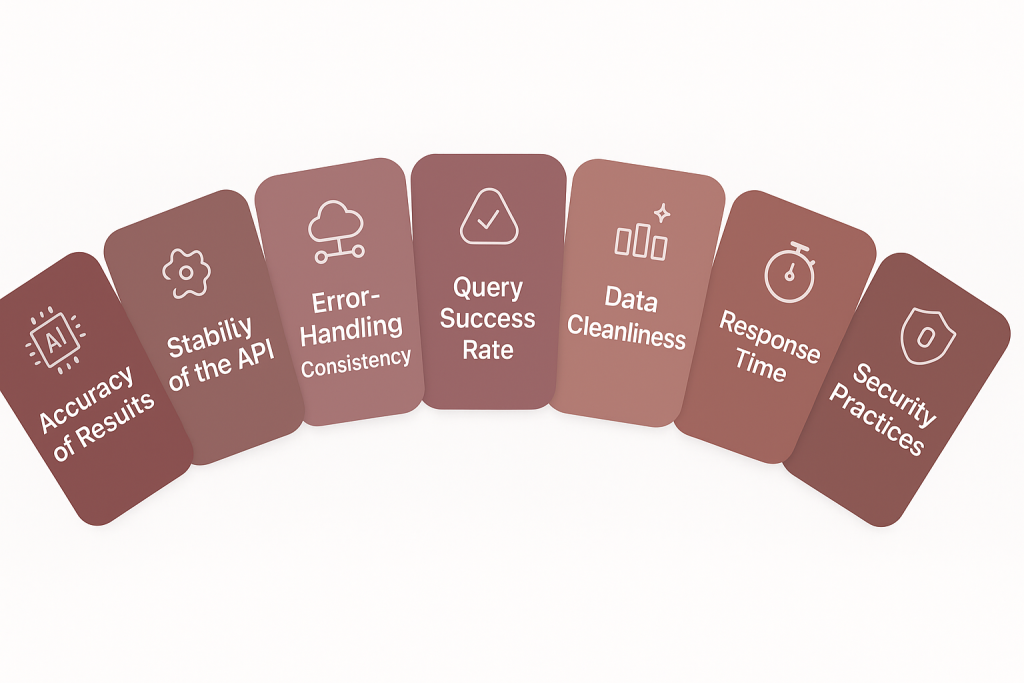
Choosing a free SERP API isn’t about the number of requests you get. It’s about whether the API can deliver data you can rely on. Developers often focus on the surface-level perks like the free quota while ignoring the deeper factors that actually determine whether an API will fit into their workflow. Evaluating these fundamentals upfront saves time, prevents frustration, and keeps your project stable from the start.
Accuracy of Results
The first thing to look at is how closely the API’s output matches the real SERP. Some free APIs rely on cached or outdated data to cut costs, which means you’re not seeing the true search environment. Inconsistent rankings or missing elements can break your logic, especially if you’re testing UI components or validating SERP features. Before you commit, compare a few API responses with live browser results to see how accurate the data really is.
Stability of the API
A free API may work perfectly one day and drop requests the next. Stability matters because SERP scraping depends on multiple moving parts proxy rotation, parsing layers, and engine behavior. If the system behind the API isn’t steady, you’ll feel it immediately. Random downtime or fluctuating success rates will affect testing, prototyping, and any automation you attach to the endpoint.
Error-Handling Consistency
Errors are part of scraping. You can’t avoid them. What really matters is how an API shows those errors back to you. A reliable API makes things clear. You get proper status codes. You see what went wrong. And you know what to do next.
With many free services, that clarity just isn’t there. Sometimes the error message makes no sense. Sometimes it changes without warning. When that happens, fixing problems takes far longer than it should. Your script also struggles to react properly. It can’t easily tell when to try again, when to slow down, or when to stop safely.
Query Success Rate
Every SERP API has a success rate, the percentage of requests that successfully return usable results. On free tiers, this number tends to dip because of shared resources and lighter infrastructure. A low success rate forces you to write heavier retry logic and burns through your free quota faster. Higher success rates reduce wasted calls and give you more predictable test cycles.
Data Cleanliness
A well-structured API response is easier to integrate, analyze, and debug. Clean data means:
- properly mapped fields,
- consistent formatting,
- clear nesting,
- no random empty objects,
- and no broken arrays.
Free tiers sometimes cut corners here, returning partially parsed or loosely formatted JSON. For learning and basic testing, that might be fine. But if you’re building anything that depends on precise SERP features, messy data becomes a serious bottleneck.
Response Time
Speed isn’t just about convenience. Slow responses can cause unnecessary timeouts, delays in chained requests, or failed concurrent tests. Free APIs often sit behind long queues, which leads to unpredictable response times. Monitoring how long it takes for your request to complete will tell you whether the API can keep up with your expected workload, even at the prototype stage.
Security Practices
Even in a free tier, the API should maintain baseline security standards. Look for HTTPS endpoints, proper authentication, and documentation that explains how data is handled. APIs that overlook the basics tend to cut corners elsewhere too, which can expose you to unnecessary risk. Security isn’t a bonus; it’s a requirement, no matter how small your project is.
When a Free SERP API Is Enough
A free SERP API doesn’t fit every use case, but when it’s used in the right context, it does its job well. The key is aligning expectations with what the free tier is actually built to support. In the following scenarios, a free SERP API is not just acceptable, it’s the right choice.
Students Learning How Search Queries Work
A student learning SEO, data extraction, or search behavior doesn’t need massive datasets. They usually want to:
- understand how a query is structured,
- see how rankings shift,
- and learn how SERP responses are formatted.
In this case, a free SERP API is more than sufficient. It lets them test keywords, compare locations, and study result layouts without worrying about budget. The focus stays on learning, not infrastructure.
Small Hobby Projects Built for Personal Use
Let’s say a developer is building a personal tool to track how their blog ranks for five keywords, just out of curiosity. The script runs once a day, pulls a few results, and logs them to a file.
This kind of project doesn’t need:
- bulk endpoints,
- high-frequency scraping,
- or enterprise uptime.
A free SERP API fits perfectly here. It keeps costs at zero and delivers exactly the amount of data needed.
Lightweight Dashboards With Limited Scope
Some dashboards aren’t built for clients or large teams. They’re internal tools used by one or two people to:
- observe basic ranking trends,
- compare a few competitors,
- or track keyword movement for a small niche.
As long as the keyword set is small and updates aren’t happening every minute, a free SERP API can support this kind of setup without breaking the workflow.
Early-Stage Prototypes and MVPs
During early development, speed matters more than scale. Developers want to validate:
- whether the idea works,
- whether SERP data fits their logic,
- and whether users actually need the product.
At this stage, paying for large datasets usually makes no sense. A free SERP API gives enough real-world data to test the concept, refine the logic, and decide if the product is worth building further.
Occasional Rank Checks, Not Continuous Monitoring
Some users don’t need daily or hourly tracking. They just want to:
- check rankings before publishing content,
- validate search visibility during a campaign,
- or run spot checks after site changes.
For these occasional use cases, a free SERP API avoids unnecessary cost while still delivering reliable snapshots when needed.
How SERPHouse Fits Into This Ecosystem
If someone needs a free SERP API purely for testing or early experimentation, SERPHouse offers a workable free tier that supports basic SERP requests without upfront cost. It’s typically used for learning, debugging queries, and validating early logic before moving into higher-volume workloads. Developers who want deeper implementation details can refer to the documentation, and those planning to scale can review the pricing separately to understand when an upgrade is necessary.
Final Thoughts
A free SERP API is a good starting point when you just want to learn, experiment, or build something small without spending money. It lets developers work with real search results, see how SERPs behave, and understand how APIs fit into real projects.
At the early stage, that’s usually enough. You don’t need heavy infrastructure or paid tools yet. You just need something that works so you can test ideas and move forward.
At the same time, free tools come with clear boundaries. They’re designed for exploration, not for scale. Choosing the right solution always comes back to one thing: what you actually need the data for. When expectations match the tool, free APIs feel useful instead of limiting and that’s where they deliver the most value.