
Table of Contents
Table of Contents
TL;DR: Search engine data helps B2B teams discover potential customers, assess brand visibility, identify reputation signals, and prioritize qualified prospects through structured research and automation.
Your salespeople waste hours chasing leads that weren’t even qualified to begin with. They schedule a call, look at the company’s Google page just five minutes beforehand, and see a company filled with bad reviews and closing its doors. It was all there on the front page.
Search engines maintain a database for nearly every single company out there. Your sales intelligence tool or B2B team can see those records at scale and determine whether each company is worth pursuing or not.
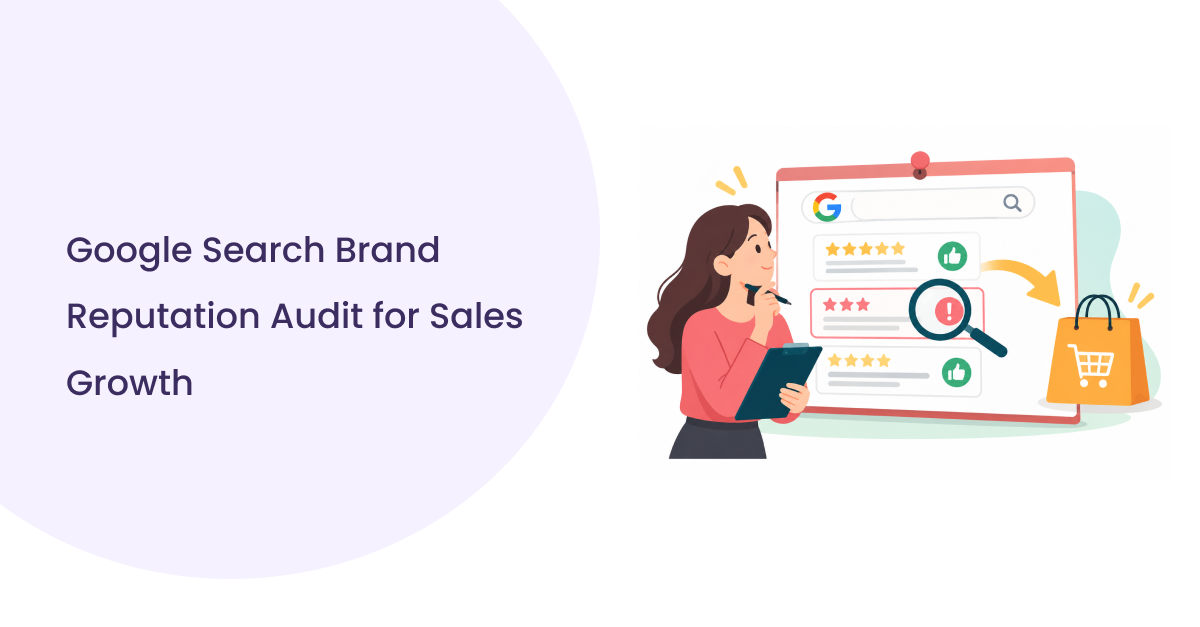
This guide shows how to discover accounts through search data, run a Google search brand reputation audit on each one, and turn the findings into a list your reps trust. It applies the question every founder asks, what shows up when you Google your company, to every prospect before the first email. Treat the Google search brand reputation audit as your quality gate, and your pipeline gets cleaner fast.
Uncover Hidden B2B Sales Opportunities in Search Results
Begin with terms that your leads use to talk about themselves. If your business is selling fleet management software to logistics companies, you can search “cold chain logistics provider,” “freight forwarding services Mumbai,” and “third party warehousing.” Include the product names and business-related phrases like “request a quote.” Perform a search for each query in the market in which you sell your products.
Each query will bring out companies that have stated they belong to your market. Make sure you save all the domains together with the queries that helped you find them. This will help explain why the account ended up on your list.
Operators cut the noise. site:clutch.co logistics pulls companies from one directory. intitle:”cold storage” finds pages built around that exact service. Quotation marks force exact phrases such as “ISO 22000 certified”. filetype:pdf “annual report” logistics surfaces brochures and reports, which often name clients, locations and expansion plans.
Combine them for precision. site:linkedin.com/company “cold chain” Pune returns company pages in one city. Ten focused minutes with operators usually beat an hour of scrolling. Every page you find here becomes evidence for the Google search brand reputation audit that follows.
Patterns extend the list. When a company comes up in five searches, it is definitely involved. When a trade publication continues to mention the same companies, check its archives. Directories, awards, and press coverage provide accounts that your initial search does not pick up.
Tag each new find with its source. During the Google search brand reputation audit later, that source helps you judge how established the company really is. Teams that plan the Google search brand reputation audit while they build the list save a second round of research.
Evaluate What Appears When You Google a Company’s Name
Use consistent branded search queries to understand how potential customers appear online and identify the reputation signals influencing buyer perception.
Build a Branded Query Set
When you find accounts with promise, search them the same way a potential customer does. Use these branded queries for all companies so that your results remain consistent:
- Exact company name
- Brand + reviews
- Brand + complaints
- Company name + pricing
- Company name + products or services
- Company name + city
These keywords will form the basic foundation of any brand SERP audit that you perform. Use them in a private window, setting your location to the market of the prospect to avoid your own history affecting things. You’ll need six searches that take two minutes.
Examine the First Page Search Result Mix
Read page one carefully. Observe the official website, review sites, press mentions, social media presence, directories, and their rankings. The order of ranking is important. A rating website in second place makes more impact than a favorable case study in second place on page two.
The page one mix tells a story. A prospect that displays its own website and profile on page one seems reliable. A prospect with a complaint website ranked second is likely to be struggling with problems, and you must adjust your offer. A Google search brand reputation audit captures that story in a few lines.
| Result type | Typical examples | What it tells you |
| Owned | Website, social profiles, careers page | How the company wants to look |
| Earned | Press features, analyst mentions, awards | How the market sees it |
| Third party | Rating platforms, directories, forums | What customers say unprompted |
The process of sorting out owned, earned, and third-party pages brings to light the disconnect. And this disconnect is precisely what a Google search brand reputation audit looks for. The wider the disconnect, the more assistance the company requires and the type. Begin every Google search brand reputation audit from page one, as page two is rarely going to alter your opinion.
Run a Google Search Brand Reputation Audit on Potential Accounts
Evaluate each prospect’s search visibility, reputation signals, and public information to uncover inconsistencies, business changes, and potential sales opportunities.
Assess Brand Visibility and Search Result Consistency
- See if the company site is ranked first for the precise name. If not, then compare descriptions, phone numbers, and addresses across listings.
- A company that uses a term like “logistics platform” on its site and “trucking broker” on directories might be halfway through a pivot.
- Look up the name with and without the legal suffixes because some Ltd and Inc versions will return totally different listings. Inconsistency often signals change, and change often signals budget.
Examine Reviews, Complaints and News Coverage
- Look back at the past year of reviews and comments grouped by subject matter. Then check news results for funding, layoffs, leadership changes, or acquisitions.
- You have your hook when new funding has come along with complaints about slow service. You should read the company responses, too.
- Quick and specific responses show that a company cares, and that’s easier to sell to. A quick online reputation audit on each prospect pays for itself here.
Identify Stale Pages and Missing Brand Information
- Look for outdated pages such as retired product lines, expired offers, or leadership from years ago. Note broken links and mismatched details.
- Check whether a knowledge panel appears and whether its facts match the website. Flag every gap in your Google search brand reputation audit notes.
- Neglected search presence often points to a stretched marketing team. If you sell marketing, data, or operations support, that is your opening.
Record Tone and Changes in Search Results
- Label the overall sentiment of page one as positive, mixed, or negative. Then start a change log that records new pages, vanished results, updated ratings, and shifts in ranking.
- Repeat the Google search brand reputation audit monthly for priority accounts. When you monitor branded search results this way, a static profile becomes a live signal.
- A new complaint thread or a sudden press spike tells your rep when to call. Every Google search brand reputation audit you store also builds a history your team can learn from.
- Over a year, a consistent audit process shows which signals actually predicted closed deals.
Convert Search Intelligence Into a More Qualified Prospect List
Grade each prospect based on a scale of 20 points. Award five points to each of the following criteria: industry match, offer match, geographic location, and online presence/reputation.
Your Google brand reputation audit is part of the latter criteria. Maintain a consistent weighting through the whole quarter for comparison purposes. A prospect with 16 or above becomes a sales prospect for this week; anything below 10 waits.
Visibility establishes the existence of an organization. It doesn’t indicate budget or timeline. A company can be ranked anywhere but be completely outside your scope.
Incorporate search signals with firmographics: number of employees, revenue bracket, and growth rate. Include business signals like hiring patterns or office expansion.
Your Google search brand reputation audit confirms the account is real, and the commercial checks confirm it is ready. Accounts that pass the online reputation audit but miss commercial criteria move to a research only tier. Revisit that tier every quarter, because circumstances change quickly.
Top prospects should have three things in common: defined operations within your segment, consistent presence within the market, and a public signal aligning with your product.
Imagine a company that produces review management software. They discover a retailer with 200 locations, an increasing number of complaints on page one, and an appointment of a head of CX. This is your top prospect.
The best prospects are companies whose search results describe the exact problem you solve. A Google search brand reputation audit finds them, and a disciplined score keeps reps focused on them. For leaders, the payoff is simple. Reps spend time on fewer and better accounts, and every audit strengthens forecast confidence.
Automate B2B Prospect Research With Structured Search Data
Collect Company and Brand Search Results at Scale: Manual audit applies to twenty accounts. Five hundred require an automatic approach. The search API gathers organic results, news, and other types of results that you choose, organized in a data format.
Use the same types and depth of results in each execution so that comparison each month remains equal. That makes branded search monitoring practical across an entire territory.
Organize Results Into a Prospect Intelligence Dataset: Record each result with the company name, website domain, search query, result URL, title of the web page, type of result, position, and date of collection. All this data allows you to filter your results in a few seconds.
For example, you will be able to gather all prospects in which a complaint page ranks among the top five. Also use a tone tag for each result and the account owner field. This way, a Google search brand reputation audit becomes standardized.
Build Repeatable Brand Monitoring and Prospect Reports: Schedule monthly runs for priority accounts and quarterly runs for the rest. Compare each run with the previous one so changes surface automatically.
Your team can then monitor branded search results for hundreds of companies without opening a browser. Set alerts for big moves, such as a complaint page entering the top three. Leaders get a monthly audit summary for their top fifty accounts without extra headcount.
SERPHouse provides structured Google search data through its SERP API. Teams use it to run each brand SERP audit on fixed settings, keep company-level records, and feed findings straight into the CRM.
Your Google search brand reputation audit then scales with the pipeline. Analysts spend their time on judgment, and every audit report arrives in the same format.
Automate B2B Prospect Research With SERPHouse
SERPHouse helps sales teams automate company discovery and brand research using structured search data. Start with 4,000 free API credits to test branded queries, assess company visibility, and build an initial prospect dataset across Google, Bing, and Yahoo.
For larger research projects, process up to 100 keywords per scheduled batch or use live requests for individual lookups. SDKs and MCP support integration with CRM systems, AI agents, and internal research workflows. Failed requests, retries, and blocked responses do not consume credits. When you need more capacity, paid plans start at $29.99/month.
Conclusion
Search data shows you which companies exist in your market and what the world says about each one. Ask what shows up when you Google your company for every account, and you will see risks and openings before your competitors do.
A Google search brand reputation audit combines visibility, reputation and fit into one clear view. Add branded search monitoring, and that view stays current. Run an audit on your top accounts this month, then expand the process as results prove themselves. Your reps will feel the difference, because every Google search brand reputation audit gives them a sharper first conversation. Find your first 100 prospect companies. Start free.