
Table of Contents
Table of Contents
Texas has always had a “build first, talk later” culture. Developers here don’t waste time or budget on tools until the idea actually proves it deserves investment. Free SERP APIs fit that mindset perfectly. They give devs a quick way to check search behavior, validate early concepts, and test how their tools react to real data without asking the finance team for approval.
Most Texas teams work in fast cycles: prototype today, refine tomorrow, ship end of week. A free API helps them stay in that rhythm. They get instant access to search results, geo-specific testing for Austin, Dallas, and Houston, and enough data to see whether a feature is worth scaling.
In short, Texas developers aren’t chasing “free.” They’re chasing speed, clarity, and low-risk experimentation. A free SERP API simply keeps that door open while bigger decisions wait their turn.
The Typical Texas Workflow: How Small Teams Test Faster
Texas development teams keep their process tight because time matters more than polish in the early stages. Their workflow isn’t complicated; it’s intentional. Each step is designed to confirm whether an idea holds up before anyone commits serious hours or budget.
1. Set Up a Lightweight Sandbox
Teams in Austin, Dallas, and Houston rarely start with a full stack. They spin up a small environment, usually a simple local script, a serverless function, or a temporary container. The goal is to get something running within minutes, not hours.
2. Pull a Small Batch of SERP Results
Instead of flooding the API with large queries, they request a few targeted keywords. This keeps things controlled and makes it easier to study how the API structures data, handles local parameters, and responds under normal conditions.
3. Validate Accuracy Across Texas Locations
Accuracy checks are taken seriously. Developers compare API responses with clean browser checks for:
- Austin
- Dallas
- Houston
This quick cross-verification tells them whether the API is reliable enough for prototypes.
4. Push a Working Prototype Quickly
If the results look stable, they move directly into a functional prototype. It’s not polished. It’s not final. But it helps them decide whether the idea deserves more attention.

Local Search Testing: A Big Deal in Texas
Local search plays a major role in how developers build and test tools across Texas. Because the state is large and each region behaves differently, Texas developers use free SERP API for testing how rankings shift locally before committing to any product direction.
1. Each City Has Its Own Search Identity
Austin leans toward tech-heavy queries. Dallas shows stronger commercial demand. Houston trends toward service and local business searches. Developers test these patterns early to avoid building features that behave identically in markets that aren’t actually identical.
2. Geo-Specific Accuracy Decides Whether a Prototype Survives
Texas teams check whether an API can consistently return correct results at a city level. They compare the API output with clean manual checks, evaluating:
- Stability across repeated tests
- Correct targeting for Austin, Dallas, and Houston
- Alignment with real SERP structures
If accuracy slips, they halt the idea immediately.
3. Client Projects in Texas Depend on Local Precision
A large share of work in the state supports local businesses. Rank tracking, reporting tools, and location-aware features all rely on precise SERP data. Local accuracy is the foundation, not an optional add-on.
4. Free SERP APIs Make Early Local Testing Low-Risk
Teams can run early experiments without budget approvals or platform commitments. Free tiers provide enough data to validate whether the idea works for Texas markets before moving to something more scalable.
Popular Use Cases for Small Projects
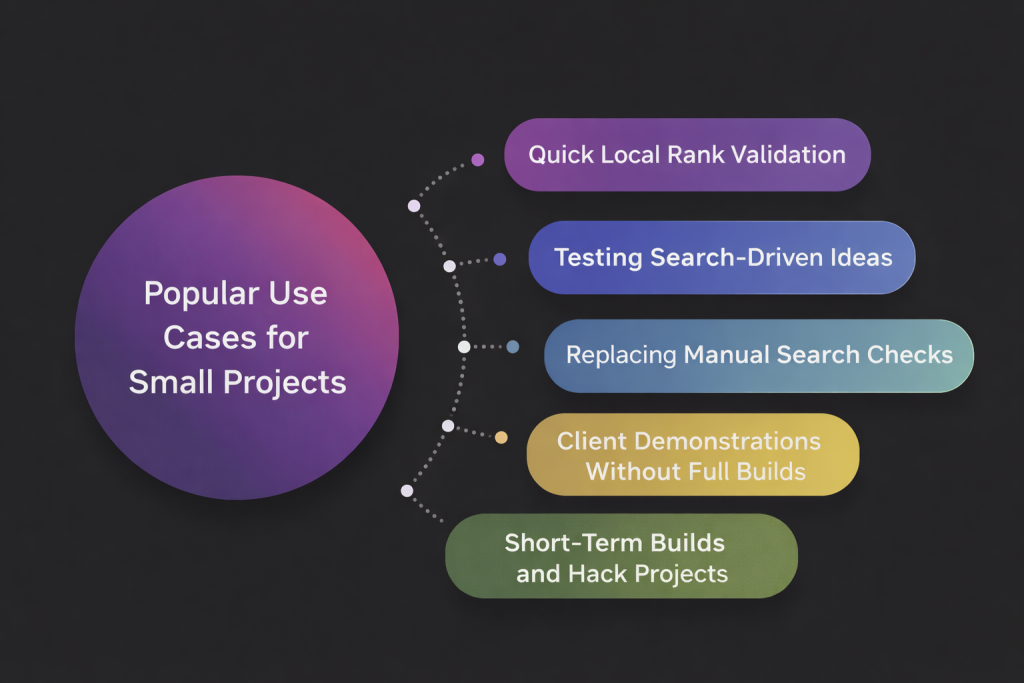
Small projects are where most real experimentation happens in Texas. These aren’t long-term systems or client-ready platforms—they’re short cycles built to answer one question quickly. That mindset explains why Texas developers use free SERP API for testing and validating ideas before committing time, budget, or infrastructure.
Quick Local Rank Validation
Developers often need to know how a keyword behaves in a specific city before building anything around it. Instead of creating full tracking systems, they run small, controlled queries to confirm whether local visibility even exists.
Testing Search-Driven Ideas
A lot of early product ideas depend on how search results are structured. Developers use SERP APIs to study snippets, result types, and layout changes to see whether their feature concept is realistic or not.
Replacing Manual Search Checks
Manually searching the same queries every day does not scale, even for small projects. Simple scripts connected to a SERP API let teams automate these checks and keep their testing consistent without adding complexity.
Client Demonstrations Without Full Builds
Freelancers and small agencies in Texas often need to show direction, not deliver perfection. Pulling real search data allows them to create convincing proof-of-concept demos without building the final system upfront.
Short-Term Builds and Hack Projects
Weekend builds, internal experiments, and hackathon projects rely on speed. Free SERP APIs provide enough data to create something functional within tight timeframes, which fits the fast-build culture common across Texas tech teams.
What “Free” Actually Covers
Free doesn’t mean unlimited—and Texas developers understand that better than most. In early-stage work, free SERP APIs are meant to answer basic questions, not run production systems. That’s exactly why Texas developers use free SERP API for testing and validating ideas first before committing to paid infrastructure.
At the free level, developers usually get enough access to validate behavior. They can run small batches of queries, test location targeting for major Texas cities, and confirm that the response format fits their workflow. For prototypes, internal tools, and proof-of-concept builds, this coverage is often more than enough.
The line gets crossed when reliability becomes critical. Once a project needs frequent checks, higher request volumes, or consistent performance across time, free tiers start to feel restrictive. At that point, the cost is no longer financial; it is measured in lost time and unstable results.
Paid access begins to make sense when a tool moves beyond experimentation. Production dashboards, client-facing reports, and automated monitoring systems require predictable limits, stable responses, and support that free tiers are not designed to provide.

Final Thoughts
Texas developers are known for making practical, data-driven decisions rather than relying on assumptions. They prefer to test ideas, observe real search behavior, and scale only when the data proves it works. That approach explains why Texas developers use free SERP API for testing early concepts before investing in paid tools or long-term solutions.
Free access allows developers to understand local search patterns, validate small projects, and move quickly without unnecessary overhead. When a project proves its value, the shift to paid solutions feels earned rather than rushed.
Ultimately, the tools matter less than the approach. Start small, test with intention, and let real results guide the next step. That discipline is what keeps Texas development teams building smarter, not just bigger.