
Table of Contents
Table of Contents
If you have been working in SEO for even a short time, you already know one thing: rankings are never still. You check today, you are in position five. Tomorrow, you are at seven. A week later, you are back at four. This constant movement is exactly why SERP Position Tracking matters more than most people realize.
Many businesses assume rankings drop only when something goes wrong. That is not always true. Google ranking check results change because algorithms evolve, competitors improve, search intent shifts, and even layout updates affect visibility. Without proper SERP Position Tracking, you are guessing instead of measuring.
The truth is simple. SEO is not a one-time task. It is ongoing monitoring. If you are not actively tracking positions, you are flying blind. Understanding how and why rankings move is the first step toward building a stable and sustainable search strategy.
What Is SERP Position Tracking?
SERP Position Tracking Defined
SERP Position Tracking is the process of continuously monitoring where your website ranks in search results for specific keywords. It is not a one-time activity. It is an ongoing measurement.
When someone types a query into Google, the search engine generates Google SERP results based on hundreds of factors. Your website may appear in position three today and position six tomorrow. Without proper SERP Position Tracking, you would never know that change happened.
For example, imagine you are targeting the keyword “Best SERP API Tool.” On Monday, your page ranks at position four. By Thursday, it drops to position eight because two competitors updated their content. A reliable serp checker or keyword position checker captures that shift immediately. That is keyword rank tracking in action.
SERP Position Tracking helps you see patterns over time. You can identify steady growth, sudden drops, or ranking volatility across multiple keywords. Instead of reacting emotionally to one fluctuation, you rely on data. This is the foundation of serious SEO monitoring.
In simple terms, SERP Position Tracking turns rankings into measurable performance metrics.
What Is SERP Position Tracking?
SERP Position Tracking Defined
SERP Position Tracking is the process of continuously monitoring where your website ranks in search results for specific keywords. It is not a one-time activity. It is an ongoing measurement.
When someone types a query into Google, the search engine generates Google SERP results based on hundreds of factors. Your website may appear in position three today and position six tomorrow. Without proper SERP Position Tracking, you would never know that change happened.
For example, imagine you are targeting the keyword “Best SERP API Tool.” On Monday, your page ranks at position four. By Thursday, it drops to position eight because two competitors updated their content. A reliable serp checker or keyword position checker captures that shift immediately. That is keyword rank tracking in action.
SERP Position Tracking helps you see patterns over time. You can identify steady growth, sudden drops, or ranking volatility across multiple keywords. Instead of reacting emotionally to one fluctuation, you rely on data. This is the foundation of serious SEO monitoring.
In simple terms, SERP Position Tracking turns rankings into measurable performance metrics.
How It Differs from a Basic Google Ranking Check

A basic Google ranking check is manual and limited. You open your browser, search for a keyword, and scroll to find your site. That method sounds simple, but it is rarely accurate.
First, results are personalized. Your location, search history, and device all influence what you see. Second, manual checks do not track historical data. You cannot compare last week’s position with today’s unless you record everything yourself. Third, you cannot scale it across hundreds or thousands of keywords.
SERP Position Tracking works differently. A rank tracking tool automates the process and collects consistent data. Keyword rankings are monitored across devices and locations. It tracks movement daily. It also supports long-term serp monitoring, so you understand trends instead of snapshots.
Think about it this way. A manual Google ranking check tells you where you stand right now. SERP Position Tracking tells you where you have been, where you are heading, and how stable your visibility truly is.
Why Rankings Change More Than You Expect
If you have managed SEO for any meaningful period, you already know rankings rarely sit still. Pages climb, stall, dip, and recover. Sometimes you update content and see no movement. Other times, you change nothing and positions shift anyway.
This is exactly why SERP Position Tracking is not optional. It is the only reliable way to understand whether ranking movement is routine volatility or a signal that something meaningful has changed in the search landscape.
Ranking fluctuations usually come from four core forces.
Google Algorithm Updates
Google refines its ranking systems continuously. Some updates are officially announced. Most are not. Even minor adjustments can reorder Google SERP results across dozens of keywords overnight.
In practice, this might look like:
- Pages with deeper topical coverage gaining visibility
- Older content slowly declining against fresher competitors
- Pages with stronger engagement signals moving upward
If you monitor one keyword in isolation, changes feel random. When you use consistent SERP Position Tracking across a keyword set, patterns become visible.
For example, if eight tracked keywords drop within a 48-hour window, the probability of a technical issue is low. The likelihood of an algorithmic recalibration is much higher. This is where structured SEO monitoring separates professionals from guesswork.
Competitor Movements
Rankings are competitive positions, not fixed placements. When another site strengthens its content or authority, the order shifts.
Competitor gains often come from practical improvements such as:
- Expanding content depth around related queries
- Improving internal architecture
- Securing high-authority backlinks
- Refining on-page structure for clarity
A reliable keyword position checker helps you detect when displacement happens. If your page moves from position three to five, the next step is not panic. It is analysis.
Review the updated Google SERP results. Identify which pages moved above you. Compare content scope, freshness, and authority signals. SERP Position Tracking provides the timeline. Competitive analysis provides the explanation.
Without tracking history, you only see the outcome, not the cause.
Search Intent Shifts
Search behavior evolves. What users expect from a query changes over time, and Google adjusts rankings accordingly.
A keyword that once favored educational guides may begin surfacing comparison pages or commercial listings. When that shift happens, informational content can decline even if quality remains high.
This is where keyword rank tracking provides context. If your position drops while the type of ranking pages changes, the issue is alignment, not authority.
For example, if a results page transitions from long-form guides to tool-based landing pages, the strategy should change. Format, structure, and intent alignment must match what users now prefer.
Ignoring intent evolution is one of the most common causes of gradual ranking loss.
SERP Feature and Layout Changes
Modern search results include far more than standard organic listings. Featured snippets, People Also Ask sections, video results, image packs, and local listings reshape visibility.
You may retain position four, yet experience lower traffic because new SERP features push organic listings downward. A simple google ranking check rarely captures that nuance.
Consistent SERP Position Tracking, combined with serp monitoring, allows you to see not only ranking numbers but visibility trends. If clicks decline while position remains stable, layout shifts are often responsible.

How SERP Position Tracking Actually Works
SERP Position Tracking is built on structured data collection, not casual observation. Instead of manually checking rankings, a system records where specific pages appear for selected keywords at consistent intervals. That data is stored, compared, and analyzed over time. The goal is not just to know your position today, but to measure stability, volatility, and directional movement.
Understanding Google SERP Results
Google SERP results are dynamic and influenced by location, device type, language, and search context. The same keyword can produce different rankings on mobile versus desktop, or in one country compared to another.
SERP Position Tracking accounts for these variables. A professional setup allows you to define:
- Geographic targeting
- Device segmentation
- Language preferences
- Frequency of tracking
This structured approach removes personalization bias and delivers standardized ranking data. Instead of seeing what appears in your own browser, you see consistent position data aligned with real search conditions.
Role of a SERP Checker and Keyword Position Checker
A serp checker automates data retrieval directly from search results. It identifies the exact ranking position of a tracked URL for each keyword. A keyword position checker then records and organizes that information in a measurable format.
These tools eliminate the limitations of manual Google ranking checks. They track multiple keywords simultaneously and maintain historical logs. This makes serp monitoring scalable for campaigns targeting hundreds or thousands of search terms.
The Importance of Accurate Keyword Rank Tracking
Accurate keyword rank tracking is essential because decisions depend on it. If position data is inconsistent or sampled incorrectly, strategy suffers. Reliable SERP Position Tracking provides clean, comparable data across timeframes.
Common Mistakes in SERP Monitoring
SERP Position Tracking only delivers value when it is done correctly. Many teams collect ranking data, yet still make poor decisions because their monitoring process is flawed. The issue is rarely the tool. It is how the data is handled.
Checking Rankings Manually
Relying on manual checks creates inconsistent data. Browsers personalize results based on history, login state, and behavior. Even using incognito mode does not fully remove variations.
Manual checking also lacks continuity. There is no structured record of movement across weeks or months. Without reliable history, trends cannot be identified. SERP Position Tracking requires systematic collection, not occasional observation. A single Google ranking check tells you very little without comparison over time.
Ignoring Location and Device Variations
Rankings differ across cities, countries, and devices. A keyword that ranks well on desktop in one region may perform differently on mobile or in another market.
If SERP monitoring does not separate these variables, the data becomes misleading. Accurate tracking must define geography and device type clearly. Otherwise, changes may appear dramatic when they are simply location-based differences.
Tracking Without Context
Position numbers alone are incomplete. Movement must be evaluated against traffic trends, search demand, and page performance. If rankings drop slightly but clicks remain stable, the impact may be minimal.
Effective SEO monitoring connects ranking data with performance metrics. SERP Position Tracking becomes meaningful only when interpreted within the broader search landscape.
What Impacts Your Keyword Positions Daily
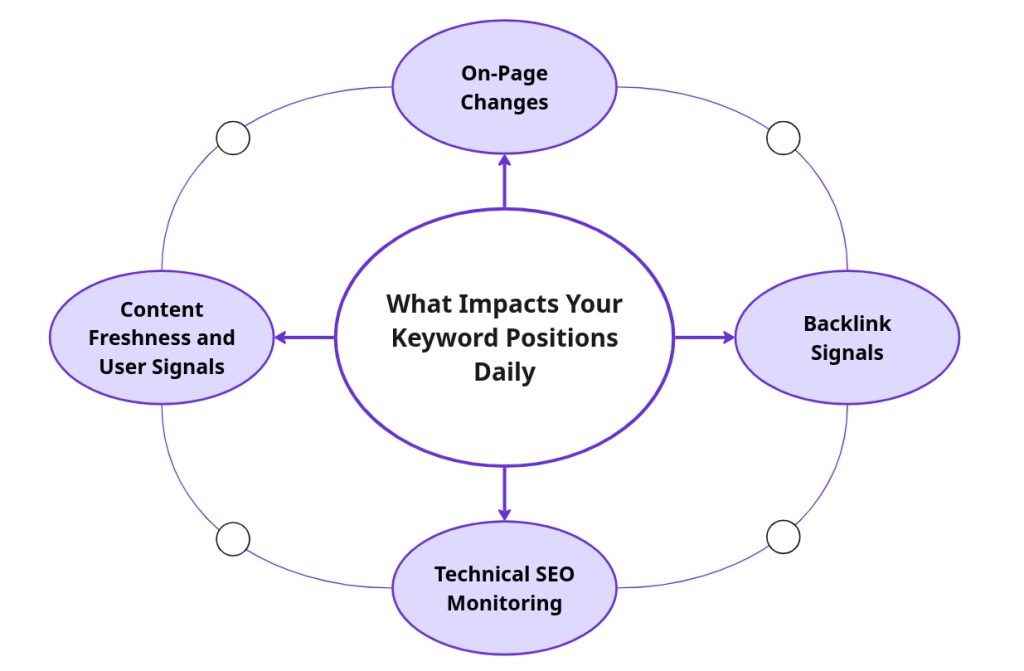
Keyword movement does not always require a major update. Small signals can influence visibility in measurable ways. SERP Position Tracking often reveals daily shifts tied to subtle changes rather than dramatic events.
On-Page Changes
Even minor edits can affect rankings. Updating headings, adjusting internal links, refining title tags, or modifying structured data can shift how search engines interpret relevance. If a page becomes clearer and more aligned with a query, positions may improve. If keyword targeting becomes diluted, rankings can soften.
Consistent SERP Position Tracking helps connect these adjustments with measurable position changes instead of relying on assumptions.
Backlink Signals
Links remain a strong authority signal. New backlinks from relevant domains can strengthen trust and improve keyword stability. On the other hand, lost links may weaken competitive positioning.
Daily keyword fluctuations sometimes correlate with link growth patterns. Monitoring backlink activity alongside SERP Position Tracking provides a clearer view of cause and effect.
Technical SEO Monitoring
Technical health directly impacts crawlability and indexation. Issues such as slow load speed, indexing errors, broken links, or incorrect canonical tags can influence rankings without obvious warning.
Ongoing SEO monitoring ensures technical barriers are identified early. When paired with structured rank data, you can determine whether technical changes affected visibility.
Content Freshness and User Signals
Search engines evaluate how users interact with content. Engagement patterns, click behavior, and perceived relevance contribute to ranking stability. Updating content to maintain accuracy and depth can reinforce keyword performance.
Choosing the Right Rank Tracking Tool
Not every Google Rank Tracker delivers reliable insight. Some tools show surface-level positions without context. Others provide structured data that supports serious decision-making. The difference matters.
When selecting a solution for SERP Position Tracking, focus on accuracy, consistency, and scalability rather than flashy dashboards.
Features That Actually Matter
A dependable rank tracking tool should provide precise position data across defined locations and devices. It should allow bulk keyword imports, historical comparison, and competitor visibility tracking.
Look for features such as:
- Daily position updates
- Clear historical trend graphs
- Support for large keyword sets
- Exportable data for reporting
- Integration with broader SEO monitoring systems
A strong serp checker does not just display numbers. It organizes ranking data in a way that supports analysis and long-term planning.
Automation vs Manual Google Ranking Check
Manual checks may work for a handful of keywords, but they fail at scale. They lack structured storage, consistency, and reporting clarity.
Automated SERP Position Tracking removes variability and ensures standardized measurement. Instead of checking one term at a time, you track hundreds simultaneously. That efficiency allows you to focus on strategy rather than repetitive tasks.
Scaling Keyword Rank Tracking Across Campaigns
As campaigns grow, keyword rank tracking must scale with them. Managing multiple projects, markets, or clients requires organized segmentation and reporting.
A professional Google Rank Tracker should handle expanding keyword lists without compromising data accuracy. Scalable SERP Position Tracking ensures visibility insights remain dependable as your SEO efforts grow.

How SERP Position Tracking Supports Long-Term SEO Strategy
Short-term ranking movement can distract teams from what actually matters: sustained growth. SERP Position Tracking provides the historical depth needed to evaluate performance beyond daily fluctuations. Instead of reacting to isolated changes, you assess direction over months and quarters.
Identifying Volatility Trends
Every niche has a baseline level of volatility. Some keywords shift frequently, while others remain stable for long periods. Long-term SERP Position Tracking reveals which terms are consistently unstable and which demonstrate steady positioning.
By analyzing ranking patterns over extended timeframes, you can distinguish between temporary swings and structural declines. This prevents unnecessary changes to pages that are simply experiencing routine variation.
Measuring SEO Growth Accurately
Growth in SEO is rarely linear. Pages may plateau before improving. Others may climb gradually without dramatic spikes. Structured tracking allows you to measure incremental progress with precision.
Instead of focusing only on top-three rankings, you evaluate overall visibility improvement across your keyword portfolio. SERP Position Tracking provides cumulative data that shows whether your strategy is strengthening domain authority and expanding reach.
Making Data-Driven Decisions
Reliable historical data supports confident planning. When trends are clear, you can prioritize content updates, resource allocation, and campaign expansion based on measurable performance.
SERP Position Tracking transforms raw ranking numbers into strategic insight. Over time, this disciplined approach builds consistency, stability, and predictable SEO growth.
Conclusion
Search visibility is never static. Positions shift, competitors adjust, and user behavior evolves. The difference between reactive SEO and strategic SEO comes down to clarity. SERP Position Tracking provides that clarity.
When rankings are monitored consistently, decisions become measured rather than emotional. Instead of questioning every minor fluctuation, you recognize patterns. Instead of assuming decline, you validate trends with data. This discipline protects long-term performance.
SERP Position Tracking also builds accountability. It connects effort with outcome. Content improvements, authority building, and structural refinements can be evaluated through measurable position movement. Over time, this creates a reliable performance baseline.
Most importantly, structured tracking strengthens planning. Resources are allocated based on evidence. You refine strategy based on measurable growth. You respond to changes with precision instead of urgency.
Search engines will continue evolving. Competition will intensify. Visibility will remain dynamic. Businesses that commit to consistent SERP Position Tracking gain a stable foundation in an unstable environment.
Long-term SEO success is not about chasing rankings daily. It is about understanding them, interpreting them correctly, and acting with confidence grounded in data.
FAQs
What is SERP Position Tracking?
SERP Position Tracking is the structured process of recording where your pages rank for selected keywords across search engines. It captures position data consistently, allowing businesses to monitor visibility using a Google Rank Tracker or similar rank tracking tool.
How often should you check keyword rankings?
For active campaigns, daily tracking is recommended. Automated keyword rank tracking provides consistent updates without manual effort. Weekly reviews are useful for strategy evaluation, but data should be collected more frequently to detect meaningful shifts.
Why do rankings fluctuate daily?
Daily movement can result from algorithm recalculations, competitor adjustments, indexing behavior, or variations across devices and regions. A reliable serp checker helps identify whether fluctuations are isolated or part of a broader trend.
Can a manual Google ranking check give accurate results?
Manual checks are limited and often influenced by personalization. They may provide a rough idea but lack structured tracking and scalability compared to a professional Google Rank Tracker.