
Table of Contents
Table of Contents
A Bing Rank Tracker helps you understand where your website stands in Bing search results and how that visibility changes over time. As search behavior spreads across more platforms and devices, Bing has become a meaningful source of steady, intent-driven traffic. Yet many teams still lack a clear way to monitor how their pages perform there.
This guide is written to remove that uncertainty. Instead of theory or complex SEO language, it focuses on how Bing rankings actually work, why they matter heading into 2026, and how tracking them properly helps you make confident decisions. Whether you are new to SEO or refining an existing strategy, understanding Bing visibility starts with tracking it the right way.
What Is a Bing Rank Tracker
A Bing Rank Tracker is a simple way to see where your website shows up in Bing’s search results when people search for specific keywords. Instead of guessing or checking manually, it tells you whether your page appears near the top, further down, or not at all for the terms that matter to you.
The key point is that it doesn’t look at rankings just once. A Bing Rank Tracker follows how your pages move in Bing over time. You can see if a page is slowly improving, staying stable, or slipping after changes to your site or content. That long-term view is what makes ranking data useful, not the exact position on a single day.
For someone new to SEO, this removes a lot of confusion. You are not trying to “win” Bing in one search. You are simply observing how Bing responds to your pages across repeated searches and keywords. A Bing Rank Tracker turns that visibility into something you can clearly understand and track, without needing technical knowledge or complex tools.
How Bing Ranking Works at a Basic Level
When someone searches on Bing, the search engine tries to show pages that best match what the user is looking for. It doesn’t aim to be complex from the outside; it focuses on showing results that feel useful, relevant, and consistent.
Here’s the basic idea behind how Bing chooses organic results:
- Relevance to the search: Bing looks at how closely a page matches the words and intent behind a search query. Pages that clearly answer the question tend to appear more often.
- Page content and clarity: Content that stays focused on a topic and explains it clearly is easier for Bing to understand and trust over time.
- Consistency over time: Pages that repeatedly appear for similar searches are seen as more stable than pages that show up once and disappear.
It’s also important to know that Bing rankings are not fixed. Results can change based on:
- The user’s location
- Whether the search is on desktop or mobile
- Small differences in how a query is written
Because of these natural changes, a single manual check doesn’t show the full picture. Tracking rankings over time helps you understand how visible a page really is and why monitoring matters in the first place.

Why Bing Rankings Matter for SEO in 2026
For a long time, Bing has been treated as a secondary option in SEO. That mindset is outdated. Going into 2026, Bing plays a much bigger role than many teams realize, especially outside the usual Google-first ecosystem.
Here’s why Bing rankings deserve real attention:
- Bing lives inside daily workflows
Bing powers search experiences across desktops, browsers, and workplace tools. In enterprise environments, default search behavior often routes through Microsoft Bing, whether users actively choose it or not. - Strong presence in non-Google ecosystems
Windows devices, corporate networks, and productivity platforms rely heavily on Bing-backed search. This creates steady visibility opportunities that aren’t influenced by Google’s crowded landscape. - Lower competition, clearer intent
Compared to Google, fewer sites actively optimize for Bing. That means rankings are easier to earn, while user intent often remains high, especially for business, software, and research-driven searches. - More stable traffic patterns
Bing rankings tend to fluctuate less aggressively. Pages that earn visibility often hold it longer, making Bing traffic more predictable and easier to evaluate over time.
Ignoring Bing doesn’t just mean skipping another search engine. It means missing consistent, high-quality traffic that comes from users who search with purpose. In 2026, smart SEO isn’t about choosing one platform; it’s about covering the ecosystems where real users already are.
How a Bing Rank Tracker Works
To understand how a Bing Rank Tracker works, it helps to look at it as a simple repeatable cycle. The tracker follows the same pattern every time so the data stays clear and dependable.
First, the tracker checks a specific keyword on Bing. It runs the search in a neutral environment, so the result is not influenced by personal history or past searches.
Next, it looks at the organic search results that Bing returns. From that page, it identifies whether your website appears and which exact page Bing chooses to show for that keyword.
After that, the tracker records the ranking position and the URL that appeared. This information is stored rather than used once and discarded.
Finally, the tracker repeats this process regularly. Each new result is compared with older ones, which makes it possible to see movement over time. This is how you know whether a page is improving, staying stable, or slowly losing visibility.
By following these steps again and again, a Bing Rank Tracker turns search rankings into something you can actually understand and rely on, instead of guessing based on a single search.
Manual Bing Rank Checking vs Automated Tracking
Before automated tools existed, checking rankings manually was the standard approach. Even today, many people still start there because it feels simple and familiar.
Manual Bing Rank Checking
Manual checking usually means opening a browser, searching for a keyword on Bing, and scrolling until you find your page. This method is often used when someone wants a quick answer or is just beginning to explore search visibility.
Why do people still use it
- It feels direct and easy to understand
- No tools or setup are required
- Useful for occasional or one-time checks
Where manual checking falls short
- Personalization can change what results you see
- Location bias means rankings vary by city or region
- Inconsistent results appear at different times or on different devices
- Time consumption grows fast when tracking multiple keywords
Automated Bing Rank Tracking
Automated tracking removes those uncertainties. Instead of relying on what one person sees in one moment, a Bing Rank Tracker checks rankings in a clean and repeatable way.
Why automated tracking is more reliable
- Searches run without personal history
- Locations can be controlled or compared
- Results are recorded the same way every time
- Ranking movement is visible over days and weeks
Why Both Approaches Matter
Manual checks help you understand how search results look in real situations. Automated tracking shows how visibility behaves over time. When combined, they give a clearer and more balanced view of how Bing actually treats your pages.
What Data a Reliable Bing Rank Tracker Should Provide
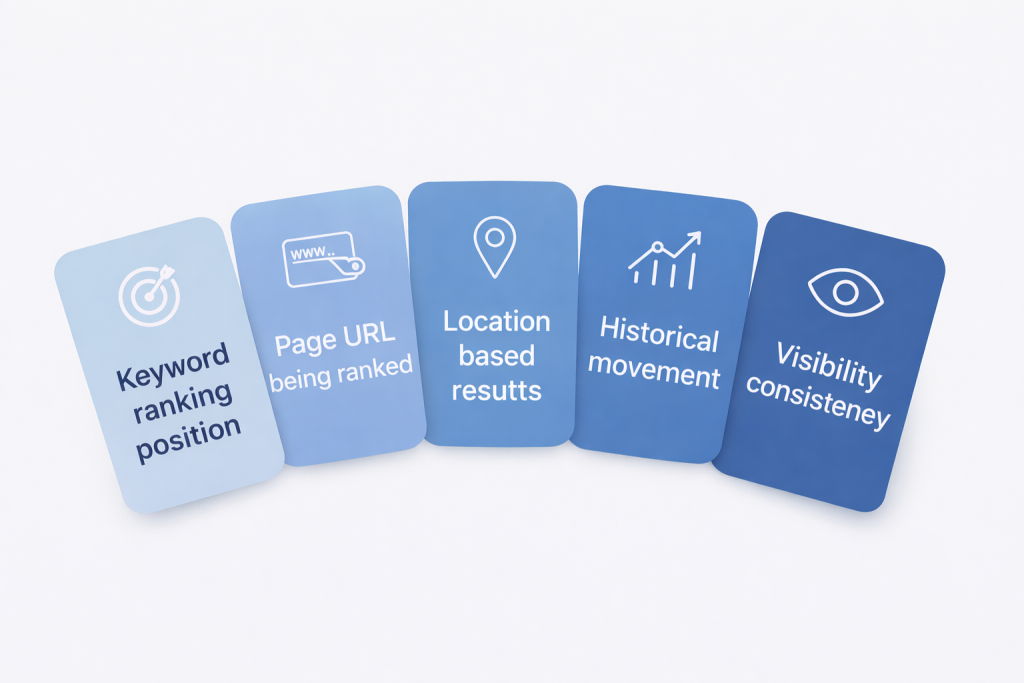
A reliable Bing Rank Tracker does not try to show everything. It focuses only on data that helps you understand visibility and decide what to do next. When the right data is clear, SEO decisions become simpler and more confident.
Keyword ranking position
This tells you where your page appears for a specific search. The number itself matters less than the direction. If a page is moving up, your work is paying off. If it drops, it is a signal to review content or structure before traffic is affected.
Page URL being ranked
Bing does not always rank the page you expect. Seeing the exact URL helps you understand how Bing views your site. This makes it easier to fix page focus issues or adjust internal linking when the wrong page is ranking.
Location based results
Search results change by location. Location data shows where a page performs well and where it struggles. This is useful when checking regional reach or testing content meant for specific markets.
Historical movement
One day of rankings does not explain much. Looking at past data shows patterns over time. This helps you separate normal movement from real changes that need action.
Visibility consistency
Consistency shows whether a page appears regularly or only once in a while. Pages that appear often are more reliable. This helps you decide which pages are worth improving and which need a rethink.
When these data points are easy to read and easy to compare, a Bing Rank Tracker becomes more than a tool. It becomes a way to validate decisions, test changes, and build trust in your SEO work.

Using a Bing Rank Tracker with an API Based Approach
A reliable Bing Rank Tracker is built on consistency. That consistency is difficult to achieve with browser-based scraping, which is why most modern tracking systems now rely on structured search data instead.
When ranking data is collected through an API, each request is handled in a clean and controlled way. There is no influence from personal search history, device behavior, or session data. The same keyword produces the same type of response every time, which makes comparisons meaningful rather than misleading.
This structure directly improves accuracy. Instead of interpreting visual layouts or shifting page elements, an API returns clear information such as ranked URLs and positions. That clarity makes it easier to validate content changes, confirm visibility, and understand real movement rather than noise.
Stability is another critical factor. Search result pages change often, and scraping setups tend to break when layouts shift. API based tracking avoids that risk because the response format remains consistent. This makes long-term tracking dependable, especially when rankings are reviewed over weeks or months.
Scalability follows naturally. As more keywords, locations, or checks are added, API based tracking continues to perform without introducing inconsistency. It supports growth without forcing changes in process or interpretation.
For this reason, dependable Bing rank tracking is typically built using official sources like the Bing Search API, supported by clear documentation and transparent pricing. When tracking is handled this way, the data remains accurate, repeatable, and trustworthy, which is essential for making informed SEO decisions.
Final Thought
Bing rank tracking is not about chasing a position or reacting to daily fluctuations. It is about understanding how your pages behave over time and how consistently they appear when real users search. When rankings are tracked cleanly and without bias, they become a source of clarity rather than confusion.
As search continues to expand beyond a single platform, Bing plays a steady and meaningful role in modern SEO. Teams that take the time to monitor Bing visibility gain a broader view of their performance and reduce their reliance on assumptions.
A reliable Bing Rank Tracker supports better decisions, calmer analysis, and long-term confidence. When the focus stays on patterns, stability, and real visibility, ranking data becomes something you can trust and act on, not something you constantly question.