
Table of Contents
Table of Contents
Search today feels more like a marketplace than a discovery tool. People don’t browse endlessly anymore. They search, scan product listings, compare prices, and decide almost instantly. Most of that happens right on the results page.
For businesses, this changes everything. If your pricing or visibility is off, you lose the sale before a user even clicks.
Manual tracking can’t keep up with how fast things change. Prices shift, competitors update, and rankings move throughout the day.
A Google Shopping API gives you direct access to this data in real time, so you can respond quickly, stay accurate, and compete where decisions are actually being made.
What is a Google Shopping API?
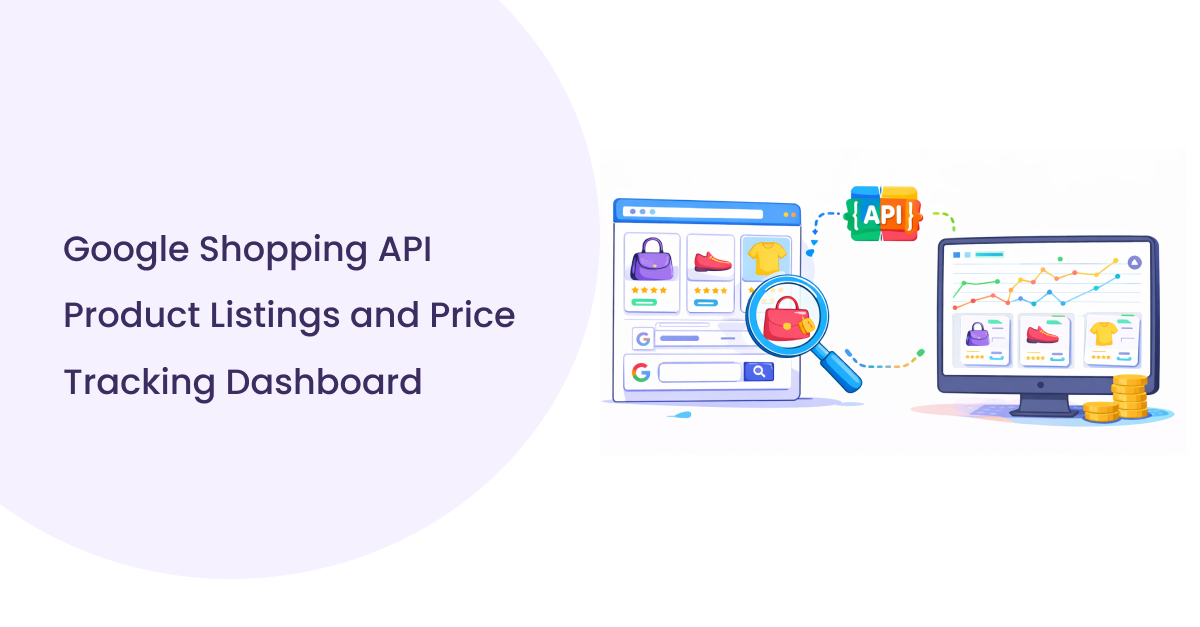
A Google Shopping API allows you to collect product listings directly from Google’s shopping results in a structured and usable format. Instead of manually checking listings, it provides key details like product titles, prices, seller names, ratings, and availability through a clean data response. This makes it easier to work with a product data API that can handle large volumes of listings without dealing with messy extraction or constant page changes. It also gives direct access to shopping SERP results, which are critical for understanding real market visibility.
How It Differs and Where It Fits
Unlike a traditional ecommerce API that only provides data from a single platform or store, this approach offers a broader market view by capturing multiple sellers shown in Google Shopping search. The data is already structured, so it can be directly integrated into modern systems such as:
- Pricing and monitoring tools powered by a price tracking API
- Analytics dashboards for deeper insights and competitor price tracking
- Internal workflows that depend on consistent product data API inputs
- Automated systems that replace unreliable google shopping scraper methods
This makes it a dependable layer in data pipelines, helping teams stay accurate, responsive, and competitive.

How Google Shopping Search Works Behind the Scenes
Google Shopping runs on structured product data submitted by sellers. Each product feed includes details like title, price, image, and availability. Google evaluates this data alongside bidding and relevance signals to determine which listings appear and in what order.
In simple terms, Google ranks products based on data quality, bid strength, and how closely they match the search intent.
When users perform a Google Shopping search, they see organized listings that highlight price, seller, ratings, and stock status. These shopping SERP results are built for instant comparison, which means even small changes in pricing or product data can directly affect visibility and clicks.
What decides which products show up
- Quality and accuracy of the product feed
- Bid competitiveness within the category
- Relevance to the user’s query
- Engagement signals such as clicks and conversions
Each listing is structured to influence decisions quickly. That’s why teams focused on competitor price tracking and real-time monitoring tend to outperform those relying on static data.Relying only on a Google Shopping scraper creates instability over time. Data becomes inconsistent, updates lag, and scaling turns into a constant maintenance task. A structured product data API solves this by delivering reliable, real-time data that fits directly into pricing and analytics workflows.
Key Features to Look for in a Google Shopping API
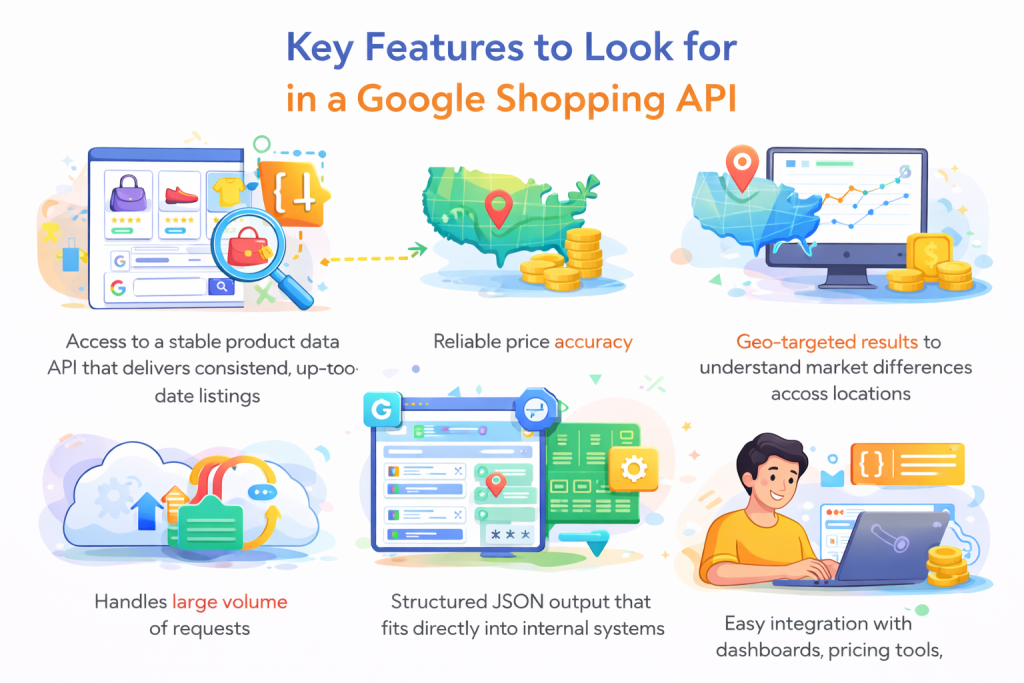
A Google Shopping API should do one thing well: give you accurate, usable product data without delays or inconsistencies. If the data is even slightly off, pricing decisions and competitor analysis quickly fall apart.
In simple terms, the right API should deliver real-time, structured shopping data that reflects actual search results.
This includes clean shopping SERP results with precise details like price, seller, ratings, and availability. Teams that rely on this data for pricing or monitoring cannot afford gaps or outdated information.
What actually matters in real use
- Access to a stable product data API that delivers consistent, up-to-date listings
- High accuracy in pricing to support reliable competitor price tracking
- Geo-targeted results to understand market differences across locations
- Ability to process large volumes of requests without failures
- Structured JSON output that fits directly into internal systems
- Easy integration with dashboards, pricing tools, and automation workflows
Many teams experiment with a google shopping scraper early on, but it becomes difficult to maintain as data scales. Breakdowns, delays, and inconsistencies are common.
A well-built API removes these issues. It provides dependable access to product listings, allowing teams to react faster, maintain pricing accuracy, and operate with confidence in competitive markets.
Price Tracking & Competitor Monitoring at Scale
Pricing is no longer a set-and-forget task. In Google Shopping, visibility often comes down to who reacts faster, not who lists first. When competitors adjust prices throughout the day, even a small delay can push your products down in shopping SERP results.
The difference between winning and losing often comes down to how quickly you detect and respond to price changes.
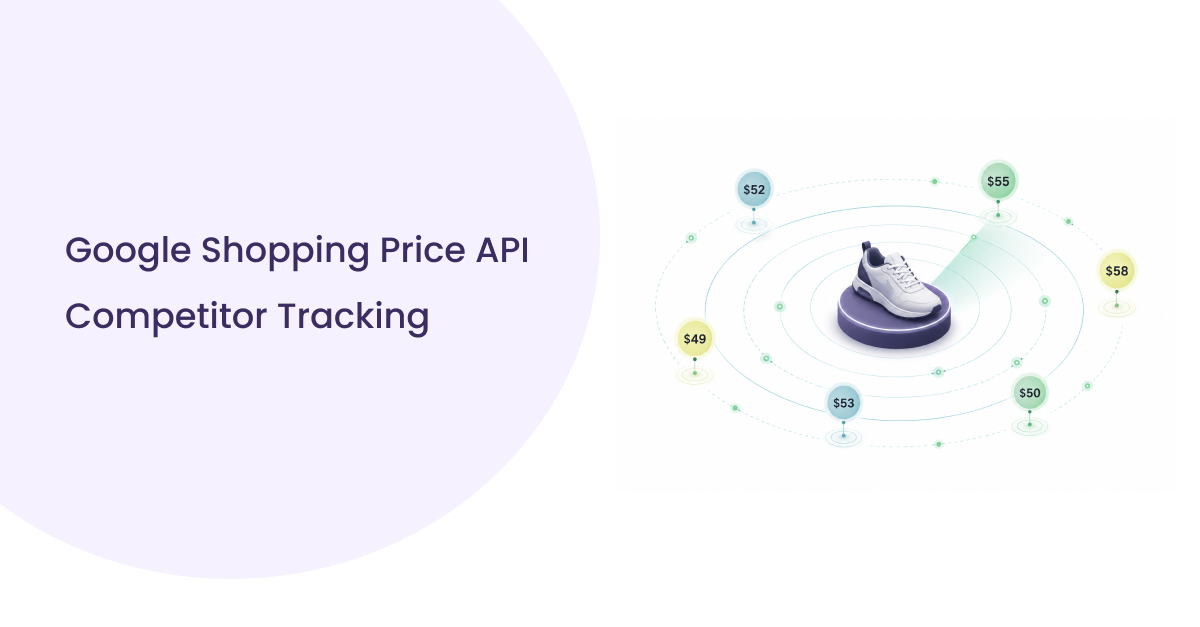
At scale, this isn’t something a team can handle manually. You need continuous data flow. A reliable price tracking API pulls live updates, helping you understand where you stand across multiple sellers and categories at any given moment. It also gives a clear view of patterns, not just isolated price points.
Instead of checking listings one by one, teams use structured product data API inputs to monitor entire catalogs, compare competitor pricing, and adjust strategies automatically. This is where real competitor price tracking happens, not in spreadsheets, but in systems built for speed.
Relying on a Google Shopping scraper might work short term, but it struggles with accuracy and scale. For consistent tracking, a proper API ensures data stays reliable, timely, and ready for action.
Why SERPHouse Google Shopping API is Built for Scale
Most APIs perform well in small tests but start breaking when usage grows. Requests fail, responses slow down, and data becomes inconsistent. That’s exactly where serious tracking systems need stability the most.
A scalable API means handling high-volume requests while keeping data accurate, fast, and consistent.
SERPHouse is built with that expectation. The Google Shopping API consistently delivers structured shopping SERP results, even when tracking large product sets across multiple queries. This allows teams to depend on the data without second-guessing its accuracy.
Built for Real-World Usage
The API returns clean and structured product data API responses that fit directly into pricing systems, analytics dashboards, and monitoring tools. Teams working on pricing or competitor price tracking don’t have time to clean or fix data; they need it ready to use.
What Makes It Reliable at Scale
- High success rate across large request volumes
- Consistent response format for easier processing
- Fast response times, even during peak usage
- Infrastructure designed to support bulk operations
- Simple integration for both developers and growth teams
- Stable alternative to a fragile Google Shopping scraper setup
This reliability becomes critical when decisions depend on real-time data. Instead of dealing with failures or delays, teams can focus on adjusting pricing, tracking competitors, and moving faster in competitive markets.

Final Thoughts
Data alone doesn’t create an advantage. What matters is how quickly and accurately you act on it. In Google Shopping, delays in pricing updates or incomplete insights can quietly reduce visibility and conversions without obvious signals.
A dependable Google Shopping API bridges that gap. It gives access to structured shopping SERP results, making it easier to monitor trends, track competitors, and respond with confidence. Instead of guessing, decisions are based on actual market conditions.
Teams still relying on a Google Shopping scraper often spend more time fixing data issues than using it. That approach doesn’t hold up when the scale increases.
With a strong product data API, the focus shifts from collecting data to using it effectively. That’s where real growth happens, faster decisions, better pricing strategies, and consistent performance in competitive markets.